
 Bitaigen Research
 The Bitaigen editorial team has compiled the core concepts of tokenized U.S. equities and the operational workflow on Binance. By reading this article, you can quickly grasp how on‑chain stocks work, their advantages and potential risks, and master step‑by‑step practical techniques for purchasing them, helping you build a more resilient position at the intersection of crypto assets and traditional finance.
What Is Tokenized U.S. Equity? How to Purchase It on Binance?
Tokenized U.S. equity refers to the issuance of blockchain‑based crypto tokens that represent real U.S. stocks. Investors can use crypto assets to buy and sell these tokens on an exchange at any time, enabling 24/7 on‑chain trading of U.S. equities.
If you want to understand the operating principle, benefits, and risks of tokenized U.S. stocks, and learn how to complete a purchase on the Binance platform, the comprehensive analysis below will walk you through each step.
Definition of Tokenized U.S. Equity
Tokenized U.S. equity (Tokenized Stocks) is the process of minting crypto tokens on a blockchain that are backed 1:1 by actual U.S. shares. It is a form of RWA (Real‑World Assets) on‑chain, i.e., converting traditional financial assets such as stocks, bonds, or real estate into divisible tokens that can be traded on a blockchain.
- 1:1 correspondence: For every token issued, an equivalent real share is held by a third‑party custodian.
- On‑chain trading: Investors only need a cryptocurrency exchange account or a Web3 wallet to buy or sell at any time, without cross‑border wire transfers or opening an overseas brokerage account.
It is important to note that holding a tokenized U.S. stock does not equal directly owning the underlying share; investors are exposed to the token’s price movements rather than shareholder rights.
How Tokenized U.S. Equity Works
The issuance and circulation of tokenized U.S. equities involve regulated fintech firms, licensed exchanges, and custodial institutions. The main workflow can be divided into four stages:
- Asset Custody (Asset‑Backed)
The issuer purchases real shares on the traditional U.S. market and stores them with a regulated bank or custodian.
- On‑Chain Minting
Based on the number of shares held, corresponding tokens are minted on public blockchains such as Ethereum, Solana, etc.
- Trading & Settlement
Investors trade the tokens on crypto exchanges or DeFi platforms. Trades settle instantly, independent of U.S. market hours.
- Redemption
Token holders may return tokens to the issuer, who then sells the underlying shares in the traditional market and returns the proceeds. Redemption is typically limited to qualified institutions or made available through a specific process.
This mint‑burn mechanism ensures that the token supply stays permanently locked to the underlying share quantity on a 1:1 basis.
Price‑Tracking Methods
1:1 Physical Backing
The platform guarantees that each token is fully backed by real shares, so the token’s value mirrors the price of the U.S. stock.
Oracle Technology
Most tokenized stocks use price oracles to feed real‑time market data from exchanges such as Nasdaq into on‑chain contracts, achieving price synchronization.
Market Pricing & Arbitrage
Tokens are matched on‑chain. If their price diverges from the underlying share, arbitrageurs can buy the cheaper token and redeem the real share, or sell the overpriced token and repurchase the share, nudging the price back toward parity.
Decoupling risk: During U.S. market off‑hours or periods of low liquidity, token prices may temporarily deviate from the underlying stock price.
Advantages of Tokenized U.S. Equity
- 24/7 trading: No restriction from U.S. market opening hours; on‑chain matching occurs instantly.
- Low entry barrier: Only a crypto exchange account or Web3 wallet is required, eliminating cumbersome overseas account opening and cross‑border remittance.
- Direct use of crypto assets: Holding stablecoins such as USDT or USDC allows you to swap for tokenized stocks without incurring fiat‑conversion costs.
- High divisibility: Tokens can be fractionated to extremely small units, making them accessible to small‑scale investors.
Risks and Limitations
| Risk Category | Specific Manifestation | Potential Consequence |
|---|---|---|
| **Loss of shareholder rights** | Token holders are not listed on the company’s shareholder register, potentially missing out on dividends or voting | Only price‑movement gains are realized |
| **Issuer or custodian risk** | Financial trouble of the issuer, frozen custodial accounts, or regulatory investigations | Tokens could be liquidated or become non‑redeemable |
| **Regulatory changes** | Tighter cross‑border securities and crypto regulations | Platforms may be forced to delist the product |
| **Price decoupling** | Low liquidity during off‑hours, large trades causing price drift | Short‑term arbitrage opportunities or loss risk |
| **Technical fees** | On‑chain gas fees, platform management fees, etc. | Costs may exceed those of traditional brokers |
Does Binance Offer Tokenized U.S. Equity Trading?
Binance launched stock tokens in 2021 but paused the service under regulatory pressure. In 2026, Binance partnered with Ondo Finance to relaunch tokenized U.S. equity trading.
In addition to tokenized stocks, Binance also provides the following U.S.‑related products:
- U.S.‑themed crypto assets: e.g., Render, Fetch.ai, whose prices tend to follow U.S. tech‑stock trends but do not represent equity ownership.
- U.S. index derivatives: Contracts that track the Nasdaq or specific sector indices, serving solely as price‑tracking tools.
The key distinction is that the latter products lack a 1:1 backing by actual shares.
Note for U.S. users: Residents of the United States must use Binance.US (the U.S.‑compliant platform) rather than the global Binance site.
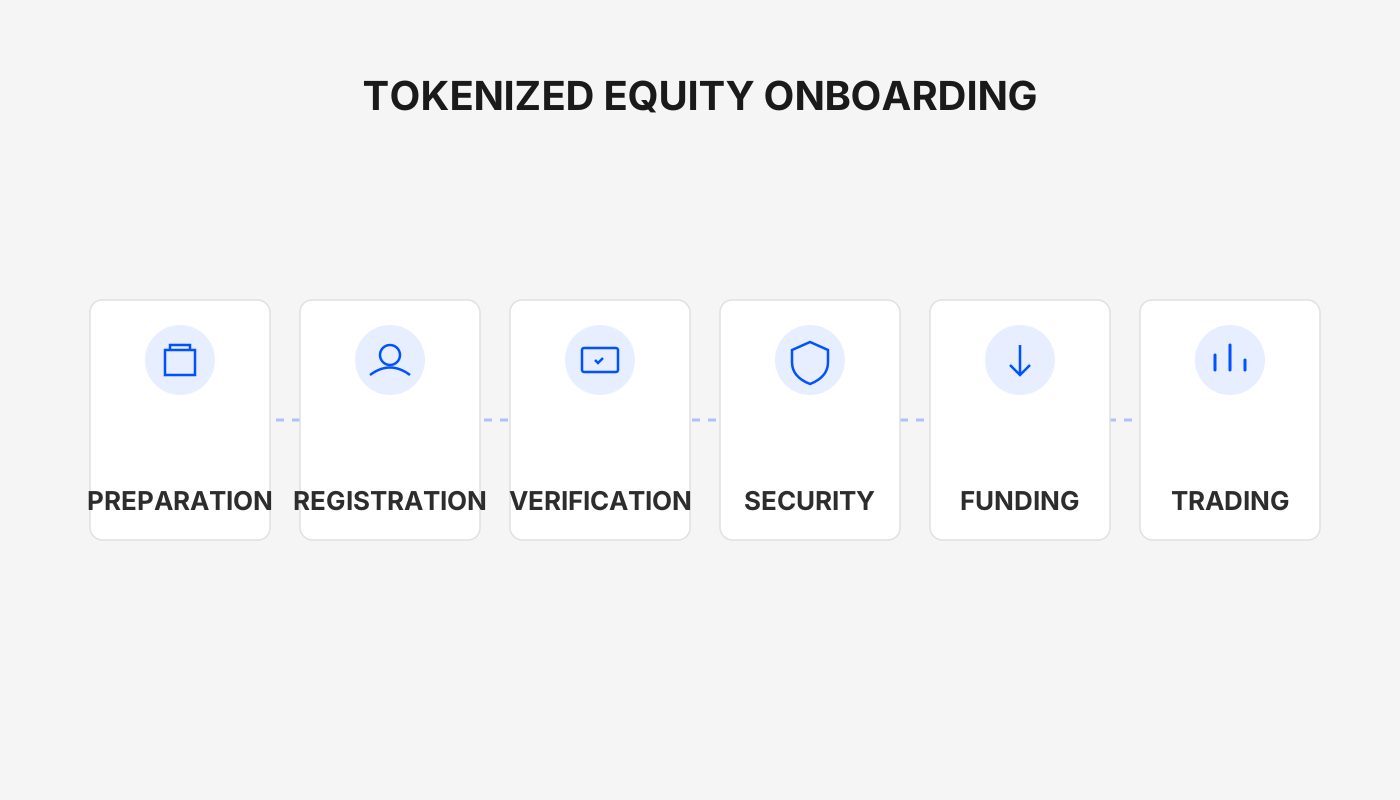
Complete Steps to Purchase Tokenized U.S. Equity on Binance
Prerequisite: You must first create a Binance account and complete KYC verification.
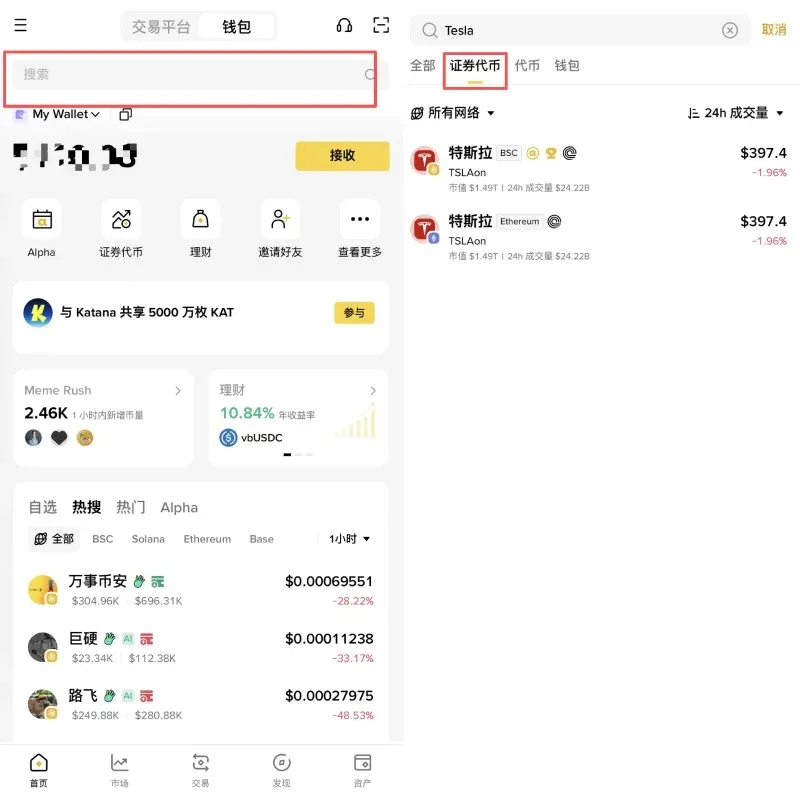
Step 1: Open the Binance Wallet and Search for Security Tokens
- Log in to Binance and go to the Wallet homepage.
- In the search bar at the bottom of the page, type a keyword (e.g., “Apple”) and select the Security Token category.
- Locate the desired token in the results and click to open its trading page.
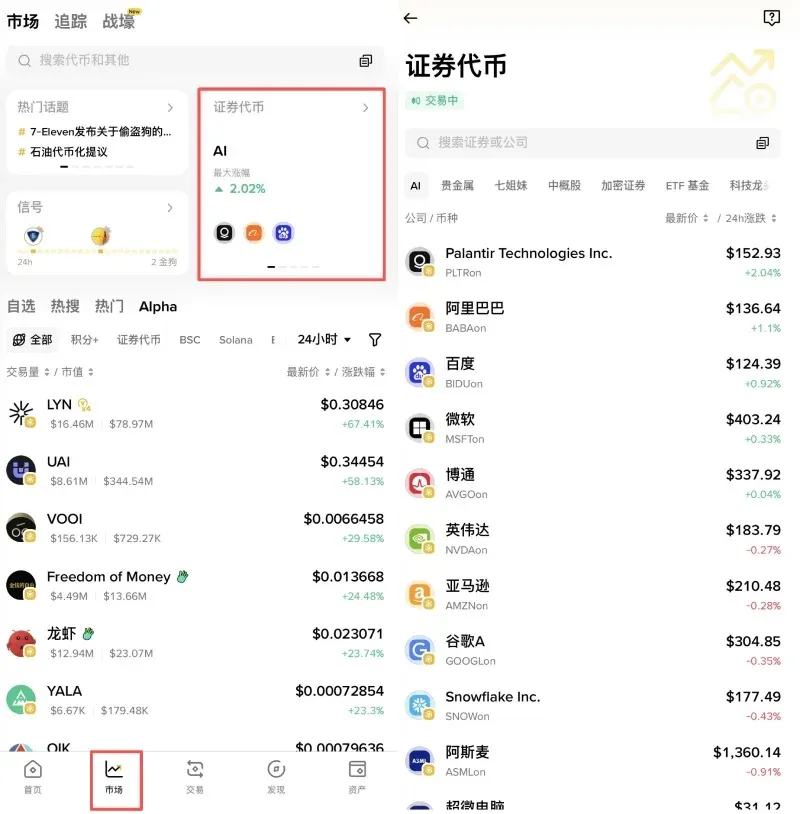
Step 2: Browse and Enter the Security Token Market
- From the Wallet homepage, tap Markets.
- Choose Security Tokens to view the full list of listed tokenized U.S. equities.
- After selecting a token, click Buy or Sell to initiate a trade.
Step 3: Execute the Trade
- Select the trading pair: e.g., USDT/Apple‑Token.
- Enter quantity or amount: The interface will instantly display the corresponding token amount.
- Confirm and submit: Once the trade is completed, the tokens are automatically deposited into your Binance wallet.
Step 4 (Optional): Transfer to a Web3 Wallet
If you wish to interact with decentralized platforms, you can withdraw the tokens from Binance to your personal Web3 wallet.
Investor Profiles Suited for Tokenized U.S. Equity
| Segment | Primary Need | Tokenized Equity Advantage |
|---|---|---|
| **Native crypto users** | Already hold crypto assets and are familiar with exchange interfaces | Low conversion cost, fully on‑chain asset management |
| **Those avoiding overseas broker accounts** | Want to bypass complex account opening and remittance procedures | Only a crypto account is needed to participate |
| **Short‑term traders** | Focus on price swings and need flexible entry/exit | 24/7 trading, instant settlement |
| **Long‑term holders** | Seek dividends and voting rights | May be better served by traditional brokers or custodial services |
Comparison of U.S. Equity Investment Methods
| Comparison Item | Tokenized U.S. Equity | Overseas Brokerage | Custodial (e.g., local broker “re‑investment” service) |
|---|---|---|---|
| **Ownership form** | Holds an on‑chain token, not a direct shareholder | Directly holds shares, recognized as a legal shareholder | Physical shares held by the local broker, custodial |
| **Dividends / voting rights** | Depends on product design; not guaranteed | Entitled to dividends and voting rights | Entitled to dividends and voting rights |
| **Trading hours** | Generally 24/7 on most platforms | U.S. market hours (including pre‑/post‑market) | U.S. market hours |
| **Settlement** | Instant on‑chain settlement | Traditional T+2 settlement | Traditional T+2 settlement |
| **Liquidity source** | Exchange order books + on‑chain market depth | Primary market liquidity (highest) | Influenced by overseas market liquidity |
| **Account & funding** | Exchange account or Web3 wallet; trade directly with stablecoins (USDT, USDC) | Must open an overseas brokerage account and perform cross‑border wire transfers (SWIFT/SEPA) | Local broker account; convert local currency (e.g., TWD) to USD via bank before investing |
| **Ideal for** | Users already in the crypto ecosystem, value trade flexibility | Long‑term investors who need full shareholder rights | Investors preferring local service, willing to pay higher fees for convenience |
Frequently Asked Questions
1. Are tokenized U.S. equities safe?
Safety depends on whether the issuer truly holds a 1:1 share reserve, the robustness of the custodian, and the platform’s regulatory compliance. Choosing issuers with audited reserves, regulated custodians, and diversifying across providers helps mitigate risk.
2. Can I receive dividends and voting rights?
Not all tokenized products grant dividends or voting rights; the entitlement is defined by the issuer. Some “native tokenized stocks” that obtained SEC clearance in 2026 have begun offering full shareholder rights.
3. What happens if the issuer goes bankrupt?
If the underlying shares are held in a segregated custodial account, they are generally excluded from the issuer’s liquidation estate. If assets are not properly isolated, token holders could face legal and liquidation risks.
4. Can tokens be exchanged for actual shares?
For retail investors, the usual path is to sell the token on the platform. Direct conversion to physical shares is typically reserved for qualified institutions or available through a specific redemption process.
5. Are fees lower?
While you avoid cross‑border remittance and some broker fees, you may still incur trading commissions, on‑chain gas fees, spreads, and issuer management fees. The overall cost depends on trade frequency and the fee schedule of the chosen platform.
6. Does this affect tax reporting?
Gains from token transactions are treated as crypto‑asset income and must be reported according to the tax regulations of your jurisdiction. If fiat is moved in or out of a bank account, corresponding tax obligations also apply.
Conclusion
As blockchain technology continues to merge with traditional finance, tokenized U.S. equities are maturing as a Real‑World Asset (RWA) product. Whether you are a conventional brokerage client or an active crypto participant, you can choose the method that best aligns with your goals for accessing the U.S. equity market.
Tokenized stocks provide a low‑threshold, always‑open gateway, allowing investors to test overseas exposure before committing larger capital. If you already allocate assets between Taiwanese equities and crypto and want a more flexible way to tap into U.S. markets, tokenized products are worth considering.
This article has fully dissected “What is tokenized U.S. equity? How to buy it? A complete guide to purchasing tokenized U.S. stocks on Binance.” For additional Binance tutorials on tokenized equities, search the Bitaigen (比特根) archive or continue browsing the related links below. Happy investing!
Related Reading
- Best Places to Sell Bitcoin (BTC) Safely in 2024
- How to Buy Bitcoin Safely: Binance Price Protection Guide
- Binance Strategic Shift: Bitcoin Now Primary Emergency Reserve
💡 Register on Binance with referral code B2345 for the maximum trading fee discount. See Binance complete guide.



