
 Bitaigen Research
 What is a DEX (Decentralized Exchange)? A Deep Dive Guide to the World's Leading DEX Platforms in 2026
If you trade traditional stocks, you are generally restricted to specific trading hours (such as 9:30 AM to 4:30 PM EST), and your capital must be held by regulated custodians or centralized brokerage firms. The emergence of Decentralized Exchanges (DEXs) has completely shattered these limitations of centralized finance.
A Decentralized Exchange (DEX) is a cryptocurrency trading platform built on blockchain technology. It facilitates peer-to-peer transactions through smart contracts without the need for a centralized intermediary to custody funds. Users interact directly via their personal wallets and maintain full control over their private keys. Characterized by high transparency, permissionless access, and 24/7 availability, DEXs serve as the core infrastructure of Decentralized Finance (DeFi).
This guide provides an in-depth analysis of:
- The definition of a DEX and its core operational mechanisms.
- Top-tier DEX platforms to watch in 2026.
- A comprehensive comparison between DEXs and Centralized Exchanges (CEXs).
- How to utilize DexScreener for professional-grade trading.
The editorial team at Bitaigen believes that as the cornerstone of DeFi, DEXs not only grant users absolute control over their assets but also represent the future trend of decentralized trading. This article will deconstruct the inner workings of DEXs, objectively compare their pros and cons against CEXs, and provide a forward-looking overview of the most influential platforms and essential trading tools in 2026. Through this systematic guide, you will gain insights into the essence of on-chain liquidity and build a more professional trading perspective in the ever-changing crypto market.
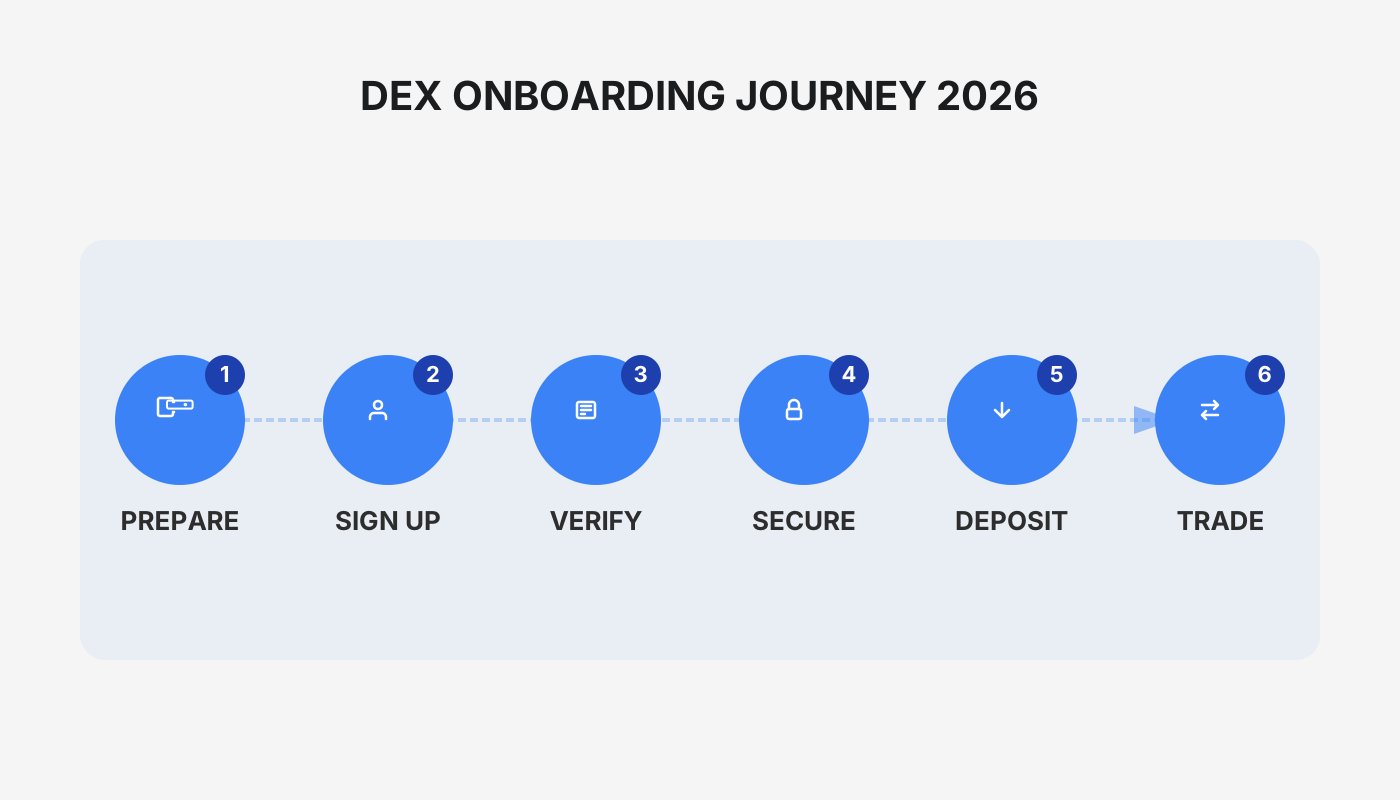
What is a DEX (Decentralized Exchange)?
A DEX (Decentralized Exchange) is a trading protocol that allows users to exchange cryptocurrencies directly without the involvement of an intermediary. Unlike centralized exchanges (CEX) such as Coinbase or Binance (note: US-based users must use Binance.US), a DEX does not require users to deposit assets into an exchange-managed account.
The fundamental difference lies in the control of assets: on a CEX, you deposit your assets into the exchange's wallet, essentially trusting that the institution will fulfill its obligation when you wish to withdraw. On a DEX, tokens remain in your personal wallet at all times, and the trading process is executed automatically by pre-set code (smart contracts).
In the market environment of 2026, this feature has become increasingly vital. Since the collapse of centralized platforms like FTX in 2022, the mantra "Not your keys, not your coins" has become an industry consensus. By eliminating custodial risk, DEXs provide users with higher asset security, although this also demands a higher degree of self-management and responsibility from the user.
The Technical Principles of a DEX: Understanding Automated Market Makers (AMM)
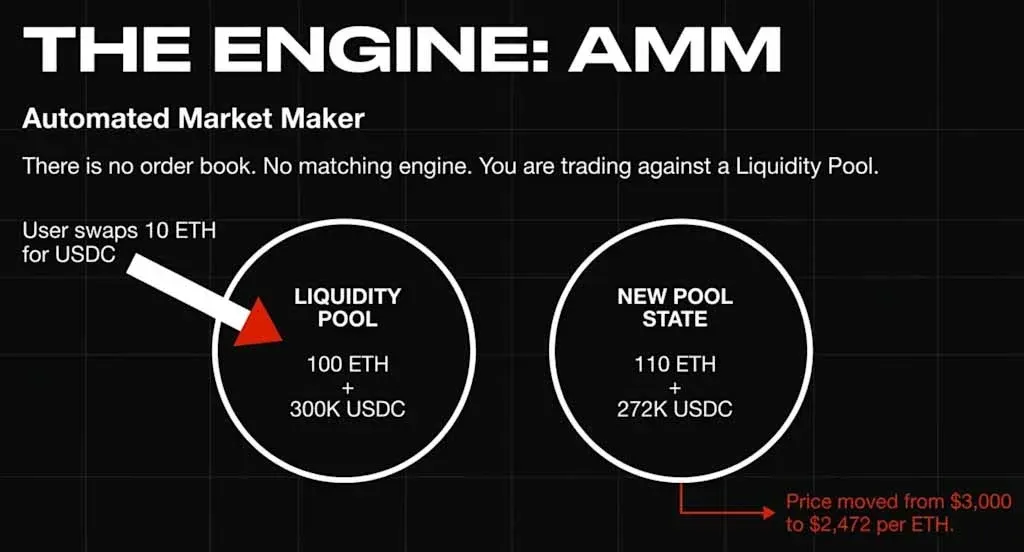
Most modern DEXs do not use the traditional "order book" model found in stock markets. Instead, they employ an innovative mechanism called an Automated Market Maker (AMM).
To illustrate, if you want to swap 1 ETH for USDC on Uniswap, the backend logic functions as follows:
- Wallet Connection: The user connects a wallet, such as MetaMask, to the DEX platform.
- Contract Authorization: The user authorizes the smart contract to access specific tokens (requiring a Gas fee payment).
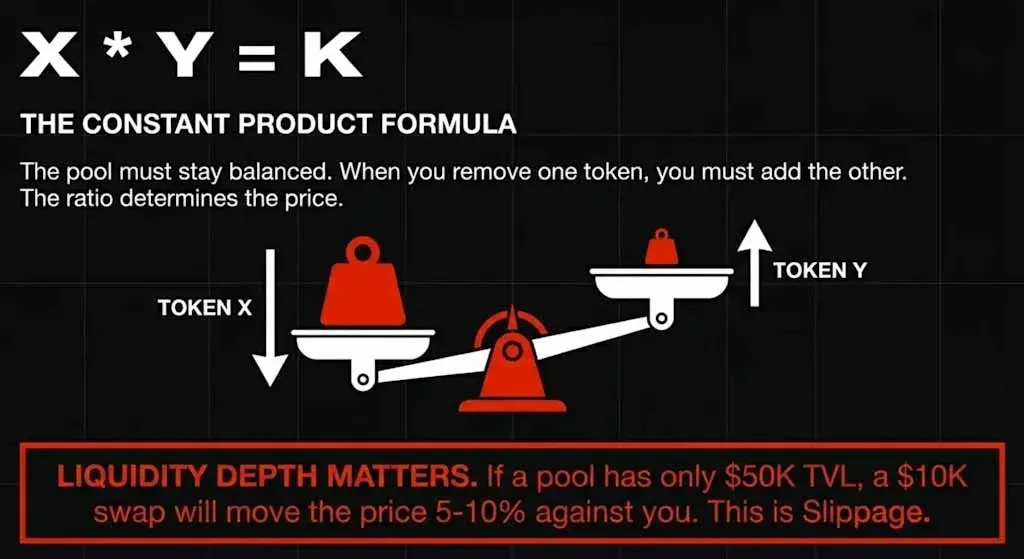
- Price Calculation: The AMM automatically calculates the exchange ratio based on the constant product formula $x * y = k$.
- Execution and Settlement: Once the transaction is finalized, ETH is transferred out of the user's wallet, and USDC is deposited directly into it.
Deep Dive into the AMM Core Formula
In the AMM model, the Liquidity Pool is the heart of the system. It is a collection of tokens locked in a smart contract, and the ratio of these tokens directly determines asset prices:
- Supply and Demand Balance: If a pool contains 100 ETH and 300,000 USDC, the price of 1 ETH is 3,000 USDC.
- Price Fluctuations: When a user buys ETH, the amount of ETH in the pool decreases while the USDC increases, causing the ETH price to rise according to the mathematical formula.
- Liquidity Depth: The higher the Total Value Locked (TVL) in a pool, the lower the Slippage (the difference between the expected price and the executed price) for large trades.
Pro Tip: Before executing large trades on a DEX, always check the liquidity. If a pool's TVL is only $50,000, a $10,000 trade could result in 5%-10% price slippage. It is recommended to use tools like DexScreener to evaluate depth beforehand.
Overview of Mainstream Decentralized Exchanges (DEX) in 2026
DEXs on different blockchains have unique characteristics. Here are the three most active representatives in the current market:
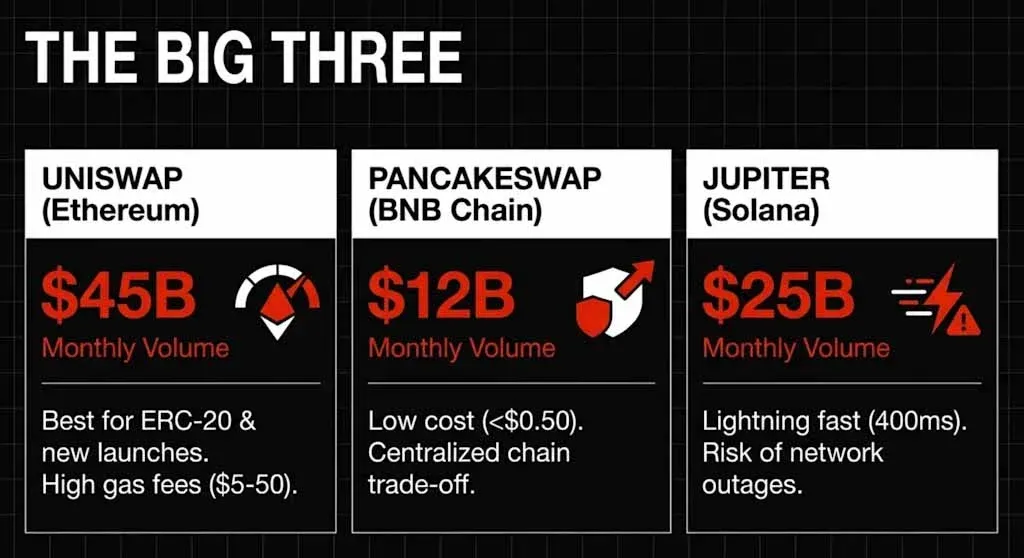
1. Uniswap (Ethereum/Multi-chain)
- Positioning: The world's largest DEX and the core of the Ethereum ecosystem.
- Advantages: Boasts extremely deep liquidity and the widest range of supported tokens.
- Features: Introduced the concept of "Concentrated Liquidity," allowing Liquidity Providers (LPs) to provide capital within specific price ranges, thereby significantly increasing capital efficiency.
2. PancakeSwap (BNB Chain)
- Positioning: The leading exchange on the BNB Chain.
- Advantages: Extremely low transaction costs, with Gas fees typically under $0.50 USD.
- Features: User-friendly interface, ideal for users seeking high-frequency, low-cost trading, although the BNB Chain is relatively less decentralized than Ethereum.
3. Jupiter (Solana)
- Positioning: The liquidity aggregator for the Solana ecosystem.
- Advantages: Ultra-fast execution (approximately 400 milliseconds) with Gas fees that are virtually negligible.
- Note: The Solana network has experienced volatility during periods of extreme congestion; users should always monitor the network status.
DEX vs. CEX: How to Choose Based on Your Needs?
DEXs and CEXs are not mutually exclusive; they are complementary. Understanding their differences helps in formulating a superior trading strategy:
| Dimension | Decentralized Exchange (DEX) | Centralized Exchange (CEX) |
|---|---|---|
| **Asset Custody** | Self-custody (User holds private keys) | Platform custody (Custodial risk exists) |
| **Identity Verification** | No **KYC** required, privacy protected | KYC mandatory to meet regulatory standards |
| **Token Variety** | Instant listing, supports massive long-tail tokens | Strict auditing, focuses on mainstream tokens |
| **Trading Costs** | Highly variable based on network Gas fees | Fixed fee rates, no on-chain Gas costs |
| **Complexity** | Requires wallet management, higher barrier to entry | Similar to banking apps, easy to operate |
| **Customer Support** | No customer service; errors are irreversible | 24/7 professional customer support |
Recommended Use Cases:
- Choose a DEX: When you need to trade new tokens not yet listed on mainstream exchanges, value your anonymity, or wish to earn yield by providing liquidity.
- Choose a CEX (e.g., BitMEX or Binance): When you need high-leverage margin trading, fiat on-ramps/off-ramps via SEPA or SWIFT, professional order types (like stop-loss orders), and real-time customer support.
Three Core Risks of Using a DEX and How to Prevent Them
While DEXs circumvent centralized custodial risks, users must remain vigilant against risks unique to the DeFi space:
1. Smart Contract Vulnerabilities
DEXs rely entirely on code. Flaws in the code can allow hackers to drain funds.
- Countermeasure: Prioritize mature platforms (like Uniswap) that have been audited by reputable firms such as CertiK or Trail of Bits and have been operating for over six months.
2. Impermanent Loss
This is a risk specific to Liquidity Providers (LPs). When the price of tokens in a pool deviates significantly from the time of deposit, the value of the assets an LP withdraws may be lower than if they had simply held the tokens.
- Countermeasure: Beginners are advised to start with stablecoin pairs (e.g., USDC/USDT), as these pairs experience almost zero impermanent loss.
3. Scam Tokens (Rug Pulls)
Because DEXs are permissionless, scammers often create fake tokens with the same names as legitimate projects or deploy malicious contracts.
- Countermeasure: Always verify the contract address via DexScreener before trading. Check if liquidity is locked, examine the percentage held by the top ten holders, and ensure the contract code is open-source and verified.
How to Use DexScreener Like a Pro
DexScreener is an essential analysis tool for DEX traders, often referred to as the "Bloomberg Terminal" of the DeFi world.
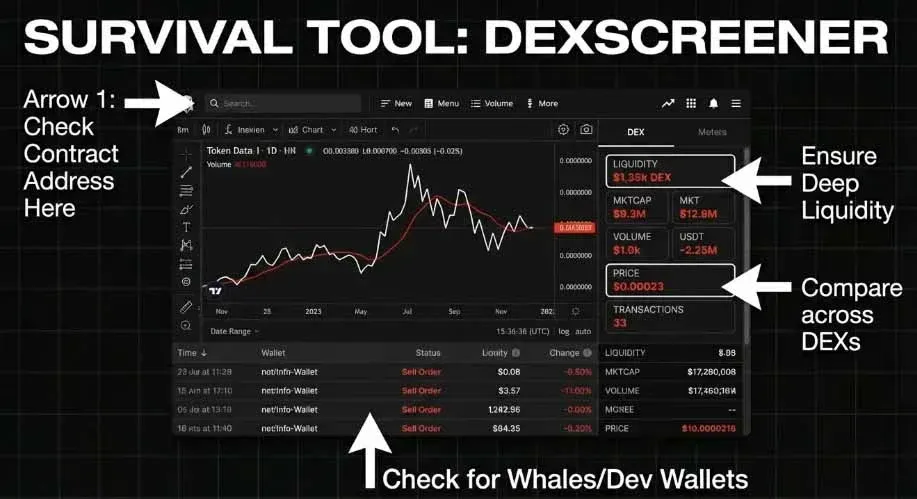
- Multi-chain Aggregated Search: Enter a token ticker to view real-time prices and liquidity across different chains and DEXs.
- New Pool Alerts: By setting filters (e.g., Liquidity > $100,000 USD), you can discover high-potential early-stage projects as soon as they launch.
- Whale Tracking: Analyze the transaction paths of high-profit wallets and observe the buying and selling patterns of large holders to assist in your investment decisions.
Conclusion
Decentralized Exchanges (DEXs) achieve financial sovereignty through technological means and are an indispensable part of the cryptocurrency industry. However, security and convenience often require a balance. In practice, it is recommended to use DEXs for asset exploration and private transactions, while utilizing CEXs for derivatives trading and fiat currency management.
*Note: Please be aware that cryptocurrency gains may be subject to capital gains tax or other taxes depending on your local jurisdiction. Always consult with a tax professional in your region.*
---
Frequently Asked Questions (FAQ)
Q: Do DEX trades require real-name verification (KYC)?
A: No. DEXs are permissionless. Users only need to connect their wallets to trade; no passports or email addresses are required.
Q: Can I recover funds if I send them to the wrong address?
A: No. Blockchain transactions are irreversible. It is highly recommended to perform a small test transaction before sending large amounts.
Q: Why are Ethereum DEX fees sometimes very expensive?
A: Every DEX transaction involves complex smart contract interactions. When the network is congested, Gas fees rise significantly. In such cases, consider using Layer 2 networks (like Arbitrum) or high-performance blockchains like Solana.
Q: Can a DEX freeze my funds?
A: The DEX protocol itself cannot freeze your funds. However, be aware that certain centrally-issued tokens (such as USDC or USDT) have "blacklist" functions within their own smart contracts that can freeze specific addresses.
This concludes our comprehensive guide on "What is a DEX (Decentralized Exchange)? Which are the largest DEXs in 2026?". For more in-depth content on DEXs and DeFi, please search for Bitaigen historical articles or stay tuned for our latest updates.
Related Reading
- Bitcoin Perpetual Contracts Funding Rate Explained
- OKX Web3 Features: Earn with DeFi, NFTs & Wallet Integration
- Bitcoin Near Bear Cycle Low? Accumulation Zone & Dip Buy
💡 Register on Binance with referral code B2345 for the maximum trading fee discount. See Binance complete guide.



