
 Bitaigen Research
 In the Binance (official registration | official download) contract‑trading page you can find a section called “Event Contracts.”
Its mechanism differs from perpetual contracts, quarterly contracts and Dual‑Currency Investment products. Below we systematically review the concept, advantages, risks, comparisons and practical steps.
In this article we provide a comprehensive overview of Binance’s newly launched Event Contracts, covering definition, benefits, operating procedures and key risk points. The goal is to help you quickly grasp the main differences compared with perpetual and quarterly contracts, and to give you a practical entry‑guide. Subsequent sections will walk you through the trading details step by step—keep reading.
Core Definition of Event Contracts
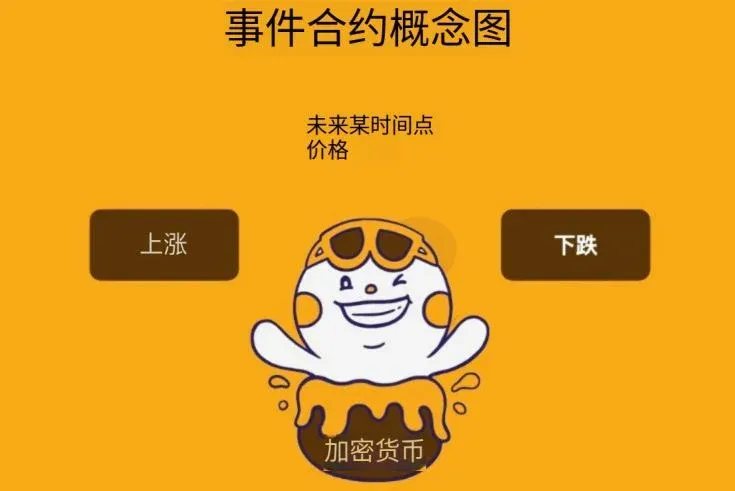
Event Contracts (English: *Event Contracts*) are essentially a “rise/fall” binary prediction on the price of a cryptocurrency at a predetermined point in time. Their logic is similar to traditional binary options:
- Deposit a certain amount of USDT and choose “up” or “down.”
- When the preset expiration time arrives, the system compares the reference price at order creation with the actual price at expiry.
- If the direction is correct, the investor receives the original principal plus the pre‑displayed reward percentage; if the direction is wrong, the principal is completely lost; if the price is exactly the same, only the principal is returned.
They are called “event” contracts because they are often tied to an upcoming macro or on‑chain data release (e.g., U.S. CPI, a protocol upgrade, etc.). In practice, most traders still rely primarily on technical analysis—for example, anticipating further upside after a breakout of a key resistance level.
Why Might Someone Choose Event Contracts?
- Low entry barrier – you only need to judge the direction; there is no need to estimate volatility or set take‑profit/stop‑loss levels.
- Limited per‑trade exposure – the platform caps the maximum amount per order, helping to control the size of a single loss.
- Transparent potential return – the payout ratio is shown before you place the order, and there are no hidden funding fees.
- Unaffected by intra‑period price swings – only the start price and the expiry price are compared; fluctuations in between do not influence the final settlement.
Potential Drawbacks and Risk Points
- No order cancellation – once placed, the order must run to expiry; you cannot modify or cancel it midway.
- Narrow asset coverage – currently only the BTC/USDT and ETH/USDT pairs are available.
- Strict time constraints – profit or loss is determined solely by the price at expiry; you cannot choose when to close the position.
- Wrong prediction equals a total loss – if the direction is incorrect, the entire principal is forfeited.
- Easy to trigger impulsive trading – the simple workflow and high‑multiple potential returns can encourage over‑trading.
Horizontal Comparison of Contract Types
| Item | Event Contract | Perpetual Contract | Quarterly Contract |
|---|---|---|---|
| Leverage allowed | No | Yes | Yes |
| Expiration date | Yes (10 min – 1 day) | No | Yes (fixed quarter) |
| Position duration | Fixed | Can be closed anytime | Fixed until quarter end |
| Affected by intra‑period volatility | No | Yes (liquidation trigger) | Yes (liquidation trigger) |
| Ability to profit on a down move | Yes | Yes | Yes |
| Funding fee | No | Yes | Yes |
| Trading fee | No | Yes | Yes |
From the table you can see that Event Contracts, like quarterly contracts, have a clear expiry time, but the former’s operation is more streamlined and the profit/loss outcome is more straightforward. Perpetual contracts offer the greatest flexibility, but they come with funding fees and liquidation risk.
Differences from Dual‑Currency Investment
| Dimension | Event Contract | Dual‑Currency Investment |
|---|---|---|
| Price reference | Spot price at order creation | Price at the first second after creation |
| Reference price selection | Fixed to creation price | User can set a custom comparison price |
| Term length | 10 min – 1 day | 4 hours – 300 days+ |
| Cancelable? | No | No |
| Expected return | Fixed by the payout rate | Annualized yield |
| Outcome on failure | Full principal loss | Full principal loss |
| Asset used for deposit | BTC, ETH | Multiple cryptocurrencies |
| Single‑order maximum | 250 USDT | Higher |
Essentially, Event Contracts are a more aggressive version of Dual‑Currency Investment: correct predictions are amplified, while wrong predictions drop to zero. If you prefer a smoother return profile, Dual‑Currency Investment may feel more stable; if you have strong conviction on short‑term price moves, the higher upside of Event Contracts can be attractive.
Platforms Supporting Event Contracts
As of now, the main platforms offering Event Contracts are Binance and MEXC. Most other large exchanges only provide perpetual or quarterly contracts. Below we use Binance as an example to demonstrate the full workflow.
If you have not yet registered on Binance, you can complete registration and download the app via the following links:
- Binance official registration (global) – copy the link into your browser.
- Binance Android app download
Note for U.S. residents: Use Binance.US instead of the global Binance platform.
Related tutorials: Comprehensive guides on Binance deposits, withdrawals, fees and security.
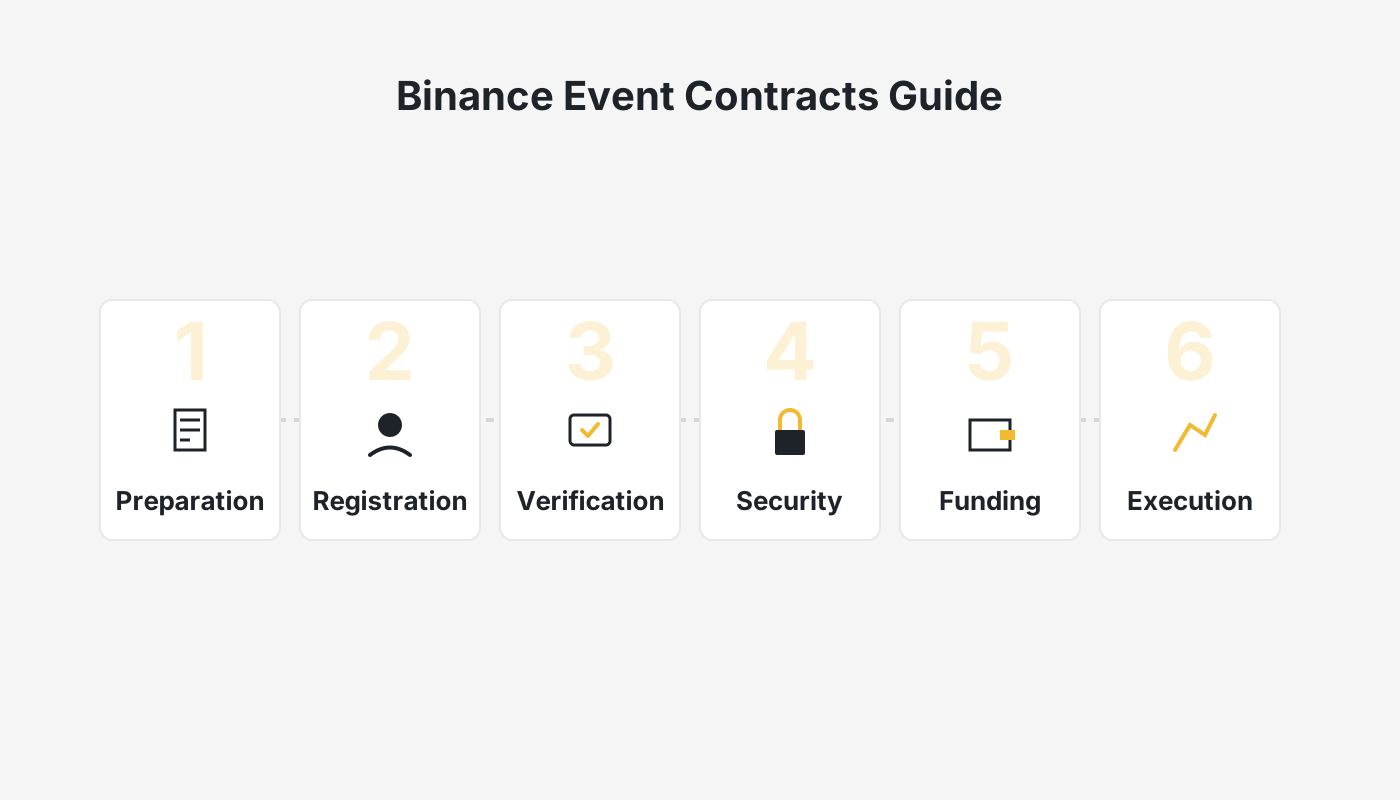
Binance Event Contracts – Step‑by‑Step Guide
Step 1: Open the Event Contracts Interface
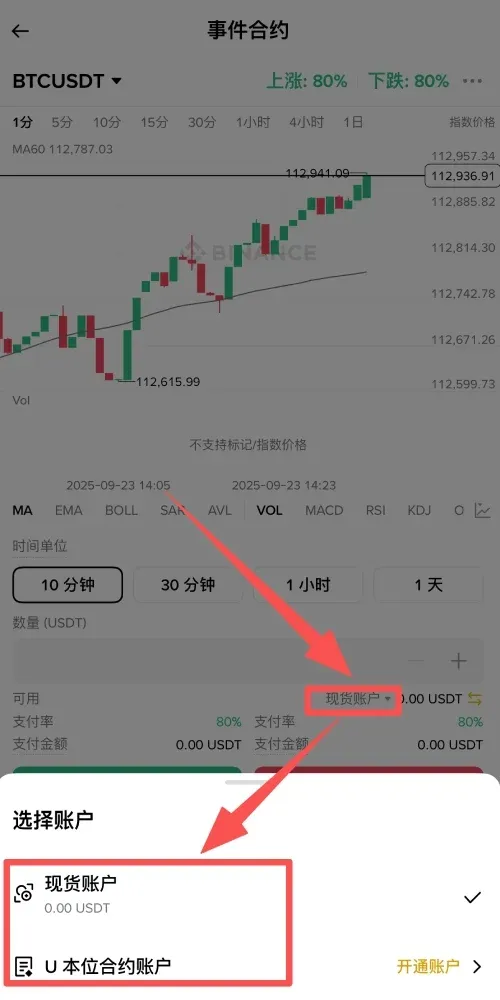
Launch the Binance app, switch to the “Derivatives” (合约) module, tap the three‑dot icon in the top‑right corner, and select the “Event Contracts” entry.
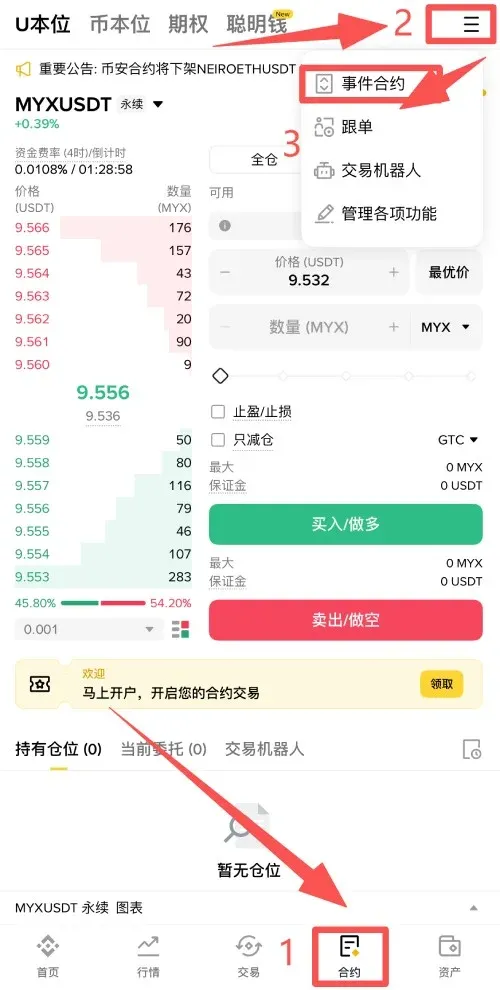
Before you enter this page, make sure you have USDT deposited in either your Spot wallet or your Derivatives wallet; otherwise you will be unable to place a trade.
Step 2: Key Points When Placing an Order
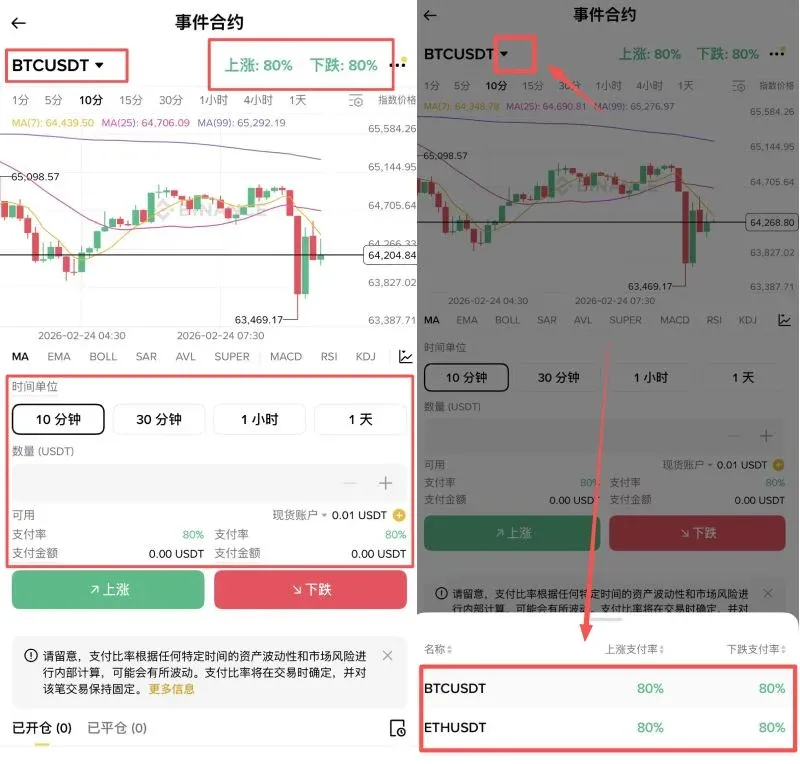
- Select the underlying pair – currently only BTC/USDT and ETH/USDT are supported.
- Check the payout rate – the system provides a reward percentage based on the asset’s volatility. For example, a 100 USDT stake with an 80 % payout rate would yield an additional 80 USDT if the prediction is correct. This rate is locked in at the moment you place the order.
- Set the time window – choose a specific interval ranging from 10 minutes up to 1 day.
- Enter the amount – minimum 5 USDT, maximum 250 USDT per order.
- Choose the direction – select “Up” or “Down.”
If your account balance is insufficient, you can tap the yellow “+” button at the bottom‑right of the amount field to transfer funds from either your Spot wallet or your Derivatives wallet. Be aware that moving funds into the Derivatives wallet may affect the margin available for other open positions.
After you confirm, the system executes the order in the next second and records the index price at that moment as the opening price. For instance, if you place a 10‑minute contract at UTC 18:59:59, the actual opening time becomes 19:00:00 and the closing time will be 19:10:00.
Once created, the order appears in the “Open” list and will remain there until expiry. If the direction is correct, you recover your principal plus principal × payout rate; if the direction is wrong, the principal is completely lost; if the price is unchanged, you receive only the principal back.
Fees and Cost Explanation
Binance does not charge any trading fee for Event Contracts. When you place an order you can already see two possible settlement outcomes: the amount you can withdraw if the contract succeeds, or the amount you receive if it fails. If the expiry price exactly matches the entry price, you can also retrieve the full principal without any fee.
Amount Limits and Risk Controls
| Item | Limit |
|---|---|
| Minimum per order | 5 USDT |
| Maximum per order | 250 USDT |
| Daily loss cap (including open positions) | 10,000 USDT |
| System‑wide cooling‑off period (7 days) cumulative loss | 50,000 USDT |
These rules are designed to prevent extreme losses from a single trade or from a short‑term series of losing trades.
Common Trading Tips and Personal Views
- Technical analysis – Use candlestick patterns, moving averages and other tools to gauge short‑term momentum. For example, a price that retests a key moving average from above may be poised to continue upward, which could justify a “up” order. Because Event Contracts usually have very short windows, the reliability of technical signals diminishes; thorough risk assessment is essential.
- Martingale‑style scaling – Some traders increase the stake after a loss (e.g., 5 USDT → 10 USDT → 20 USDT) hoping that a single win will offset previous losses. Keep in mind that the payout rate is typically below 100 %, so over the long run this approach can still generate a net loss. The payout rates are set by the platform and are not under the trader’s control, making it difficult to achieve a positive expected value over many trades.
Overall, the high upside of Event Contracts stems from the platform‑determined payout rate. If the platform aims not to lose money, the long‑term expected return for users is often negative. Therefore, it is crucial to stay rational, avoid chasing “quick‑and‑easy” profits, and treat each trade as a high‑risk speculative bet.
Frequently Asked Questions (FAQ)
- Are there dedicated technical indicators for Event Contracts?
No. Traders usually rely on standard indicators such as moving averages, trend lines, etc.
- What is the minimum amount required?
You can start with as little as 5 USDT.
- Can I close the position early?
No. Orders are settled only at expiry based on the actual outcome.
- Can sub‑accounts use Event Contracts?
Since 2026, Binance sub‑accounts no longer support Event Contracts; you must trade with your main account.
Summary of Key Points
- Profit is pursued by making a binary prediction on short‑term price movement.
- The potential payout (or loss) is known before you place the order.
- Orders cannot be closed early; you must wait for expiry.
- A wrong direction results in a total loss of the principal, effectively a “zero‑balance” outcome.
- Platforms such as Binance (or Binance.US for U.S. users) provide this product without additional trading fees.
This concludes the comprehensive analysis of Binance’s Event Contracts, covering definition, pros and cons, comparison with other contract types, practical steps, and typical risks. For more hands‑on tutorials, stay tuned to Bitaigen (比特根) future updates.
Tax reminder: Crypto‑related gains may be taxable in your jurisdiction. Please consult a qualified tax professional to understand your local obligations.
Related Reading
- Download Binance Android App in Mainland China – 2026 Guide
- Binance Grid Trading for Beginners: Spot vs Futures
- 2026 Top Crypto Exchanges: Binance, OKX, Bitget, Bybit, Gate
💡 Register on Binance with referral code B2345 for the maximum trading fee discount. See Binance complete guide.



