 Bitaigen Research
 Bitcoin: What It Is and How to Trade It
Bitcoin was launched by Satoshi Nakamoto in 2009 as a decentralized digital currency and has become one of the most recognized crypto assets worldwide.
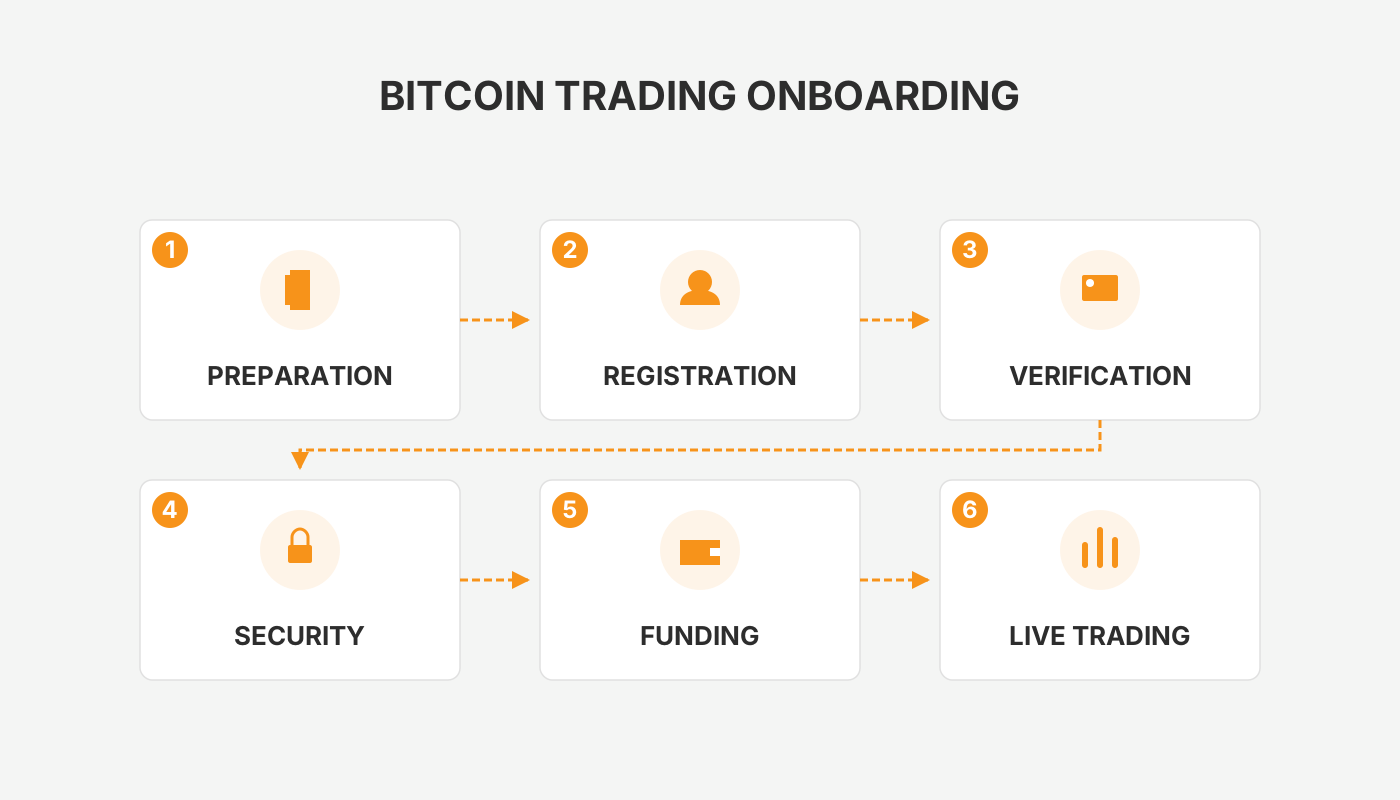
Bitcoin can be bought and held on the spot market, or you can go long/short via futures contracts on an exchange. Below you will find a detailed step‑by‑step guide covering registration, funding, and order placement.
In this article we break down the core concepts of Bitcoin and provide the complete workflow—from account creation and funding to spot and contract trading—so beginners can start safely on a regulated platform. If you want to get up and running quickly while avoiding common pitfalls, keep reading.
What Is Bitcoin?
Before we discuss *how to play Bitcoin*, it’s essential to understand its nature. Bitcoin was created in 2009 as a decentralized digital currency built on blockchain technology. Its key characteristics are:
- Decentralization – No bank or government backs it; transactions are validated by a global network of nodes.
- Fixed Supply – The total issuance is capped at 21 million coins, giving it scarcity‑driven anti‑inflation properties.
- Transparent & Traceable – All transaction records are publicly stored on the blockchain and cannot be altered.
By 2025, Bitcoin’s use cases have broadened further. Some jurisdictions have incorporated it into cross‑border payment systems, and major tech companies are gradually adding Bitcoin as a payment option. Understanding these fundamentals is the first step into the crypto world.
Below we explain how to purchase Bitcoin on an exchange.
How to Trade Bitcoin Spot?
1. Choose a Regulated Exchange
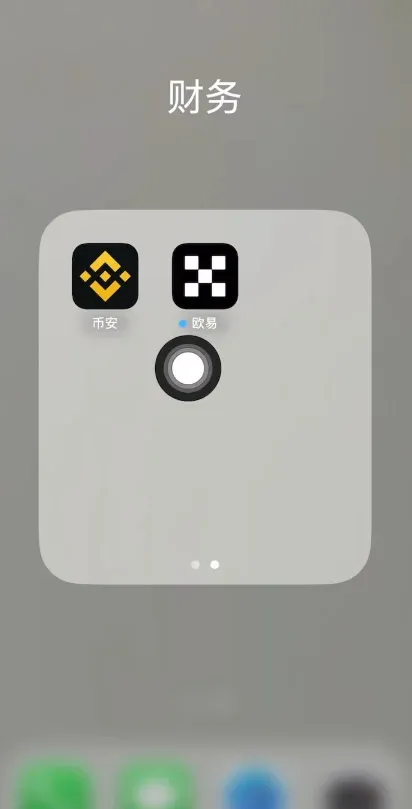
Beginners should steer clear of obscure platforms and prioritize exchanges with strong liquidity and relatively strict regulatory oversight. The two most widely used platforms among Chinese‑speaking users are Binance and OKX (formerly OKEx). Both offer user‑friendly interfaces and a full suite of features.
Note for U.S. residents: Use Binance.US instead of the global Binance platform to remain compliant with U.S. regulations.
2. Register and Complete Security Settings
Using Binance as an example, download the official app (official download). Follow the on‑screen prompts to register with a mobile number or email, complete identity verification (KYC), and enable two‑factor authentication (2FA).
3. Buy USDT with Fiat
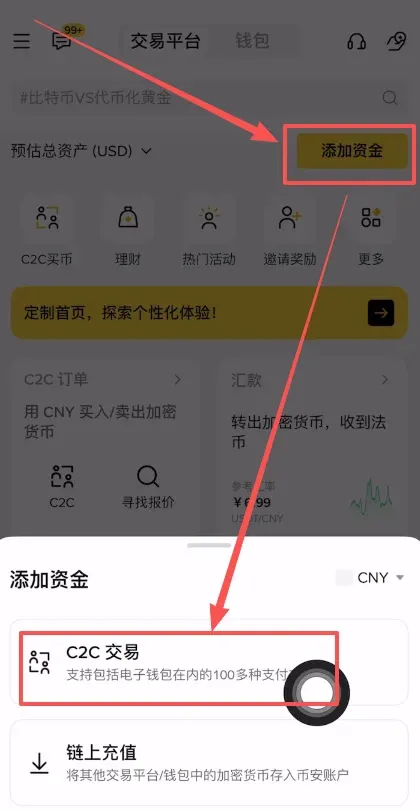
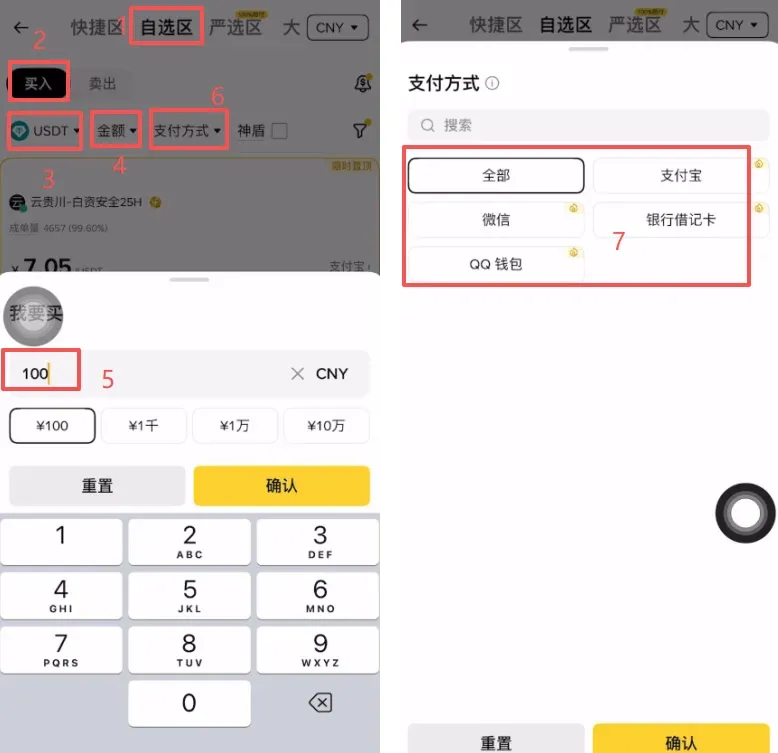
- Tap Add Funds → C2C Trading on the home screen.
- In the “Custom” section, select Buy and choose the stablecoin USDT, which is pegged 1:1 to the U.S. dollar.
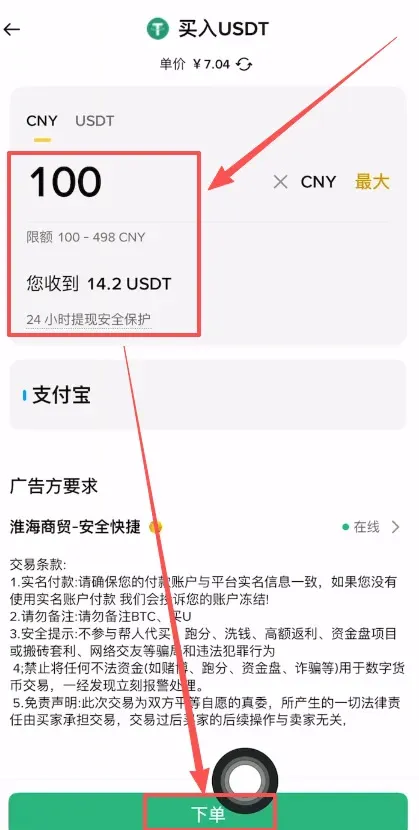
- Enter the amount you wish to spend (e.g., $100 USD). Choose a payment method such as bank transfer (SWIFT/SEPA), credit/debit card, or local e‑wallets (Alipay, WeChat, QQ Wallet).
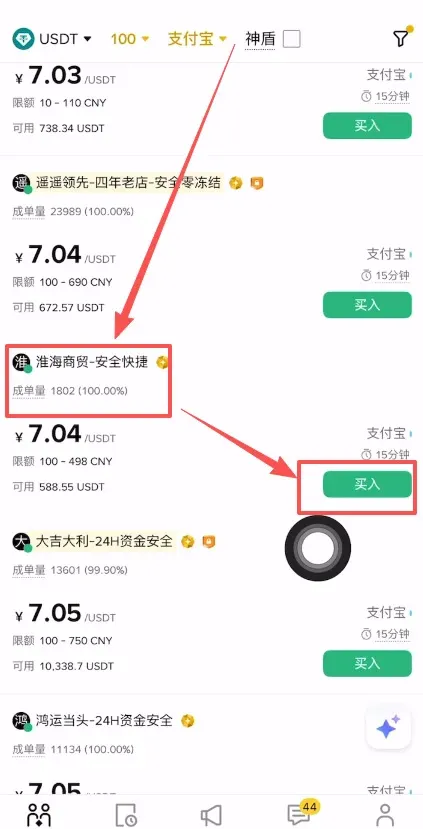
- Pick a seller with high trading volume (e.g., “Huaihai Trade”) and click Buy to complete the payment.
Fiat tip: For non‑Chinese users, selecting a bank transfer via SWIFT or SEPA will often result in lower fees and higher limits.
4. Open the Spot Trading Interface
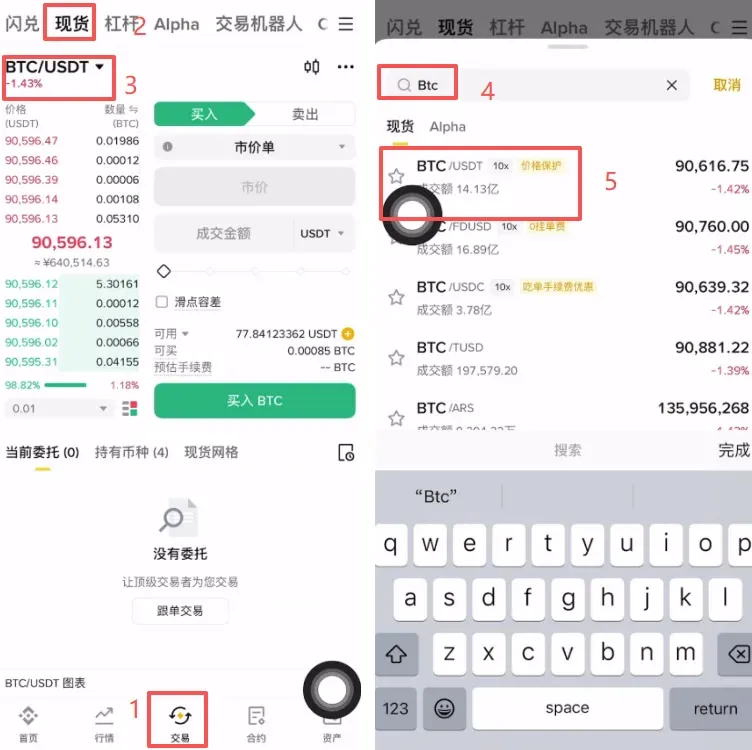
- After your USDT deposit is confirmed, tap the Trade tab at the bottom and select Spot.
- Use the search bar to type “BTC” and pick the trading pair BTC/USDT.
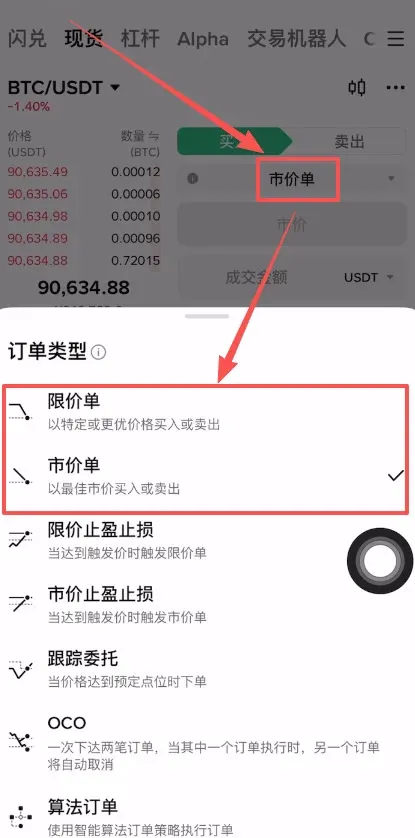
5. Place an Order to Buy Bitcoin
- Market Order – Executes instantly at the best available price.
- Limit Order – Allows you to set a specific buy or sell price. Beginners are generally advised to start with a market order.
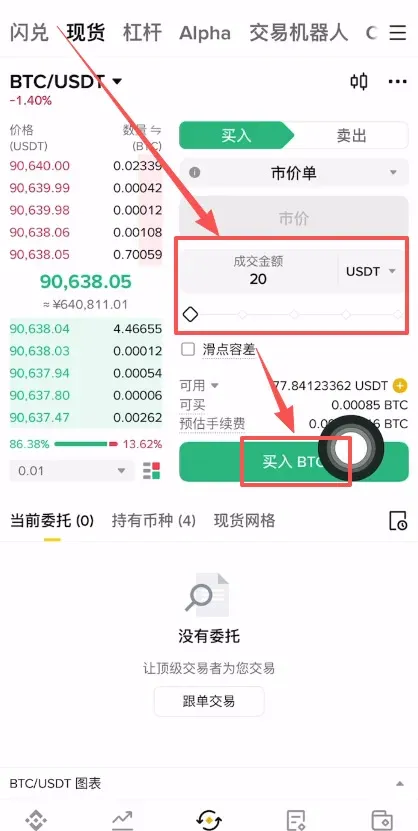
- Enter the amount of USDT you wish to spend, then click Buy BTC to submit the order.
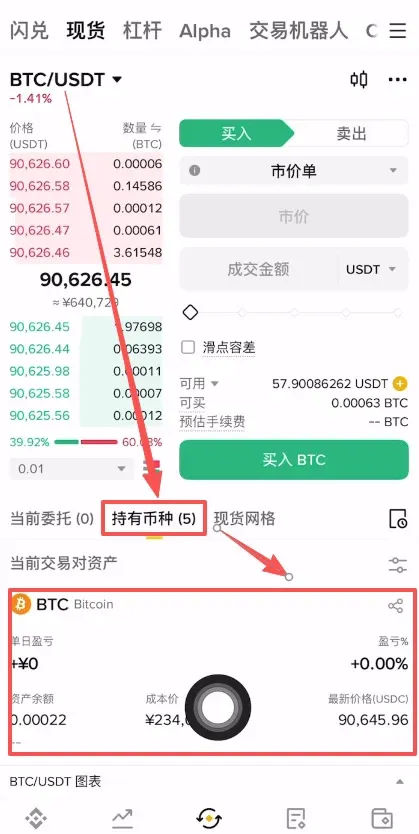
Once the purchase is successful, you can view your holdings under the Assets (or “Holdings”) section, where the newly acquired Bitcoin will be listed.
How to Trade Bitcoin Futures (Perpetual Contracts)?
The following walkthrough uses OKX (formerly OKEx) to demonstrate a long position on a perpetual futures contract.
1. Register and Access the Futures Section
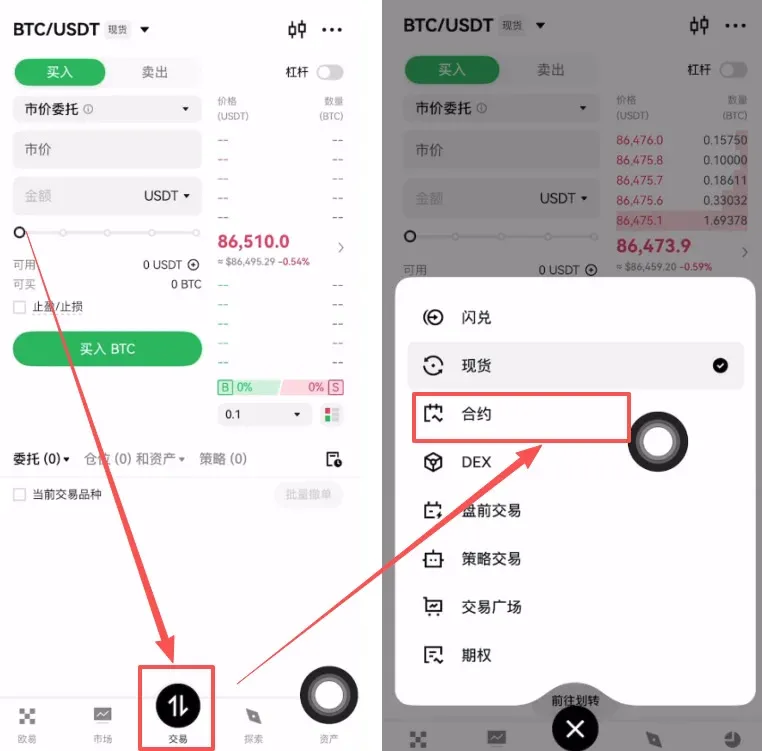
Open the OKX app (official registration link), finish identity verification, then tap Trade → Derivatives at the bottom of the screen.
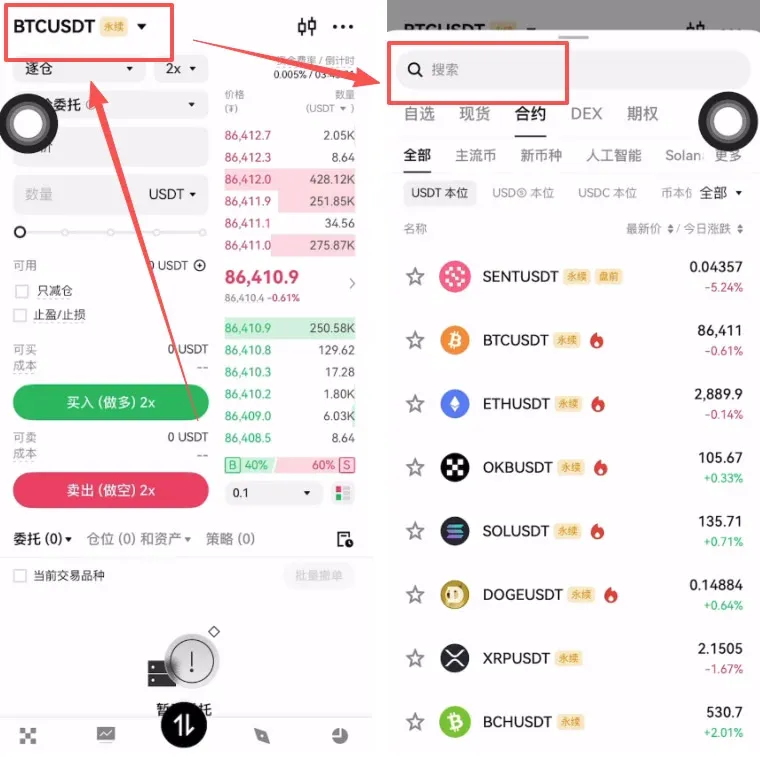
2. Choose the Contract
Search the derivatives list for “BTCUSDT Perpetual Contract” and select it.
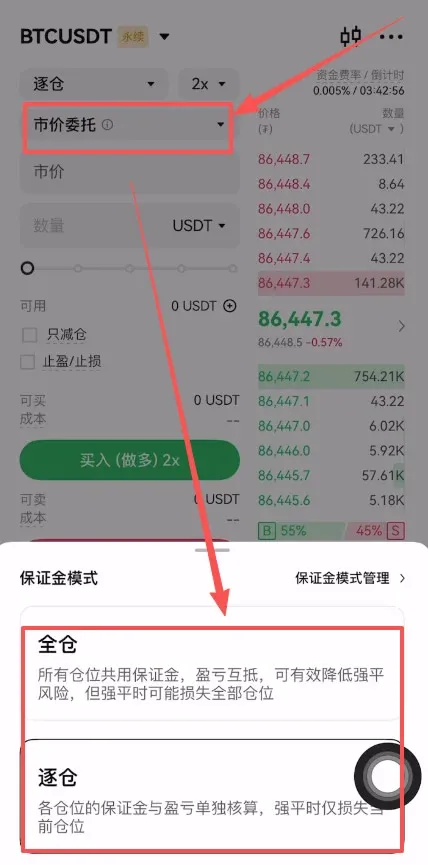
3. Set the Margin Mode
- Isolated Margin – Only the margin allocated to this specific order is at risk; liquidation is limited to that position.
- Cross Margin – The entire available balance in your account is used as collateral, increasing both potential profit and risk. Beginners are generally recommended to stick with Isolated Margin.
4. Pick the Leverage
Leverage can be adjusted up to 100×, but most traders use 2‑3× for a more manageable risk profile. In this example we use 2× leverage.
5. Choose the Order Type
- Market Order – Executes instantly at the current market price, suitable for quick entry.
- Limit Order – Lets you set a specific price, useful when you have a clear price target. This tutorial uses a Market Order.
6. Transfer Margin to the Futures Wallet
If your spot wallet does not contain enough USDT, go to Funding → Transfer and move the required amount of USDT into the futures account.
7. Enter Quantity and Submit the Order
- Input the number of contract units you wish to buy.
- Tap Buy Long (or Sell Short for a bearish bet). After confirming, the system will place your order.
8. Close the Position or Set Take‑Profit
In the Positions list you can click Close All to liquidate the entire position instantly, or you can set individual take‑profit and stop‑loss orders to manage risk automatically.
Comprehensive Overview of Bitcoin Strategies: From Holding to Advanced Tactics
Mastering “how to play Bitcoin” hinges on selecting a strategy that matches your risk tolerance. The mainstream approaches in 2025 are summarised below:
| Strategy | Core Idea | Ideal Audience | Key Tools |
|---|---|---|---|
| Long‑Term Holding (HODL) | Rely on scarcity for long‑term appreciation | Investors seeking steady, low‑maintenance exposure | Cold wallets, hardware devices |
| Spot Trading | Buy low, sell high to capture price swings | Traders who can monitor markets regularly | Real‑time candlestick charts, order‑book depth, AI‑assisted forecasts |
| Futures & Leverage | Amplify gains (and losses) with margin | Experienced users with solid risk‑control skills | Isolated margin, stop‑loss/take‑profit, demo accounts |
| Staking & Yield | Lock assets to earn a fixed annual return | Holders needing predictable cash flow | Staking platforms, typical APY 3‑8% |
Risk Management: Three Pitfalls Beginners Must Avoid
When exploring “how to play Bitcoin”, safety is paramount. The following three risk categories are especially prevalent:
- Excessive Leverage Speculation
- *Example*: In 2025 a trader used 100× leverage and was liquidated within five minutes.
- *Mitigation*: Newcomers should keep leverage at 5× or lower and always set stop‑loss orders.
- Phishing Scams
- *Statistic*: Over 2,000 fake exchange websites are created each month worldwide.
- *Protection*: Only access platforms via official domain names or verified mobile apps.
- Emotion‑Driven Trading
- *Psychology tip*: Define clear profit‑taking and loss‑cutting thresholds in advance to curb impulsive decisions driven by FOMO (fear of missing out).
Tax reminder: Crypto gains may be subject to taxation in your jurisdiction. Consult a tax professional to ensure compliance with local laws.
Bitcoin’s History and Evolution
- October 2008 – Satoshi Nakamoto released the *Bitcoin Whitepaper*, proposing a peer‑to‑peer electronic cash system.
- January 2009 – The genesis block was mined, marking the launch of a decentralized ledger.
- 2010 – A programmer paid 10,000 BTC for two pizzas, creating the first real‑world transaction.
- 2011‑2021 – Bitcoin repeatedly broke major price milestones (US $1, US $1,000, US $20,000), drawing institutional interest and pushing market capitalization to new highs.
- 2025 – Bitcoin functions as a bridge for cross‑border payments, digital gold, and a key component of the DeFi ecosystem.
Real‑World Use Cases for Bitcoin
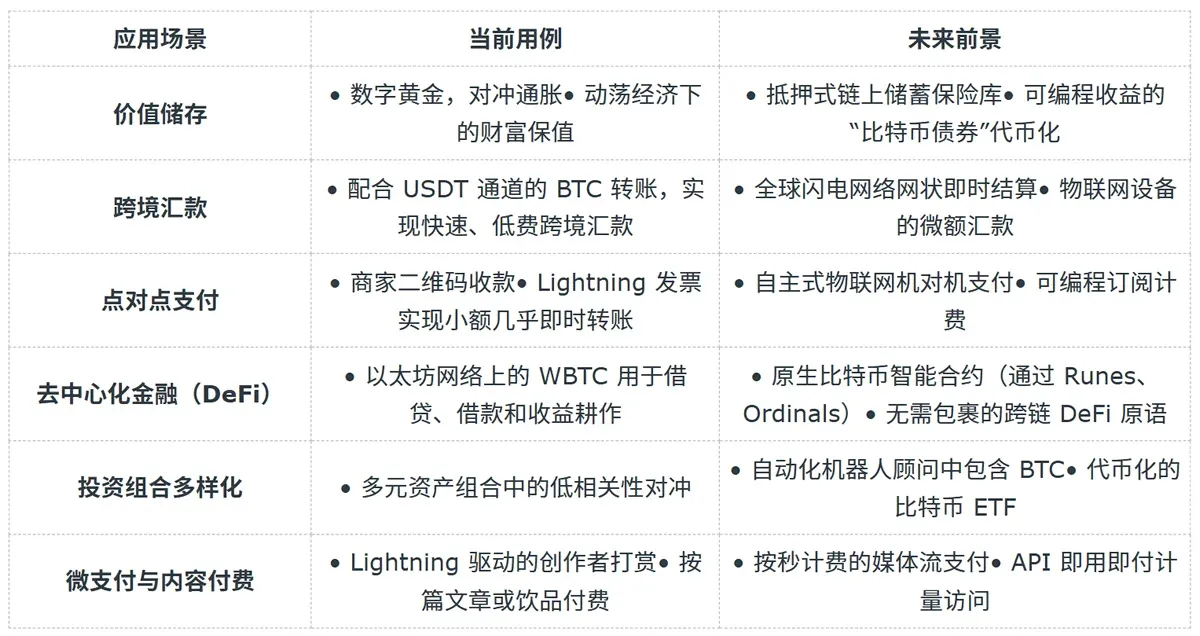
- Store of Value – In economies with currency depreciation or capital controls, Bitcoin acts as “digital gold,” helping users preserve purchasing power.
- Cross‑Border Remittances – Coupled with USDT liquidity, Bitcoin can facilitate low‑cost international transfers that settle within an hour.
- Peer‑to‑Peer Payments – Merchants accept QR‑code payments; the Lightning Network enables near‑instant, sub‑cent micro‑transactions with minimal fees.
- Decentralized Finance (DeFi) – Tokenised versions such as Wrapped BTC (WBTC) bring Bitcoin into smart‑contract platforms, supporting lending, borrowing, and liquidity mining.
- Portfolio Diversification – Because Bitcoin’s correlation with traditional assets is low, it serves as a hedge against inflation and market volatility.
Conclusion
This guide has walked you through concept basics, exchange selection, spot purchasing, futures trading, and a range of strategic options for how to play Bitcoin. Whether you aim to hold for the long term or engage in short‑term trading, using a regulated platform and adhering to strict risk‑management practices are the foundations for safe and effective participation.
Take the first step now and start your Bitcoin journey!
*The above constitutes the full content of “How to Play Bitcoin? Spot and Futures Purchase Tutorial.” For additional tutorials, follow Bitaigen (比特根) and explore related articles.*
Related Reading
- Bitcoin Inverse‑V Crash Past $71.5K: Data & Fed Outlook
- BTC HYPE Analysis: 6.41% Short‑Term Profit Back‑Test
- Bitcoin Futures: Common Scams & Real Relationship
💡 Register on Binance with referral code B2345 for the maximum trading fee discount. See Binance complete guide.



