 Bitaigen Research
Surge in the Scale of Stablecoins Used in Illicit Activities
The latest report from TRU Labs (TRM Labs) shows that in 2025, illicit entities transferred roughly $141 billion worth of stablecoins, setting a five‑year record. The report stresses that this figure does not imply a proportional rise in overall crypto‑related crime; rather, it reflects a growing preference for stablecoins in certain illegal use‑cases because of their operational convenience.
“In some criminal chains, the share of stablecoins has risen markedly, primarily because they provide a clear efficiency advantage at those stages.” — TRM Labs
Sanctions Evasion and Large‑Value Transfers
Data indicate that transactions linked to sanctions evasion accounted for 86 % of all illicit crypto flows in 2025. Of the total $141 billion of stablecoin movement, about $72 billion involved a token pegged to the Russian ruble, A7A5, whose activity is almost entirely confined to sanction‑related ecosystems.
TRM Labs further points out that Russian‑affiliated platforms on the A7 network intersect with state‑supported networks in China, Iran, North Korea and Venezuela. This overlap highlights that stablecoins have become a critical infrastructure for sanctioned actors to bypass traditional financial oversight and move value across borders.
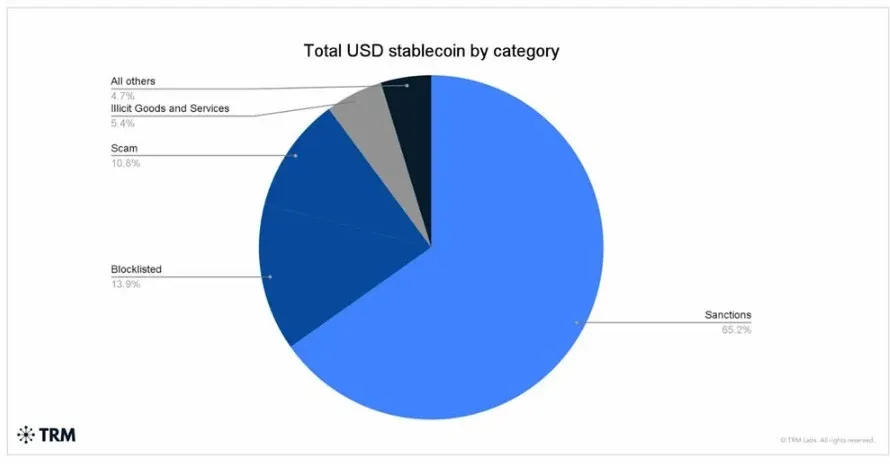
Sanctions evasion is the primary driver behind the use of illicit stablecoins — Source: TRM Labs
Starting from TRM Labs’ newest report, we dissect emerging trends in cross‑border sanctions evasion and high‑value transfers involving stablecoins, revealing the logic and risk evolution of their use in illegal chains. This article helps readers grasp regulatory focal points and anticipate potential compliance challenges, making it a worthwhile read.
Markets Secured Solely by Stablecoins
Compared with crimes such as scams, ransomware and hacking—where perpetrators tend to favor Bitcoin or only switch to stablecoins in later laundering stages—illegal goods and services as well as human trafficking almost exclusively use stablecoins for payment. These markets prioritize payment certainty and liquidity over any appreciation potential of the underlying asset.
Projections suggest that by the end of 2025, platforms like Huione, which use stablecoins as collateral, will see transaction volumes exceed $17 billion, with roughly 99 % of the value denominated in stablecoins. TRM Labs explains that the core function of such platforms is to provide infrastructure for money‑laundering, not to serve as conventional investment vehicles.
Observations from Other Agencies
- Chainalysis reported in February that crypto funds flowing to suspected human‑trafficking networks grew 85 % year‑over‑year, and almost all of those transactions were executed with stablecoins.
- In the same period, TRM Labs recorded that the annual total stablecoin transaction volume repeatedly topped $1 trillion, which extrapolates to an annualized figure of about $12 trillion, with roughly 1 % attributed to illicit purposes.
When contrasted with United Nations estimates that 2 %–5 % of global GDP—approximately $800 billion to $2 trillion—is laundered each year, TRM’s data provide a blockchain‑level breakdown that falls within that broader range.
---
The above constitutes a full analysis from TRM Labs on the 2025 peak of illegal stablecoin activity, reaching $141 billion. For further coverage, follow Bitaigen (比特根) in upcoming reports.
Additional notes for a global audience:
- Fiat transactions related to crypto purchases or conversions are typically processed via SEPA, SWIFT or other international banking corridors.
- U.S. residents must use Binance.US rather than the global Binance platform to remain compliant with local regulations.
- Crypto gains may be taxable in your jurisdiction; consult a tax professional to understand your obligations.
💡 Register on Binance with referral code B2345 for the maximum trading fee discount. See Binance complete guide.
⚠️ Risk Disclaimer: Crypto prices are highly volatile. This is not investment advice.



