
 Bitaigen Research
In this article we outline the latest integration progress of crypto‑treasury firms and focus on senior executives’ optimistic outlook for tokenized credit businesses. By interpreting these signals, readers can gauge industry trends, spot potential business opportunities, and appreciate the nuanced analysis that follows.
Tokenized Public and Private Credit Instruments: A New Revenue Stream for Crypto Treasuries
“In today’s financial system, credit products are among the most widely used financial tools,” BTCS Chief Strategy Officer Wojciech Kashić told *Cointelegraph*.
He added that these credit instruments can also be tokenized on a blockchain.
“I foresee that tokenized real‑world assets (RWA), especially the tokenization of public and private credit, will experience significant growth over the next 24 months,” Kashić continued.
These tokenized assets can serve as collateral on decentralized finance (DeFi) platforms, underpinning lending applications.
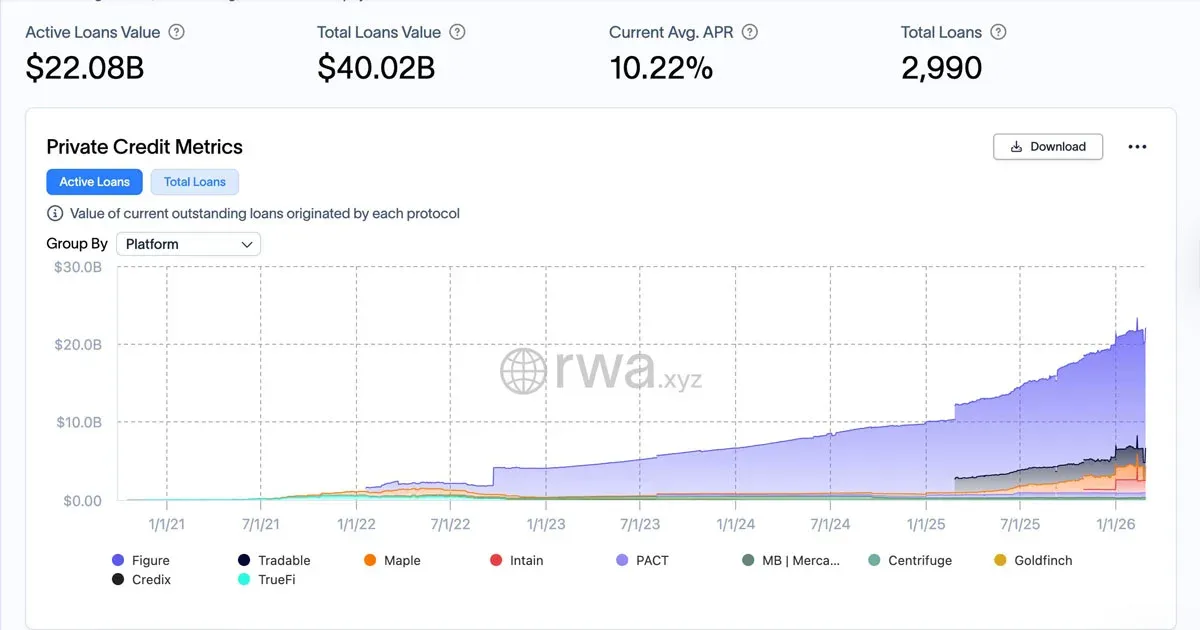
Tokenized Private Credit Market Overview (source: RWA.XYZ)
Strategy — a globally leading Bitcoin wealth‑management firm that offers credit‑style and fixed‑income products to clients. The company says its fixed‑income solutions are the reason index provider MSCI is considering adding Strategy and other similar crypto‑bond issuers to its equity indices.
“Strategy’s wealth‑management business delivers diversified securities—including equities and fixed‑income—to give investors varying degrees of exposure to the Bitcoin economy,” the firm wrote in its response to MSCI.
---
Since 2025, crypto‑reserve companies have generally been confronting a sector‑wide downturn, with many firms seeing share prices fall below the book value of the crypto assets recorded on their balance sheets. This wave of devaluation even preceded the broader market collapse that unfolded in October.
Against this backdrop, industry observers expect a pronounced wave of consolidation this year. BTCS’s Chief Strategy Officer Kashić noted that companies with actual operating businesses are actively pursuing mergers or acquisitions of firms whose market prices are below net asset value (NAV).
“Operating businesses — for example, providing validation services for blockchain networks or issuing public and private credit instruments — generate cash flow, making crypto‑treasury companies more competitive than those that merely hold crypto assets,” Kashić explained to *Cointelegraph*.
He further clarified that this cash‑flow advantage enables such firms to acquire competitors that are struggling with crypto investments or whose market capitalization is lower than the value of the assets they hold.
“When you merge with other players, two plus two can sometimes equal six or even more. That means in a market where every company trading below NAV is fighting for survival, you can gain a leadership edge more quickly,” Kashić added.
In summary, as industry consolidation accelerates and tokenized credit tools develop rapidly, crypto‑treasury firms are poised to achieve larger‑scale mergers and synergies by 2026. To stay updated on the latest developments surrounding 2026 crypto‑treasury integrations, follow the forthcoming coverage from Bitaigen.
*Note for global readers:* Transactions involving fiat currency should be conducted in USD where applicable, with SEPA or SWIFT transfers used for cross‑border payments. U.S. users wishing to trade on Binance must use Binance.US rather than the global Binance platform. Additionally, crypto‑related gains may be subject to taxation under the relevant local jurisdiction.
💡 Register on Binance with referral code B2345 for the maximum trading fee discount. See Binance complete guide.
⚠️ Risk Disclaimer: Crypto prices are highly volatile. This is not investment advice.



