
 Bitaigen Research
Recent performance across the crypto‑asset market has been weak. According to data from CoinGecko, the global cryptocurrency market capitalization has fallen from roughly $30 trillion at the start of 2024 to about $25 trillion today, a decline of close to 20 %. This macro‑level pressure is also reflected in Bitcoin‑related financial products.
On the day in question, the spot Bitcoin ETF recorded a net outflow of $545 million, turning the week’s overall fund flow negative and bringing the cumulative net outflow for the week to $255 million. Data from SoSoValue shows that this single‑day withdrawal is the largest since January 26, 2026.
To date, these funds have attracted about $3.5 billion in net inflows since the start of the year, but redemption requests during the same period totalled $5.4 billion, resulting in a net outflow of $1.8 billion for the year. Assets under management (AUM) remain roughly $93.5 billion.
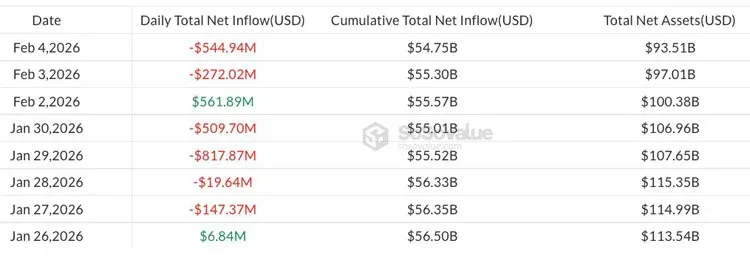
Spot Bitcoin ETF fund flows since January 26, 2026. Source: SoSoValue
In this article we outline recent changes in the fund flows of spot Bitcoin ETFs, correlate them with the broader decline in crypto market cap, and analyze the underlying market sentiment and potential risks. By presenting data and charts visually, we aim to help investors assess whether the current downtrend may be reversing and whether it warrants continued attention.
Only 6 % of Bitcoin ETF Investors Have Withdrawn Their Holdings
Even though Bitcoin ETFs have logged their largest paper‑losses since launch a little over two years ago, some analysts still see a degree of resilience during periods of market volatility. Cumulatively, spot Bitcoin ETFs have recorded $54.8 billion in net inflows, about 13 % lower than the historical peak of $62.9 billion reached in October 2023.
Bloomberg ETF analyst James C. Sifrit wrote on X: “Considering that these funds once attracted roughly $63 billion at their peak, this performance is fairly respectable.”
Likewise, Bloomberg senior ETF analyst Eric Balchunas noted that despite the recent market dip, the majority of Bitcoin ETF investors are still holding their positions.

Source: Eric Balchunas
Balchunas estimates that, although Bitcoin’s price has fallen sharply and many positions are now underwater, only about 6 % of the total assets have been withdrawn from these funds so far. He added that iShares Bitcoin ETF (IBIT) from BlackRock has seen its AUM decline to $60 billion, after briefly touching the $100 billion mark.
Related: Bitcoin ETF rebounded $562 million after a $1.5 billion sell‑off, but headwinds persist
He further commented: “Over the next three years it may stay at this size, and even then it would remain the fastest‑growing ETF to reach the $60 billion threshold in history.”
While Bitcoin ETF capital is flowing out dramatically, alt‑coin‑focused funds are showing mixed trends. The Ethereum ETF logged an outflow of roughly $79.5 million on the same day, the XRP fund saw a modest $4.8 million inflow, and the Solana ETF recorded an outflow of about $6.7 million.
The above provides a complete analysis of why the Bitcoin (BTC) ETF experienced a $545 million single‑day net outflow and continued its downtrend as Bitcoin approached the $70,000 level. For more information on the day’s fund dynamics, stay tuned to Bitaigen’s (比特根) follow‑up reports.
*Note for U.S. readers: Access to Binance services should be through Binance.US, not the global Binance platform.*
Related Reading
- BlackRock Bitcoin Spot ETF Backed by Top Market Makers
- Bitcoin ETF Outflows Rise as Capital Shifts to DeFi & AI
- Bitcoin ETF $105M Outflow, IBIT Buyer Laurore Takes $436M
💡 Register on Binance with referral code B2345 for the maximum trading fee discount. See Binance complete guide.
⚠️ Risk Disclaimer: Crypto prices are highly volatile. This is not investment advice.



