
 Bitaigen Research
For years, investors holding an Ethereum‑linked ETF have paid management fees while missing out on the native staking yield that the network generates. That inefficiency was finally broken this morning—as BlackRock entered the staking competition, it turned Ethereum into a productive Wall Street asset.
In a first for the U.S. market, the world’s largest asset manager launched a product that can capture both price appreciation and validator rewards. Investors no longer have to choose between holding and earning; the two now occur in tandem.
When the announcement went live, Ethereum’s price rose 2.8 % overnight, climbing back above the $2,100 level as the weekend session began.
The total cryptocurrency market capitalization also recovered, gaining 2 % over the past 24 hours and retaking the critical $2.5 trillion threshold.
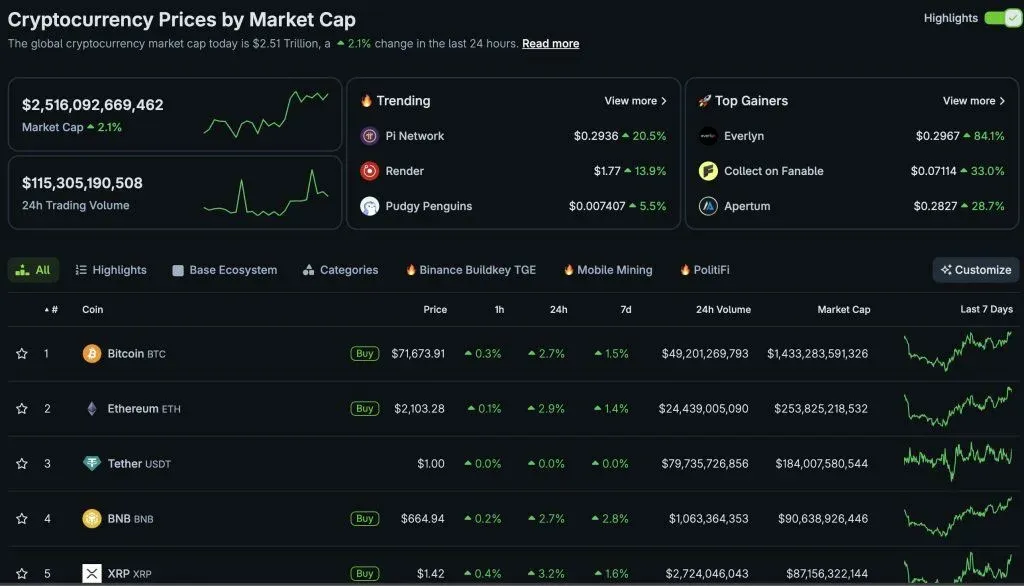
Source: CoinGecko.
In this article we dissect BlackRock’s newly launched Ethereum staking trust, explain how it breaks through the traditional ETF earnings ceiling by melding on‑chain validator rewards with asset appreciation, and explore the potential impact on market liquidity and investor allocation. A thorough read is recommended.
BlackRock Joins the Staking Race: ETHB Listed on Nasdaq
BlackRock officially rolled out the iShares Staked Ethereum Trust (ETHB) on Nasdaq today. This vehicle differs from the firm’s existing iShares Ethereum Trust (ETHA), which manages over $6.5 billion and serves solely as a passive price‑tracking instrument.
The new tool plans to allocate 70 %–95 % of its held ether to staking in order to generate yield. Its fee structure is relatively aggressive: a standard sponsorship fee of 0.25 %, but BlackRock has applied a promotional waiver that brings the charge down to 0.12 %.
The reduced rate applies to the first $2.5 billion of net asset value (NAV) or during the first 12 months after launch, whichever threshold is reached first.
iShares Americas head Jessica Tan framed the launch as a direct response to client demand, aiming to provide a product that fully reflects the economic realities of the asset class.
The trust joins BlackRock’s digital‑asset platform, which oversees roughly $130 billion in assets, further cementing the firm’s leadership in the digital‑asset ETF space.
BlackRock’s Institutional Ethereum Shift: Yield Is No Longer Optional
The rollout signals that institutional adoption has moved beyond mere exposure. Previously, regulatory friction prevented U.S. issuers from embedding staking mechanisms in exchange‑traded products, forcing investors to choose between the safety of an ETF and the direct yield from holding ether. That binary choice has now disappeared.
The appearance of ETHB demonstrates that regulators are gaining a deeper understanding of the technical details of proof‑of‑stake blockchains. Recent coordination between the SEC and CFTC could pave the way for more complex structured products of this kind.
For asset allocators, the implication is clear: holding a sizable amount of ETH without staking it effectively means accepting a benchmark performance that lags behind what could be earned on‑chain.
Competitors such as Fidelity and Grayscale are currently on the defensive. With BlackRock successfully packaging staking rewards into a product that costs only 0.12 %, existing spot ETFs feel pressure to evolve into staking‑enabled tools. The market standard for Ethereum products is therefore being raised.
Supply Dynamics: Dollar‑Denominated ETH Scarcity Tightens
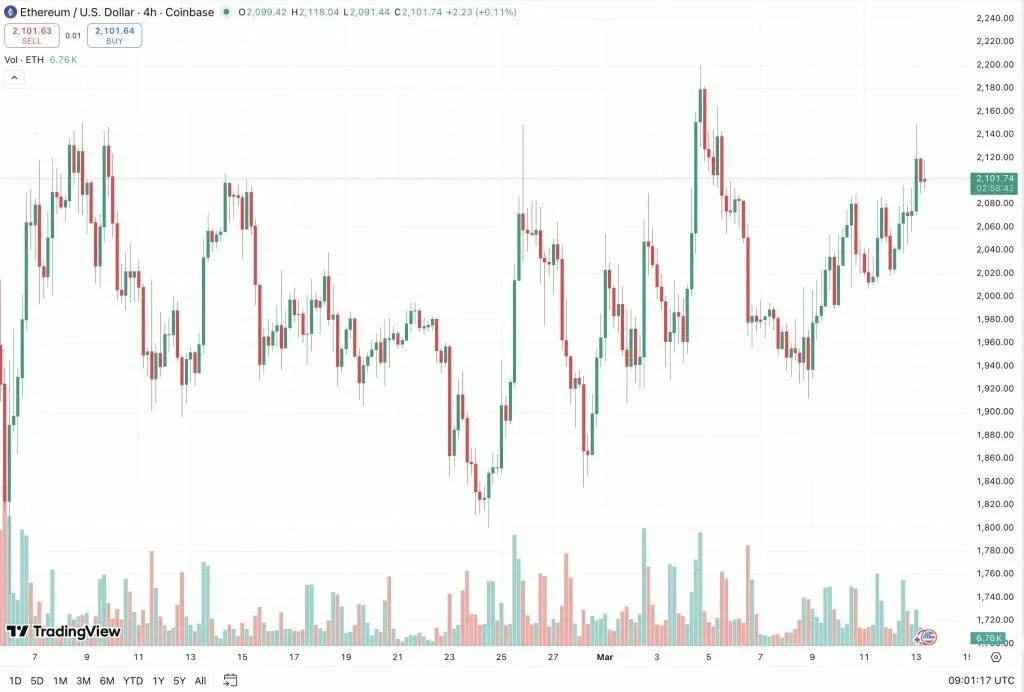
Source: TradingView
The launch of ETHB creates a fresh demand vector for the Ethereum network. Unlike a spot ETF that simply stores tokens in cold storage, a staking ETF locks those tokens into validator nodes, thereby reducing the amount of ether available for active trading.
If capital shifts from BlackRock’s existing ETHA product to the newly introduced ETHB staking fund, or if fresh inflows arrive specifically seeking yield, the proportion of ether committed to staking contracts will rise.
This aligns with a broader market trend—Ethereum’s scarcity index has already turned positive. ETHB’s successful debut institutionalizes the locking process and accelerates that dynamic.
As ETH/USD approaches the $2,150 resistance level, the introduction of BlackRock’s new Ethereum staking ETF could help push the price toward the next target around $2,400.
---
*Note: For residents of the United States, cryptocurrency trading on Binance must be conducted via Binance.US (the U.S.‑compliant platform), not the global Binance site.*
*Crypto gains may be taxable in your local jurisdiction; consult a qualified tax professional for guidance.*
---
💡 Register on Binance with referral code B2345 for the maximum trading fee discount. See Binance complete guide.
⚠️ Risk Disclaimer: Crypto prices are highly volatile. This is not investment advice.



