
 Bitaigen Research
 In this article we provide a detailed analysis of BlockDAG’s technical architecture, listing roadmap, and ecosystem layout, helping readers quickly grasp the project’s core elements and assess its long‑term potential. Please continue reading. We will also conduct an in‑depth evaluation of its hybrid consensus model and pre‑sale incentive mechanisms to give you a more complete perspective.
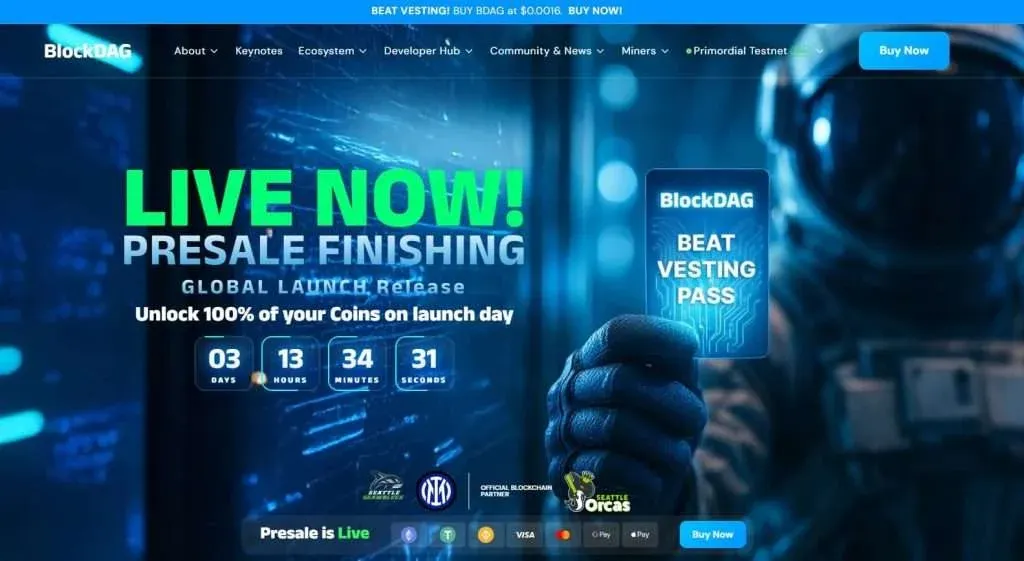
After the pre‑sale window closes on August 11, the official launch date for the BlockDAG (BDAG) token was also set. At that time the token will debut on five exchanges: XT, MEXC, LBank, BitMart, and Coinstore. (U.S. users should use Binance.US rather than the global Binance platform for any subsequent listings.) The pre‑sale discount price was USD 0.002, and the platform offered an incentive that could double the invested amount. To date the pre‑sale has raised more than USD 360 million; after the sale ends a token generation event (TGE) will occur at a price of USD 0.05 per token, which represents an increase of over 1,560 % compared with the current trading price of roughly USD 0.0016.
---
What is BlockDAG?
BlockDAG aims to create a brand‑new Layer‑1 smart‑contract chain that competes directly with mainstream networks such as Ethereum and Solana. Its core technology uses a hybrid consensus model: parallel processing is achieved on a Directed Acyclic Graph (DAG) structure to boost transaction throughput, while a Proof‑of‑Work (PoW) mechanism is retained to ensure network security and decentralisation on a level comparable to Bitcoin.
Unlike traditional blockchains that can confirm only one transaction at a time, BlockDAG can handle multiple transactions simultaneously, significantly enhancing the network’s scalability. The project also provides low‑code tools for developers, lowering the barrier to deploying decentralized applications (DApps) on the chain. All on‑chain activities must be paid for with the native token $BDAG, which helps maintain steady demand for the token as network usage grows.
---
What is the BDAG token?
BDAG is the native cryptocurrency of the BlockDAG ecosystem and serves several key functions:
- Payment of on‑chain transaction fees and smart‑contract execution fees.
- Reward for PoW mining, incentivising nodes to participate in validation.
- Governance token that allows holders to vote on the project roadmap and critical policy decisions.
---
BlockDAG Mining
Unlike Ethereum, Solana and other chains that have switched to Proof‑of‑Stake (PoS), BlockDAG continues to rely on PoW for transaction confirmation. Any user with the appropriate hardware can join the mining process. The project has released a dedicated ASIC miner and also launched mobile mining clients for iOS and Android. Users may purchase the dedicated miner directly from the official website or run the official mobile app on their smartphones to mine and earn BDAG rewards.
---
BDAG Tokenomics
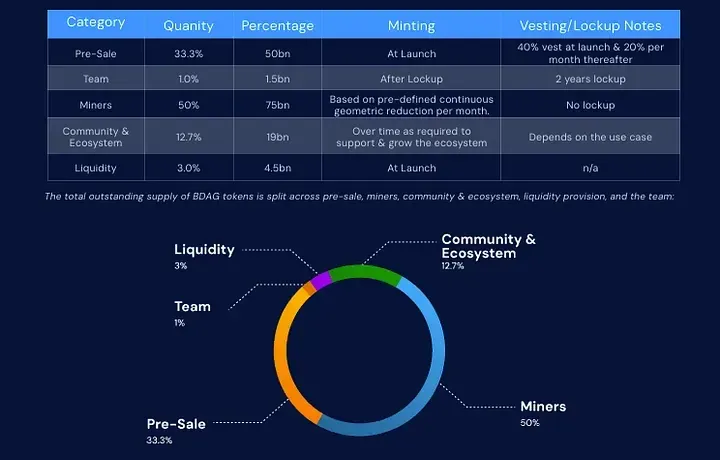
The total supply of BDAG is capped at 150 billion, allocated as follows:
| Category | Percentage | Description |
|---|---|---|
| Miners | 50 % | Distributed via PoW block rewards (75 billion BDAG) to secure the network and maintain decentralisation |
| Pre‑sale | 33.3 % | Sold in tranches (50 billion BDAG) to raise roughly USD 300 million; 40 % unlocks at listing, the remaining 60 % vests linearly over three months |
| Community & Ecosystem | 12.7 % | Used for airdrops, liquidity mining, development grants, etc., to stimulate ecosystem growth |
| Exchange Liquidity | 3 % | Provides initial liquidity for the BDAG/USDT pair, helping to create a deep order book |
| Team | 1 % | Locked for two years to align the team’s long‑term interests with the project’s direction |
The token design does not incorporate a burn fee; instead, inflation is curbed through a fixed supply and staged release schedule. In the future, the governance layer could activate an optional burn module via a fee‑customisation feature, giving holders a say in supply management and potentially supporting a relatively stable value trajectory.
---
BDAG Price Forecast
During the pre‑sale, BDAG’s price rose from USD 0.0001 to the current level of roughly USD 0.0016, but the project team has not disclosed the official listing price. Considering that the pre‑sale has already secured more than USD 332 million, with a hard cap set at USD 600 million, there remains upward demand potential.
If the pre‑sale is extended further, it could put pressure on the post‑listing performance because some investors may prefer to take profits once tokens unlock. Community frustration over repeated listing‑date delays is also growing, raising concerns about project transparency and regulatory compliance. Based on the current market climate and project timeline, a conservative estimate places the BDAG price at around USD 0.032 by the end of 2025.
---
Is BlockDAG a Good Investment?
Strengths
- Scalability
By introducing DAG‑based sharding at Layer‑1, BlockDAG can parallelise transaction processing, dramatically lowering fees and increasing throughput, thereby offering a technical edge in the race against Ethereum and Solana.
- Team & Partnerships
The project is led by former Spirit Blockchain COO Anthony Turner, whose core team boasts extensive blockchain development experience. Media collaborations include Bloomberg and CoinDesk, and the project has secured the official blockchain partnership of Inter Milan as well as UFC fighter Alex Pereira as brand ambassador—resources that could boost visibility.
- Community‑Centric Token Distribution
Only 1 % of the total supply is allocated to the founding team; the vast majority goes to miners, pre‑sale participants, and ecosystem incentives, ensuring that the community retains a dominant role in the project’s evolution.
Risks
- Liquidity Constraints
With only 3 % of the supply earmarked for exchange liquidity, early trading on mainstream “alt‑coin” venues may suffer from thin order books, affecting the trading experience.
- Competitive Landscape
Existing Ethereum Layer‑2 solutions already lock in over USD 46 billion of value and continue to grow rapidly. For BlockDAG to surpass these mature solutions in speed, cost and scalability will be a considerable challenge.
- Sustainability of PoW
Most modern smart‑contract platforms have migrated to PoS to reduce energy consumption and offer staking rewards. While PoW provides an entry point for early miners, its energy costs and potential regulatory pressures could limit long‑term viability.
- Community Trust
Repeated changes to the listing timetable and a lack of clear progress updates have caused some early supporters to doubt the team’s commitment. Frequent countdown adjustments also erode confidence within the community.
Overall Assessment
BlockDAG has raised a substantial amount of capital during its pre‑sale and possesses notable technical ideas and partnership assets. However, uncertainties around the exact listing date, limited liquidity provision, and stiff competition from established Layer‑2 solutions make short‑term returns uncertain. Investors seeking stable, low‑risk returns should carefully weigh the project’s risks against its potential upside.
---
Frequently Asked Questions (FAQ)
Q: What is BlockDAG?
A: BlockDAG is a new Layer‑1 blockchain built on DAG technology, designed to improve transaction speed and network scalability. It is currently in the native token $BDAG pre‑sale phase.
Q: How can I participate in BlockDAG mining?
A: Any user can purchase a dedicated miner from the official website or use the iOS/Android mobile client to mine on a smartphone, earning BDAG rewards while helping the network reach consensus.
Q: How do I buy $BDAG?
A: During the pre‑sale you can purchase directly on the BlockDAG official page; after listing, you will be able to trade on supported exchanges such as XT, MEXC, and others.
---
Conclusion
BlockDAG combines the security of PoW, the parallel processing power of DAG, and EVM compatibility with the goal of becoming a competitive Layer‑1 public chain by 2025. The project has already raised roughly USD 300 million in its pre‑sale and attracted more than 1.5 million mobile miners, indicating a degree of community momentum. Should the network continue to deliver low fees, stable performance, and a developer‑friendly environment, BlockDAG could capture a niche between established public chains and emerging alt‑coins. Conversely, any technical delays or execution shortcomings could dampen its growth trajectory. The ultimate outcome will depend on execution capability, ecosystem health, and the broader cyclical dynamics of the cryptocurrency market.
For more in‑depth information about BDAG, stay tuned to Bitaigen’s (BitRoot) ongoing coverage.
*Please note that cryptocurrency gains may be taxable in your jurisdiction; consult a tax professional for advice relevant to your local regulations.*
Related Reading
- BlockDAG (BDAG) Token: Mainnet, TGE & Listings in Feb 2026
- BlockDAG (BDAG) Price Forecast 2026‑2030: Will It Rise?
- DCR Token Outperforms AR with Higher Purchase Value
💡 Register on Binance with referral code B2345 for the maximum trading fee discount. See Binance complete guide.



