
 Bitaigen Research
 Since the launch of the Ethereum 2.0 Beacon Chain on December 1 2020, more than 120,000 validators have deposited staking funds, earning an average annual return of roughly 7.8 %. In the current Phase 0 stage, users who wish to stake can choose the service model that best matches their asset size, technical capability, and security preferences.
---
The Bitaigen editorial team has compiled the key points of Ethereum 2.0 staking to help investors of various scales and technical backgrounds quickly differentiate the four mainstream solutions in terms of safety, yield and liquidity. The following sections break down each option in detail so you can identify the staking path that fits your own requirements.
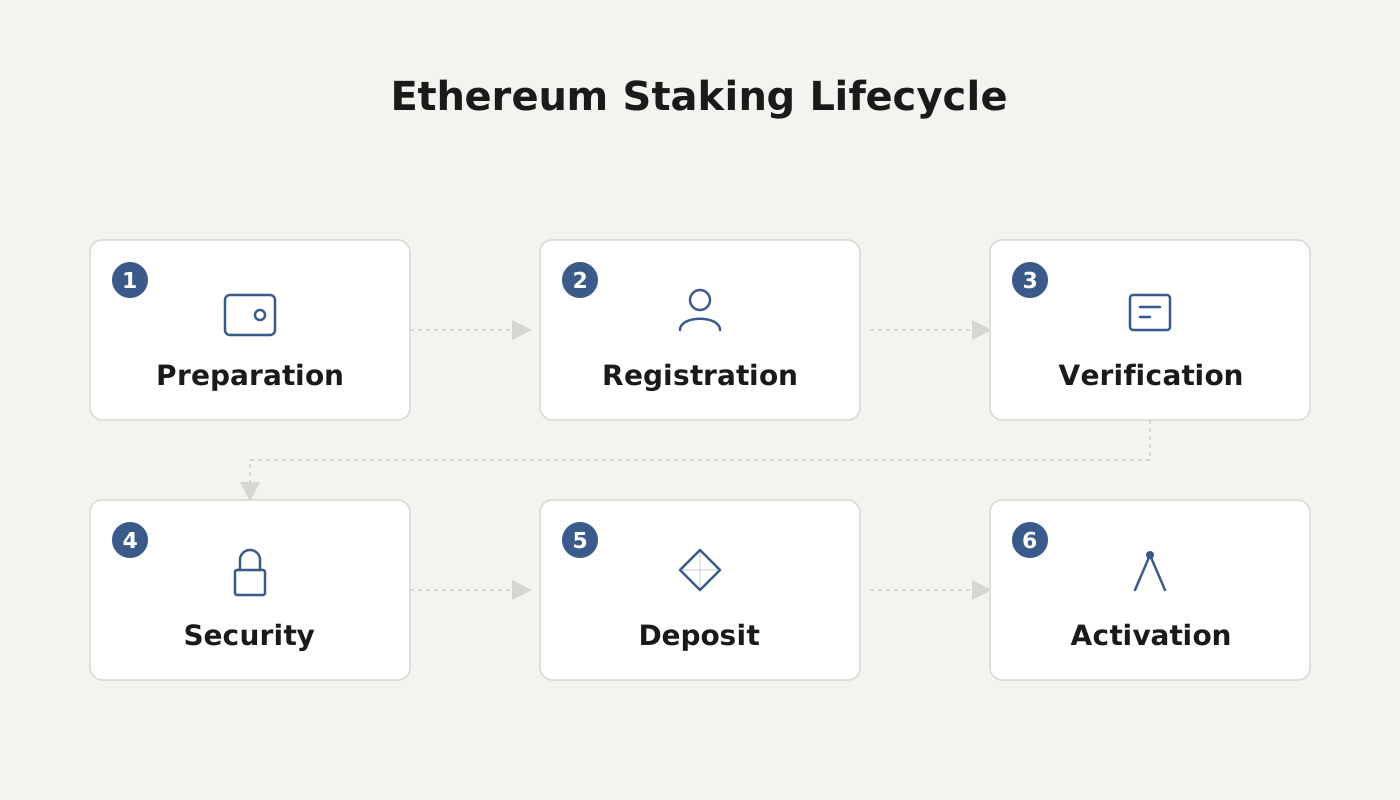
How to pick the right Eth2 staking solution?
- Asset size – Do you have the 32 ETH threshold (approximately USD 10,000 or more via SEPA/SWIFT transfers)? If not, you may need a pooled product that supports smaller deposits.
- Technical readiness – Do you have the experience and time to run a full node and maintain a client?
- Security preference – Do you prioritize full self‑custody of your assets, or are you comfortable delegating custody to a trusted institution?
- Liquidity needs – Do you need the ability to trade or exchange your staked funds freely during the staking period?
Based on these factors, we will introduce four common staking approaches and compare their pros and cons.
---
Non‑custodial cloud services
This model keeps ownership of the assets with the user while bringing in a third‑party node operator to handle the day‑to‑day maintenance of the validator. Each validator node involves two keys:
- Validator key – Imported by the service provider into the node client to sign blocks and perform on‑chain validation.
- Withdrawal key – Held exclusively by the user in a decentralized wallet and used to withdraw the staked principal and rewards.
Advantages
- Assets remain under the user’s control at all times; the provider cannot access the principal or earnings.
- Node status, online rate and reward data are published on‑chain, allowing real‑time monitoring.
- Only a service fee is required; you do not need to purchase hardware or perform complex operations yourself.
Disadvantages
- A custodial‑type fee is still payable; if the provider goes offline or suffers a slash, the user may bear the corresponding penalty.
- Currently limited to full‑size stakes (≥ 32 ETH), making it unsuitable for small‑scale investors.
Typical providers offering this model include InfStones and Staked.us.
---
Staking‑pool solutions based on custodial arrangements
Built on a fully custodial foundation, this approach introduces staking‑pool tokens (ERC‑20) as proof of stake, solving the liquidity problem caused by long‑term ETH lock‑up. After depositing ETH with a custodial entity, users receive an equivalent amount of token (e.g., BETH, stETH, aETH, vETH) that can be freely transferred on the Ethereum mainnet or used in DeFi strategies.
Advantages
- Allows participation with less than 32 ETH, lowering the entry barrier.
- Tokenisation makes the staked asset tradable, improving liquidity.
- Users do not need to worry about node operation; the service provider handles everything.
Disadvantages
- Although multi‑signature wallets or smart contracts reduce centralisation, the assets are still custodied, exposing users to the custodian’s security risk.
- The token’s discount or premium is influenced by market supply‑demand and the provider’s operational health, so users must assess value fluctuations.
- As with fully custodial solutions, transparency around validator uptime and reward rates is limited.
Common staking‑pool tokens on the market today include:
- BETH (Binance – U.S. users should use Binance.US)
- stETH (Lido Network)
- aETH (Ankr)
- vETH (Bifrost)
---
Fully custodial solutions
In this model the user simply transfers the ETH to be staked to a reputable custodial institution, which then takes care of everything from node deployment to monitoring and reward distribution. The custodian charges a percentage‑based service fee, and the user no longer retains direct control over the assets during the staking period.
Advantages
- The simplest workflow; no hardware purchase or technical maintenance required.
- Custodians can aggregate many small accounts, enabling users who do not meet the 32 ETH threshold to stake collectively.
Disadvantages
- Centralised custody means that a breach, hack, or internal mistake at the custodian could jeopardise user funds.
- Users have limited insight into validator uptime, slashing events or other performance metrics.
- Information about whether the assets are truly being used for staking and how rewards are allocated often relies solely on the custodian’s reputation and brand.
Major platforms offering fully custodial staking include Binance, Coinbase, Kraken, and several centralized wallet services. (U.S. residents should access Binance.US rather than the global Binance platform.)
---
Self‑run node solution
This is the most original and technically demanding option. Users download and operate both Eth1 and Eth2 clients, configure a complete validator node, and must have at least 32 ETH as stake along with the necessary hardware. The entire lifecycle—node launch, upkeep, upgrades and fault handling—is managed exclusively by the user.
Advantages
- Full control over both assets and validator, eliminating any third‑party centralisation.
- Aligns perfectly with Eth2’s design goal of decentralised validator participation.
Disadvantages
- Requires substantial hardware, network bandwidth and professional operational expertise.
- If the node goes offline or gets slashed, the user bears all responsibility and any penalties.
- In February 2023, U.S. staking service Staked suffered two large‑scale slashing events that affected nearly 100 validators, illustrating the high technical bar required for self‑run setups.
The official self‑run guide can be found on the Ethereum Launchpad: https://launchpad.ethereum.org.
---
Summary
| Asset size | Technical ability | Recommended solution |
|---|---|---|
| < 32 ETH | — | **Staking‑pool solution** (choose a reputable pool based on token discount/premium and brand) |
| ≥ 32 ETH | Has node‑operation experience | **Self‑run node** (maximum decentralisation) |
| ≥ 32 ETH | No operations experience but values asset ownership | **Non‑custodial cloud service** (balances security and convenience) |
| ≥ 32 ETH | Prioritises convenience above all | **Fully custodial** (ideal for hands‑off users) |
Ethereum 2.0 is still in its early development phase, and the staking market has considerable growth potential. The various options cater to small‑scale investors, technical enthusiasts and institutions that demand high security. When deciding, consider your capital size, technical readiness and risk tolerance to select the staking path that best matches your situation.
For deeper analysis of Eth2 staking, stay tuned to Bitaigen’s upcoming special reports.
Note: Crypto staking rewards may be taxable in your jurisdiction; consult a local tax professional to understand your obligations.
Related Reading
- Ethereum Staking: Validator Rewards & Risk Management
- Ethereum 2.0 Staking: Lock ETH, Earn Rewards & Withdraw
- Ethereum 2.0 Staking Withdrawal After Shanghai Upgrade
💡 Register on Binance with referral code B2345 for the maximum trading fee discount. See Binance complete guide.



