
 Bitaigen Research
 Ethereum ETF Receives Final SEC Approval on July 23 2024, Fees Ranging from 0.19% to 2.5%, Anticipated to Boost Digital‑Asset Market Liquidity
In this article we outline the latest approval process for the Ethereum ETF, its fee structure, and the potential impact on market liquidity. The goal is to help investors quickly capture the key facts, understand the significance of the product, and explore subsequent positioning opportunities. Please continue reading.
Ethereum ETF Latest Progress and Approval Timeline
The U.S. Securities and Exchange Commission (SEC) approved rule change 19b‑4 for eight spot‑Ethereum ETF products in May. Following that, the major issuers filed updated S‑1 registration statements.
ETF Store President Nate Geraci confirmed that the deadline for the revised S‑1 filings was August 8, indicating that the review process is moving forward smoothly. Analysts are broadly optimistic, expecting the ETFs to receive final approval and list within the next week.
According to reports, BlackRock, Franklin Templeton, and VanEck have already received “pre‑approval” from the SEC, suggesting that final clearance is imminent.
Bloomberg ETF analyst Eric Balchunas projects that the S‑1 will be signed after the market close on the following Monday, allowing the Ethereum ETF to begin trading on Tuesday, July 23.
The ETFs are expected to list on mainstream venues such as Nasdaq, the New York Stock Exchange, and the Chicago Board Options Exchange, marking a pivotal step in the integration of crypto assets into the traditional financial system. Matt Hougan estimates that the first 18 months could attract more than $15 billion in inflows, a scale comparable to the early days of the Bitcoin spot‑ETF launch.
Update: International media reported on July 23 that the SEC has given final approval to the latest S‑1 filings for the first nine Ethereum spot ETFs. The inaugural products are slated to open for trading at 9:30 a.m. local time on Tuesday (21:30 Taiwan time). Registration statements for 21Shares, Bitwise, BlackRock, Fidelity, Franklin Templeton, VanEck, and Invesco Galaxy became effective on Monday afternoon, and Grayscale’s Ethereum Trust and its mini‑trust have also completed registration.
Ethereum ETF Fee Overview
Understanding the fee structure is essential before investing in an Ethereum ETF.
- BlackRock enters the market with an annual expense ratio of 0.25%. Fees accrue daily based on net asset value and are settled quarterly. Payment can be made in cash, in kind, or a combination of both.
- BlackRock also indicated that it may waive all or part of the fee during the product’s launch phase to enhance attractiveness.
Below is a summary of the nine publicly disclosed Ethereum spot ETFs (key terms introduced for the first time are bolded):
| Issuer / Fund Name | Ticker | Expense Ratio | Discount / Waiver Conditions |
|---|---|---|---|
| **BlackRock** | ETHA | 0.25% | 0.12% for the first **$2.5 billion** or first 12 months |
| **Fidelity** | FETH | 0.25% | 0% fee for the calendar year 2024 |
| **Bitwise** | ETHW | 0.20% | 0% fee for the first **$500 million** or first 6 months |
| **21Shares** | GETH | 0.21% | 0% fee for the first **$500 million** or first 6 months |
| **VanEck** | ETHV | 0.20% | 0% fee for the first **$1.5 billion** or first 12 months |
| **Invesco × Galaxy** | QETH | 0.25% | No discount |
| **Franklin** | EZET | 0.19% | 0% fee for assets under **$10 billion** or before 31 January 2025 |
| **Grayscale** Ethereum Spot ETF | ETHE | 2.50% | No discount |
| **Grayscale** Ethereum Mini ETF | ETH | 0.25% | 0.12% for the first **$2 billion** or first 12 months |
The table shows that several issuers are offering fee reductions during the launch period, allowing investors to compare products according to their cost preferences.
Potential Impact of the Ethereum ETF and Core Drivers
Matt Hougan, Chief Investment Officer at Bitwise, notes that while the Ethereum ETF faces implementation challenges, its price‑driving potential could exceed that of the Bitcoin ETF for three main reasons:
- Extremely low inflation rate – Daily issuance of new Ether is minimal, creating scarcity that helps stabilize the price.
- Low staking cost – Unlike Bitcoin miners, who must sell a portion of their holdings to cover high electricity bills, Ethereum staking incurs negligible direct expenses, reducing sell‑pressure.
- Large locked‑up supply – Roughly 28 % of Ether is currently staked or otherwise locked, significantly shrinking the circulating supply and fostering a more favorable supply‑demand balance.
Price Outlook: Could Ethereum Reach $5,000 by the End of 2024?
Hougan predicts that if ETF inflows materialize as expected, Ethereum could break the $5,000 level by year‑end 2024, roughly a 47 % increase over the current price of about $3,401.
He also cautions that stronger‑than‑anticipated inflows could push the price even higher. Daan Crypto Trades shares a similarly upbeat view, arguing that the potential capital attracted by the ETFs is currently undervalued.
From a technical perspective, Ethereum is trading above its 200‑day moving average (MA), forming a “top” that suggests a short‑term breakout is possible, especially around the ETF launch dates.
Conversely, anonymous trader Kaleo argues that Ethereum might experience a pull‑back relative to Bitcoin after the ETF debut. Futures positioning data indicates that a 10 % rise to $3,750 would trigger roughly $1.31 billion of short‑covering, whereas a 10 % decline would only liquidate about $544 million of long positions, hinting at a short‑term bias toward correction.
Overall, the crypto market remains highly volatile; technical indicators and expert opinions should be taken as reference points only. Investors are urged to conduct thorough independent research before making any decisions.
Latest Ethereum Price
As of July 23, the spot price of Ethereum stood at $3,444.83, down 0.85 % over the previous 24 hours.
Market capitalization is $418,474,819,608, ranking second among all crypto assets. The 24‑hour trading volume reached $18,959,202,139, and the circulating supply is approximately 120,228,315 ETH.
Ethereum price chart:
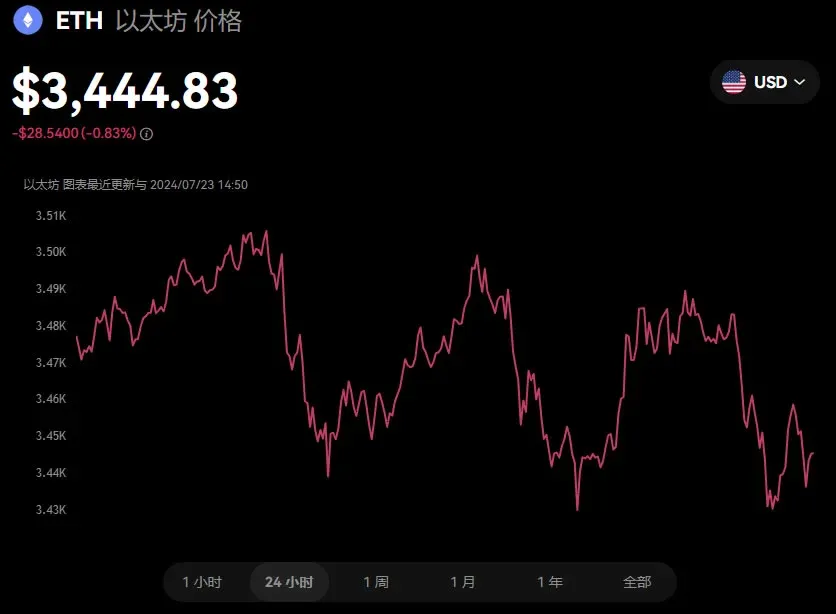
Although the ETF has received approval, the price has not shown a clear upward move in the short term. Market participants should watch for a possible “dip‑then‑rise” pattern similar to what occurred after the initial Bitcoin ETF listings.
---
Note for U.S. investors: Trading on Binance.com is not available in the United States. U.S. residents must use Binance.US or another regulated U.S. exchange for crypto transactions.
Tax reminder: Gains from cryptocurrency transactions may be taxable in your jurisdiction. Consult a tax professional to understand your local reporting obligations.
Related Reading
- What Is an Ethereum ETF? A Simple Guide for Investors
- Spot Ethereum ETFs: Issuers & SEC Approval Steps
- Ethereum ETF Guide: Spot & Futures Funds After SEC Approval
💡 Register on Binance with referral code B2345 for the maximum trading fee discount. See Binance complete guide.
⚠️ Risk Disclaimer: Crypto prices are highly volatile. This is not investment advice.



