
 Bitaigen Research
 In the wake of the U.S. Securities and Exchange Commission (SEC) recently approving several cryptocurrency ETFs, market attention toward an Ethereum ETF continues to rise.
An Ethereum ETF is a fund listed on an exchange that tracks the spot or futures price of Ether (ETH), allowing investors to gain exposure to its price movements without directly holding ETH.

The Bitaigen editorial team systematically interprets the operating mechanics of an Ethereum ETF and its potential impact on the investment ecosystem from three angles—regulatory developments, fund structure, and market reaction—helping readers quickly grasp both opportunities and risks. Continue reading to learn the key points behind the approval of a spot‑ETF.
Ethereum ETF Latest News and Developments
- The U.S. Ethereum spot ETF has recorded a cumulative net inflow of more than $634 million over 11 consecutive days.
- The growth of Ether ETFs aligns with bullish sentiment on ETH, which has posted a 43 % price increase over the past 30 days.
- Data from Sosovalue shows that since May 16, the Ethereum spot ETF has accumulated a net inflow of $78.17 million, bringing its total assets under management to $9.37 billion.
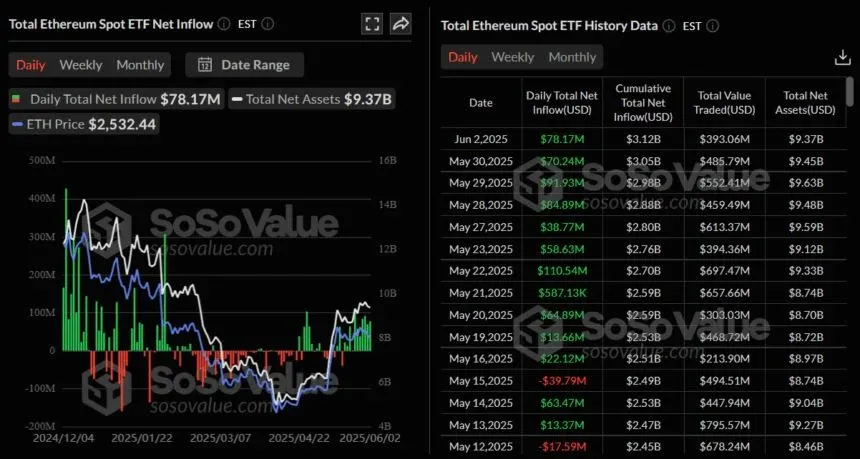
Asset Inflow Overview
| Date | Cumulative Net Inflow (USD) | Total Net Assets (USD bn) |
|---|---|---|
| May 16 | $78.17 million | 9.37 |
| June 2 | — | — |
Since early May, Ethereum has shifted from an oversold condition to a hot‑ticket asset, drawing interest from multiple institutional players. Notably, the well‑known gaming‑marketing firm SharpLink announced plans to allocate $1 billion toward purchasing Ether, providing additional price support.
What Is an Ethereum ETF?
An Ethereum ETF (Exchange‑Traded Fund) is an investment vehicle designed to replicate the performance of Ether (ETH). Like a stock, the ETF trades on a securities exchange and offers several advantages:
- Diversification – A single trade gives exposure to a basket of assets.
- Low Cost – Management fees are typically lower than those of traditional mutual funds.
- Liquidity – Shares can be bought or sold at any time during market hours.
- Transparency – Holdings are disclosed publicly, so investors know exactly what they own.
The majority of Ethereum ETFs achieve price tracking by holding futures contracts, meaning investors do not need to store the digital asset themselves.
Ether ETF vs. Bitcoin ETF
| Comparison Dimension | Ether ETF | Bitcoin ETF |
|---|---|---|
| Benchmark Asset | Ether (ETH) | Bitcoin (BTC) |
| First Listing Date | October 2 2023 | October 19 2021 |
| Trading Volume | Newer entrant, relatively smaller scale | Largest market size, high activity |
| Management Fee | Approximately **0.65 %‑0.95 %** | Approximately **0.65 %‑0.95 %** |
Both product types use futures contracts to mirror price movements, but they differ in underlying asset, launch date, and liquidity profile.
What Is a Spot Ethereum ETF?
A spot ETF physically holds the underlying asset, tracking the real‑time spot price of Ether. Compared with a futures‑based ETF, the spot structure is more straightforward and reduces the complexity for investors who are less familiar with futures contracts.
Potential benefits of a spot ETF include:
- Broadening the Investor Base – Lowers the entry barrier for crypto, attracting traditional investors.
- Reduced Volatility – Consolidated capital can smooth out the impact of single‑position swings.
- Enhanced Liquidity – Injects additional depth into the Ethereum market.
- Facilitating Institutional Adoption – Institutional investors tend to favor compliant spot products.
Has the SEC Approved a Spot Ethereum ETF?
Following the approval of a Bitcoin spot ETF, the market widely expected an Ethereum spot ETF to receive clearance in 2024. Bloomberg ETF analyst Eric Balchunas estimated a ~70 % probability of approval in May and noted that “the spot markets for Ethereum and Bitcoin are tightly linked.”
Multiple asset‑management firms—including BlackRock, VanEck, ARK Invest, 21Shares, Fidelity, and Invesco Galaxy—have filed applications. The SEC is required to render a decision between May 23 and August 7. Ultimately, the Ethereum spot ETF was approved on July 23 2024.
Potential Price Impact of Spot ETF Approval
The launch of a spot ETF is expected to channel broader capital inflows into Ethereum because it offers investors a convenient exposure route. However, the magnitude of price influence will depend on several factors:
- The number and size of ETFs that receive approval
- The intensity of investor demand
- Overall market sentiment
For instance, Grayscale is currently seeking approval for an Ethereum spot ETF and already holds roughly $5 billion worth of ETH (about 2.5 % of circulating supply). If approved, those ETH would be transferred into the fund, further boosting market liquidity.
Currently Tradeable Ethereum ETFs (Futures‑Based)
| Fund Name | Ticker |
|---|---|
| Bitwise Ethereum Strategy Active ETF | AETH |
| Bitwise Bitcoin‑Ethereum Equal‑Weight Strategy Active ETF | BTOP |
| ProShares Ethereum Strategy Active ETF | EETH |
| ProShares Bitcoin‑Ethereum Equal‑Weight Strategy Active ETF | BETE |
| ProShares Bitcoin‑Ethereum Market‑Cap Weighted Strategy Active ETF | BETH |
| VanEck Ethereum Strategy Active ETF | EFUT |
Additionally, starting at 9 p.m. UTC on July 23, spot ETFs from 21Shares, Bitwise, BlackRock, Fidelity, Franklin Templeton, VanEck, and Invesco Galaxy will begin listing and become tradable.
Is an Ethereum ETF Right for You?
- Suitable – Investors who are accustomed to trading stocks and ETFs on traditional broker platforms and who lack experience with crypto wallets. A spot ETF lets them obtain ETH exposure within a familiar trading environment without the need to self‑custody digital assets.
- Not Suitable – Investors who desire 24/7 trading, want to hold and manage ETH directly, or prefer the flexibility of owning the underlying token. ETFs are confined to exchange trading hours, potentially missing portions of crypto market volatility.
Before deciding whether to invest, assess your personal risk tolerance, investment objectives, and liquidity requirements. Please note that cryptocurrency gains may be taxable in your local jurisdiction, so you should consult a tax professional.
*(U.S. investors should access crypto‑related assets through Binance.US rather than the global Binance platform, in compliance with local regulations.)*
---
This article provides a comprehensive answer to “What is an Ethereum ETF? What impact might a spot Ethereum ETF approval have?” For further updates, stay tuned to Bitaigen’s forthcoming reports.
Related Reading
- Ethereum ETF:普通投资者的以太坊敞口新桥梁
- Grayscale Seeks SEC Approval for Spot BNB ETF
- Why Ethereum ETFs Struggle Without a “Digital Gold” Tagline
💡 Register on Binance with referral code B2345 for the maximum trading fee discount. See Binance complete guide.
⚠️ Risk Disclaimer: Crypto prices are highly volatile. This is not investment advice.



