
 Bitaigen Research
 <article>
In this article we outline the technical roadmap of Fabric Protocol, the core functions of the ROBO token, and its potential value in the integration of robotics and blockchain, combined with the current ecosystem layout and governance mechanism to provide readers with an objective investment perspective. If you want to know whether the project can achieve an ecosystem breakthrough in the future, please continue reading.
Key Highlights
- Fabric Protocol (ticker ROBO) runs on Base (EVM‑compatible), with plans to migrate to a self‑developed Layer 1 chain, focusing on deep integration of robotics technology and blockchain.
- The ROBO token can be obtained on multiple exchanges, offering spot trading pairs such as ROBO/USDT and ROBO/ETH.
- The project adopts a “unit proof” mechanism, recording robot contributions on‑chain and distributing rewards to enhance transparency and traceability.
- Through decentralized collaboration, verifiable work records, and on‑chain governance, Fabric Protocol aims to bring fundamental change to the robotics industry.
---
ROBO Token Position and Function
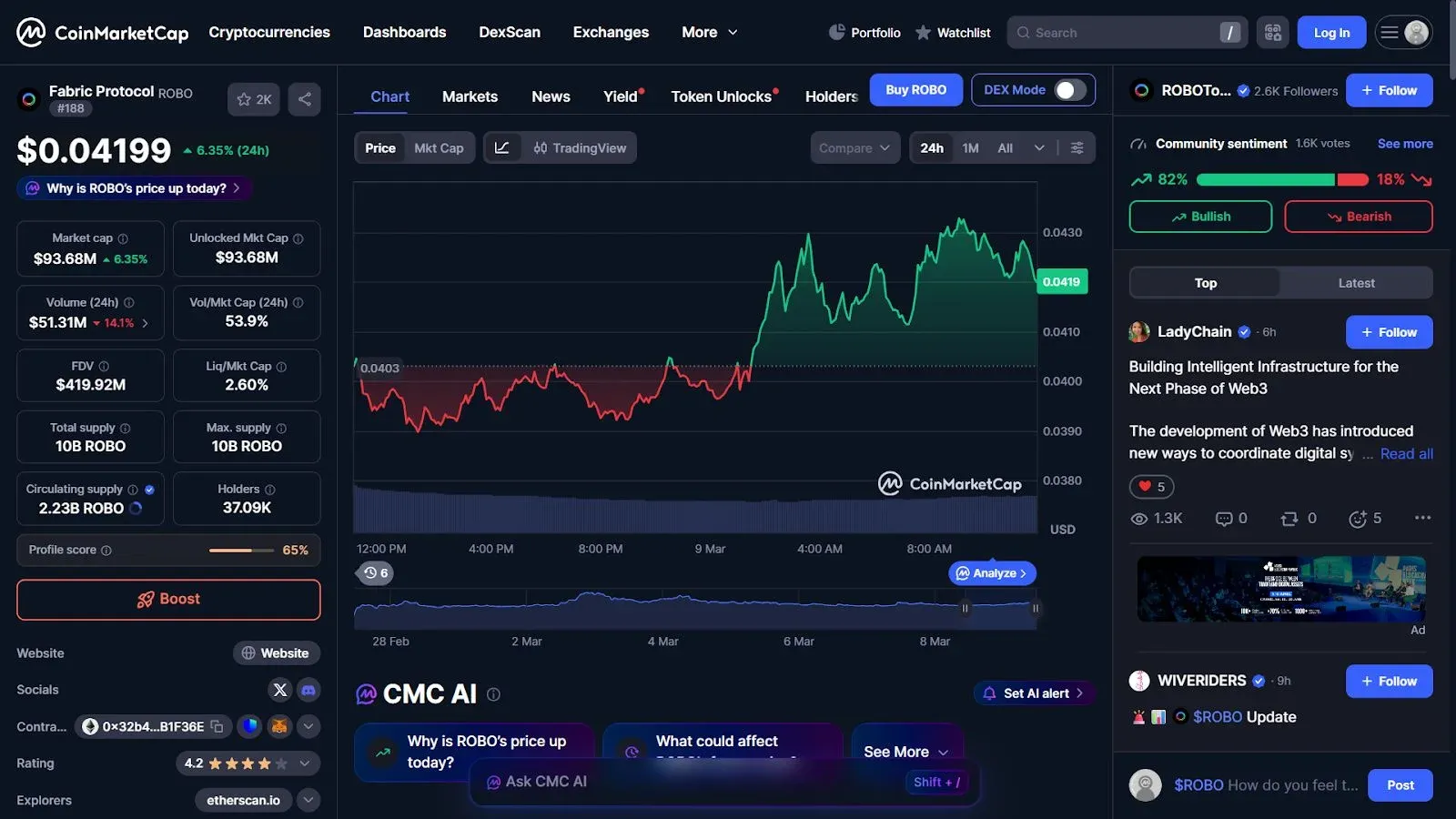
ROBO is the native utility token of Fabric Protocol, serving multiple functions including network fees, staking, governance, and robot work incentives. The total supply is fixed at 10 billion tokens, designed to provide long‑term value support for the ecosystem.
Tokenomics
- Fee payment: When robots perform on‑chain identity verification, data exchange, etc., they pay transaction fees in ROBO.
- Staking collateral: Operators can stake ROBO as task collateral, increasing the credibility of task allocation.
- Governance participation: Token holders vote via veROBO on protocol upgrades and parameter adjustments.
- Task settlement: Completed work earns ROBO rewards through Proof‑of‑Robot‑Work (PoRW), creating an on‑chain closed loop between task and compensation.
Typical Use Cases
- Autonomous delivery: Robots bid for delivery tasks and automatically receive ROBO payment upon completion.
- Industrial automation: Factories post production tasks in token form; robots execute and settle.
- Smart cities: Waste‑handling, surveillance, and other public‑service robots use ROBO to complete and settle tasks.
- Decentralized marketplace: Robots offer services or procure resources on‑chain, using ROBO as the medium of exchange.
- R&D support: Developers use ROBO to access network resources for experimenting with and iterating robot algorithms.
---
Core Working Principles of Fabric Protocol
Fabric Protocol uses a decentralized network to turn robots into independent governance nodes, providing infrastructure for identity registration, task assignment, work verification, and smart‑contract interaction.
Robot Identity and On‑Chain Registration
💡 Register on Binance with referral code B2345 for the maximum trading fee discount. See Binance complete guide.



