
 Bitaigen Research
 We examine Litecoin from three primary perspectives—technical implementation, supply mechanism, and ecosystem—to systematically outline its core design, including the use of the Scrypt mining algorithm, an approximate 2.5‑minute block interval, and relatively low transaction fees. We then combine these observations with broader industry trends to objectively assess its potential role in everyday payments, value storage, and portfolio diversification, as well as the challenges it may encounter. The article also briefly revisits Litecoin’s historical evolution, community governance model, and liquidity performance on major exchanges, providing a panoramic reference. Continue reading to develop a more comprehensive and rational understanding of this “digital silver.”
Litecoin (LTC) Quick Facts
Litecoin (LTC) is a significant asset in the cryptocurrency space. Below is an overview of its basic parameters.
Litecoin (LTC) was created by Charlie Lee in 2011 as a decentralized digital currency that runs on its own blockchain, uses the Scrypt proof‑of‑work algorithm, and targets a block time of roughly 2.5 minutes, delivering fast, low‑cost peer‑to‑peer payments.
- Ticker: LTC
- Chain: Litecoin (independent Layer‑1 blockchain)
- Contract address: N/A (native blockchain coin)
- Circulating supply: ~75,949,000 LTC (June 2025)
- Maximum supply: 84,000,000 LTC
- Primary use‑case: Peer‑to‑peer digital money for quick, inexpensive transactions
- Current market cap: ~US$6.9 billion (June 2025) *(U.S. users should access USD trading pairs via Binance.US rather than the global Binance platform)*
- Availability on Phemex: Yes (traded on Phemex’s spot market)
What Is Litecoin (LTC)?
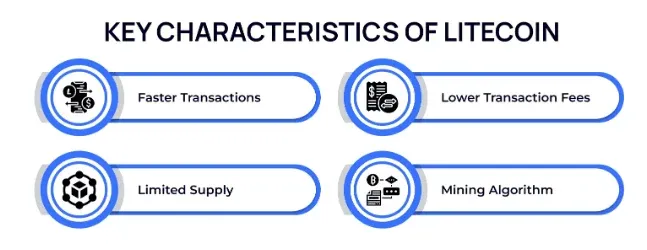
Litecoin (LTC) is a decentralized cryptocurrency launched by Charlie Lee in 2011 with the aim of offering a faster payment solution than Bitcoin. Often dubbed “digital silver,” it runs on an independent blockchain and was one of the first Bitcoin forks. Its block time of only 2.5 minutes enables quicker confirmations and lower fees, making it suitable for everyday transactions.
Litecoin employs the Scrypt mining algorithm to address Bitcoin’s network congestion and high‑fee issues, positioning itself as digital cash within the payment ecosystem. It also serves as a testbed for innovations such as Segregated Witness (SegWit) and privacy extensions, some of which may later be adopted by Bitcoin.
Today, Litecoin is integrated with mainstream payment processors like PayPal and MoneyGram, and it is accepted by a wide range of merchants, reinforcing its role as a reliable medium of exchange.
How Much LTC Exists?
Litecoin’s tokenomics resemble Bitcoin’s, with a hard cap of 84,000,000 LTC. By mid‑2025, roughly 75,000,000 LTC were in circulation, representing about 90 % of the total supply.
- Halving mechanism: Approximately every four years a halving reduces the block reward, controlling inflation. The most recent halving on 2 August 2023 cut the reward from 12.5 LTC to 6.25 LTC, resulting in about 3,600 new LTC per day until the next halving expected in 2027.
- Supply endpoint: The final LTC is projected to be mined around the year 2140.
- Burn mechanism: Litecoin does not implement active token burning; supply remains unchanged unless a holder loses access to their wallet.
A controlled supply schedule prevents arbitrary inflation and is appealing to investors.
What Does LTC Do?
Litecoin’s core function is that of a peer‑to‑peer digital currency, enabling fast and inexpensive value transfer. Its main use‑cases include:
- Everyday payments
- Low fees and short confirmation times make LTC suitable for micro‑transactions. Retailers such as Newegg and several travel booking sites accept LTC.
- Cross‑border transfers and remittances
- Enables cross‑border conversion within an hour and is already integrated with platforms like MoneyGram and PayPal.
- Network fees
- LTC serves as the native fee token for its own network, with transaction costs typically only a few cents (USD).
- Cross‑chain and Lightning Network
- Was among the first to implement atomic swaps with Bitcoin, demonstrating cross‑chain capabilities.
- Supports the Lightning Network for off‑chain instant transactions (though adoption is not as widespread as Bitcoin’s).
- Value storage
- Referred to as “Bitcoin’s silver,” its volatility is generally lower than many altcoins, and it is often viewed as a relatively stable store of value.
In summary, Litecoin focuses on rapid, low‑cost payment functionality. While it does not provide the complex DeFi features of some newer platforms, its dependable value‑transfer service remains valuable in the digital economy.
Litecoin vs. Bitcoin
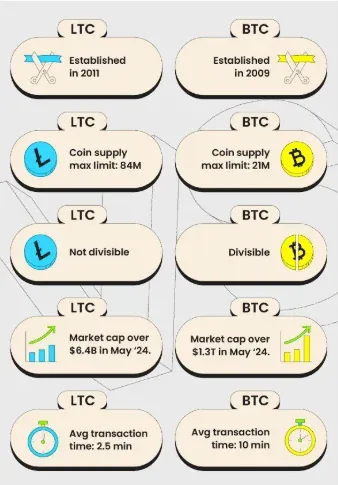
Both Litecoin and Bitcoin are decentralized proof‑of‑work (PoW) cryptocurrencies, yet they differ in several technical and functional aspects:
| Comparison Dimension | Bitcoin (BTC) | Litecoin (LTC) |
|---|---|---|
| **Block time** | ~10 minutes | ~2.5 minutes |
| **Transaction fees** | High (peak > US$30) | Low (a few cents) |
| **Hash algorithm** | SHA‑256 (ASIC‑dominant) | Scrypt (GPU/ASIC compatible) |
| **Maximum supply** | 21,000,000 BTC | 84,000,000 LTC |
| **Halving interval** | Every 210,000 blocks (~4 years) | Every 840,000 blocks (~4 years) |
| **Positioning** | “Digital gold,” store of value | “Digital silver,” everyday payments |
| **Innovation adoption** | Conservative, security‑first | Faster adoption of SegWit, MimbleWimble, etc. |
- Speed & fees: LTC confirmations typically take 5‑15 minutes with fees of only a few cents, whereas Bitcoin may require 30‑60 minutes and substantially higher fees.
- Mining hardware: Bitcoin mining is dominated by ASICs; Litecoin’s Scrypt algorithm also works on GPUs, historically making it more accessible to hobbyist miners and enabling merged mining with Dogecoin.
- Security: Bitcoin’s larger hash rate offers stronger resistance to 51 % attacks. Litecoin’s smaller network has never experienced a successful attack.
- Ecosystem acceptance: Bitcoin enjoys broader institutional and retail adoption, with a market cap roughly 50 times that of LTC. Litecoin is favored in payment‑focused scenarios.
The two coins play complementary roles in the crypto ecosystem, akin to the relationship between gold and silver.
The Technology Behind LTC
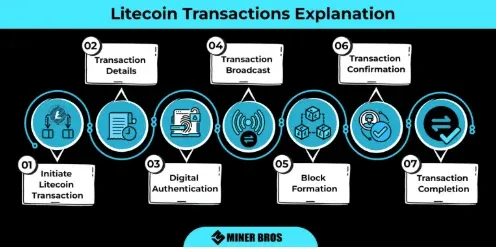
Litecoin builds on Bitcoin’s foundation while incorporating several innovations. Its main technical characteristics are:
- Consensus mechanism: Proof‑of‑Work (PoW) using the Scrypt hash function, compatible with both GPU and ASIC miners. Network difficulty automatically adjusts to maintain an average 2.5‑minute block interval.
- Block size: Up to 4 MB per block; after SegWit activation the network can process roughly 56 transactions per second. In 2023 the chain processed over 67 million transactions cumulatively.
- MimbleWimble Extension Block (MWEB): An optional privacy layer launched in May 2022 that enables confidential transactions while still allowing compliance‑friendly auditing.
- Lightning Network: Full compatibility with the Lightning Network, providing off‑chain, instant, zero‑fee transfers and improving cross‑chain exchange efficiency.
- Infrastructure: Supported by an active community and the Litecoin Foundation, with partners such as Crypto.com and TenX offering debit‑card integrations and other real‑world applications.
- Security: Over a decade of uninterrupted operation, featuring multi‑signature support, hardware‑wallet integration, and other safeguards. Although the development team is relatively small, the codebase is a fork of Bitcoin and can be audited rigorously.
In essence, Litecoin mirrors Bitcoin’s design, adds Scrypt mining, and incorporates privacy extensions like MimbleWimble to create a fast, reliable payment chain.
Team and Origin
Litecoin was founded by Charlie Lee in October 2011, making it one of the earliest “altcoins.” Lee, a former Google engineer, sought to improve Bitcoin’s codebase to achieve faster transactions.
- Network launch: Went live on 13 October 2011 with a fair‑launch approach and no large pre‑mined allocation.
- Subsequent development: While working at Coinbase, Lee continued to promote LTC. In 2017 he sold or donated all of his holdings to avoid conflicts of interest.
- Foundation governance: The Litecoin Foundation, established in 2017, oversees core development and community initiatives. Lee serves as Managing Director, and the foundation funds upgrades and events through donations and strategic partnerships.
To date, Litecoin ranks among the top‑valued cryptocurrencies, with key milestones such as SegWit activation (2017), Lightning Network deployment, and the 2022 MWEB privacy upgrade.
Major News and Events
- October 2011 – Litecoin released, becoming the first successful Bitcoin fork.
- December 2013 – Dogecoin forked from Litecoin, introducing merged mining.
- May 2017 – SegWit activated, improving scalability and paving the way for Lightning.
- December 2017 – Founder sold his LTC holdings, causing market volatility.
- August 2019 – Second halving reduced block reward to 12.5 LTC.
- October 2020 – PayPal added LTC support, boosting mainstream visibility.
- May 2021 – LTC reached an all‑time high of approximately US$413.83.
- May 2022 – MWEB upgrade launched, adding optional privacy features.
- February 2023 – Ordinals protocol enabled LTC NFTs, spurring a new wave of community activity.
- July/August 2023 – Third halving lowered rewards to 6.25 LTC; price hovered around US$110.
- End of 2023 – Transaction volume hit record levels, confirming continued relevance.
These milestones illustrate Litecoin’s full lifecycle—from inception and technical iteration to market fluctuations.
Is LTC a Good Investment?
Disclaimer: The following information does not constitute financial advice. Cryptocurrency investing carries risk; conduct your own research and assess your risk tolerance before committing capital. Additionally, crypto gains may be taxable in your jurisdiction, so consult a tax professional regarding local obligations.
When evaluating Litecoin’s investment potential, consider these dimensions:
- Historical performance
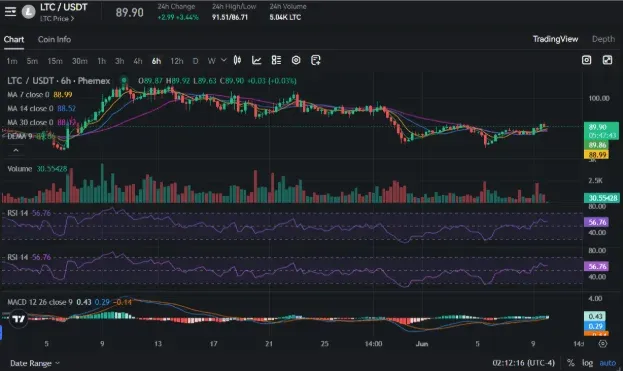
- Over 12 years of operation demonstrate resilience. The all‑time peak of roughly US$413 in May 2021 and a subsequent pullback by mid‑2025 suggest possible upside.
- Utility and adoption
- Broad merchant and payment‑processor integration creates genuine demand. Record transaction volumes in 2023 indicate sustained growth in everyday payment use‑cases.
- Community and development
- A loyal community exists, though it is smaller than Bitcoin’s or Ethereum’s. Development momentum slowed after the 2022 MWEB rollout, which could affect future competitiveness.
- Competitive landscape
- Faces competition from payment‑focused projects like XRP, Stellar, and stablecoins. Its strengths lie in decentralization and a capped supply, but it remains less dominant as a store of value compared with Bitcoin.
- Liquidity
- Highly liquid on platforms such as Phemex, offering tight spreads suitable for both retail and institutional traders.
- Risk factors
- Price volatility can exceed 80 % in bear markets. Regulatory risk is modest, though privacy‑enhancing features like MWEB may encounter restrictions in certain jurisdictions.
Overall assessment: Litecoin’s solid market positioning, payment‑centric functionality, and limited supply attract investors seeking a Bitcoin alternative. Its potential returns are generally more moderate than those of newer, higher‑risk altcoins, but it also offers a higher degree of maturity and stability. Whether it fits your portfolio depends on personal risk appetite, investment objectives, and your view of the future of digital payments.
This completes the comprehensive analysis titled “What Is Litecoin (LTC)? Supply, Technical Foundations, and Investment Outlook.” For deeper insights, explore additional articles on Bitaigen (比特根).
Related Reading
- Reef Finance Analysis: Tech, Governance & REEF Token Outlook
- Litecoin (LTC) Price Sep 2025 - Leading Crypto Payment Method
- Litecoin Price Decline: Key Drivers & Future Outlook
💡 Register on Binance with referral code B2345 for the maximum trading fee discount. See Binance complete guide.



