
 Bitaigen Research
This article is written by the Bitaigen editorial team, focusing on PACT’s innovative mechanisms on Aptos, its ecosystem layout, and potential risks, to help you comprehensively assess its investment value. We will analyze the technical principles, market sentiment, and future development trends, assisting you in making a more rational judgment. Please continue reading.
Pact (PACT) Current Price
Pact (PACT) is currently priced at $0.0000822, with a 24‑hour trading volume of $1.06 M, a market capitalization of approximately $1.79 M, and a market share of 0.00067 %. Over the past 24 hours the price has moved ‑5.95 %.
PACT Price Data
- 24 h volume: $1.06 M
- All‑time high: $0.00153
- 24 h high: $0.0001095
- All‑time low: $0.0001293
- 24 h low: $0.0000748
PACT Market‑Cap Information
- Market cap: $1.79 M
- Fully‑diluted market cap: $16.92 M
- Market‑cap share: 10.6 %
- Market sentiment: Neutral
PACT Supply Figures
- Circulating supply: 13.25 B PACT
- Total supply: 125 B PACT
- Maximum supply: 125 B PACT
What Is the PACT Token?
PACT is a permissioned on‑chain credit protocol built on the Aptos blockchain. By tokenizing real‑world private‑credit assets such as loans, credit lines, and fund shares, it aims to facilitate cross‑border lending. The protocol embeds the entire credit lifecycle (origination, maintenance, settlement) directly onto the blockchain, intending to create a global, transparent, and efficient private‑credit market.
The PACT Foundation operates as a decentralized micro‑finance organization, with the goal of expanding global credit access, especially in emerging markets. The project cites World Bank data—about 50 % of adults worldwide lack formal credit channels—and offers a technology‑driven solution that enables individuals with internet and mobile phone access to obtain credit services.
Overview
PACT, as a Real‑World Asset (RWA) protocol, uses blockchain technology to make traditionally illiquid credit assets transferable and composable like native digital assets. The system standardizes the digital representation of loans, tracks ownership, and provides a global market for asset‑backed lending and credit‑fund management. The architecture is designed for high‑frequency, small‑ticket loans, helping to lower capital costs and improve credit accessibility.
Target customers include fintech lenders, asset‑management firms, and traditional financial institutions, offering them an end‑to‑end, programmable credit infrastructure covering loan origination, servicing, repayment, and settlement in stablecoins. By moving these processes on‑chain, PACT aims to achieve compliance automation, reduce administrative overhead, and increase transparency.
The ecosystem is underpinned by a governance model centered on the PACT token, while a consortium of institutional partners supplies custodial, compliance, and capital‑provision frameworks, helping partners obtain larger financing opportunities and manage risk effectively.
History
Although the official founding date of the project has not been disclosed, key milestones include expansion into mainstream crypto markets. In October 2025, the PACT Foundation announced that its native token would be listed on several centralized exchanges. Subsequently, on 26 February 2026, PACT launched trading on Kraken, MEXC, and Gate.io, markedly improving token liquidity and accessibility.
By early 2026, the protocol had originated over $19 billion in on‑chain loans, processing more than 2,000 loans per day on average. Its Software Development Kit (SDK) has been used to create hundreds of thousands of embedded user wallets.
How Does It Work?
PACT is built on the Aptos blockchain and provides an on‑chain credit and payment protocol that handles loan disbursement, servicing, repayment, covenants, and stable‑coin settlement entirely on‑chain. Unlike RWA projects that merely tokenize off‑chain loans, PACT embeds credit logic directly into smart contracts, enabling the following automated processes:
- Loan disbursement and repayment tracking
- Cross‑border payments using stablecoins
- Risk control for embedded loan contracts
- High‑frequency, small‑ticket loan processing
The protocol discloses that, through fintech partners, it has already issued more than $19 billion in on‑chain loans, supporting thousands of daily transactions.
Role of the $PACT Token
$PACT serves as the protocol’s governance and coordination asset, with primary functions that include:
- Voting within the PACT DAO
- Submitting and implementing upgrade proposals
- Aligning incentives through staking
- Allocating ecosystem rewards
Holders can stake their tokens to participate in governance while also contributing resources to network security. Governance tokens are commonly used for community decision‑making in DeFi.
Technology and Protocol Architecture
PACT selects the Aptos blockchain for its low latency and high throughput, which support real‑time cross‑border stablecoin flow and high‑frequency micro‑loan origination. The core architecture enables fully automated credit‑line creation, risk management, and settlement pipelines.
Core Services
Loan Tokenization
Each individual loan is converted into a unique, transferable digital token on the blockchain that records ownership and terms, acting as a digital key to access off‑chain private‑loan data.
Credit‑Line Tokenization
Smart contracts generate self‑executing credit bases that realize programmable credit lines, automatically enforcing predefined terms, covenants, and accounting rules, thereby significantly reducing operating costs and risk.
Fund Tokenization
The protocol supports tokenized shares or units of credit funds, helping fund managers raise capital from a global investor pool, automatically executing complex distribution waterfalls and generating compliance reports. Limited partners can view holdings and fund reports via white‑label portals.
Security
PACT has undergone a formal security audit, and its decentralized governance structure has been independently audited, with the audit reports made public.
PACT: Staking Mechanism and vePACT
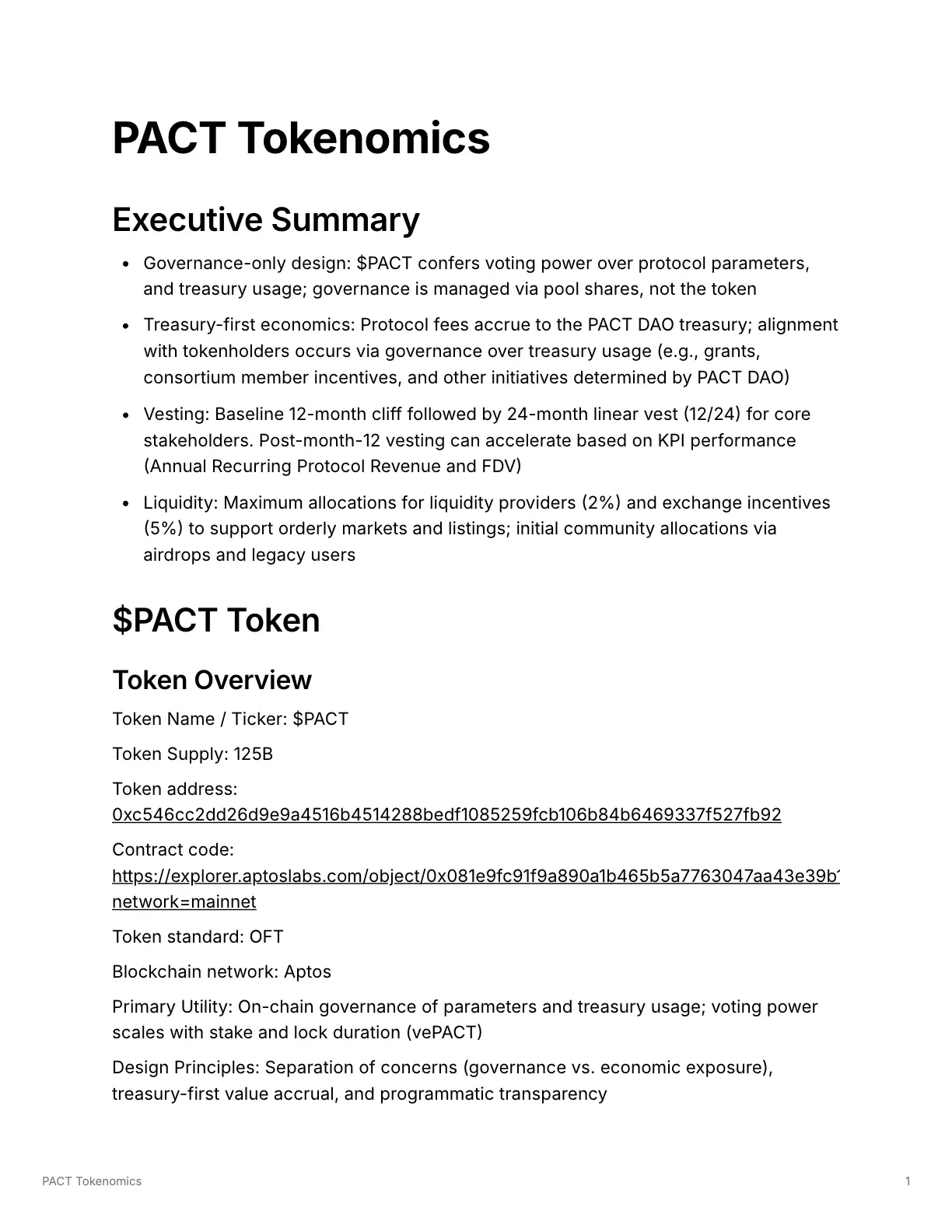
The ecosystem operates around a sophisticated staking contract. Users delegate PACT tokens and receive a non‑transferable synthetic token called vePACT. vePACT represents a user’s stake in the network; the lock‑up period can be as long as 12 months, during which value accrues gradually. Current governance proposals suggest that the issuance rate can increase by roughly 8 % per month based on lock‑up duration. To prevent sudden liquidity exits, the protocol imposes a mandatory 30‑day cooldown for users who wish to unstake.
Governance Tools and vePACT Functionality
vePACT acts as the primary instrument for decentralized decision‑making, granting holders voting rights over protocol upgrades and fee structures. Unlike passive‑holding models, vePACT allows users to claim a portion of protocol fees as a reward for active participation; fee distribution is proportional to vePACT balances and must be manually triggered by holders to ensure transparency and compliance. The governance framework also enables the community to vote on specific allocations of treasury funds for research, incentives, and other purposes.
Ecosystem Incentives and Network Growth
The PACT Foundation’s reward structure is linked to protocol usage metrics and fee revenue, avoiding speculative inflation. After migrating to Aptos, the protocol benefits from higher scalability, achieving low‑cost securitization of assets worldwide. Reward information is displayed publicly on the protocol dashboard, with a focus on contributors who provide liquidity or facilitate high‑volume credit transactions. The redesigned DAO architecture keeps key token‑economic parameters flexible, allowing rapid response to market changes.
PACT Token ($PACT)
The PACT token is the native utility and governance asset of the ecosystem, launched on 26 February 2026 on Kraken, MEXC, and Gate.io. Its main functions are:
- Governance: As the native governance asset of the PACT DAO, holders can propose, vote, and drive protocol upgrades.
- Ecosystem Utility: Used for staking to enhance network security, coordinate incentive mechanisms, and allocate protocol revenue and treasury resources.
Ecosystem and Products
PACT has released several native products to meet the diverse needs of developers, fund managers, and other participants:
- KREDU × OPERA MINIPAY: A loan aggregation platform that allows users with Web3 wallets to access unsecured credit products.
- WALLET SDK: Enables third‑party developers to embed PACT’s loan and tokenization features into their web and mobile applications.
- ANALYTICS API: Provides advanced analytics data on loan portfolios and fund performance.
- PACTLabs Dashboard: Offers enterprises and fund managers a centralized interface to manage assets and monitor activity.
These products demonstrate the protocol’s practicality for on‑chain loan origination and financial‑tool management.
Governance and Partnerships
PACT’s governance relies on community proposals, token‑staking votes, and forum discussions. The overall framework has passed an independent security audit.
PACT Consortium
The consortium consists of institutional partners that provide compliance and capital frameworks, helping partners collaborate on credit solutions, pool financing resources, and jointly manage risk. Major members include:
- Custody & Banking: BitGo handles institutional‑level digital‑asset custody.
- Settlement & Payment Agency: Brassica (a BitGo subsidiary) acts as the secondary‑market payment and settlement agent, ensuring compliance.
- Capital Providers: BSFG collaborates with PACT to build financing tools; Tiberia, a SEC‑registered investment adviser, guides U.S. capital into emerging‑market credit.
- Payment Infrastructure: Tether (USDT) supplies cross‑border stablecoin payment channels.
- Lending Partners: KREDU and BSFG are core loan providers.
Why Does Exchange Listing Matter?
Support from exchanges such as Kraken, MEXC, and Gate.io improves token accessibility, bringing:
- Higher liquidity
- Easier price discovery
- Broader geographic coverage
- Integration with existing trading ecosystems
Listing does not alter the underlying protocol but helps expand the user base and strengthen market infrastructure.
Connection to Stablecoin Finance
PACT’s infrastructure is designed specifically for stablecoin‑based credit systems. Stablecoins are pegged to fiat currencies and are widely used in crypto trading and DeFi. By integrating loan issuance, repayment, and settlement directly on‑chain with stablecoins, PACT aims to reduce friction in cross‑border credit and automate the intermediary‑heavy steps of traditional finance.
Partner Comments
- KREDU CEO Wesley Caddell: “Partnering with PACT helps us reach more users through smarter credit solutions.”
- BSFG Co‑Founder & CEO PC Chitalkar: “The PACT consortium enables us to work with leading institutions, take on larger financing opportunities, and manage risk effectively.”
PACT: Rebuilding the Global Credit Market with On‑Chain Infrastructure
PACT is now listed on platforms such as MEXC, Gate.io, and Kraken. The global credit market exceeds $300 trillion, yet it still relies on traditional intermediaries, resulting in slow capital flow, high costs, and limited access to affordable credit for many people.
Through blockchain and stablecoins, PACT embeds loan logic, ownership, contractual terms, repayment mechanisms, and distribution waterfalls entirely on‑chain, delivering programmable financial solutions. Its advantages include:
- Lower capital costs
- Real‑time access to global capital liquidity
- Inclusive financial channels for underserved populations
To date, PACT has achieved:
- > $19 billion in cumulative on‑chain loans issued
- > $6 billion in active loan volume
- Over 1 million wallets created
- Approximately 22 million on‑chain transactions
- Ranked as the top risk‑weighted asset issuer on the Aptos platform
Strategic Roadmap
PACT treats credit as a “Trojan horse” for entering on‑chain finance. Future plans are divided into three stages:
- Use credit as the entry point to cultivate stablecoin usage habits.
- Expand into savings, payments, and other core financial services.
- Build a complete on‑chain banking ecosystem.
Price Outlook
2026‑2032 Forecast Overview
- The 2026 average price is projected between $0.000013‑$0.000083.
- From 2027 to 2032, the price range is expected to be $0.00003‑$0.000356, with the upper bound potentially delivering substantial growth relative to today’s level by 2029.
2032‑2037 Forecast Overview
- The projected range is $0.000243‑$0.004744; reaching the upper bound would represent a marked increase compared with the current price. These forecasts are for reference only and do not constitute investment advice.
Frequently Asked Questions
What is the difference between PACT and vePACT?
PACT is the native utility token used for governance and staking; vePACT is a non‑transferable synthetic token received by staking PACT, representing voting power and reward allocation.
How long does it take to unstake?
The protocol requires a 30‑day cooldown before the fully staked PACT can be withdrawn.
Does vePACT guarantee returns?
The protocol does not guarantee passive returns; rewards stem from active governance participation and the distribution of protocol fees.
Why migrate from Celo to Aptos?
The migration targets Aptos’s faster transaction speeds and lower costs, which better serve high‑volume micro‑finance lending needs.
How can I participate in the Pact Foundation’s governance?
Stake PACT to obtain vePACT, then you can vote on fee structures, upgrades, and ecosystem proposals.
Supported Exchanges
1. Binance (not yet listed)
- Referral code: `B2345` (register to enjoy a permanent 20 % fee discount)
- Binance official website
Note for U.S. users: Binance.US should be used instead of the global Binance platform.
2. Huobi
- Referral code: `b6yq8223` (same discount)
- Huobi official website
3. OKX (not yet listed)
- Referral code: `B2345` (same discount)
- OKX official website
4. Gate.io
- Referral code: `VLIWUGTFAA` (same discount)
- Refer to the Gate.io website and app download links on the platform page
5. Bitget
- Referral code: `vxje` (same discount)
- Bitget official website
6. Bybit
- Referral code: `B2345` (same discount)
- Bybit official website
Official Referral Codes (minimum 20 % fee discount)
Conclusion
Tokenomics 2.0 positions PACT as the foundational layer for decentralized micro‑finance on the Aptos network. By leveraging the vePACT model to incentivize long‑term commitment, the foundation cur
💡 Register on Binance with referral code B2345 for the maximum trading fee discount. See Binance complete guide.



