 Bitaigen Research
 Perpetual futures short‑term trading relies on five core strategies: a no‑expiry mechanism, funding‑rate arbitrage, dynamic leverage, order‑book verification, and volatility‑calibrated stop‑loss/take‑profit. The detailed execution points include millisecond‑level matching, maker‑only orders, 5–15 minute cycles, positioning around funding‑rate settlements, 3–5× leverage, Level 2 market‑depth monitoring, and ATR‑based dynamic exits.
In this article we systematically outline the core mechanics of perpetual contracts and the key short‑term operational considerations. The goal is to help traders harness the no‑expiry feature, funding‑rate windows, and dynamic‑leverage tactics, thereby improving the precision and efficiency of strategy execution. The piece includes practical case studies for reference, enabling you to navigate high‑volatility environments with greater composure.
The No‑Expiry Mechanism of Perpetual Contracts Fits the Short‑Term Rhythm
Perpetual contracts have no fixed settlement date, allowing positions to be opened and closed at any time. This eliminates the slippage and capital‑allocation disturbances associated with expiry roll‑overs, making the instrument naturally suited to high‑frequency, short‑duration trading.
- Choose a trading platform that supports millisecond‑level order matching, ensuring that orders can be inserted deep into the order book instantly.
- Enable the platform’s “maker‑only” mode to avoid taking liquidity and suffering slippage that erodes tiny profit margins.
- Strictly limit the trading horizon to the 5‑minute to 15‑minute candlestick window, thereby sidestepping the impact of overnight funding‑rate settlements.
Funding‑Rate Windows Form Short‑Term Arbitrage Nodes
Funding rates are settled every eight hours. When long and short forces become imbalanced, a noticeable rate deviation emerges. The 30 minutes surrounding each settlement often exhibit price‑reversion volatility, providing a quantifiable entry signal.
- Fifteen minutes before the next funding settlement, check both the sign and magnitude of the rate: if the rate > 0.01 % and positive, long positions are at a premium and short positions can be deployed opportunistically.
- After settlement, if the first candlestick shows a long upper shadow or long lower shadow together with a surge in volume, this condition triggers a reverse short‑term opportunity.
- Use the platform’s built‑in funding‑rate history chart to locate three consecutive rounds of rates moving in the same direction. During this phase the price‑anchoring effect weakens and the probability of heightened volatility rises to 73.6 %.
Leverage Must Be Dynamically Linked to Position Duration
The shorter the holding period, the lower the leverage should be; excessive leverage can cause a forced liquidation from a tiny adverse price move, depriving you of a chance to re‑enter.
- For 5‑minute‑scale trades, adopt a uniform 3–5× leverage to ensure that a price reversal of < 1.5 % does not breach the liquidation threshold.
- When a single trade’s profit reaches 8 % of the margin, manually reduce leverage to 2×, locking in floating gains and extending the position’s error‑tolerance window.
- Activate the exchange’s “auto‑leverage adjustment” switch and tick “reduce leverage after 120 seconds of holding” to avoid forgetting the manual step.
Order‑Book Microstructure Provides Real‑Time Liquidity Validation
Short‑term trading depends on instantaneous fills; the depth and thickness of the bid/ask ladders directly determine entry and exit quality. Therefore you must monitor Level 2 data continuously rather than rely solely on the mid‑price.
- Before opening a position, verify that the quantity at the best bid and best ask each equals at least 200 times the contract’s minimum order size; otherwise skip the signal.
- If the best‑bid level experiences three or more consecutive cancellations, each ≥ 500 contracts, it indicates a large order probing liquidity—avoid chasing the move.
- Employ the platform’s “order‑book heat‑map” to pinpoint the price band that received the densest new order flow in the past 60 seconds; this band serves as the strongest short‑term support or resistance zone.
Profit‑Taking and Stop‑Loss Must Be Calibrated to Volatility, Not Fixed Pips
Crypto market volatility is far from constant. Fixed‑point profit‑taking and stop‑loss levels can be swept away during high‑volatility bursts and cause premature exits during calm periods. Using the Average True Range (ATR) as a dynamic benchmark is recommended.
- Retrieve the current contract’s 14‑period ATR value and set the stop‑loss at 1.0 × ATR and the take‑profit at 2.5 × ATR.
- When price breaks the high of the previous candlestick and volume reaches 180 % of its average, move the stop‑loss up to the median price of that candlestick.
- If two consecutive candlesticks each have a body length < 0.3 × ATR, pause all new entry orders and allow only exit orders.
What Is a Perpetual Futures Contract?
A perpetual futures contract is a derivative instrument that lets users take long or short exposure to an underlying asset (e.g., BTC, ETH) without actually owning the asset itself.
Perpetual Futures vs. Traditional Futures
| Feature | Perpetual Futures | Traditional Futures |
|---------|-------------------|---------------------|
| Expiration date | None | Exists (e.g., quarterly delivery) |
| Price anchoring method | Funding‑rate mechanism | Delivery price |
| Market behavior | Funding‑rate mechanism | Automatic settlement or liquidation at expiry |
| Time limitation | Close at any moment | Forced settlement at expiry |
| Typical use cases | High‑frequency trading, shorting, arbitrage, speculation, hedging, institutional hedging | Speculation, hedging, institutional hedging |
Because perpetual contracts have no fixed term, their trading style resembles spot markets while still offering leverage and two‑way exposure, a combination that enjoys broad popularity among both institutions and retail participants.
Operational Logic of Perpetual Futures: Three Core Mechanisms
Unlimited Holding Period: Flexible Design Without a Delivery Date
Unlike traditional futures, perpetual contracts lack a predetermined delivery date. This means you can adjust the holding period to match your personal strategy and market conditions, avoiding forced liquidation due to an approaching expiry and giving your strategy continuity.
Settlement Mechanism: How Is Profit and Loss Calculated?
Perpetual contracts usually employ a Mark Price to assess unrealized profit and loss (PnL), rather than the real‑time last trade price, to protect against market manipulation and inadvertent liquidations.
- Mark Price: Calculated from a weighted index of several spot markets, providing a price that closely reflects the true market value.
*Example: BTC spot prices on three exchanges are 30,000 USD, 30,100 USD, and 29,950 USD. The system computes a weighted average of 30,017 USD, which becomes the Mark Price.*
- Floating PnL: The unrealized profit or loss of an open position based on the Mark Price.
*Example: You go long 1 ETH contract at 3,000 USD. If the current Mark Price is 3,500 USD, the floating profit equals (3,500 – 3,000) × 1 = 500 USD.*
- Forced Liquidation: If losses deplete your margin below the required maintenance level, the system automatically closes the position to prevent a negative balance.
*Example: Your margin balance is 200 USD, and the position has already lost 300 USD. The platform will liquidate the position to avoid debt.*
Funding‑Rate Mechanism: Why Perpetual Prices Stay Close to Spot
To keep perpetual contract prices from drifting far away from the underlying spot market, a Funding Rate is introduced. This rate forces long and short participants to pay each other, nudging the contract price back toward the spot index.
How Funding Rates Work
- Positive funding rate: Long side pays the short side.
- Negative funding rate: Short side pays the long side.
- Settled every eight hours; the exchange itself does not charge a fee—only the two sides settle with each other.
*Illustrative example*: If the funding rate is +0.01 % and you hold a 1,000 USD long position, you will owe 0.1 USD (1,000 × 0.01 %) to the short side at the next settlement. Closing the position before the settlement eliminates the payment.
Why Funding Rates Matter to Traders
- Short positions can generate income when the rate is positive.
- Long‑term holdings must account for funding‑rate costs as part of the total expense.
- High‑frequency or short‑term strategies are only marginally affected by funding payments because the exposure window is brief.
Major Domestic Exchange Apps – Official Websites + Download Links
- OKX: Referral code B2345 – `Official registration` `Official download`
- Binance: Referral code B2345 – `Official registration` `Official download` (U.S. users must use Binance.US; the global Binance platform is not available in the United States)
- Huobi: Referral code b6yq8223 – `Official registration` `Official download`
- Bitget: Referral code vxje – `Official registration` `Official download`
- Gate.io (Sesame Open Door): Referral code A1lBAVFW – `Official registration` `Official download`
- Bybit: Referral code 88946 – `Official registration` `Official download`
Note: When moving fiat into or out of these platforms, use USD transfers via SEPA, SWIFT, or local bank wires as supported.
Step‑by‑Step Guide to Installing, Registering, and Using Crypto Exchanges
- How long does it take to start trading after opening an OKX account in 2026? Safety overview, download/registration, buying, withdrawing – a full tutorial.
- How to download Binance on an iPhone in Mainland China? Binance download, registration, fund‑in/fund‑out, buying and selling tutorial. (U.S. residents should use Binance.US.)
- 2026 latest Huobi HTX (formerly Huobi) official app download and installation guide for Android and iOS.
- Can Bitget be used in China? Does Bitget support Mainland Chinese users for download and registration?
- How to register on Gate.io? Gate.io download and registration tutorial (2026 edition).
- Bybit beginner’s full guide (2026): registration, verification, deposit, and detailed steps to purchase Bitcoin.
Conducting Contract Trading on an Exchange
First, transfer your fiat‑backed stablecoin (USDT) to the dedicated contract wallet. The naming of contract wallets varies across platforms but is generally intuitive.
| Exchange | Spot‑wallet Name | Contract‑wallet Name |
|----------|------------------|----------------------|
| Binance | Funding wallet | Futures wallet |
| OKX | Funding wallet | Trading wallet |
| Huobi | Fiat‑spot wallet | Derivatives wallet |
OKX Contract‑Trading Workflow
The steps below illustrate contract trading on OKX; other exchanges follow a similar pattern.
- Switch to the Perpetual Futures tab. The first click on “Trade” may take you to the spot page; click “Trade” again and select “Perpetual” to reach the futures interface.
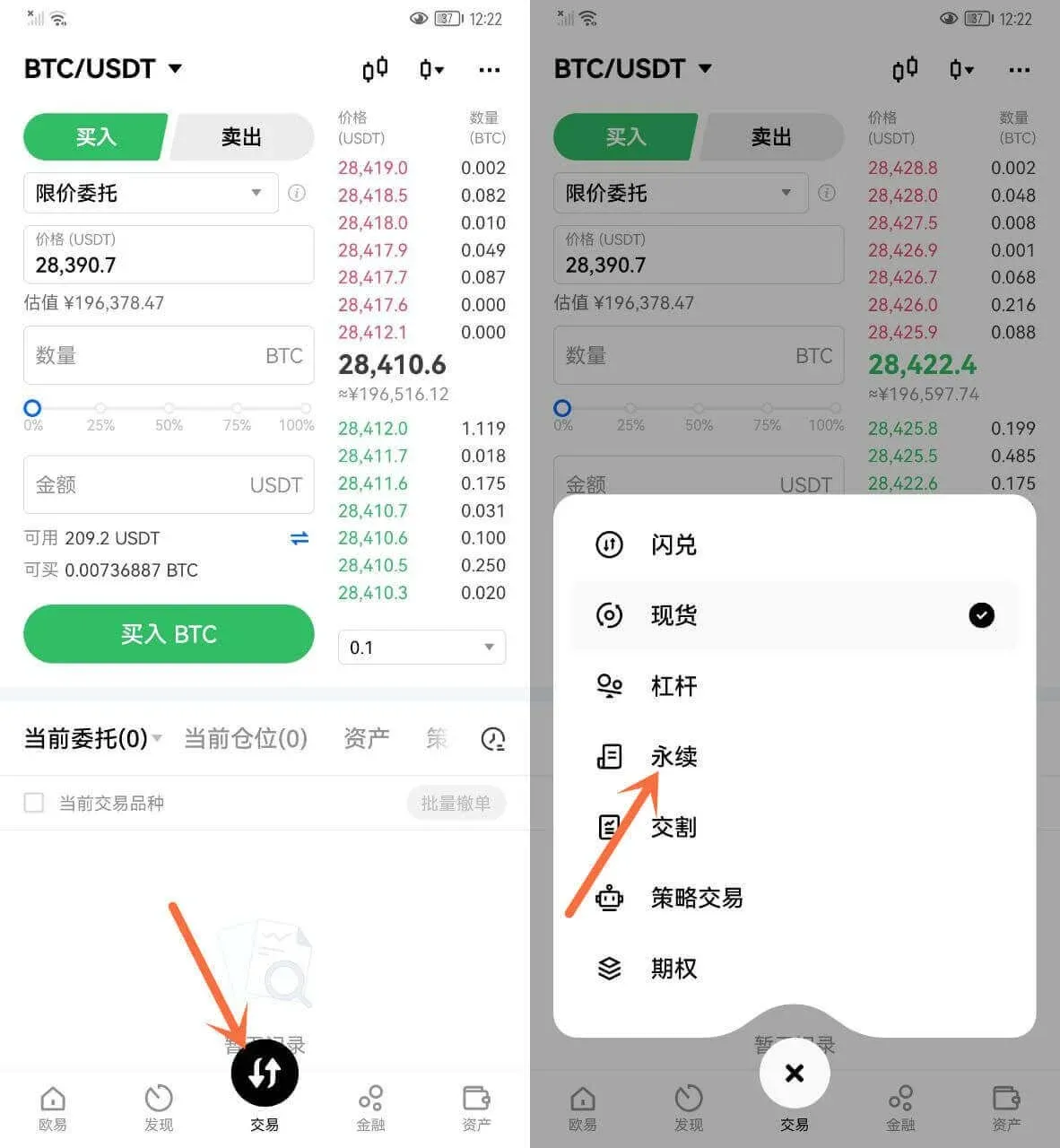
- On the perpetual‑trading screen you will see the BTC/USDT perpetual contract (U‑denominated). If you see BTC/USD, it is a coin‑denominated contract. You can search for other crypto perpetuals as needed. This tutorial uses the Bitcoin U‑denominated perpetual as an example, demonstrating a 20× long on 0.01 BTC.
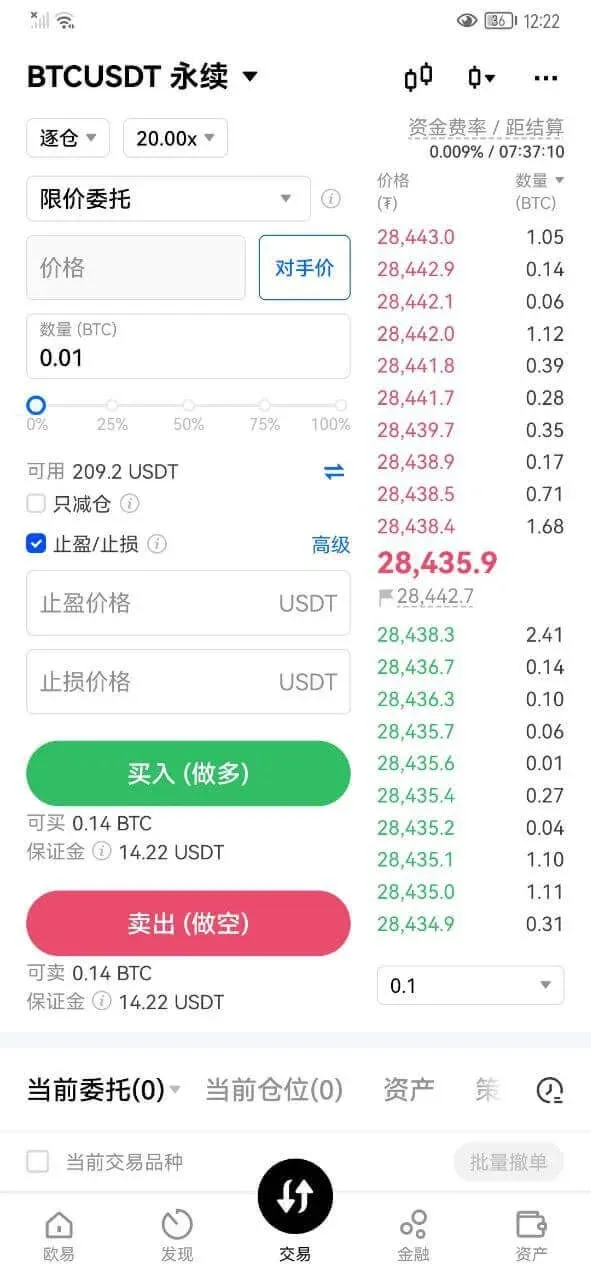
- The default order type is a limit order. With the current price at 28,435 U, setting a limit at 28,000 U will only execute if the market price falls to that level; you can cancel at any time before execution. Clicking “Counterprice” sends the order at the best available opposite price, which is essentially the current market price. After placing a limit order you can switch to advanced limit, market, or stop‑loss/take‑profit modes by clicking the exclamation‑mark “¡” next to the order‑type selector for a detailed explanation.
- In this example we use a limit‑order‑counterprice with isolated margin mode, 20× leverage, buying 0.01 BTC. The required margin is roughly 14.21 U. A 5 % rise in Bitcoin would double the margin; a 5 % drop would trigger liquidation (fees excluded).
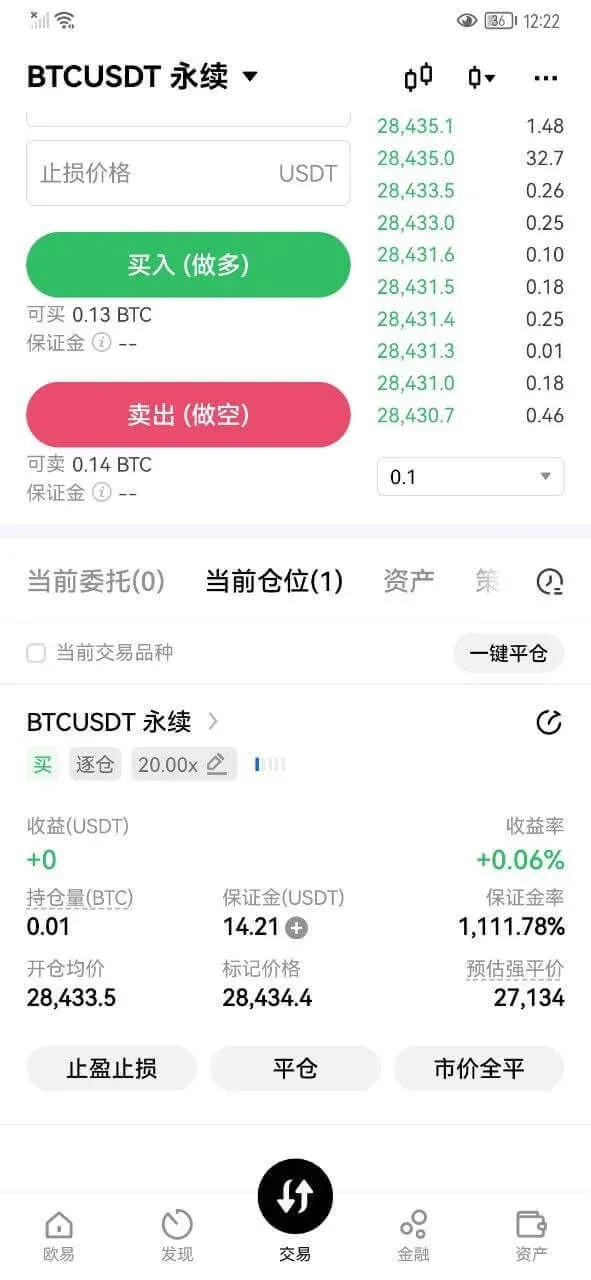
- Closing the position. After opening, you may close at any time regardless of profit or loss. Common closing methods include:
- One‑click close: When you hold multiple positions (e.g., BTC and ETH), a single click liquidates all at market price.
- Market close: Instantly close the position at the prevailing market price.
- Limit close: Set a target price; the order only executes when the market reaches that level.
The above constitutes a comprehensive guide to the question “Are perpetual contracts suitable for short‑term trading? How to operate them?” for the reader’s reference.
Tax reminder: Gains from cryptocurrency trading may be subject to taxation in your jurisdiction. Consult a tax professional to understand your local reporting obligations.
💡 Register on Binance with referral code B2345 for the maximum trading fee discount. See Binance complete guide.



