
 Bitaigen Research
 After Vitalik sells a meme token on‑chain, the token’s market cap often rebounds within minutes to a few hours, creating a short‑term rally that the industry has dubbed the “Vitalik Sell‑off Effect.”
In this article we systematically review Vitalik’s recent on‑chain token sales, dissect the underlying trading patterns and market reactions, and explore why these transactions are frequently seen as catalysts for short‑term price moves. By tracking the data and revisiting specific case studies, readers can grasp the logic behind the phenomenon and the associated risks. Continue reading for a complete insight.
Is Vitalik’s Selling Again Acting as a Price‑Boost Engine?
On August 5, Vitalik sold Nerio. Although the token experienced an immediate “pin‑drop” of roughly 60 %, the sale subsequently marked a turning point that helped the token’s market cap break through $700 million.
On October 5, Vitalik once more dumped several meme tokens on‑chain, including MOODENG, Neiro, KABOSU and others. MOODENG had attracted attention after its Solana‑based version surged to a $300 million market cap, while its peak value on Ethereum was only about $10 million. After Vitalik’s sale, the Ethereum market cap rebounded within minutes to $10 million and then entered a steady upward trajectory.
Yesterday, Vitalik transferred MOODENG again, receiving 260.16 ETH (approximately $642,000), and donated the proceeds to the charity Kanro. He then posted a statement on Twitter:
- “Thanks to the meme projects that send tokens directly to charitable causes (e.g., Ebull donated a large amount of tokens to several organizations last month).”
- “All tokens sent to me will be donated to charities (thanks to MOODENG—the 10 billion tokens I received today will fund technologies to combat airborne diseases). I’d even like to donate directly to institutions or set up a DAO so the community can help decide.”
- “I’ve always believed the best outcome for meme coins is to generate positive impact for the world, and seeing these actions is truly inspiring.”
*Note for U.S. readers: any related fiat conversions should be performed via Binance.US rather than the global Binance platform, using SEPA or SWIFT where applicable.*
Following the announcement, MOODENG and EBULL saw their market caps surpass $100 million and $10 million, respectively.
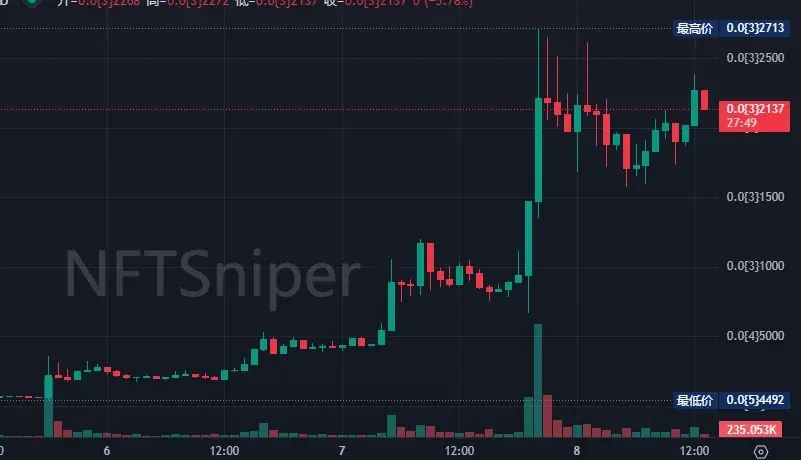
The performance of Neiro and MOODENG evokes the 2021 episode when Vitalik sold Shiba Inu (SHIB). The community immediately began promoting the token as the “next Shib,” prompting a wave of meme‑coin transfers to Vitalik’s address.
Odaily, using publicly available on‑chain data, has analyzed Vitalik’s current holdings and the regularities of his trading behavior.
Vitalik’s Holding Statistics
This section aggregates tokens whose holding value exceeds $100,000 or that have recorded a sale within the past 180 days, sorted by descending holding value. The data are displayed in the table below:
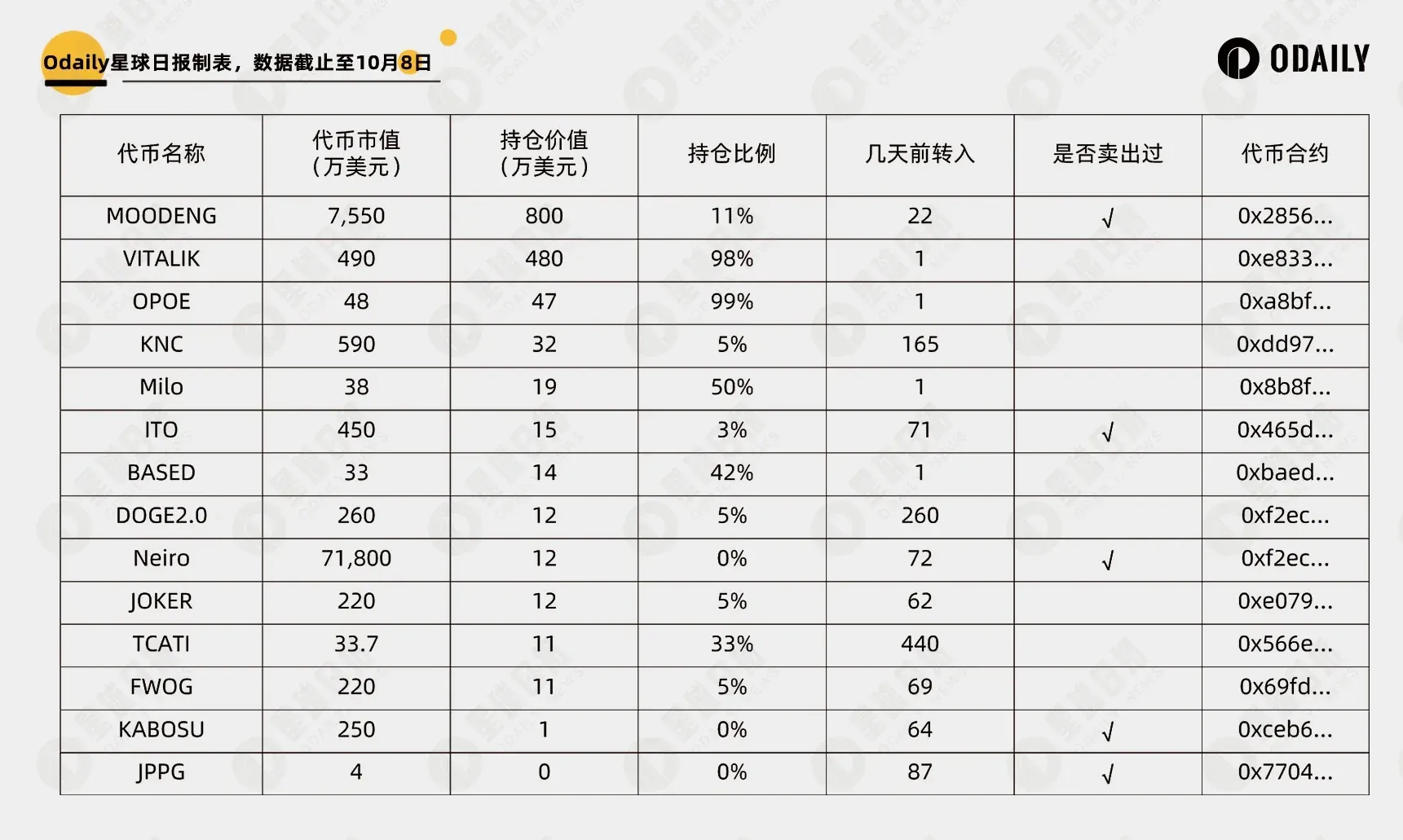
- The “sell‑then‑rise” pattern has been validated recently. After Neiro, the “Vitalik Sell‑off Effect” became even more pronounced. ITO and KABOSU were sold on October 5, delivering 222 % and 73.7 % gains respectively within an hour; by contrast, the earlier JPPG crash led to a total loss.
- There is no fixed rule governing which tokens are sold. Over the past year, the market caps of tokens Vitalik has sold range from tens of thousands of dollars (e.g., RICHPEPE) to millions of dollars (e.g., Neiro, MOODENG). This indicates that neither market cap nor liquidity alone determines whether a token will trigger the “sell‑off effect.”
- The proportion of holdings sold also varies widely. Some cases involve a full liquidation (e.g., JPPG), while others involve only 2.5 % of the position (e.g., MOODENG). Generally, the amount sold in a single transaction is on the order of tens of ETH. To capture a potential “sell‑off effect,” investors might watch tokens whose liquidity can absorb a 5 %‑20 % holding‑size sell‑off.
- Beyond the tokens listed above, meme coins are transferred to Vitalik’s address every hour. Because the transferred amounts are typically small, they are omitted from the table, but some of these tokens have exhibited modest post‑transfer price appreciation. Readers are encouraged to monitor such activity independently.
Tax reminder: Crypto‑related gains or charitable donations may be subject to tax reporting in your local jurisdiction. Please consult a qualified tax professional for guidance.
Key Takeaways on the Trading Pattern
- Price rebounds are common within a short window after a sale. Most documented cases show a notable price increase within minutes to a few hours following the transaction.
- Holding size and sell‑off proportion are diverse. Both full‑position dumps and tiny fractional sales have occurred; the critical factor is the token’s liquidity tolerance.
- Charitable donations and community governance. Vitalik frequently directs received tokens toward charitable causes or DAO‑style community governance, enhancing the public image of the projects involved.
- Community amplification effect. Each time Vitalik sells, the community often rallies around slogans like “the next Shib,” generating secondary publicity that can further fuel price movement.
The above constitutes a deep‑dive analysis by the editorial team at Bitaigen into Vitalik’s token‑selling behavior and the characteristics of his holdings, provided for readers’ reference.
Related Reading
- MUBARAK Token Surge on BNB Chain: Liquidity vs User Growth
- Bitcoin Whales Add 236K BTC in V‑Shaped Bottom‑Fishing
- Bitcoin Price Forecast 2030: Will BTC Hit $500,000?
💡 Register on Binance with referral code B2345 for the maximum trading fee discount. See Binance complete guide.
⚠️ Risk Disclaimer: Crypto prices are highly volatile. This is not investment advice.



