
 Bitaigen Research
 Privacy coins have become a distinct category in the cryptocurrency market, aiming to enhance user anonymity and protect financial data from public scrutiny. Unlike traditional cryptocurrencies such as Bitcoin, whose transaction records are stored on a transparent blockchain that anyone can view, privacy coins employ advanced cryptographic techniques to obscure details such as the sender’s identity, the recipient’s address, and the transaction amount. This focus on confidentiality addresses growing concerns about surveillance, data leaks, and the potential linking of digital transactions to real‑world identities.
Monero (XMR) is a cryptocurrency that achieves default privacy through ring signatures, stealth addresses, and RingCT, and it still holds potential value in 2026 amid tightening regulation and rising demand for privacy.
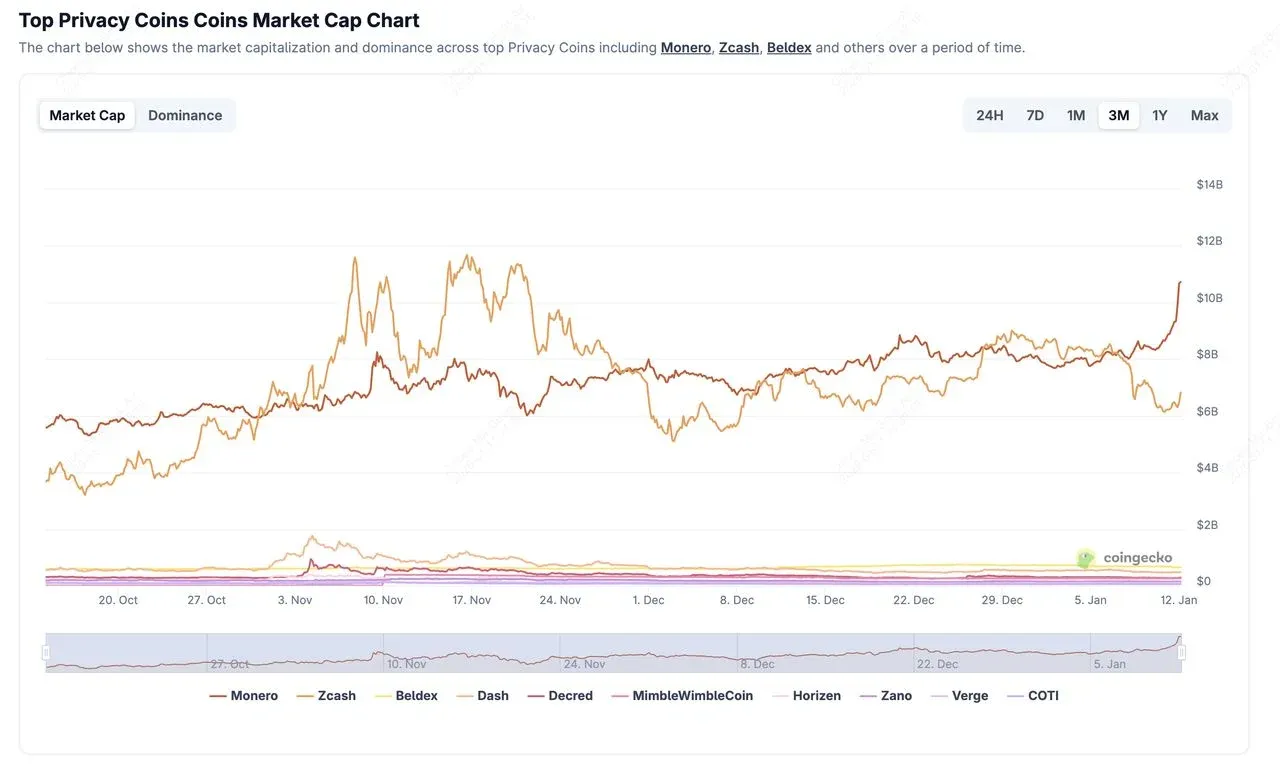
Source: CoinGecko
Monero (XMR) stands out as the leading privacy coin, prioritizing secure, private, and censorship‑resistant transactions. Launched in 2014, it has become synonymous with fungibility—every unit of the currency is interchangeable and indistinguishable from any other, free from any taint associated with prior use. As of January 2026, with digital assets facing mounting regulatory pressure, Monero (XMR)’s emphasis on built‑in privacy continues to attract users seeking protection from tracking, making it a cornerstone of the privacy‑centric crypto ecosystem.
We examine Monero’s core privacy mechanisms, real‑world use cases, and future potential from technical, ecosystem, and regulatory perspectives, helping readers understand its strengths and challenges and decide whether it remains worth watching today.
What Is Monero (XMR)?
Monero (XMR) is an open‑source cryptocurrency that enables fast, cheap, and private payments worldwide. It runs on a decentralized blockchain and is not constrained by traditional banking systems such as wire‑transfer fees, multi‑day settlement delays, or fraudulent chargebacks. Unlike most cryptocurrencies with transparent ledgers, Monero (XMR)’s blockchain is deliberately opaque, ensuring that transactions remain confidential and untraceable by default.
The core function of Monero is electronic cash, allowing users to send and receive funds without intermediaries. The project is community‑driven, with more than 500 developers worldwide contributing, and its research lab continuously innovates in privacy and security technologies. As of January 2026, Monero (XMR) has a market capitalization of roughly USD 9.4 billion, placing it among the top‑20 cryptocurrencies by market cap.
Who Created Monero?
The origin of Monero (XMR) traces back to the CryptoNote protocol outlined by the pseudonymous author Nicolas van Saberhagen in a 2013 whitepaper. The first implementation was Bytecoin in 2012, but concerns over its pre‑mined supply (allegedly 80 % of tokens were unfairly minted) led to a fork. In 2014, a developer known as thankful_for_today launched BitMonero based on CryptoNote. Community disagreements caused another fork on April 18 2014, creating Monero (XMR). Since then, the project has been maintained by an anonymous core team, with well‑known contributors such as Riccardo Spagni (FluffyPony) serving as chief maintainer until 2019. Today, Monero remains a community‑driven project with no single founder.
How Does the Monero Blockchain Work?
Monero (XMR) operates on a proof‑of‑work blockchain, with miners validating transactions using the RandomX algorithm. A new block is produced every two minutes, and rewards are distributed through a tail emission schedule. A transaction begins with the sender’s wallet generating a stealth address for the recipient. The sender’s funds are mixed using a ring signature (current ring size is 16 to improve anonymity) and the amount is concealed with RingCT.
The anonymized transaction is broadcast, verified by miners, and added to the blockchain. The recipient scans the chain with a view key to detect incoming funds without revealing any details publicly. This process ensures complete obfuscation, making Monero (XMR) an ideal choice for private financial interactions.
What Are Monero’s Main Features? What Makes It Unique?
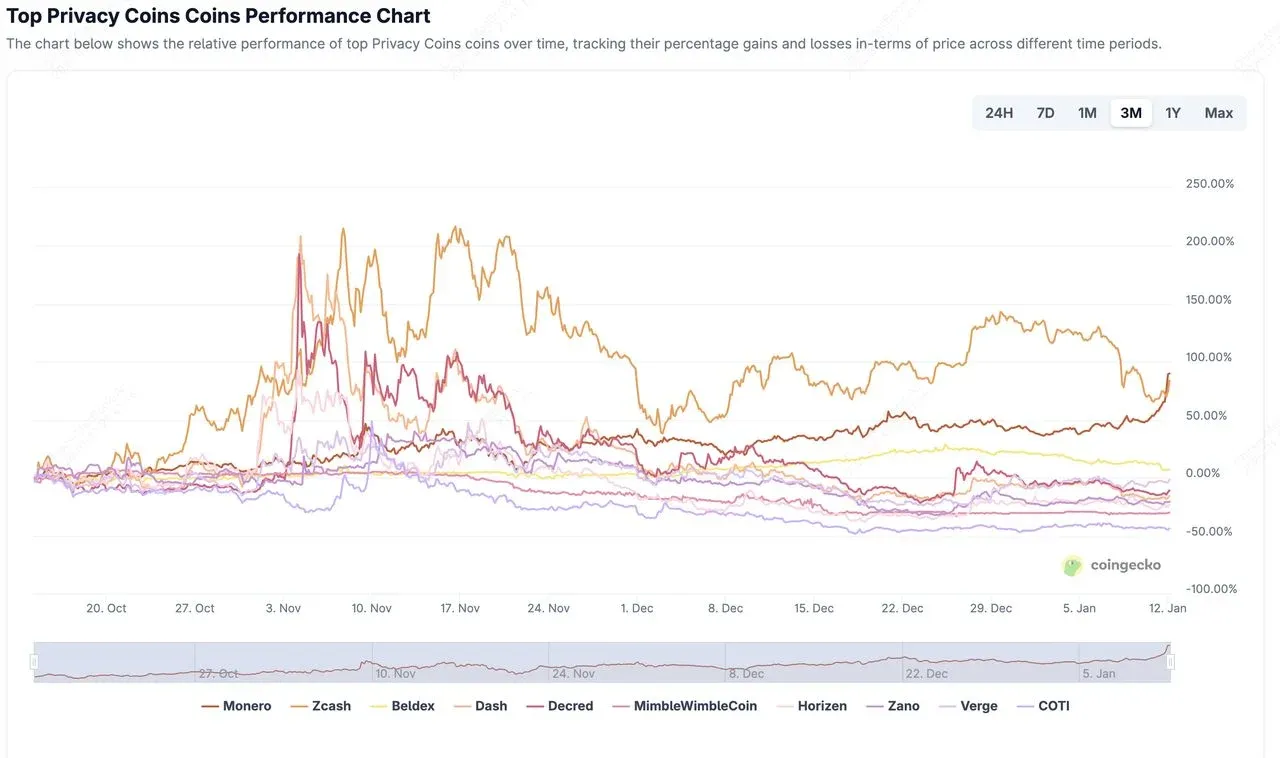
Source: CoinGecko
Monero (XMR)’s primary characteristics revolve around its powerful privacy mechanisms, setting it apart from other cryptocurrencies:
- Default Privacy – Every transaction employs ring signatures (mixing the sender’s inputs with decoys), stealth addresses (one‑time addresses for recipients), and RingCT (hiding amounts), concealing sender, receiver, and value.
- Fungibility – Unlike Bitcoin, where coins can become “tainted” by their transaction history, Monero (XMR) guarantees that all units are identical, reducing risk for merchants accepting payment.
- ASIC‑Resistant Mining – Monero uses the RandomX algorithm, which favors consumer‑grade CPUs and GPUs over specialized ASIC hardware, promoting decentralization and fair participation.
- Dynamic Scalability – Adaptive block size and fee mechanisms, together with a tail emission (a permanent block reward of 0.6 XMR), incentivize miners over the long term.
- Additional Anonymity Layers – Tools such as Dandelion++ for transaction propagation and integration with the invisible internet project (I2P) further obscure network activity.
Monero’s distinctiveness lies in its unwavering commitment to default privacy. While other privacy coins offer optional privacy, Monero forces all users to employ privacy features, eliminating the risk of selective transparency. This grassroots, developer‑led approach, without a central founder or pre‑mined supply, has cultivated a resilient and censorship‑resistant network.
What Are Monero’s Three Major Security Features?
The security of Monero (XMR) is deeply intertwined with its privacy architecture, providing robust protection against tracking, attacks, and centralization risks:
- Cryptographic Tools – Ring signatures blend the sender’s inputs with decoy outputs, stealth addresses generate one‑time destinations, and RingCT encrypts transaction amounts. These functions guarantee full default privacy and bolster overall network integrity. The RandomX proof‑of‑work algorithm, being ASIC‑resistant, reduces the likelihood of a 51 % attack.
- Network‑Layer Defenses – Dynamic block size mitigates congestion and spam; tail emission offers ongoing miner incentives; integration with Tor/I2P provides IP anonymity, while Dandelion++ obscures how transactions spread across the network.
- Upgrade Hardenings – Recent “Fluorine” hard forks enhanced spy‑node resistance, further improving resilience against monitoring and malicious network participants, making Monero highly resistant to analysis and compromise while following security best practices.
What Is the XMR Token Used For?
XMR is the native token of the Monero (XMR) network, primarily used for private transactions, payments, and value storage. It serves as the medium for fees and rewards within the ecosystem. Unlike Bitcoin, which has a capped supply, Monero (XMR) has an uncapped total supply but follows a fixed emission rate after its initial curve, with tail emission ensuring continuous miner incentives.
XMR’s value derives from its utility in privacy‑preserving applications such as anonymous donations, online shopping, and cross‑border transfers. As of January 2026, the circulating supply of XMR is about 18.4 million coins.
How to Use Monero (XMR) for Payments
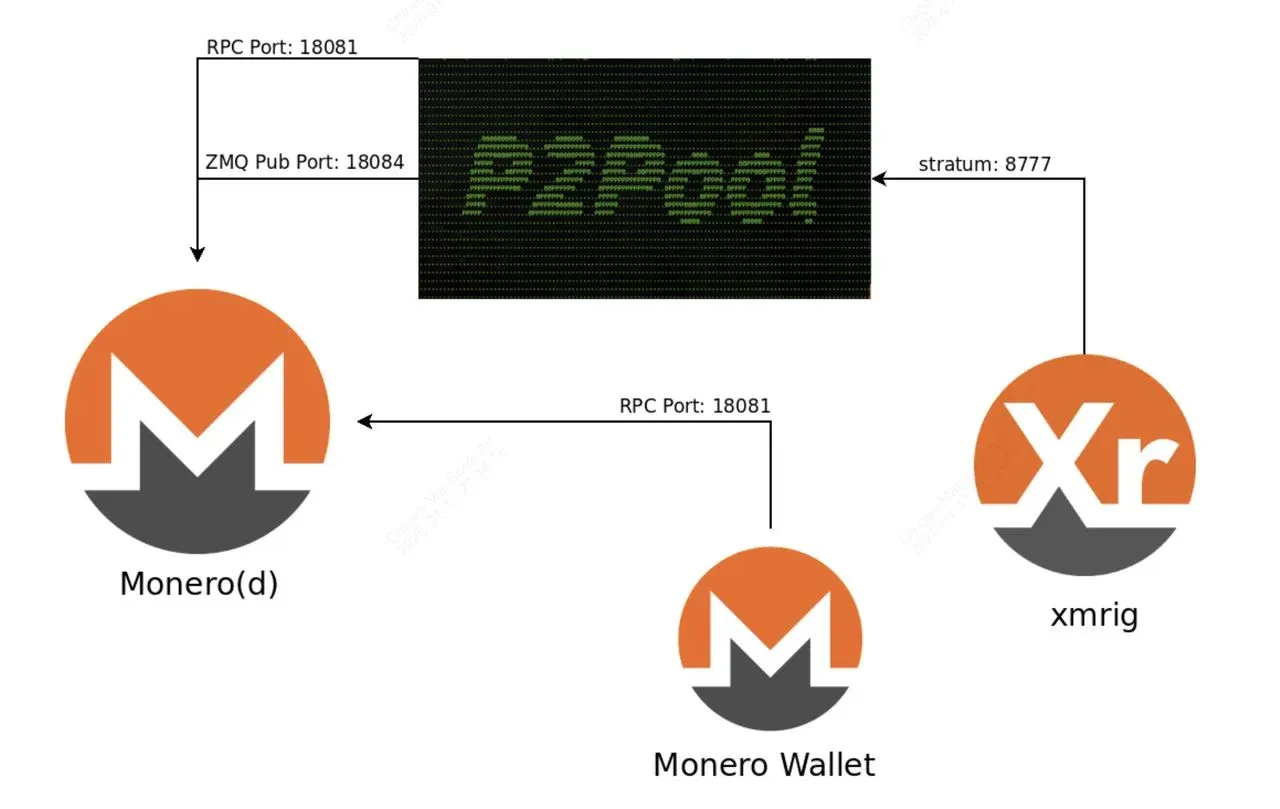
Source: How to Set Up and Install Monero(d) P2Pool
To use Monero, you first need a cryptocurrency wallet that supports XMR. You can use the official Monero GUI or CLI wallet, or a third‑party wallet to generate a private Monero address, which is the string you share to receive XMR.
Once you hold XMR, you can send and receive payments just like with other cryptocurrencies, but with stronger privacy protection. Monero employs stealth addresses, ring signatures, and confidential transactions, so the sender, receiver, and amount are hidden on‑chain. You can use XMR to pay merchants that accept it, conduct peer‑to‑peer transfers, or exchange it for other crypto assets on exchanges.
The wallet handles all steps in the background: constructing the transaction, signing it locally, and broadcasting it to the Monero network while preserving anonymity.
How to Mine XMR on the Monero Network
Monero uses a proof‑of‑work algorithm called RandomX, designed to be ASIC‑resistant and CPU‑friendly. Ordinary desktop computers can efficiently mine XMR, helping keep the network decentralized.
There are three main mining approaches:
- Solo Mining – Connect your wallet directly to the network; no fees and fully decentralized, but rewards are unpredictable unless you have substantial hash power.
- Pool Mining – Join a mining pool to receive steadier payouts; pools charge fees and introduce some centralization risk.
- P2Pool – A recommended decentralized pool system offering 0 % fees, instant payouts to your wallet, no custodial risk, and no central operator. As of January 2026, P2Pool runs version 4.13 with an active network hash rate of roughly 234 MH/s.
The most popular mining software is XMRig, an open‑source miner optimized for CPUs. For a user‑friendly setup, Gupax provides a graphical interface that runs XMRig and automatically connects to P2Pool.
In January 2026, mining Monero is only profitable for users with extremely low or free electricity costs. Most miners participate to support network privacy and decentralization rather than to guarantee income.
Monero vs. Zcash: Similarities, Differences, and Key Distinctions
Monero (XMR) and Zcash (ZEC) are both leading privacy coins, but they differ fundamentally in how privacy is implemented. Monero enforces mandatory default privacy through ring signatures, stealth addresses, and RingCT for every transaction, whereas Zcash uses zk‑SNARKs to provide optional privacy, allowing users to choose between transparent and shielded transactions.
This distinction gives Monero stronger inherent fungibility and anonymity, while Zcash offers more flexibility for regulatory compliance and selective transparency. As of 2026, Monero maintains a larger market cap and adoption within privacy‑focused communities; Zcash experienced notable price gains at the end of 2025, attracting institutional interest because of its adjustable privacy features.
Why Did Monero Surge About 40 % in a Single Week in January 2026?
In early January 2026, Monero (XMR) experienced a dramatic price surge. Between January 11 and 12, 2026, XMR repeatedly broke its previous all‑time high (around USD 518 in 2021), with some reports showing prices above USD 590, daily gains of 18 %–25 %, and weekly gains exceeding 35 %–40 %.
This rally pushed its market capitalization close to or above USD 10 billion, placing it among the top‑tier cryptocurrencies and reclaiming its position as the leading privacy coin.
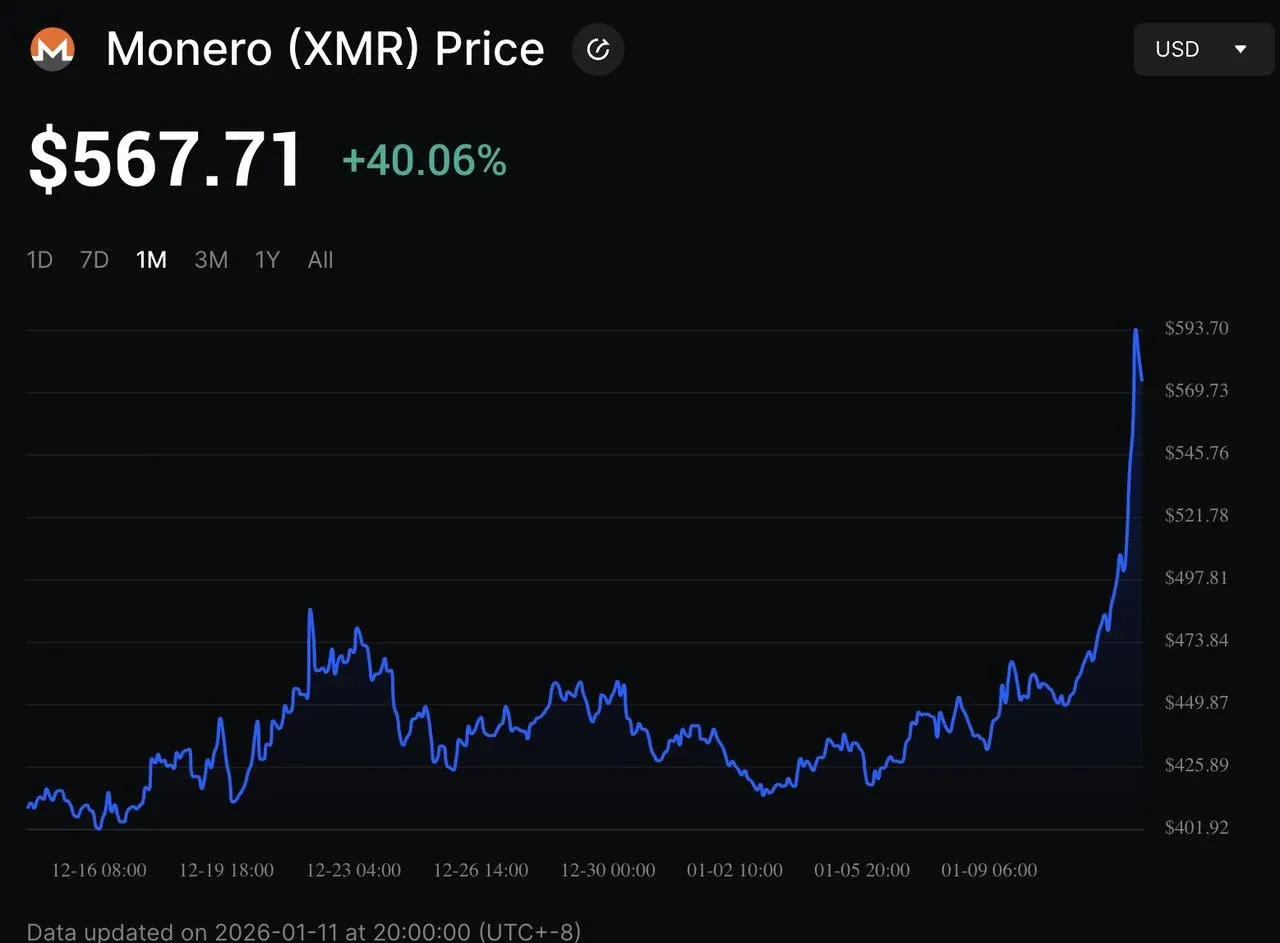
Source: BingX
The primary catalyst was a massive capital rotation within the privacy‑coin sector, triggered by a governance crisis at rival Zcash (ZEC). In early January 2026, Zcash’s core development team, the Electric Coin Company (ECC), announced a collective resignation amid internal disputes over governance, working conditions, and board decisions. The turmoil caused ZEC’s price to drop roughly 25 %–26 % in a single week. Capital quickly flowed from ZEC into the more mature privacy coin—Monero (XMR)—which benefited from mandatory default privacy, a decentralized development model, and proven resilience.
Beyond the Zcash shock, tightening global regulation in 2026 (e.g., the EU DAC8 directive coming into effect on January 1, 2026) required exchanges to collect detailed transaction data, further increasing demand for anti‑tracking tools. Geopolitical instability and heightened data‑security concerns also nudged users toward anonymous digital assets.
Project upgrades such as the “Fluorine” hard fork bolstered network security, while wallet‑experience improvements and overall market resilience of privacy coins reinforced Monero’s strong performance.
Conclusion: Is Monero a Good Investment in 2026?
Monero (XMR) epitomizes the pinnacle of cryptocurrency privacy, delivering untraceable transactions through innovative technology while remaining decentralized and accessible. From its community‑fork origins to its role in advancing financial freedom, and from the explosive price rally in 2026 driven by Zcash capital flows and regulatory shifts, Monero addresses the limitations of transparent blockchains and serves as a vital tool in an age of digital surveillance.
Although evolving regulations in 2026 may pose challenges to its default anonymity, Monero’s robust feature set, dedicated ecosystem, and recent market momentum keep it highly relevant. Whether used for everyday payments, mining, or value storage, Monero (XMR) empowers users to regain control over their financial privacy.
*Note: Crypto gains may be taxable in your jurisdiction; consult local tax regulations.*
*For fiat transactions, the global market typically uses USD and SEPA/SWIFT channels. U.S. residents should use Binance.US rather than the global Binance platform.*
Related Reading
- Privacy Coins 2026: Monero vs Zcash – Full‑Chain Anonymity & Trends
- 2026 Privacy Coins: Concealing Transactions Amid Regulation
💡 Register on Binance with referral code B2345 for the maximum trading fee discount. See Binance complete guide.



