
 Bitaigen Research
 Cryptocurrency Yield Farming (Liquidity Mining)
Yield farming in the cryptocurrency space is an investment strategy on decentralized finance (DeFi) platforms where idle tokens are deposited into liquidity pools to earn transaction fees and additional token rewards.
Cryptocurrency yield farming is currently a hot topic among investors in the decentralized finance (DeFi) arena. It attracts both new and seasoned users with its attractive returns. By supplying liquidity to DeFi platforms and liquidity pools, participants can harness this mechanism to generate passive income from assets that would otherwise sit idle.
While crypto mining offers participants the opportunity to earn substantial rewards, it also carries certain risks. So, what exactly is yield farming? This article delves deeply into yield farming, helping you understand this potentially lucrative investment strategy, including how it works, its advantages, and its inherent risks.
Key Takeaways
- Liquidity mining is a crypto‑investment technique that turns idle digital assets into income.
- Liquidity farmers assume relatively high risk but can earn passive returns by providing liquidity to pools and DeFi protocols.
- Annual Percentage Yield (APY) is the primary performance metric; participants need to understand how to calculate it to evaluate potential earnings and avoid hype traps.
- Advanced tactics such as leveraged farming and protocol stacking can boost returns, albeit with heightened risk.
- DeFi is evolving rapidly; new tools, cross‑chain integrations, and analytics platforms require participants to learn how to leverage these resources for sustainable profitability.
In this article we systematically outline the core principles of liquidity mining, typical operational workflows, and the characteristics of leading platforms, helping readers quickly assess whether the strategy fits their asset allocation. We also flag potential risks and mitigation points; subsequent sections will expand on the details—please continue reading.
What Is Yield Farming (Liquidity Mining)?

Yield farming (also called liquidity farming or liquidity mining) is an investment approach within the DeFi ecosystem. Participants deposit idle cryptocurrencies into a DeFi platform or liquidity pool to obtain higher passive‑income returns.
Liquidity mining generates liquidity rewards by supplying tokens or crypto assets to a decentralized finance (DeFi) protocol. Rewards may come in the form of extra tokens or interest earned from providing capital to a decentralized exchange (DEX).
The revenue originates from how DeFi platforms utilize the deposited assets: the assets can be lent to other users for interest, or they can be used to enhance a project's market depth. Unlike traditional financial institutions, DeFi liquidity mining is fully automated, with smart contracts guaranteeing transparent execution. While the strategy has high‑return potential, it also entails certain risks.
How DeFi Liquidity Mining Works
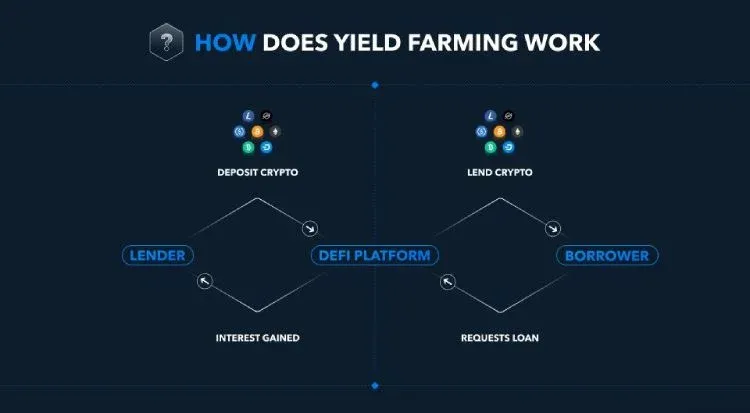
DeFi liquidity mining relies on a decentralized architecture where multiple participants collaborate to keep transactions flowing smoothly. The contributions of each role are as follows:
- Liquidity Provider (LP): Deposits a token pair into a liquidity pool and earns a share of the transaction fees when users swap tokens; many platforms also distribute governance tokens as an extra incentive.
- Lender: Protocols such as Aave or Compound supply assets to borrowers; lenders earn interest that fluctuates with supply‑and‑demand dynamics.
- Staker: Locks tokens on a blockchain or within a liquidity pool to help secure the network; rewards depend on the amount staked and the staking duration.
- Borrower: Provides collateral to obtain loans in other token forms; failure to repay can trigger liquidation.
Mining rewards are typically paid out in governance tokens or the protocol’s native token and are measured using the Annual Percentage Yield (APY), which helps farmers estimate yearly potential earnings.
The entire process is governed by smart contracts that automatically execute once predefined conditions are met, ensuring safety, transparency, and efficiency without a central intermediary.
To maximize returns, many liquidity miners practice compounding—re‑investing earned rewards either manually or via yield aggregators that automate reinvestment, thereby optimizing overall profitability.
Staking vs. Liquidity Mining: What’s the Difference?
- Deposit Horizon: Liquidity mining is generally flexible; assets can be withdrawn at any time, whereas staking often involves a lock‑up period that limits liquidity.
- Transaction Costs: Liquidity miners may incur gas fees when moving assets between pools, especially during network congestion, which can erode profits. Stakers, whose assets remain locked, usually avoid these recurring fees.
- Potential Returns: Liquidity mining typically offers higher APYs because of fierce competition among pools, but the associated risk is also greater. Staking yields are usually lower yet more stable, and long‑term staking can sometimes deliver superior cumulative returns.
- Risk Factors: Liquidity mining faces risks such as fund withdrawal delays, smart‑contract bugs, and hacking incidents. Staking on mature blockchains is comparatively safer, though it still carries the possibility of slashing penalties or market‑price volatility.
Leading Liquidity Mining Platforms
| Platform | Key Features | Primary Reward Token |
|---|---|---|
| **Aave** | Launched as ETHLend in 2017, rebranded to Aave in 2020; a leading DeFi lending protocol | **AAVE** |
| **Uniswap** | Utilizes an **Automated Market Maker (AMM)** model; supports 50/50 token pairs | **UNI** |
| **PancakeSwap** | Built on Binance Smart Chain, offering fast and low‑cost trades; introduced V3 in 2023 with LP staking | **CAKE** |
| **Curve Finance** | Specializes in stablecoin swaps, delivering low slippage and high capital efficiency | **CRV** |
| **Yearn Finance** | Automates yield‑farming strategies, providing **Vaults** and **yTokens** | **YFI** |
| **Compound** | Early algorithmic lending platform; interest rates are dynamically adjusted by smart contracts | **COMP** |
Note for U.S. readers: Access to Binance’s global platform is restricted in the United States. To engage with Binance‑listed assets, use Binance.US, which complies with U.S. regulations.
Benefits of Yield Farming
- High Returns: Compared with traditional crypto investments, liquidity mining can generate superior yields by aggregating rewards across multiple platforms.
- Diversification: Participants can shift between different platforms and strategies, spreading risk across a broader portfolio and mitigating the impact of any single asset’s volatility.
- Innovation‑Driven: DeFi’s permissionless and decentralized nature continuously spawns new tools and functionalities, enhancing usability and efficiency and delivering ongoing innovation premiums to early adopters.
By leveraging the advantages of liquidity mining (including lending), users can continuously explore fresh passive‑income streams within the DeFi ecosystem. Systematic learning and careful planning can improve financial outcomes and increase the likelihood of meeting personal investment goals.
Risks of Yield Farming
- Smart‑Contract Vulnerabilities: Coding errors or malicious exploits may result in loss of funds.
- Impermanent Loss: When the relative prices of the two tokens in a pool diverge, liquidity providers may see a reduction in value compared with simply holding the assets.
- High Gas Fees: Congested networks such as Ethereum can impose substantial transaction costs that significantly eat into profits.
- Market Volatility: Sharp price swings in crypto assets can affect overall profitability.
- Governance Risks: Includes risks of capital reallocation, liquidity concentration, and other protocol‑specific governance decisions; participants should understand the underlying governance mechanisms.
How Beginners Can Start Crypto Liquidity Mining

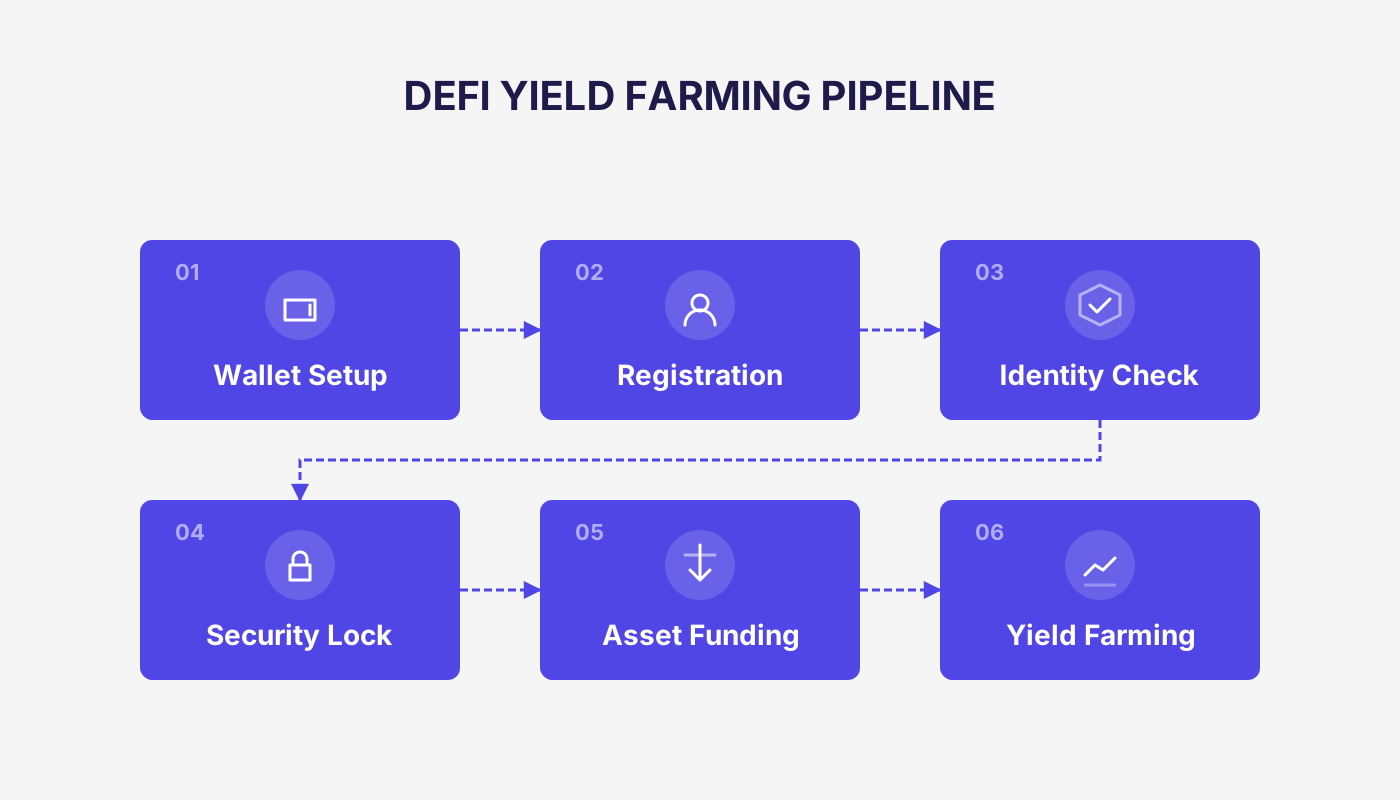
The following steps help newcomers quickly begin liquidity mining and earn passive income:
- Create a Digital Wallet
Choose a wallet compatible with DeFi applications, supporting stablecoins and the Ethereum network (or compatible layer‑2 solutions). Most liquidity‑mining protocols operate with ETH and stablecoins such as USDT or USDC. When moving fiat into crypto, you can use USD via SEPA/SWIFT transfers or local bank wires, depending on your jurisdiction.
- Purchase Cryptocurrency
Acquire mainstream tokens like USDT, USDC, ETH, or other assets on a centralized exchange (CEX) or a decentralized exchange (DEX) and transfer them to your wallet. Beginners are advised to start with modest amounts and diversify across several tokens to become familiar with the ecosystem.
- Select a Liquidity Mining Platform
Evaluate each platform’s reputation, security audits, customer support, displayed APY, and available products. After comparison, decide which protocol aligns best with your risk tolerance and capital size.
- Deposit Tokens into a Liquidity Pool
Follow the chosen platform’s instructions to supply assets to the appropriate pool, aiming for the highest available yield or the pool that matches your desired risk profile.
- Manage Yield‑Farming Performance
- Manual mode: Periodically monitor market conditions and move assets to higher‑yielding projects.
- Automated mode: Use aggregators that provide dashboards showing balances, earned rewards, and real‑time yields.
- Reinvest or Withdraw Rewards
Accumulated rewards can be claimed at any time, or you can enable automatic reinvestment to benefit from compounding. Most aggregator platforms support both options.
How to Calculate Liquidity‑Mining Returns
Yield‑farming profitability is usually projected on an annual basis, with the core metrics being Annual Percentage Yield (APY) and Annual Percentage Rate (APR).
- APR: Reflects the simple interest earned over a single period, ignoring compounding effects.
- APY: Incorporates the impact of compounding, providing a more accurate picture of long‑term earnings.
Sample Calculation (illustrative only):
```
APY = (1 + APR / n) ^ n – 1
where n = number of compounding periods per year (e.g., daily compounding n = 365)
```
Actual returns are influenced by transaction fees, price fluctuations, and smart‑contract performance. It is advisable to track performance using daily or weekly metrics for a finer‑grained assessment.
Frequently Asked Questions
Which widely used farming techniques can boost yield and profit?
Moving assets between different DeFi protocols—such as Compound, Curve, or Uniswap—to chase higher returns is a common method for increasing earnings.
What is an example of liquidity mining?
Providing liquidity to DEXs like PancakeSwap or Uniswap, then earning a share of the trading fees plus any governance tokens the platform distributes.
How can I earn yields with Bitcoin?
On DeFi platforms that support tokenized Bitcoin (e.g., wBTC), you can lend the wrapped BTC or supply it as liquidity, earning interest, fees, or governance‑token rewards. This approach also carries high risk.
Is liquidity mining still profitable today?
Profitable opportunities still exist, but participants must remain aware of impermanent loss, market volatility, and smart‑contract risk, and should only engage after thorough evaluation.
Conclusion
In the fast‑moving world of decentralized finance (DeFi), liquidity mining offers a potentially lucrative yet risk‑laden investment avenue. By supplying liquidity to lending and trading protocols, investors can transform otherwise idle crypto assets into passive income streams. Although the strategy boasts attractive upside, it also exposes participants to impermanent loss, protocol shutdowns, market swings, and smart‑contract vulnerabilities.
Before entering liquidity mining, conduct comprehensive research. Understand each platform’s technical implementation, governance structure, and audit history. Employ diversification, stay updated on security developments, and use reputable aggregators to monitor performance. These practices can help you enhance profit potential while mitigating risk.
Tax Disclaimer: Crypto‑related gains may be taxable in your jurisdiction. Consult a qualified tax professional to determine your obligations under local law.
That concludes the full translation of “What Is Liquidity Mining (Yield Farming)? A Comprehensive Guide to How It Works and the Main Platforms.” For more information, search for prior Bitaigen (比特根) articles or continue browsing related posts below. We appreciate your ongoing interest and support for Bitaigen (比特根)!
Related Reading
- CELO Explained: Crypto Basics, Mechanism & How to Buy
- Understanding TVL (Total Value Locked) in DeFi Crypto Markets
- TVL in Crypto: Benefits, Risks & Investment Guide
💡 Register on Binance with referral code B2345 for the maximum trading fee discount. See Binance complete guide.



