
 Bitaigen Research
In this article we outline the core concepts and operational flow of liquidity mining, helping you quickly understand the role of LPs, sources of yield, and the practical significance within the DeFi ecosystem. With clear diagrams and case analysis, even readers who are new to the topic can grasp the key points within minutes. Subsequent sections will expand on hands‑on techniques and risk mitigation, making a thorough read worthwhile.
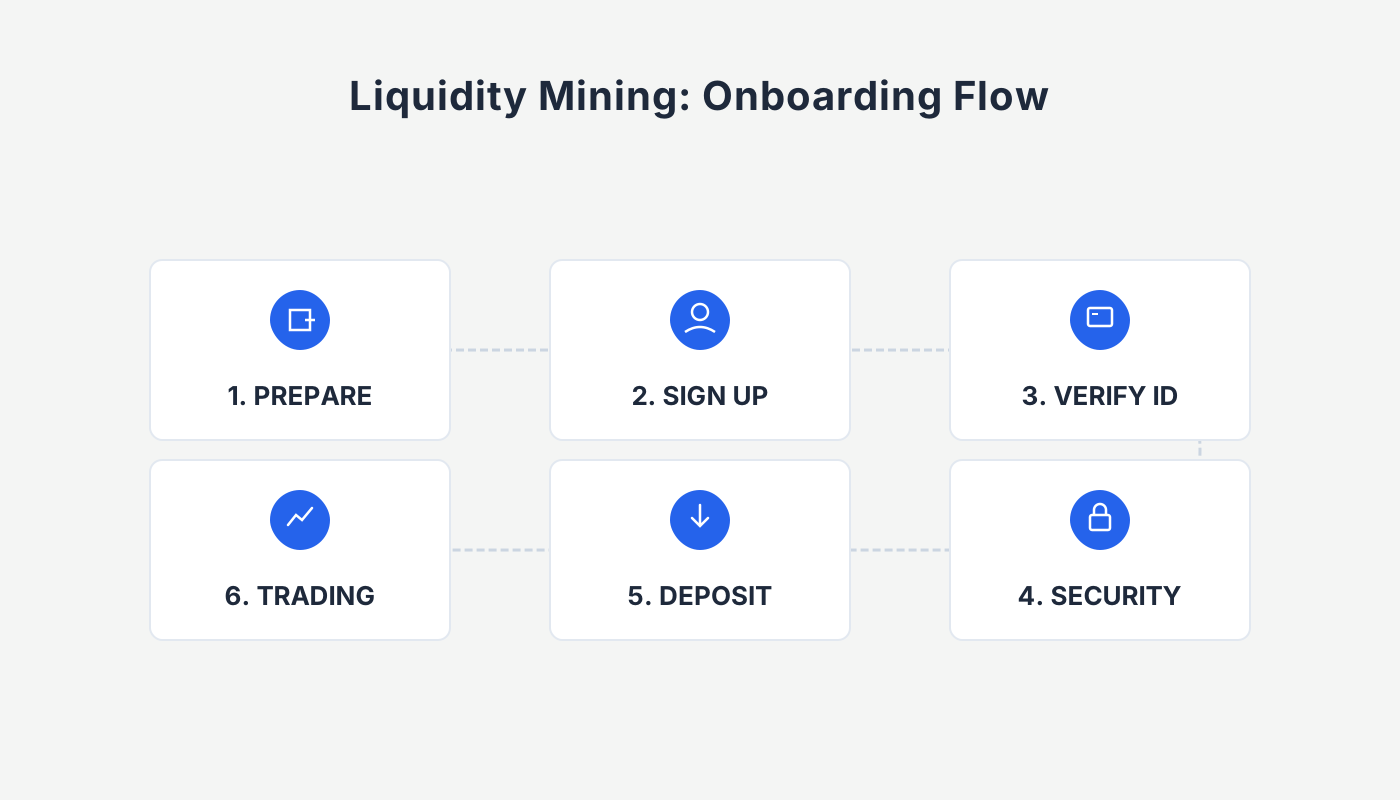
What is Liquidity Mining?
Liquidity mining is a DeFi investment method that rewards participants with transaction fees and platform incentives for supplying two or more tokens to a decentralized exchange (DEX). At the same time, it deepens the order book of the trading pair and contributes to market stability.
Users who provide liquidity are called Liquidity Providers (LPs). In traditional financial markets, liquidity is essential for smooth buying and selling—for example, when traveling you expect a bank to have foreign currency on hand, and the bank earns a return by charging a small fee. Liquidity mining works on the same principle: users deposit assets such as Ethereum (ETH) and USDT, allowing others to swap between them at any time, and they receive a share of the transaction fees generated.
Why Does the DeFi World Need Liquidity?
In any market, a trade requires a matching buyer and seller. If market depth is insufficient, slippage occurs and trades can become stuck. Decentralized exchanges lack traditional market makers and therefore rely on LPs to lock tokens into smart contracts, creating a *liquidity pool*. When traders swap assets in the pool, the fees they pay are automatically distributed to LPs, forming a “decentralized bank”‑like revenue model that draws from trading fees and platform token rewards.
How Liquidity Mining Operates
Liquidity mining is built on the AMM (Automated Market Maker) mechanism. Instead of an order book, an AMM determines prices based on the ratio of the two tokens held in the pool.
Operational steps:
- Choose a trading pair (e.g., ETH/USDT).
- Deposit equal‑value amounts of the two tokens into the liquidity pool.
- The system mints an LP Token that represents your share of the pool.
- Transaction fees generated by other users are allocated proportionally to all LPs.
- If the platform issues a governance token or other incentives, these are automatically distributed as well.
The primary sources of LP earnings are:
- Transaction fee income
- Platform token rewards
The entire process is executed by smart contracts, ensuring transparency and eliminating the need for manual intervention.
Sources of Yield in Liquidity Mining
Yield 1: Transaction Fee Income
Fee income depends on the pool’s fee setting, typically ranging from 0.01 % – 1 %. Fees are shared according to each LP’s ownership proportion. For example:
- Total fee revenue: $100,000
- Total pool capital: $1,000,000
- Your contribution: $200,000 (20 % of the pool)
Your share of fees would be $100,000 × 20 % = $20,000. When setting a fee rate, consider market competition and user activity; a rate that is too high may deter traders and reduce overall volume.
*Note for U.S. participants:* If you intend to move fiat (USD) via SEPA or SWIFT, be aware that U.S. residents must use Binance.US rather than the global Binance platform.

Yield 2: Platform Token Rewards
To incentivize liquidity provision, many platforms distribute their native governance tokens. For instance, providing liquidity on Curve Finance yields both trading fees and CRV token rewards.
Three Major Risks of Liquidity Mining
Risk 1: Asset Price Decline
If the price of the assets you supplied falls, the net result may still be a loss despite receiving fees and token rewards. This mirrors holding dividend‑paying stocks whose share price drops.
Risk 2: Impermanent Loss
Impermanent loss (IL) is a temporary reduction in value caused by relative price changes between the two assets in the pool. The loss becomes permanent only when you withdraw your liquidity. The greater the divergence from the initial price ratio, the larger the IL.
Example (ETH‑USDC)
- Initial state: ETH price $1,500. You deposit 2 ETH + 3,000 USDC (total value $6,000), representing 5 % of the pool.
- Price movement: ETH rises to $3,000. Arbitrageurs trade USDC for ETH in the pool, re‑balancing it to a 50/50 value split. The pool now holds approximately 28.28 ETH + 84,852 USDC.
- Withdrawal: Your 5 % share yields about 1.414 ETH + 4,242.64 USDC, worth $8,484.64.
- Holding the assets: If you had kept the original 2 ETH + 3,000 USDC, they would now be worth $9,000.
- Impermanent loss: \((9,000 – 8,484.64) / 9,000 ≈ 5.72 %\).
To explore IL under different price scenarios, you can use online calculators that factor in pool composition, fee rates, and time horizon.
Risk 3: Regulatory and Tax Considerations
Crypto earnings, including fee income and token rewards, may be subject to tax in your jurisdiction. In many countries, these gains are treated as capital gains or ordinary income and must be reported to tax authorities. Always consult a qualified tax professional to ensure compliance.
---
By understanding the mechanics, potential returns, and inherent risks outlined above, participants can make more informed decisions when engaging with liquidity mining across the global DeFi landscape.
Related Reading
- Liquidity Mining Guide: Earn Rewards on DeFi Platforms
- Liquidity Mining Guide: Earn Passive Income & Avoid Risks
- DeFi Liquidity Mining: Boost Capital Flow & Trade Efficiency
💡 Register on Binance with referral code B2345 for the maximum trading fee discount. See Binance complete guide.



