
 Bitaigen Research
 When talking about liquidity mining, one inevitably mentions DeFi, which has been the hottest investment segment in the crypto space over the past two years. The boom in DeFi has spawned a multitude of derivative products, and many projects attract users by issuing their own tokens and launching liquidity‑mining campaigns. However, the cryptocurrency market is intrinsically volatile, and there is no such thing as a completely safe investment. What to do if the price of a liquidity‑mining token drops? If you encounter a token price decline, it is advisable to mitigate risk through diversification, stop‑loss orders, market monitoring, rebalancing liquidity, and possibly hedging or staking strategies.
During the DeFi surge, liquidity mining attracted massive capital, but price swings often catch investors off guard. In this article we outline practical responses to token‑price pullbacks, including asset diversification, stop‑loss settings, real‑time monitoring, and hedging tactics, to help readers preserve earnings and lower risk amid volatility. For more detailed step‑by‑step instructions, keep reading.
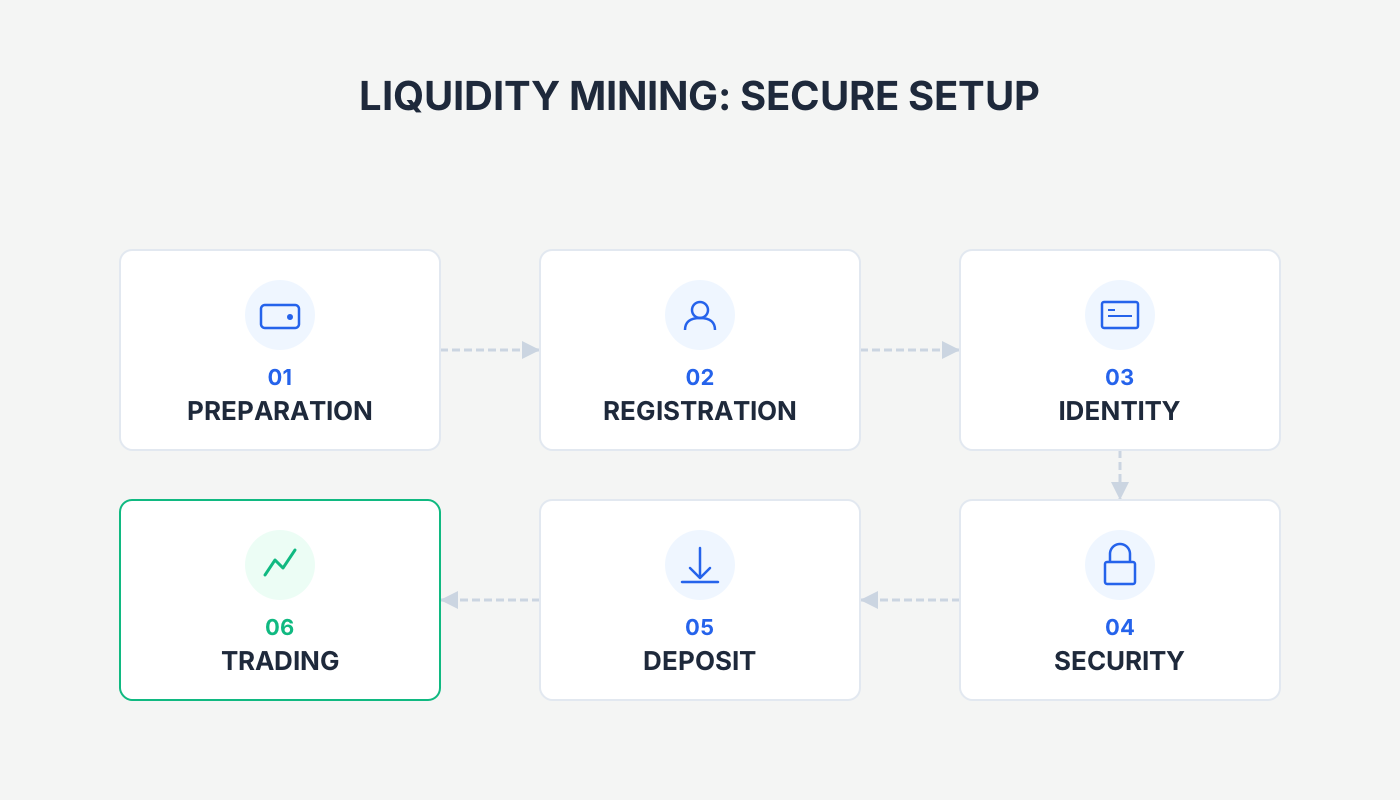
What to Do When a Liquidity‑Mining Token’s Price Falls?
When a token’s price experiences a correction, the following actions can help you manage the investment and limit losses:
1. Diversify allocations
- Spread your holdings across multiple cryptocurrencies or other financial instruments so you don’t “put all your eggs in one basket.”
2. Continuous monitoring
- Use market‑tracking tools (e.g., CoinGecko, TradingView) to follow price movements and on‑chain data in real time.
3. Set stop‑loss orders
- Pre‑configure stop‑loss orders on your exchange; if the token falls to the preset threshold, the system will automatically sell, capping the loss.
4. Evaluate the project’s fundamentals
- Research the technical implementation, real‑world use cases, and team background of the liquidity‑mining project to separate genuine utility from pure hype.
5. Understand the reward structure
- Familiarize yourself with the liquidity‑pool incentive scheme, including mining tokens, fee distribution, etc. Even if the token price drops, rewards may offset part of the loss.
6. Rebalance liquidity
- A price decline can skew the asset ratio inside the pool; adjust positions periodically so the two assets’ values stay more balanced.
7. Withdraw cautiously
- When deciding to pull out, consider your personal risk tolerance and transaction fees, avoiding extra costs from frequent trading.
8. Clarify risk profile
- Liquidity mining is a high‑volatility, high‑risk activity; only use capital you can afford to lose.
Hedging Risks in Liquidity Mining
Liquidity‑mining returns are tightly linked to token prices, and common hedging techniques include shorting and staking:
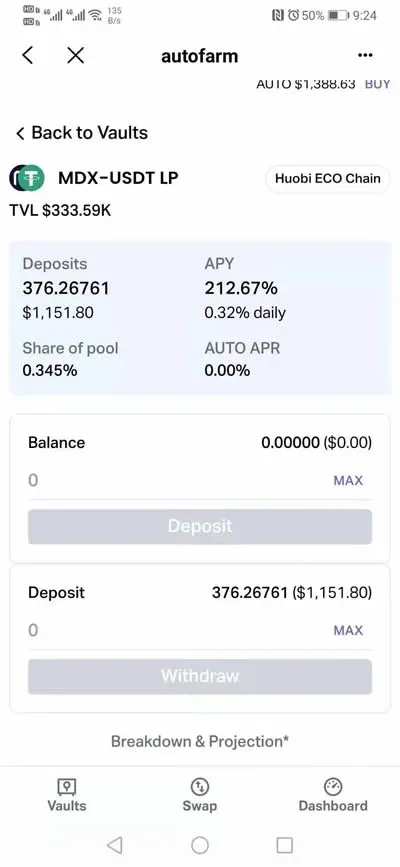
- Short‑position hedge: Using MDX as an example, when you provide MDX‑USDT liquidity you can simultaneously open a short position on MDX on the same platform. If MDX crashes, the profit from the short offsets the loss in the liquidity pool, achieving a risk‑neutral stance.
- Yield comparison: If MDX’s borrowing annualized rate is 200 % and the MDX‑USDT mining APR is also around 200 %, even if the platform advertises 400 % (compounded), the actual net return is often reduced by impermanent loss, sometimes to roughly half of the advertised figure.
Single‑Token Mining
Mining a single token cannot shield you from a drastic price plunge. Achieving an α‑neutral position would require allocating half of your capital to a short, which typically cuts the overall return by about 50 %. By contrast, LP (dual‑token) mining only needs roughly one‑third of the capital shorted, allowing the return to stay around two‑thirds of the unhedged yield.
Staking‑Based Mining
Staking can lessen the profit erosion and liquidation risk that come with shorting. Common staking ratios are:
- USDT staking rate 80 %
- “Air‑token” (a token with little intrinsic value) that can be withdrawn after staking 85 %
Calculation: 80 % × 85 % = 70 %; thus, 100 USDT can be staked to receive approximately 70 USDT worth of air‑tokens. The overall capital utilisation becomes 170/200 ≈ 85 %, and the yield stays at roughly 85 % of the original level, a noticeable improvement.
Risk notice: If the air‑token’s price spikes dramatically (e.g., +100 %), a liquidation event may be triggered; if the rise exceeds 140 %, forced liquidation could occur. In extreme market conditions, liquidation losses may offset the overall pool earnings.
Example
Assume you commit 240 USDT to an MDX‑USDT liquidity pool:
- Stake 140 USDT and receive about 100 USDT (equivalent to 50 MDX) to form the LP position.
- If MDX drops to 1 USDT, the LP’s re‑valued worth remains roughly 140 USDT. After subtracting the 50 USDT MDX liability, the net gain is about 230 USDT, less roughly 10 USDT of impermanent loss.
To further reduce the air‑token liquidation risk, consider using assets with higher correlation to the air‑token—such as BTC—as collateral.
Impermanent Loss (IL)
Impermanent loss is one of the primary hazards for liquidity providers. Its formula is:
\[
\text{divergence\_loss}= \frac{2\sqrt{\text{price\_ratio}}}{1+\text{price\_ratio}}-1
\]
Typical relative (HODL) losses for common price changes:
| Price multiplier | Relative loss |
|---|---|
| 1.25× | 0.6 % |
| 1.50× | 2.0 % |
| 1.75× | 3.8 % |
| 2× | 5.7 % |
| 3× | 13.4 % |
| 4× | 20.0 % |
| 5× | 25.5 % |
Although a 5‑fold rise leads to about a 25 % relative loss, high APRs can make this loss tolerable; similarly, when prices fall you do not need to wait for an equivalent multiple before considering an exit.
Air‑Token Crash Risk
- Avoid low‑value tokens: Most “air‑tokens” on the market lack real utility. Prefer platform tokens such as BNB, BUSD, or HOO for mining.
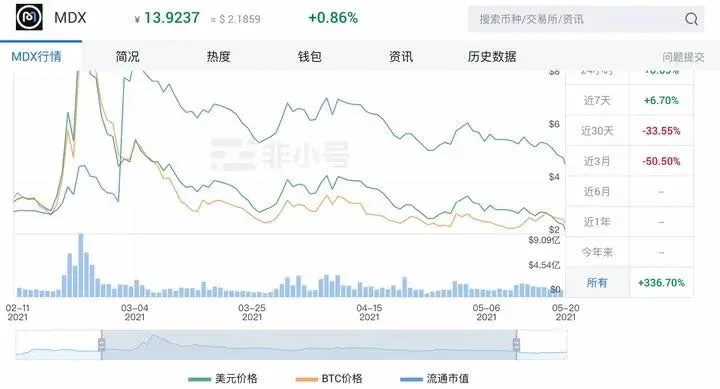
- Reference rankings: Platforms like FeiXiaoQie (非小号) provide DeFi project rankings; select assets with higher liquidity and security scores.
DApp Platform Risks
Some DApps with little activity or negligible traffic may promise high yields but fail to generate actual returns. Prioritize platforms that have strong trading volume, active communities, and top‑tier rankings.
Smart‑Contract Risks
Network congestion or contract vulnerabilities can also cause fund loss. For instance, “Black Thursday” events on certain platforms during peak periods remind users to evaluate contract security carefully.
What Is Liquidity Mining?
Liquidity mining is a mechanism where digital assets are locked to provide liquidity to a decentralized exchange (DEX) in exchange for rewards. The core workflow is:
- Provide liquidity: Users (called liquidity providers, LPs) deposit equal‑value amounts of two tokens into a smart‑contract‑controlled liquidity pool.
- Generate fees: Traders swapping within the pool incur fees, a portion of which is distributed to LPs.
- Additional incentives: Many projects also distribute native platform tokens as extra rewards, similar to staking, but with a more complex technical implementation.
Most liquidity‑mining projects today are built on Ethereum’s ERC‑20 standard, and rewards are also paid out as ERC‑20 tokens. As cross‑chain technology and Layer‑2 solutions mature, the liquidity‑mining ecosystem is likely to expand across multiple blockchains.
---
The above content answers the question “What to do if a liquidity‑mining token’s price falls.” Development teams behind DeFi projects are generally small, and liquidity mining is not as straightforward as it may appear. When faced with adverse price movements, investors should conduct thorough risk assessments, employ hedging tools, and continuously monitor project fundamentals. All crypto investments carry risk; before entering any position, make sure you fully understand the risks and only use capital you can afford to lose.
*Note for U.S. readers*: If you reside in the United States, you must use Binance.US rather than the global Binance platform to comply with local regulations.
*Tax reminder*: Gains from cryptocurrency activities may be taxable in your jurisdiction. Consult a tax professional to ensure compliance with local tax laws.
Related Reading
- Liquidity Mining Explained: Core Concepts, LP Roles & Yield Sources
- Liquidity Mining Guide: Earn Rewards on DeFi Platforms
- Liquidity Mining Guide: Earn Passive Income & Avoid Risks
💡 Register on Binance with referral code B2345 for the maximum trading fee discount. See Binance complete guide.



