
 Bitaigen Research
 Passive Income in 2025: Two Main Approaches
- Staking – delivers relatively stable, low‑risk returns.
- Cloud mining – aims for higher, but more volatile, rewards.
For crypto‑related earnings in 2025, staking is a long‑term, ESG‑friendly option with clear regulatory guidance, while cloud mining is a high‑risk, speculative activity.
From a 2025 industry perspective, we outline the fundamental differences between staking and cloud mining, helping investors clarify the core risk‑and‑reward points and quickly decide which passive‑income model best fits their asset‑allocation needs. We also provide a brief assessment of the regulatory environment and ESG considerations.
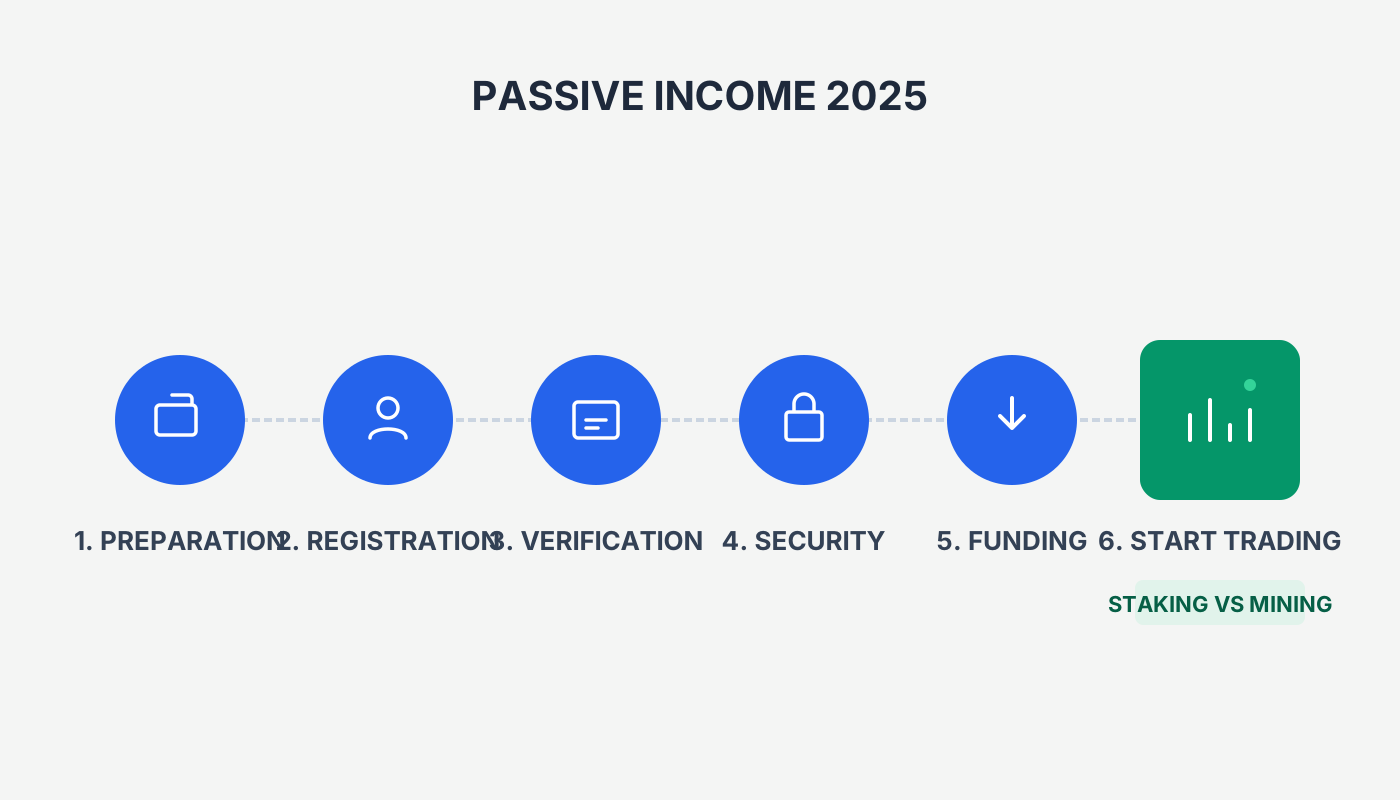
Cloud Mining vs. Crypto Staking: Profitability Comparison
When evaluating potential returns, staking typically offers more stable and predictable earnings; cloud mining can potentially generate higher returns but carries stronger speculative risk.
| Category | Cloud Mining Yield (**APR**) | Crypto Staking Yield (**APY**) |
|---|---|---|
| Standard contracts | 5%‑10% (e.g., Bitcoin cloud mining, ZA Miner) | 3%‑18% depending on the network |
| High‑risk scams | Projects such as XRP claim 100%‑800% annualized returns, usually Ponzi or fraudulent schemes | — |
As of mid‑2025, the average annual percentage yields (APY) for major networks are:
- Ethereum (ETH): around 3%
- Solana (SOL): 6%‑8%
- Cardano (ADA): 4%‑6%
- NEAR Protocol (NEAR): 9%‑11%
- Liquid staking (e.g., Marinade): 10%‑12%
- Cosmos (ATOM): up to 18% (exchange‑offered staking net of fees ~6%)
- Small‑cap networks: Injective, SEI, SUI and others can provide double‑digit yields, but with lower liquidity and higher volatility
What Is Cloud Mining?
Cloud mining allows participants to engage in cryptocurrency mining without owning physical hardware. Users rent hash power from companies that operate large‑scale farms or data centers, purchase a contract, and receive a share of the daily mining rewards (e.g., BTC, ETH) proportional to the rented power after service and maintenance fees are deducted. This lowers the technical barrier, making it especially attractive for individuals with limited technical knowledge or in regions where energy costs are high.
What Is Crypto Staking?
Staking is the core mechanism of proof‑of‑stake (PoS) networks. Token holders lock up assets to help the network validate transactions and maintain security, earning additional tokens as a reward. Participation typically takes two forms:
- Running a validator node – requires technical expertise and dedicated hardware.
- Delegating to a reputable validator – simple to operate and suitable for most users.
A recent innovation is liquid staking (e.g., Lido, Marinade). The platform issues derivative tokens that represent the staked assets (*stETH*, *mSOL*, etc.), allowing the capital to remain liquid and usable in other DeFi protocols while still earning staking rewards.
Main Risks of Cloud Mining and Staking
The risk profiles of the two strategies differ. The table below contrasts the key risk factors:
| Risk Factor | Cloud Mining | Crypto Staking |
|---|---|---|
| **Platform risk** | Very high – the sector is rife with scams, bankruptcies, and limited transparency | Moderate – the industry is maturing; primary risk stems from validator misbehavior or slashing |
| **Market volatility** | High – rewards are paid in crypto; a price drop can instantly erase fiat‑denominated gains | High – token price still matters, but earnings are more predictable |
| **Liquidity** | Low – funds are locked until contract expiry | Medium to high – traditional staking has an unbonding period; liquid staking offers near‑instant liquidity |
| **Operational risk** | High – hardware degradation, fluctuating energy costs, and other uncontrollable factors | Low to medium – largely dependent on the chosen validator’s reliability |
| **Centralization** | High – dominated by large farms, contrary to decentralization ideals | Medium – while large validators exist, PoS inherently distributes influence more broadly |
Environmental Impact and Sustainability
For ESG‑conscious investors, cloud mining’s energy consumption remains a primary concern. Proof‑of‑work (PoW) networks such as Bitcoin consume roughly 150 TWh of electricity annually, much of it sourced from fossil fuels. Some farms are experimenting with renewable energy or relocating to cooler climates to reduce cooling costs, yet the overall environmental pressure stays significant.
In contrast, staking relies on the energy‑efficient PoS consensus. Since Ethereum’s transition to PoS in 2022, its power usage has dropped by about 99.95%, making staking an ESG‑friendly investment choice.
2025 Regulatory Landscape and Investor Suitability
Cloud mining faces considerable regulatory uncertainty. For example, Kuwait has banned mining activities outright, while the United States, although relatively permissive, sees increasing scrutiny from environmental groups. Regulatory risk could lead to service interruptions or higher compliance costs.
Staking enjoys a more mature regulatory environment. Most staking‑as‑a‑service providers now offer audits, insurance, and custodial solutions that meet institutional compliance standards, resulting in fewer regulatory hurdles.
Practical Considerations for Global Users
- When converting fiat to crypto, use USD transfers via SWIFT or SEPA where applicable.
- U.S. residents should conduct transactions through Binance.US rather than the global Binance platform.
- Crypto gains may be taxable in your jurisdiction; consult a tax professional to understand local obligations.
Choosing the Right Strategy for You
- Beginners or users with limited technical skills: Cloud mining offers a “plug‑and‑play” model with typical annual returns of 5%‑10%; however, staking via exchanges or liquid‑staking platforms is equally straightforward and generally safer.
- Investors seeking high‑risk, high‑reward opportunities: Some cloud‑mining projects (e.g., certain XRP schemes) advertise 100%‑800% annual returns but are extremely risky and lack transparency. A comparatively safer high‑yield approach is staking emerging networks such as Cosmos or NEAR, which can deliver 15%‑20% APY.
- Institutional investors or compliance‑focused individuals: Staking provides regulated infrastructure, audit reports, and insured custodial services, making it the more reliable option.
- Long‑term, ESG‑oriented investors: The low energy consumption, regulatory flexibility, and alignment with DeFi trends make staking the superior strategy.
Frequently Asked Questions
Which yields higher returns, cloud mining or staking?
Cloud mining may claim extreme returns of 100%‑800% in rare cases, but standard contracts typically deliver 5%‑10% APR. Staking offers more stable returns, usually ranging from 3% to 18% APY depending on the network.
Which option is more environmentally friendly?
Staking uses PoS consensus, consumes minimal electricity, and is regarded as ESG‑friendly. Cloud mining remains dominated by energy‑intensive PoW processes, resulting in a larger environmental footprint.
What are the main risks of cloud mining?
Key risks include platform fraud, fluctuating operating costs, low liquidity, and a high degree of centralization.
Should beginners start with cloud mining or staking?
Cloud mining’s “plug‑and‑play” approach is easy to adopt, but staking—especially through reputable exchanges or liquid‑staking services—offers comparable simplicity with higher security, making it a solid choice for newcomers.
How do the regulatory environments differ?
Staking faces fewer regulatory barriers, supported by mature compliance infrastructure. Cloud mining encounters greater regulatory uncertainty and potential policy restrictions.
---
This concludes the overview of crypto passive income in 2025: Staking vs. Cloud Mining. For the latest insights on cloud mining and other cryptocurrency topics, search for past articles from Bitaigen (比特根) or continue browsing the links below. Thank you for your continued interest and support!
Related Reading
- Liquidity Mining Guide: Earn Passive Income & Avoid Risks
- Liquidity Mining vs Staking: Differences, Benefits & Risks
- Celo Explained: CELO Token, Governance, Staking & Mining
💡 Register on Binance with referral code B2345 for the maximum trading fee discount. See Binance complete guide.



