
 Bitaigen Research
This article introduces the concept of perpetual contracts and their four most common applications.
Perpetual contracts allow traders to take long or short positions without owning the underlying spot asset, and leverage can be used to magnify the position in pursuit of higher returns. However, the associated risk grows proportionally. The contract price does not simply follow the spot market; it is kept in line with spot through the funding‑rate mechanism and the mark price. Although it is a high‑risk instrument, proper use of stop‑loss/stop‑take‑profit orders, hedging and arbitrage strategies can still make it a component of a disciplined investment approach.
In this article we systematically break down the core principles of perpetual contracts, explain long and short operations, the leverage mechanism, and common arbitrage ideas. By analysing key elements such as the funding rate and the mark price, we help readers balance risk and reward and provide practical trading tips. If you want to learn how to flexibly position yourself without holding the spot asset, keep reading.
What is a Perpetual Contract?
A perpetual contract is an innovative financial product in the crypto space. It resembles a traditional futures contract in form, but it has no expiration or settlement date. Traders only need to focus on price movements, making it relatively straightforward to use. Perpetual contracts are priced based on an index price—a weighted average derived from major spot exchanges and their trading volumes.
Consequently, the execution price of a perpetual contract is usually close to the spot price, and only under special circumstances does the mark price diverge.
Definitions
When trading perpetual contracts, you should be familiar with the following key concepts:
- Initial margin: The minimum amount of cryptocurrency that must be deposited to open a margin trade.
- Maintenance margin: The minimum amount of cryptocurrency required to keep the margin trade alive.
- Basis: The price difference between the futures contract and the underlying spot market.
- Mark price: The reference price used to calculate all traders’ unrealized P&L; it helps prevent market manipulation and ensures the perpetual contract price stays aligned with the spot price.
- Funding rate: A periodic payment exchanged between longs and shorts based on the gap between the perpetual contract market and the spot price. When the rate is positive, longs pay shorts; when negative, shorts pay longs.
- Leverage: Perpetual contracts do not require 100 % of the contract value as collateral; some products allow up to 100× leverage.
- Unrealized P&L: The profit or loss of an open position that has not yet been settled.
- Close (liquidate): Converting a position into cash. A forced liquidation occurs when margin becomes insufficient; the system automatically converts the position into cash or an equivalent stablecoin.
Market Positioning of Perpetual Contracts
Crypto investment strategies are diverse, and perpetual contracts are often polarising because of their high‑leverage nature: some claim they can deliver “overnight financial freedom,” while others jokingly refer to them as “overnight trips to the park.” Are perpetual contracts a gamble or a tool? Below we systematically outline their operating principles, risk points, and typical use cases to help readers make better use of this financial product.
Perpetual contracts are formally called perpetual futures contracts and are a common instrument in the crypto ecosystem. Their English abbreviation is PERP. For example, the Bitcoin perpetual contract is often written as BTC/PERP.
Core Concept: Differences Among Three Trading Modes
Perpetual contracts originate from futures contracts, and both differ from spot trading in the following ways:
- Spot: Direct ownership of a transferable, spendable cryptocurrency such as Bitcoin or Ethereum.
- Futures contract: Holds a voucher that settles at a future date at a pre‑agreed price; you do not directly own the cryptocurrency itself.
- Perpetual contract: Has no fixed expiry; as long as margin is sufficient, you can hold the position indefinitely and close it at any time.
Illustrative example: Buying 1 A‑coin on the spot market for $100 deducts $100 from your wallet and adds 1 A‑coin to your balance. If you instead spend $100 to buy an A‑coin futures contract that expires in 10 days, you own a voucher “Buy A‑coin for $100 in 10 days.” If, at expiry, A‑coin trades at $120, the voucher yields a $20 profit; if it falls to $80, you incur a $20 loss.
The only distinction between perpetual contracts and futures is the absence of a settlement date—investors can decide when to close the position based on their funding situation.
Long and Short Mechanisms
Perpetual contracts support the traditional long/short paradigm:
- Long (bullish): Buy the contract when you expect the price to rise, then close the position after the price has increased to capture profit.
- Short (bearish): Sell the contract when you expect the price to fall, then buy it back after the price has dropped to capture profit.
Leverage Multipliers: Amplifying Gains and Risks
Leverage works like a physical lever: a small amount of capital can control a much larger position. For instance, using $100 with 10× leverage to go long on A‑coin results in an actual order value of $1,000. If A‑coin moves from $100 to $110, the position value rises from $1,000 to $1,100, yielding a $100 profit—equivalent to a 100 % return on the original $100 capital. The same downside move would wipe out the entire capital. In the crypto space, perpetual contracts can offer leverage up to 125×, far above the typical 20× ceiling in traditional financial futures.
Margin and Liquidation Mechanics Explained
- Initial margin: The collateral posted when opening a position. For example, opening a 10× leveraged trade with $100 means that $100 is the initial margin, allowing the position to endure up to $100 of loss before liquidation.
- Liquidation (forced close): When losses deplete the margin, the system automatically closes the position to prevent a negative balance. In the example above, if A‑coin drops to $90, the $100 loss exhausts the margin, triggering a forced liquidation.
Profit and loss scale with the leverage ratio; a 10 % price swing under 10× leverage translates to a 100 % change in the trader’s equity.
Funding Rate: Price‑Anchoring Mechanism
The funding rate is a periodic settlement fee exchanged between longs and shorts:
- When the rate is positive, longs pay shorts, raising the cost of holding a long position and indirectly encouraging shorts.
- When the rate is negative, shorts pay longs, raising the cost of holding a short position and indirectly encouraging longs.
The core purpose of the funding rate is to pull the perpetual contract price toward the spot price on a regular basis. Because perpetual contracts lack a fixed settlement time, price divergence from spot can be larger, so an 8‑hour funding‑rate settlement is used to rebalance the long‑short forces.
As an illustration, Binance offers a registration link for new users that includes a permanent 20 % fee discount. Note for U.S. residents: you must use Binance.US rather than the global Binance platform.
Binance new‑user registration: Click to register
Binance APP download: Click to download
Interface and Common Terminology
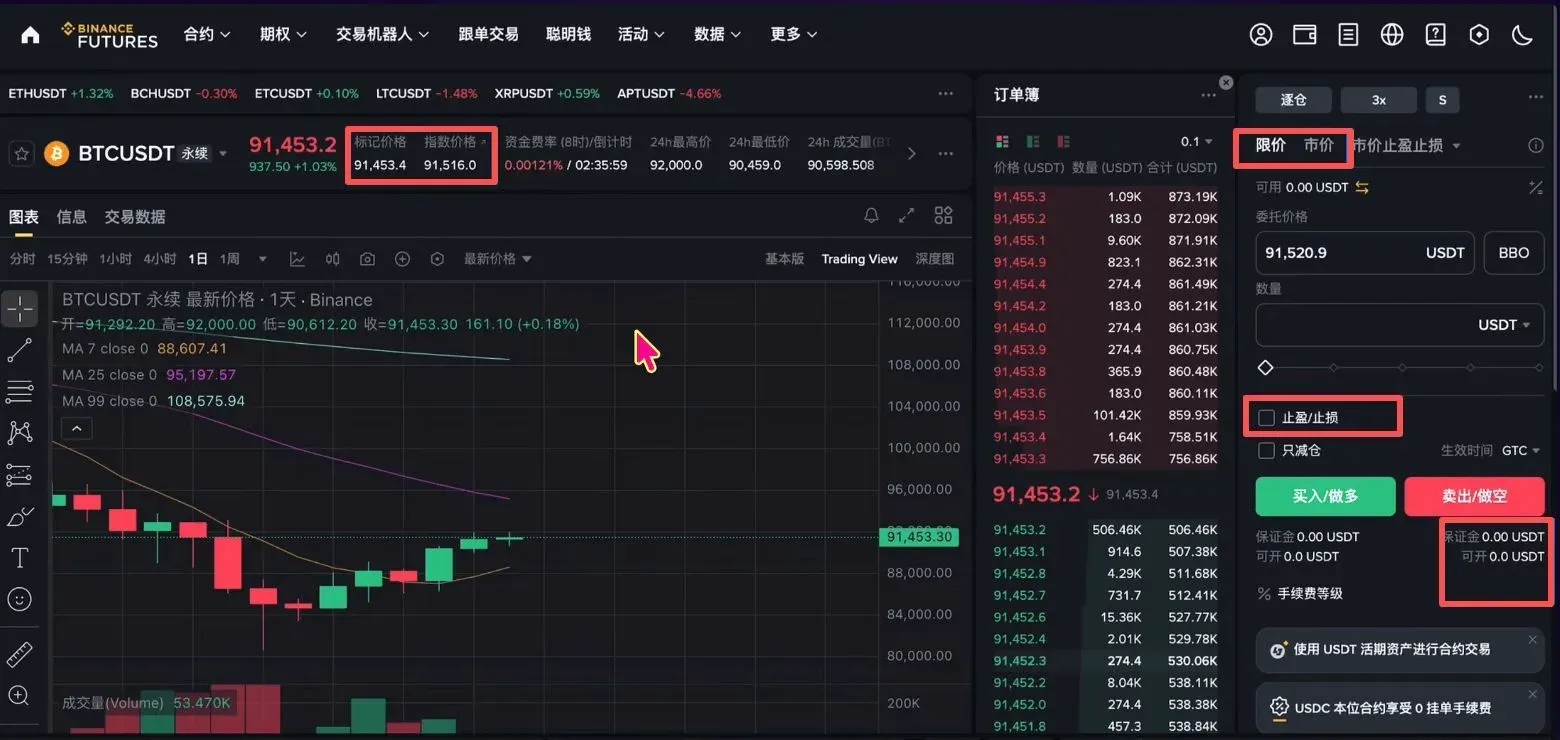
Many beginners find the contract‑trading interface intimidating, but once the key terms are understood you can get up to speed quickly. The image below shows typical labels:

- Index price: The weighted average across major spot markets.
- Mark price: The reference price for the perpetual contract, i.e., the current contract price used for P&L calculations.
- Limit order: An order placed at a specific target price; it only executes when the market reaches that price.
- Market order: Executes immediately at the best available price.
- Take‑profit / Stop‑loss: Predetermined price levels that automatically close the position when profit or loss thresholds are hit.
- U‑denominated contract: Uses a USD‑pegged stablecoin (e.g., USDT, BUSD) as margin and settlement unit, such as BTCUSDT.
- Coin‑denominated contract: Uses a non‑stablecoin (e.g., ETH, BNB) as margin and settlement unit. Beginners are generally advised to start with U‑denominated contracts.
Trading Fee Explanation
Using Binance as an example, perpetual contract fees are split into two categories:
- Taker fee (market orders or limit orders that fill immediately): 0.04 % of the margin amount.
- Maker fee (limit orders that sit on the order book before being filled): 0.02 % of the margin amount.
Exchanges lower maker fees to encourage liquidity provision.
Liquidation Mechanism in Depth
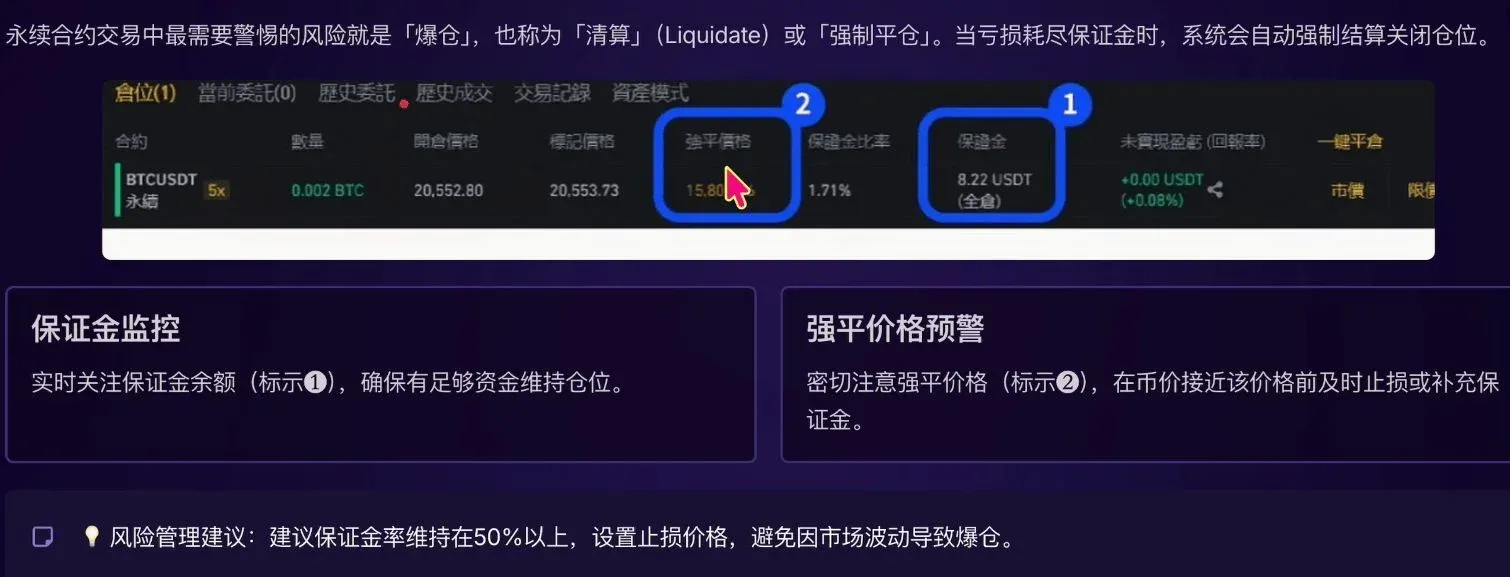
Because of leverage, perpetual contracts carry a heightened risk of liquidation (also called “clearance” or “forced close”). Liquidation does not only happen when losses exceed 100 %; the exchange will trigger a partial or full liquidation once the margin approaches depletion, protecting both long and short parties. Knowing the liquidation price and promptly adding margin or setting stop‑loss orders can significantly reduce the chance of an involuntary close.
Risk Analysis: Liquidation and “Spike” (Flash Crash)
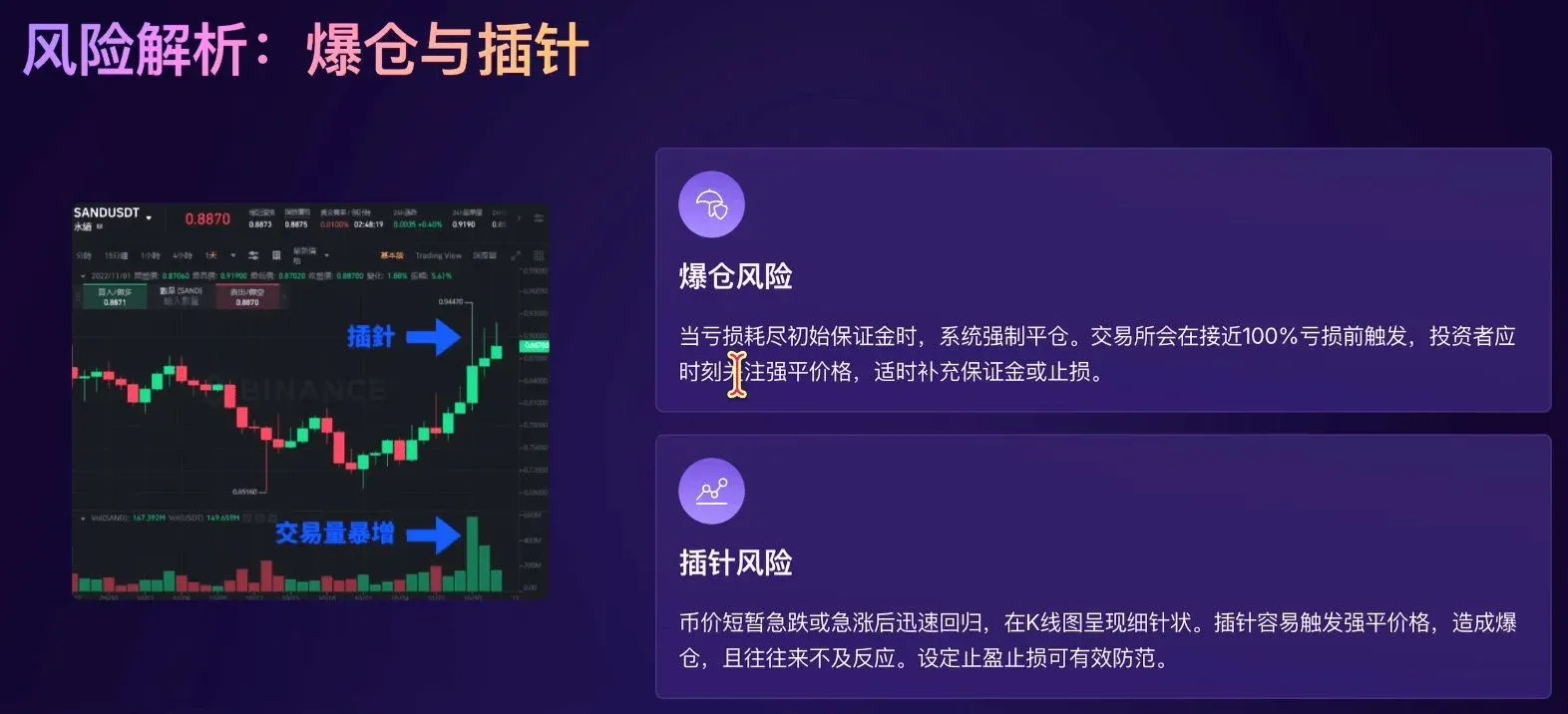
Besides forced liquidation, price “spikes” (or flash crashes) are another risk to watch. A spike is a very short‑term, sharp price movement that quickly reverts, often appearing as a tiny dotted line on a candlestick chart. Because spikes can instantly hit the liquidation price, a position may be liquidated before the trader has a chance to add margin. Properly setting take‑profit and stop‑loss levels can mitigate the impact of such sudden events.
Four Practical Application Strategies
- Long or Short – When technical analysis, news flow, or on‑chain metrics suggest a short‑term rise or fall for a particular coin, you can directly take a long or short position via a perpetual contract.
- Leverage Trading – Use leverage to amplify potential returns, while remembering that risk is amplified as well; employ it cautiously.
- Hedging Arbitrage – If you hold spot assets and are worried about a near‑term decline, you can short the same coin’s perpetual contract to hedge, protecting your capital or reducing losses.
- Basis (Funding‑Rate) Arbitrage – Simultaneously buy the spot asset and short the perpetual contract to capture the funding‑rate differential, while keeping overall exposure balanced.
Perpetual contracts are fundamentally a neutral financial instrument. When used correctly and combined with well‑placed take‑profit and stop‑loss orders, they can help investors achieve reasonable returns and become a powerful tool in a diversified crypto portfolio. Nevertheless, always maintain a strong risk‑management mindset.
Tax note: Crypto‑related gains, including those from perpetual contracts, may be taxable in your jurisdiction. Consult a tax professional to ensure compliance with local regulations.
This concludes the article. For more details on perpetual contracts, you may search the Bitaigen (比特根) archive or follow the related links below. Thank you for supporting Bitaigen!
---
💡 Register on Binance with referral code B2345 for the maximum trading fee discount. See Binance complete guide.



