
 Bitaigen Research
Stablecoin de‑peg refers to the phenomenon where the price of a stablecoin that is supposed to be anchored to the US dollar shows a noticeable deviation (for example $0.90 or $1.10) and does not recover the one‑to‑one parity within a brief timeframe.
When a stablecoin loses its expected $1 anchor, the entire crypto ecosystem can feel the shock: liquidity and confidence in DeFi protocols, exchanges, and lending markets may all experience a cascading effect.
In this article we systematically outline the nature, causes, and potential risks of stablecoin de‑peg events. Using typical examples such as USDe, UST and others, we dive deep into the underlying mechanisms and the chain‑reaction impact on the DeFi ecosystem. Our goal is to help readers separate fact from hype, and to improve their ability to identify and mitigate risks.
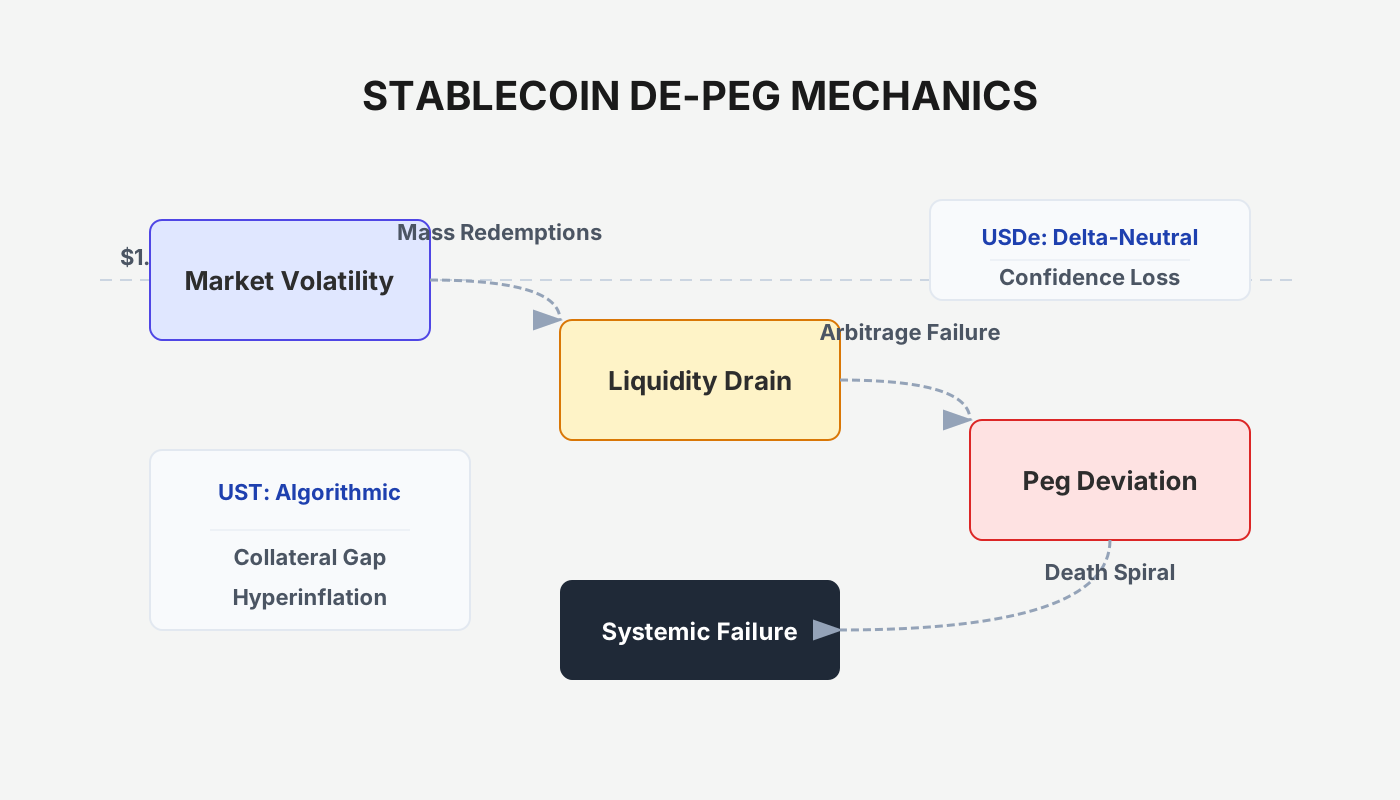
What is stablecoin de‑peg?
Stablecoin de‑peg describes a token that should maintain a price of $1 but whose market trading price deviates markedly from that benchmark and fails to return to parity in the short term. When the deviation persists for several hours or even days, it can spill over into DeFi, trading and lending markets, eroding trust in the broader crypto system.
A minor fluctuation of less than 1 % is considered normal, but prolonged large‑scale deviations or sharp drops often signal deeper stress. Moody’s data shows that from early 2020 to mid‑2023 more than 1,900 de‑peg incidents were recorded, of which 609 involved major stablecoins.
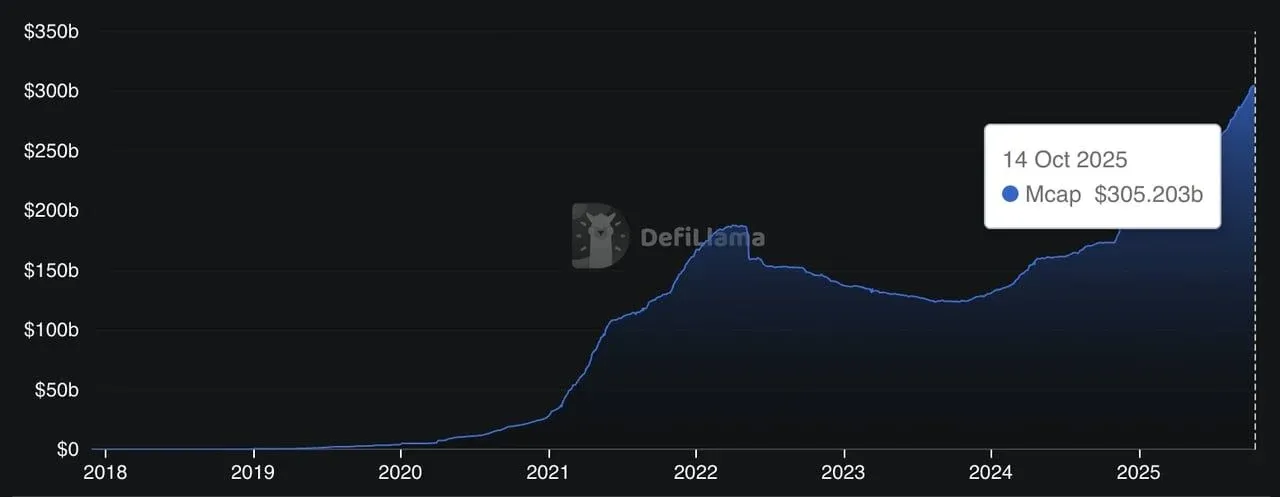
Total stablecoin market cap (source: DefiLlama)
According to OCBC (Oversea‑Chinese Banking Corporation) data, by October 2025 the stablecoin market size had surpassed $305 billion, dominated by fiat‑backed issuers such as USDT and USDC. Among the 1,914 de‑peg events counted by Moody’s, 609 involved mainstream stablecoins; most were brief deviations, while a few—most notably UST and USDR—experienced catastrophic collapses. It is worth noting that USDC briefly fell to $0.8789 during the Silicon Valley Bank crisis in March 2023, but rebounded quickly once its reserves were confirmed. By contrast, the 2022 collapse of Terra UST/LUNA erased several hundred billion dollars of market value and permanently damaged confidence in algorithmic models.
How stablecoins maintain their peg
Before exploring the causes of de‑peg, it is essential to understand the anchoring mechanisms used by different categories of stablecoins.
1. Fiat‑backed stablecoins
These tokens hold US dollars, US Treasury bills or cash equivalents in reserve, theoretically enabling a 1:1 redemption. Representative examples include USDT and USDC. When the price falls below $1, arbitrageurs buy the token and redeem it for fiat; when the price rises above $1, they mint new tokens and sell them, thereby restoring price equilibrium.
2. Crypto‑collateralized stablecoins
Tokens such as DAI use over‑collateralized crypto assets. For each $1 of DAI minted, typically at least $1.5 worth of ETH or other pledged assets are locked. If the value of the collateral drops, the system automatically liquidates positions to preserve solvency.
3. Algorithmic or synthetic stablecoins
Algorithmic stablecoins rely on smart‑contract rules and auxiliary tokens to adjust supply and demand. They can scale quickly but are highly dependent on market confidence. When confidence collapses, the peg mechanism can disintegrate just as rapidly.
4. Hybrid or RWA‑backed stablecoins
Emerging stablecoins may hold tokenized real‑world assets (RWA) such as real‑estate or short‑term bonds. While transparency improves, large‑scale redemption can exhaust liquidity, creating a de‑peg risk despite the presence of “real” assets.
Six common triggers of de‑peg
| # | Trigger | Typical manifestation | Representative case |
|---|---|---|---|
| 1 | **Liquidity shock** | Large‑scale redemptions drain reserves or on‑chain liquidity pools, pushing price below $1 | USDR fell to roughly $0.51 in October 2023 |
| 2 | **Reserve or counter‑party risk** | Bank or custodian holding the reserves goes bankrupt or is frozen by regulators | USDC price dropped to $0.8789 in March 2023 |
| 3 | **Mechanism failure** | Mint/burn logic breaks, causing a self‑reinforcing price spiral | Terra UST collapse in 2022 |
| 4 | **Oracle or exchange failure** | Bad data source or thin order book leads to abnormal pricing | USDe briefly hit $0.65 on Binance in 2025 |
| 5 | **New‑coin liquidity gap** | Insufficient initial liquidity results in volatile pricing | USST slipped to $0.96 after launch |
| 6 | **Market panic or macro pressure** | Global risk events trigger simultaneous redemptions across multiple coins | Multiple stablecoins briefly de‑pegged in October 2025 |
Even the most robust stablecoins can de‑peg if several of the above factors converge.
Real‑world de‑peg cases
1. Ethena USDe (October 2025)
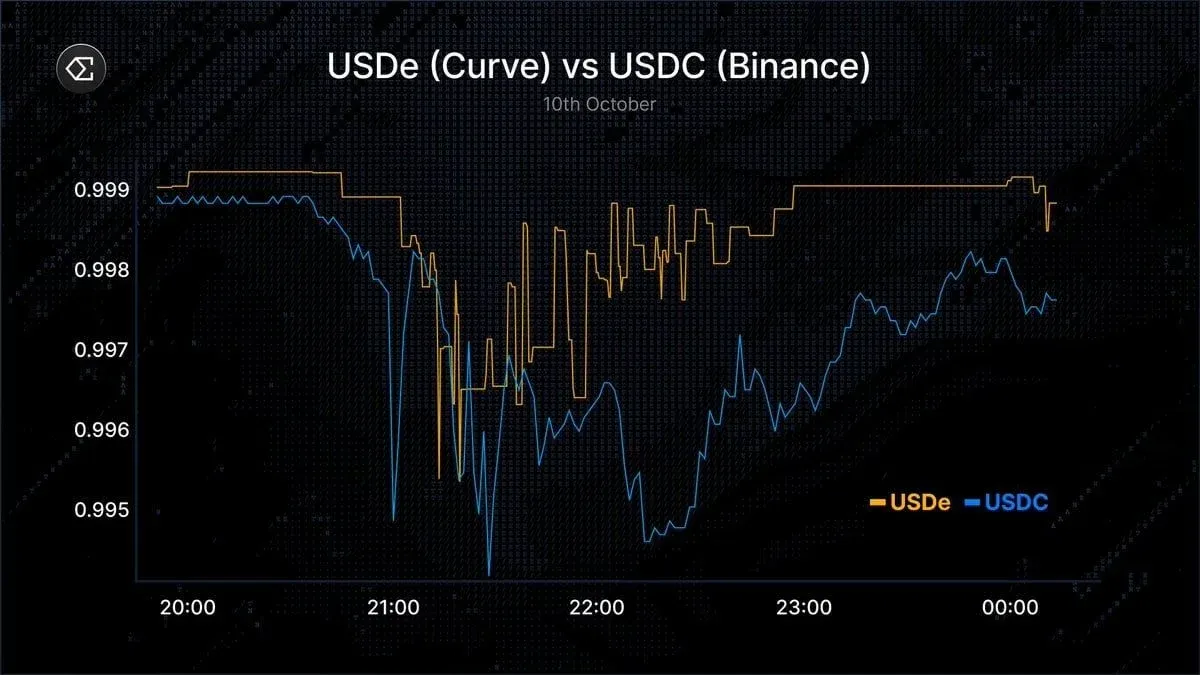
During the market plunge of October 2025, USDe on Curve and Binance (U.S. users should access Binance.US) briefly traded at $0.65 on Binance. The cause was an oracle that relied solely on a thin order‑book rather than a deeper liquidity index. Although the chart shows dramatic volatility, Ethena officially confirmed that its Delta‑hedged reserve remained fully collateralized and redemptions were unaffected; the peg recovered within about an hour. This example illustrates how exchange‑specific oracle errors can create a “false de‑peg” in turbulent market conditions.
2. STBL USST (October 2025)
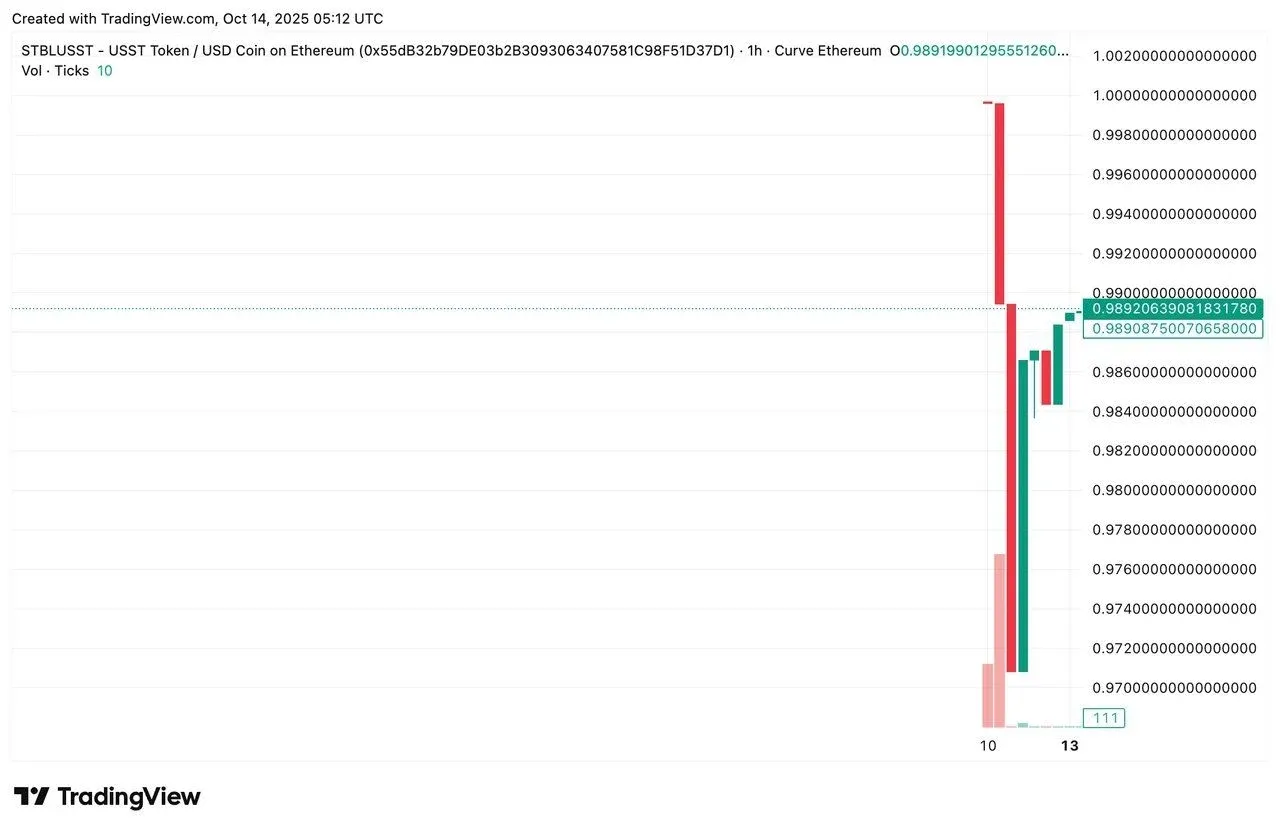
Soon after launch, USST fell to around $0.96 due to thin liquidity and speculative selling. The lack of deep market making made the token vulnerable to slippage and delayed arbitrage. STBL later partnered with Ondo Finance to introduce $50 million worth of USDY (tokenized US‑Treasury yield assets) as collateral, improving transparency and redemption credibility. This case highlights how newly issued stablecoins can experience short‑lived de‑pegs before sufficient liquidity and trust are established.
3. Real USD (USDR) – Tangible Protocol (October 2023)
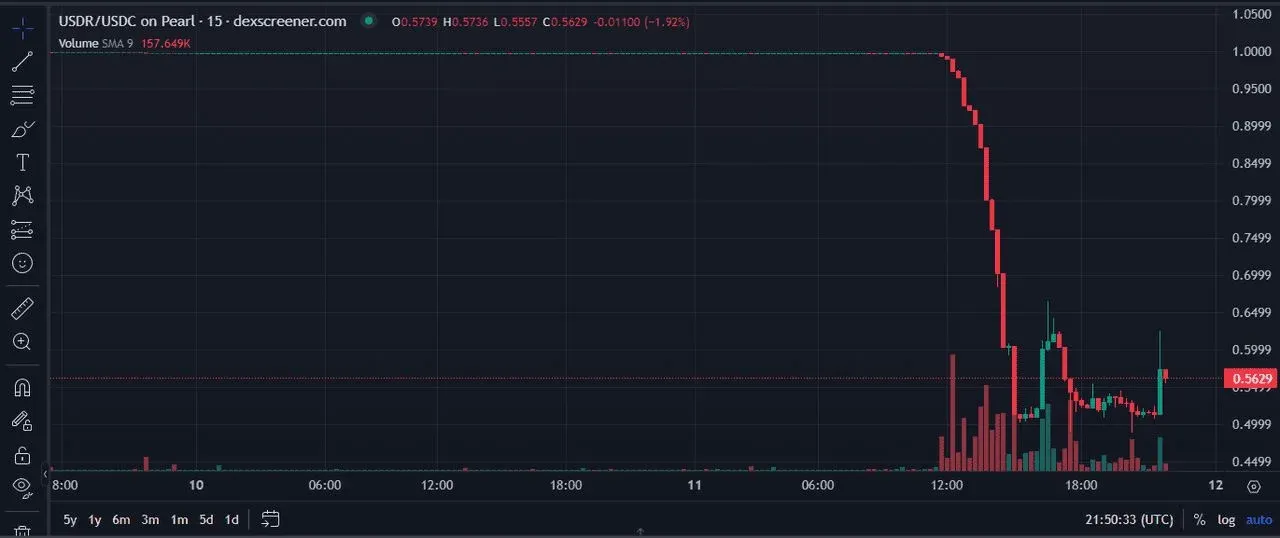
USDR is backed by tokenized real‑estate and DAI. In October 2023, a massive redemption wave exhausted its DAI buffer, driving the price down to roughly $0.51. The remaining real‑estate tokens lacked sufficient liquidity to satisfy withdrawal demands quickly, causing the peg to collapse. Although the on‑chain balance was technically over‑collateralized, asset liquidity and redemption speed did not match, confirming that “backed” does not automatically mean “liquid”.
4. USDC (March 2023)
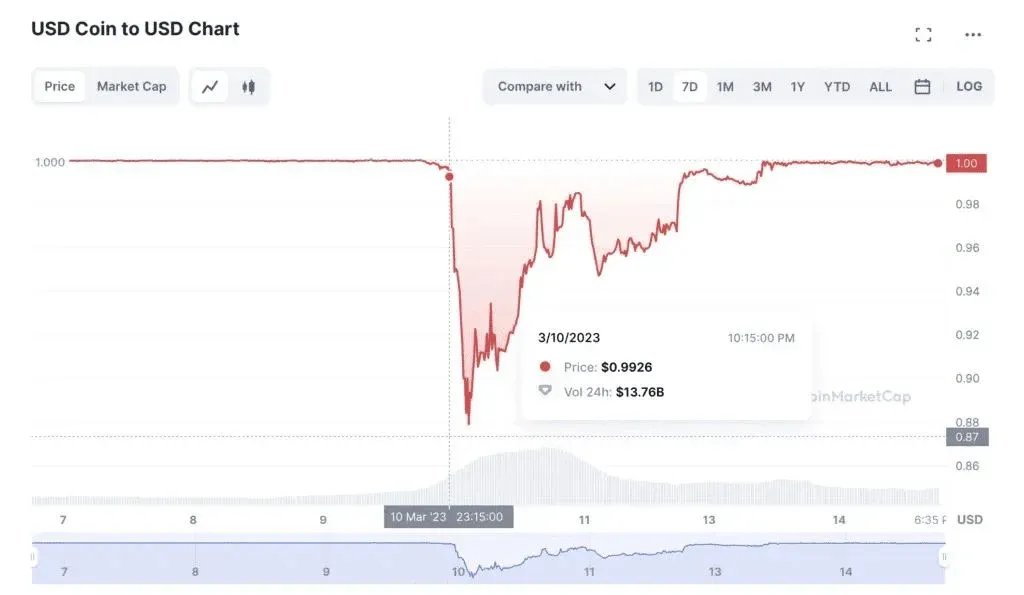
After the collapse of Silicon Valley Bank, USDC saw $33 billion of its $400 billion reserve temporarily frozen, triggering a panic sell‑off that pushed the price down to $0.8789. Market capitalization evaporated by tens of billions of dollars within hours. Regulators later guaranteed the SVB deposits, allowing USDC to swiftly restore its peg; the circulating supply shrank by about $19 billion due to the redemption surge. This episode demonstrates that fiat‑backed stablecoins are also exposed to counter‑party and banking concentration risk, underscoring the importance of diversified custodial arrangements.
5. Terra UST / LUNA (May 2022)
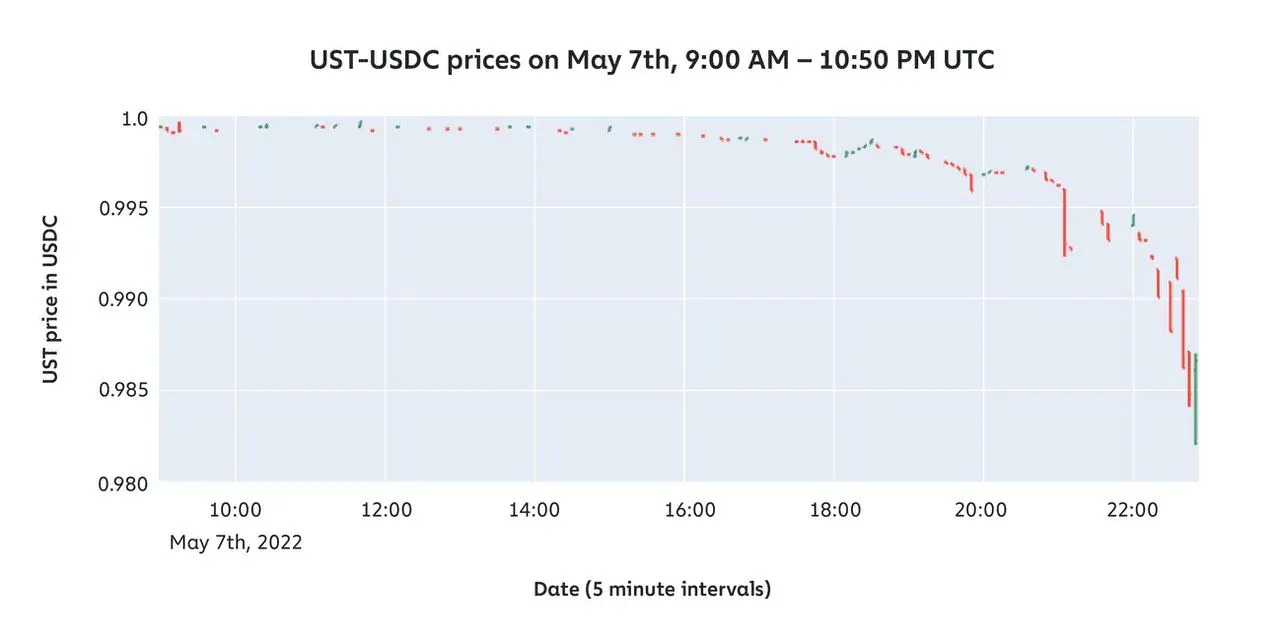
UST, a pure algorithmic stablecoin, suffered a confidence shock that led holders to redeem massive amounts of UST for LUNA, triggering a hyper‑inflationary feedback loop. Within days both tokens fell from $1 to under $0.10, wiping out more than $40 billion in market value. The case proves that a purely algorithmic model lacks an intrinsic self‑healing mechanism; once redemption pressure exceeds the system’s capacity, mathematical recovery becomes impossible.
Impact of de‑peg on crypto investors
- Capital loss and volatility: Any price below $1 creates an immediate loss; for example, a $10,000 position valued at $0.90 incurs a $1,000 loss.
- DeFi liquidation cascade: Stablecoins serve as key collateral in lending and derivatives protocols; even modest de‑pegs can trigger multi‑chain liquidation spirals.
- Liquidity freeze: Market makers may withdraw under pressure, widening bid‑ask spreads, raising redemption costs, or even preventing completions.
- Erosion of confidence: Each de‑peg event chips away at system trust, nudging users toward “safer” assets and further draining liquidity.
- Regulatory backlash: High‑profile de‑peg incidents often attract regulatory scrutiny, potentially leading to stricter compliance requirements that limit trading pairs or DeFi participation.
*Note: Crypto gains may be taxable in your jurisdiction. Consult a tax professional to understand your obligations under local law.*
Ten‑step guide to reduce de‑peg risk (practical measures)
- Diversify holdings: Allocate across fiat‑backed USDC/USDT, decentralized DAI/sDAI, and a modest amount of yield‑bearing tokens such as USDe.
- Prioritize transparency and depth: Choose coins that publish audited reserve reports, disclose collateral data, and enjoy deep liquidity on platforms like Curve and Uniswap.
- Monitor reserve locations: Know which banks, Treasury securities or money‑market funds hold the reserves, and stay alert to any counter‑party stress or regulatory intervention.
- Set exposure caps: Keep stablecoin exposure between 10 %–30 % of your total portfolio, adjusted for your personal risk tolerance.
- Track liquidity metrics in real time: Use tools such as DeFiLlama or Curve; when a single token accounts for more than 60 % of a liquidity pool, treat it as a warning signal.
- Create price alerts: Treat a dip below $0.995 as an early warning; if the price falls under $0.98, consider moving to another stablecoin or a mainstream crypto asset.
- Verify redemption pathways: Ensure you can redeem directly with the issuer or a trusted custodian, not solely through third‑party platforms.
- Avoid excessive leverage: When using stablecoins for leveraged positions or liquidity mining, maintain conservative margin ratios and monitor liquidation thresholds closely.
- Employ hedging tools: Experienced users may hedge de‑peg risk with short positions, options, or delta‑neutral strategies.
- Follow official communications: During market turbulence, prioritize information from issuers, exchange dashboards, or on‑chain data over unverified community rumors.
Summary
Stablecoins provide the backbone for trading, DeFi lending, and on‑chain settlement in the crypto economy, but they are not risk‑free. Even top‑tier tokens can de‑peg under pressures such as banking issues, liquidity dry‑ups, or oracle failures. Investors should treat stablecoins as “digital dollars” and mitigate potential losses through diversification, transparency checks, and continuous monitoring. By staying vigilant about liquidity, reserve safety, and official updates, participants can maintain a relatively resilient stance in the volatile crypto market.
Frequently asked questions about stablecoin de‑peg
1. What does “stablecoin de‑peg” mean in the crypto space?
It refers to a situation where a stablecoin’s market price deviates significantly from its $1 anchor—for example, a token labelled $1 actually trades at $0.90.
2. Are all de‑peg events risky?
Not necessarily. Small or brief deviations are often corrected automatically through arbitrage; however, large, sustained de‑pegs like those seen with UST or USDR can lead to permanent value loss.
3. Which stablecoins have recently experienced de‑peg?
Recent examples include USDe, USST, USDC, UST, and USDR, each triggered by liquidity gaps, oracle errors, or reserve pressure.
4. How can I tell if a stablecoin is safe from de‑peg?
Watch real‑time reserve data, third‑party audit reports, and on‑chain liquidity depth. Avoid tokens with opaque reserves or untested algorithmic designs.
5. Which type of stablecoin is relatively safer?
Historically, fiat‑backed stablecoins with audited reserves and solid redemption mechanisms—such as USDT and USDC—recover more quickly after shocks.
---
This concludes the article. For a more comprehensive analysis of stablecoin de‑peg, please search for previous Bitaigen (比特根) articles or continue browsing the related content below. Thank you for supporting Bitaigen (比特根)!
Related Reading
- USDe Stablecoin Slides 35% Off Peg on Binance
- USOR Tokenization: Linking U.S. Oil Reserves to Blockchain
- Mantra (OM) Token: RWA Tokenization, Staking & Governance
💡 Register on Binance with referral code B2345 for the maximum trading fee discount. See Binance complete guide.



