
 Bitaigen Research
 In this article we outline Strive analysts' deep analysis of AI‑driven deflation and monetary policy, explore how it could reshape Bitcoin’s long‑term value landscape, and break down the logic behind the key assumptions. To understand what these forward‑looking views might mean for future asset allocation, keep reading.
Strive analyst Joe Burnett argues that AI‑induced deflation will push policymakers toward easing, and he projects that Bitcoin could reach roughly $11 million per coin by the first quarter of 2036.
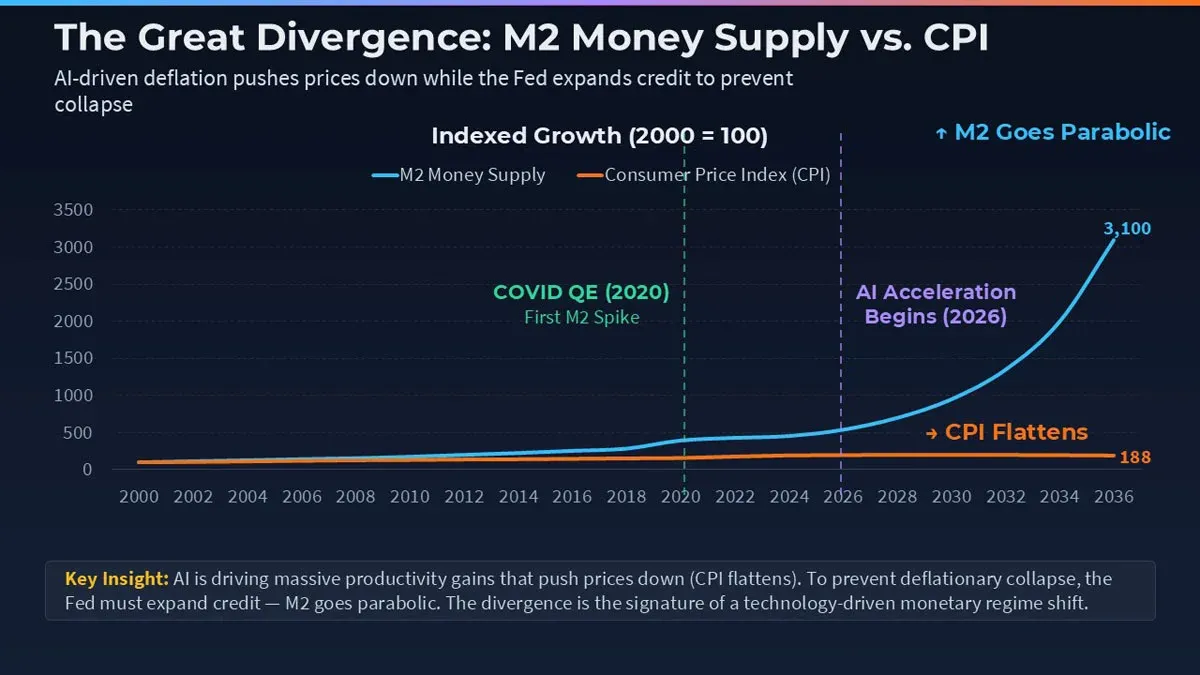
In his latest report, Burnett notes that productivity gains from artificial intelligence are expected to depress the prices of goods and services, squeeze profit margins, and consequently force central banks to continuously expand the money supply to avoid a deflationary spiral. This AI‑deflation mechanism forms the cornerstone of his forecast.
Key Assumptions and Projected Outcomes
- The share of Bitcoin market capitalization within global financial assets is expected to rise from the current ~0.2 % to about 12 %.
- Global wealth is assumed to grow at a compound annual growth rate (CAGR) of roughly 7 %.
- Based on the above premises, the Bitcoin market cap would expand about 176‑fold over a ten‑year horizon, reaching approximately $230 trillion.
“My baseline budget for Q1 2036 is $11 million per Bitcoin.” — Joe Burnett
The AI‑Deflation Engine as a Driver of Structural Money Expansion
AI‑deflation refers to the persistent downward price pressure generated by AI‑driven automation and cost reductions. Burnett contends that within a debt‑based fiat monetary system, deflation forces wages and asset prices lower while nominal debt obligations remain unchanged, thereby heightening instability in credit markets.
“As artificial intelligence drives real‑economy deflation, central banks and fiscal authorities will inject liquidity to stave off a deflationary spiral.”
Under such conditions, money supply would continue to outpace scarce assets such as Bitcoin.
The Rise of “Digital Credit” and Its Impact on Bitcoin Demand
The report also highlights an emerging “digital credit” model being championed by institutions—including the world’s largest corporate Bitcoin holder Strategy. The model works by offering investors USD‑denominated income through publicly traded securities that are collateralized by large Bitcoin balance‑sheet assets issued by a treasury‑company. The proceeds are then used to acquire additional Bitcoin.
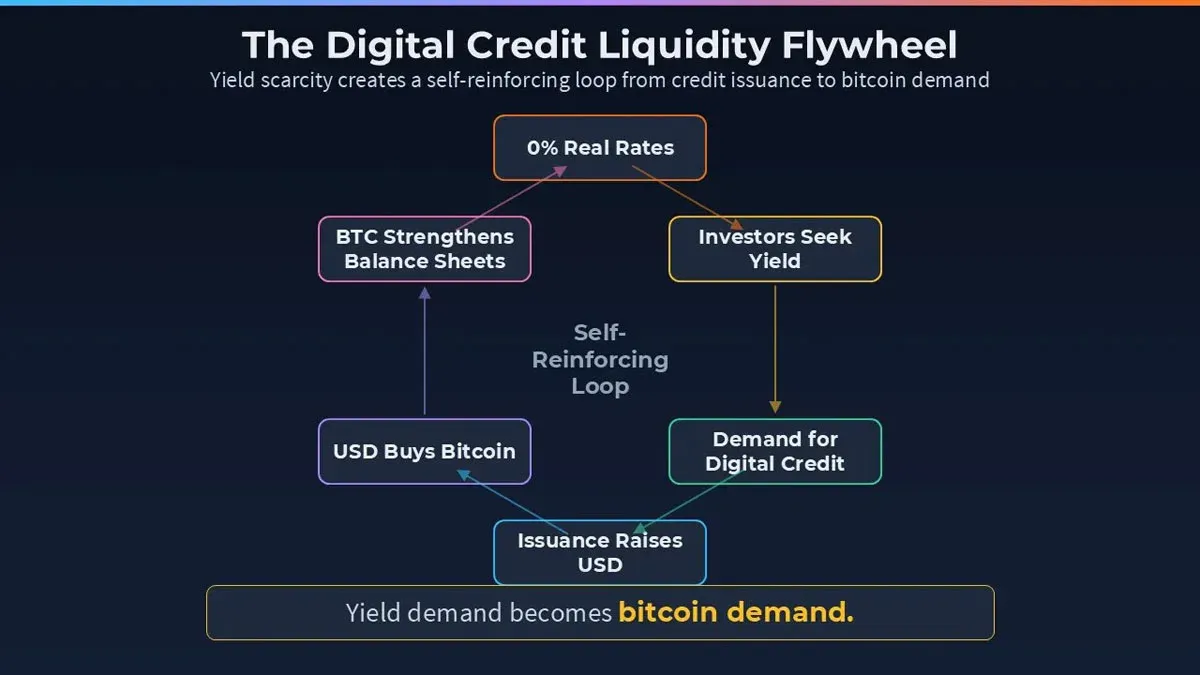
Burnett foresees that digital credit products will create a “reflective loop” between global yield demand and Bitcoin accumulation, marking what he describes as “the early stage of a credit system built on a verifiable scarce monetary base.”
Market View Comparison
- Nic Puckrin, co‑founder and chief market analyst at Coin Bureau, says the forecast implies Bitcoin could eventually equal roughly ten times the current U.S. M2 money supply, about four times the present U.S. stock‑market valuation, and roughly twice the size of global GDP.
- He adds that this translates to an implied CAGR of around 53 %. While Bitcoin’s historical annual growth rate from 2015‑2024 has hovered near 60 %, the analyst cautions that as market cap expands, the pace of growth is likely to moderate.
How This Forecast Differs From Others
Compared with bullish scenarios that rely on shorter time frames, the $11 million target appears considerably more aggressive. For instance, ARK Invest’s November 2025 report set a bullish 2030 Bitcoin price of $1.5 million and a bearish target of $300 k.

The above constitutes a full breakdown of the Strive analyst’s AI‑deflation‑based price projection for Bitcoin in 2036. For further insight into AI‑deflation, the 2036 Bitcoin outlook, and additional Strive material, stay tuned to upcoming posts from Bitaigen (比特根).
*Note for U.S. readers: when accessing cryptocurrency exchanges, be sure to use Binance.US rather than the global Binance platform. Additionally, cryptocurrency gains may be taxable under local jurisdiction; consult a tax professional for guidance.*
Related Reading
- Bitcoin Price Forecast: Technical & Sentiment Analysis Predict Consolidation
- Bitcoin Price Forecast 2026‑2040: Extreme Panic vs Institutional Accumulation
- Bitcoin Price Forecast 2026: Trends, Drivers & Charting Tips
💡 Register on Binance with referral code B2345 for the maximum trading fee discount. See Binance complete guide.



