
 Bitaigen Research
The Bitcoin network recently surpassed the milestone of 20 million coins mined. At the current issuance rate, roughly 450 new coins enter circulation each day. Because of the halving event that occurs every four years, the remaining one million bitcoins expected to be mined this century are projected to be fully extracted around the year 2140.
Energy Co’s managing partner David Eng noted on X this past Sunday: “We are about to enter a global‑asset era with virtually no new supply.” This view echoes the market’s focus on scarce digital assets.
In this article we outline Bitcoin’s recent milestone, analyze how tightening supply reinforces its scarcity, and, drawing on industry experts, explore the potential implications for the global asset landscape. If you want to understand the mechanics behind it and the outlook ahead, keep reading.
Bitcoin’s limited supply provides “predictable rules”
Raphael Zagury, chief executive officer of Elektron Energy, told Cointelegraph that Bitcoin’s supply schedule remains transparent for decades to come, and that its unprecedented predictability is a trait highly valued when dealing with wealth.
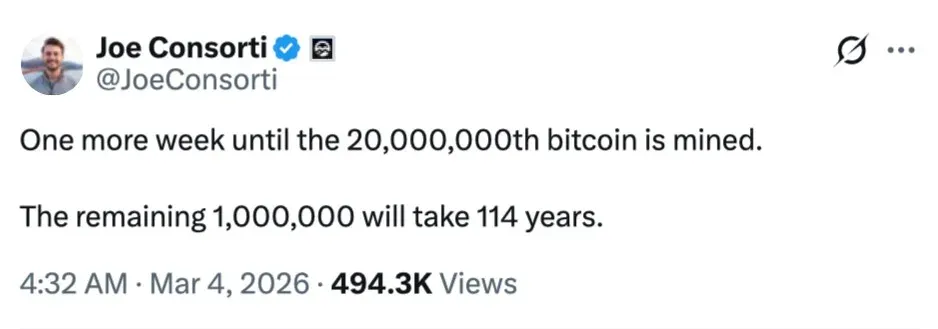
In a report by Joe Consorti, Swyftx portfolio manager Tommy Rogulj added: “The countdown to the final one million underscores Bitcoin’s unique hard‑cap characteristic.” He pointed out that Bitcoin is a permissionless, neutral asset with a fixed supply curve that cannot be expanded arbitrarily like fiat currencies—a feature that gains importance amid rising geopolitical tensions and technological uncertainty.
In December of last year, Grayscale Investments voiced a similar sentiment: a transparent, predictable, and ultimately scarce digital‑currency system is increasingly favored in the current economic environment due to the tail‑risk associated with sovereign money.
“No event, no impact” on BTC price: crypto executives
Even though the supply milestone draws attention, several analysts believe its short‑term impact on Bitcoin’s price will be limited.
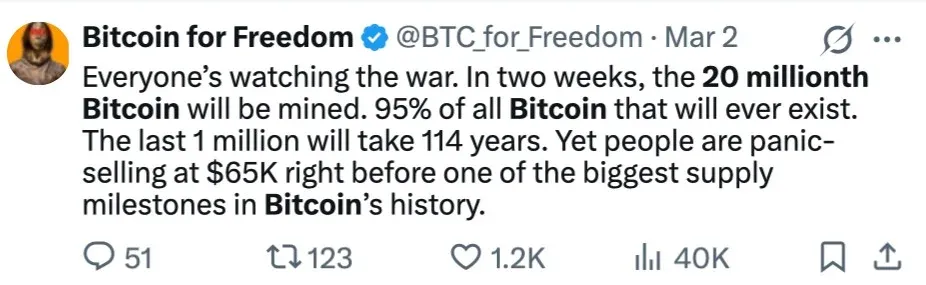
According to data from Freedom Bitcoin, Charles Edwards, founder of Capriole Investments, told Cointelegraph: “The market has already priced in the supply growth rate (inflation), and the current inflation rate is now lower than that of gold. I don’t see this generating a significant shock.” Zagury’s view aligns with Edwards’s; he believes “this milestone alone is unlikely to push prices higher in the short term, as liquidity and macro‑economic factors remain dominant.” Nevertheless, Zagury added that, over the long run, scarcity combined with a predictable issuance schedule forms a powerful combination that markets tend to reward.
CoinMarketCap data shows that at the time of publication Bitcoin was trading around $68,670 USD, having experienced roughly a 19 % correction over the past year.
What happens after Bitcoin’s supply ends?
When the last bitcoin is mined—estimated around 2140—the network’s security incentives will shift from block rewards to transaction fees. Industry observers warn that this transition could raise fee levels, but it also means miners will continue to earn revenue by processing transactions, thereby maintaining the chain’s security.
Bitcoin (BTC) enthusiasts are using the birth of the 20 millionth coin as an opportunity to underscore its scarce nature. For more updates on the 20 millionth Bitcoin, follow Bitaigen (比特根) and its related coverage.
*Note for U.S. readers: When accessing cryptocurrency exchanges, U.S. residents should use Binance.US rather than the global Binance platform. For fiat deposits and withdrawals, SEPA (for EUR) or SWIFT (for USD) are commonly used.*
Related Reading
- Corporate Treasuries Turn to Bitcoin: A‑Share Leaders 2025
- Bitcoin Breaks $90k, Ethereum $2k: Technical Analysis Tips
- How Many BTC Does Binance Founder CZ Actually Own?
💡 Register on Binance with referral code B2345 for the maximum trading fee discount. See Binance complete guide.



