
 Bitaigen Research
 Bitcoin’s Identity Crisis: Why It Is Becoming Less Like a Safe‑Haven Asset
Because in the 2025‑2026 macro environment, Bitcoin’s performance under tight liquidity conditions has become highly synchronized with software stocks, showing volatility more akin to high‑risk growth equities rather than traditional safe‑haven assets.
---
Everyone Is Asking the Wrong Question
Since Bitcoin hit its all‑time high of $126,000 on October 6 2025, the price has retreated roughly 50 %. In the same period, gold reached a new peak of $5,595 on January 29 2026, up more than 25 %. The crypto market’s Fear & Greed Index fell to just 5 on February 6, lower than the level seen during the FTX collapse, and only barely recovered to the teens afterward. Commentators in the crypto community have once again debated whether Bitcoin is digital gold.
Core premise: An asset’s identity is not fixed. Under different macro regimes, Bitcoin’s behavior has shifted repeatedly—in 2017 it moved in lockstep with gold, in 2021 it trailed tech stocks, and from the end of 2024 to the present it has closely followed software stocks.
For institutional investors the more pressing question is: What factors are driving Bitcoin’s price in today’s liquidity‑constrained environment?
Data up to February 2026 shows that Bitcoin behaves more like a highly volatile software stock. Whether this is a temporary macro resonance or a permanent redefinition of Bitcoin’s role in portfolios remains to be seen, but the numbers can no longer be ignored.
We examine Bitcoin’s recent performance from a macro perspective, dissect its divergence from traditional safe‑haven assets, and explore the key drivers under tight liquidity. This article provides data‑backed correlation analysis to help investors reassess Bitcoin’s place in an asset mix. It is worth a careful read.
How Strong Is This Correlation? How Long Has It Lasted?
Bitcoin’s relationship with the software‑stock‑tracking ETF IGV has deepened in three distinct phases:
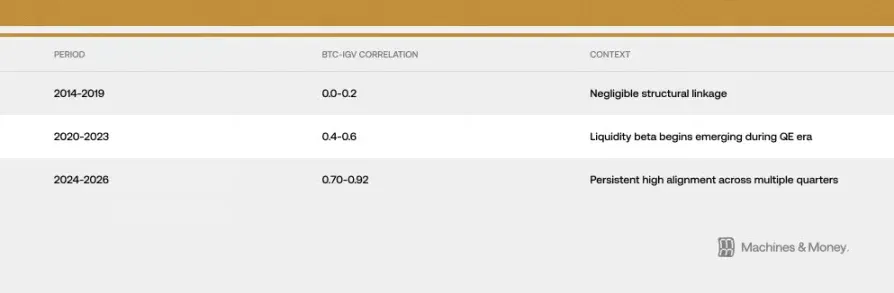
- 30‑day rolling correlation: Approximately 0.73 as of late February 2026.
- Duration of high correlation: A correlation above 0.5 has persisted for 18 months, far exceeding the typical 3‑6 month short‑term style shift, yet still short of the 4‑7 year full market cycle needed to confirm a permanent change.
The recent decline further highlighted the synchronicity: IGV fell about 23 % in 2026, while Bitcoin dropped 19‑20 % over the same span. Over the past month and the past three months the two have moved almost hand‑in‑hand, with Bitcoin’s volatility 1.1‑1.3 times that of the software stocks—well below the commonly cited 2‑3 times multiplier for crypto.
Note: During market turbulence, short‑term correlations can spike even when assets have no fundamental link. However, this round of high synchronization has lasted more than 18 months, suggesting a factor more stable than random noise. Causality or permanence cannot yet be declared.
2025: A Major Test of the “Safe‑Haven” Label
The macro backdrop of 2025—accelerating fiscal expansion, a weakening USD, rising geopolitical risk, stubborn inflation, and market expectations of a Fed rate cut—should have been an ideal proving ground for Bitcoin’s “digital gold” claim. The outcome was surprising:
- Gold: Rose from roughly $4,400 to a new high of $5,595.
- Bitcoin: Fell from $126,000 to just over $60,000.
Both assets operated under the same macro conditions but produced opposite price paths, indicating that their inflation‑hedging capabilities are not equivalent.
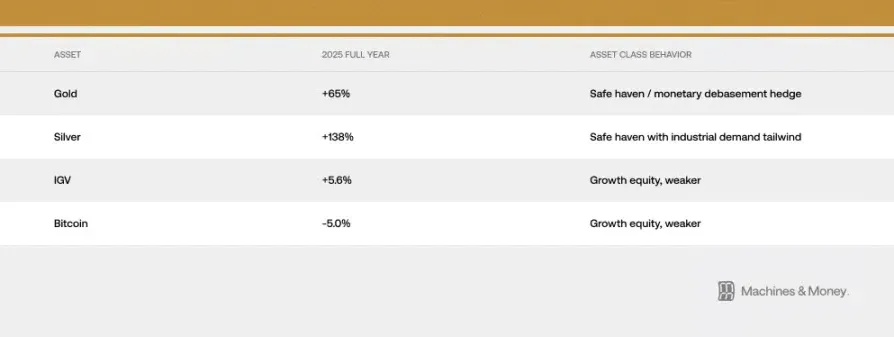
Central banks worldwide bought a cumulative 863 tons of gold in 2025, marking the third consecutive year of sizable net purchases; no central bank bought Bitcoin. This stark divergence in capital allocation is the strongest rebuttal to the “digital gold” argument: in a risk‑off macro climate, institutional and sovereign investors chose gold over Bitcoin at a ratio exceeding 3 : 1.
This does not mean Bitcoin can never act as a safe‑haven; rather, given today’s investor composition, market conditions, and liquidity environment, it has not yet fulfilled that role. In 2025, both Bitcoin and software stocks posted single‑digit returns, while traditional hard assets shone, further reinforcing the convergence narrative.
Why Is This Happening? Three Structural Reasons
1. Shift in How Institutional Capital Is Managed
The launch of Bitcoin ETFs fundamentally altered the way institutions trade the asset.
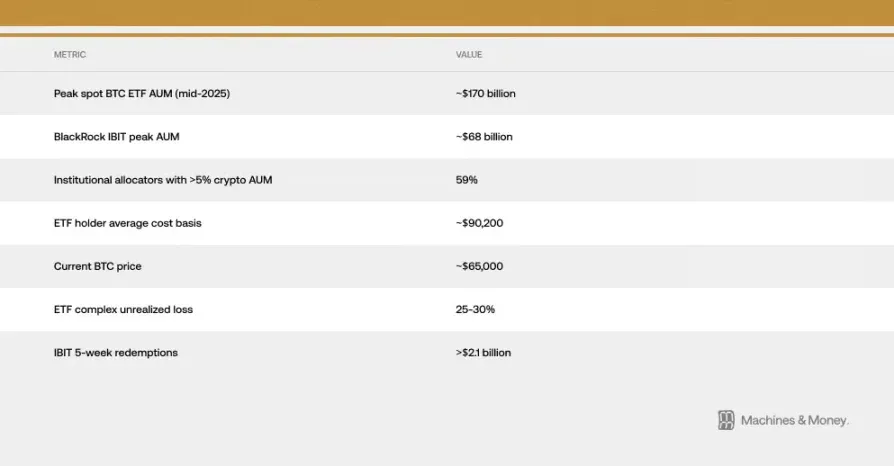
- Unified framework: Institutions now place Bitcoin and software stocks within the same decision‑making model, treating them equally in risk‑control systems.
- Synchronous buying/selling: When a fund reduces exposure to growth‑stock risk, it often sells both software equities and Bitcoin together.
- Cost pressure: The average cost basis of U.S. spot Bitcoin ETFs sits around $90,000, while the market price has slipped to roughly $64,000, generating an unrealized loss of 25‑30 % for the funds. This pressure forces capital that might otherwise be held long‑term into a continuous sell‑off.
Since the start of 2026, redemption cascades from ETFs have been frequent, pushing Bitcoin’s price lower. For example, BlackRock’s iShares Bitcoin Trust (IBIT) saw outflows exceeding $2.1 billion over the past five weeks—a record since the ETF’s inception.
2. Shared “Sensitivity Points” to Macro Variables
Bitcoin and software stocks respond similarly to several macro‑economic drivers:
- Changes in real interest rates
- The size of broad‑money (M2) liquidity
- Federal Reserve tightening or easing cycles
- USD strength/weakness
- Overall market risk appetite (VIX, credit spreads)
Both belong to the class of long‑duration, rate‑sensitive assets: they rise when real rates fall and fall when rates climb. Tightening liquidity squeezes both.
Evidence shows Bitcoin’s price swings are more a reaction to liquidity stress than to the earnings of software firms. For instance, in February 2026 the release of two unrelated AI products triggered noticeable Bitcoin volatility, transmitted through the “institutional pipeline” described above.
VIX movements tell a similar story: a rising VIX leads to simultaneous drops in Bitcoin and software stocks; a falling VIX does not generate a commensurate rally, matching the behavior of high‑volatility growth assets rather than safe‑haven instruments.
3. MicroStrategy’s “Amplifier” Effect
MicroStrategy, the publicly traded company holding the largest Bitcoin stash, is classified on Nasdaq as a software/technology firm. Its stock price mechanically links to the broader software sector.
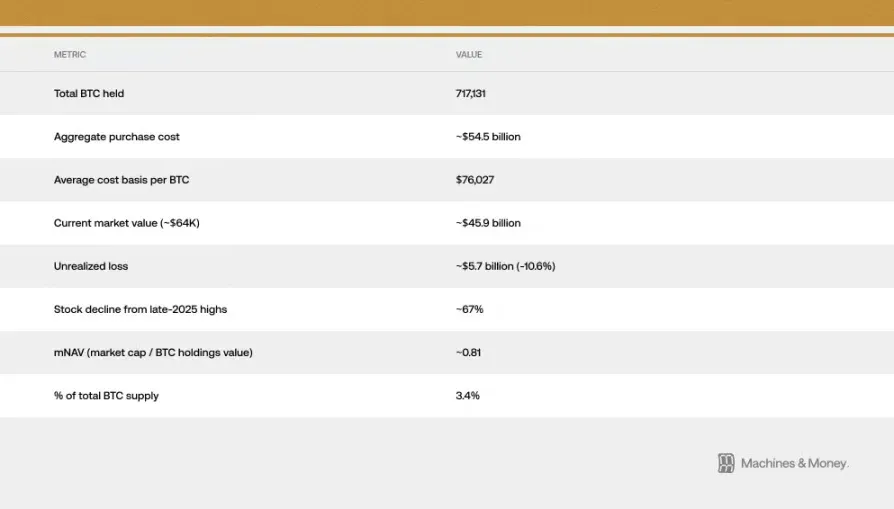
- Bidirectional loop: A decline in the software sector drags MicroStrategy’s share price down, which in turn fuels pessimism about Bitcoin and creates additional selling pressure.
- Amplification: Since the end of 2025, MicroStrategy’s stock has fallen about 67 %, outpacing the declines of both the software‑stock ETF and Bitcoin itself. The company’s market cap has even slipped below the market value of its Bitcoin holdings, creating a “discount‑to‑net‑asset” situation.
In January 2026, MSCI debated removing companies that hold more than half of their assets in digital currencies from its indices. Although the proposal was not enacted, it underscored the fragility of such firms under conventional financial rules.
Looking Ahead: Three Possible Frameworks
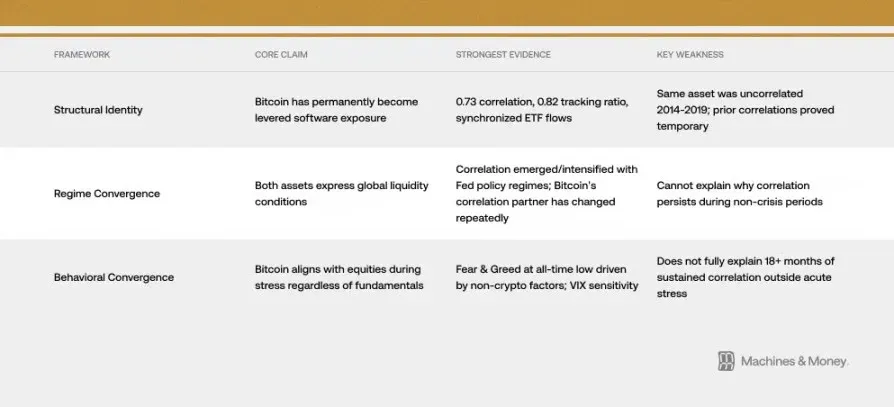
Framework 1: Bitcoin Has Permanently Transformed Into a Leveraged Software Stock
- Evidence: Correlation as high as 0.73, synchronized ETF flows, shared institutional ownership.
- Conclusion: The ETF era permanently embeds Bitcoin within tech‑stock portfolios, altering its risk profile.
- Caveat: Historically Bitcoin‑software correlations have hovered near zero; we must watch whether this relationship survives a full rate‑rise → rate‑cut cycle.
Framework 2: Cyclical Convergence – The Sync Is a Liquidity‑Availability Symptom
- Explanation: In tight‑liquidity phases, Bitcoin and software stocks move together; in a looser monetary environment, the link may dissolve.
- Forecast: If the Fed resumes easing and the 2024 halving effect becomes evident, Bitcoin could outperform software stocks in the second half of 2026, pulling the correlation down to 0.3‑0.5.
Framework 3: “Band‑Together” Effect During Market Stress
- Mechanism: Under panic‑driven risk aversion, Bitcoin clusters with all high‑volatility risk assets, moving in lockstep.
- Illustration: During the VIX surge of 2022, both asset classes fell together; on February 6 2026 the Fear & Greed Index hit a historic low, coinciding with a broad sell‑off of growth‑oriented assets.
Current evidence leans toward Framework 2, yet the institutional mechanics described in Framework 1 could extend the period of high correlation.
What Might Happen? Several Scenarios
| Scenario | Key Assumption | Possible Outcome |
|---|---|---|
| **Scenario 1: Correlation Persists** (Base case) | Liquidity remains tight and macro policy stays unchanged | Bitcoin continues to act like a high‑volatility growth asset; 30‑60‑day rolling correlation stays in the **0.5‑0.8** band |
| **Scenario 2: Paths Diverge** | The Fed initiates easing, halving impact materializes, AI‑related risk concerns fade | Correlation drops to **0.3‑0.5**; Bitcoin may outpace software stocks |
| **Scenario 3: Permanent Convergence** | Correlation climbs above **0.8** and endures across a full easing‑tightening cycle, with major index providers formally classifying Bitcoin as a tech/ growth constituent | Bitcoin’s identity becomes permanently that of a technology/growth asset |
Test criteria: If, during a Fed‑driven easing phase, the correlation remains high, the “identity‑changed” hypothesis gains support; if the correlation weakens markedly after easing, the “cyclical convergence” view is validated.
Until the next round of monetary easing in 2026‑2027, the question stays open.
Conclusion
Bitcoin’s identity has never been static. Its positioning hinges on the investment logic of its dominant holders—today, chiefly institutional investors who treat it as a growth‑stock exposure. While Bitcoin’s underlying technology remains unchanged, market pricing is driven by who holds it and why they hold it. In the present liquidity‑constrained climate, its synchronization with software stocks is a factual observation, not an intrinsic trait. For anyone seeking to understand Bitcoin’s role in a modern portfolio, the focus should be on actual holdings structures and macro‑liquidity dynamics.
---
This concludes the article. For more analysis on Bitcoin’s outlook, search Bitaigen to access prior pieces or continue exploring the links below. Thank you for reading, and we look forward to your continued engagement!
*Disclaimer*: Crypto gains may be taxable in your jurisdiction; consult a tax professional for guidance. U.S. readers should use Binance.US rather than the global Binance platform for any fiat‑on‑ramp activities involving USD, SEPA, or SWIFT transfers.
Related Reading
- Bitcoin Returns to $90K, BlackRock ETF Investors Profit
- Bitcoin dips below $80,000, briefly under $76,000
- Bitcoin & Ethereum ETFs Lose $1B, Market Down 6%
💡 Register on Binance with referral code B2345 for the maximum trading fee discount. See Binance complete guide.



