
 Bitaigen Research
 In this article we outline why Bitcoin experienced a sharp inverse‑V drop after breaking a key price level, and we delve into how the latest US non‑farm payroll data impacts expectations for Federal Reserve rate cuts. By looking at both macroeconomic indicators and on‑chain activity, we aim to help readers identify potential market turning points; subsequent details should not be missed.
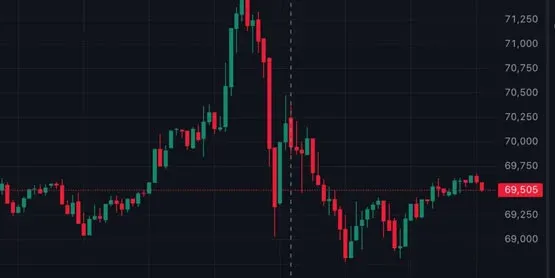
After breaking the $71,500 threshold, Bitcoin saw a rapid sell‑off because US October non‑farm payrolls unexpectedly fell to 12,000 jobs. The market’s expectation of a significant Fed rate cut prompted buyers to withdraw quickly, sending the price tumbling and creating an inverse‑V plunge.
US Non‑Farm Payroll Hits Post‑Pandemic Low
Data released last night by the U.S. Bureau of Labor Statistics show that October non‑farm payroll additions unexpectedly plunged to 12,000, the lowest figure since the pandemic began and far below the market’s prior forecast of 106,000. The prior month’s figure was sharply revised down from 254,000 to 223,000. The October unemployment rate held steady at 4.1%, unchanged from the previous reading and in line with expectations.
Probability of a One‑Point Rate Cut This Month Rises to 98.2%
The sharp dip in the non‑farm data may have been influenced by hurricane damage and strike activity. Fitch Ratings notes that if the estimated strike impact (about 44,000 jobs) reported by the BLS is added back to the October figure and a three‑month moving average is applied, the actual non‑farm employment increase would be roughly 119,000 jobs. Although this remains below the first‑half‑year average of 207,000 per month, it does not represent a dramatic collapse. On this basis, the Federal Reserve is unlikely to base policy decisions solely on the 12,000‑job number.
Goldman Sachs, commenting on next week’s FOMC meeting, said that while the anomalous payroll data caused by strikes and hurricanes could be treated as one‑off events, the weak employment performance lifts the odds of a one‑point rate cut in November. The Fed is expected to keep monetary policy accommodative.
According to the CME FedWatch Tool, market expectations for a one‑point rate cut this month have risen to 98.2%, with a two‑point cut probability at 1.8%. Almost no participants believe the Fed will keep rates unchanged.
U.S. Equities Rally
Affected by the payroll data, U.S. equities, which had shown weakness the previous day, posted a noticeable rebound. Intraday performance of the four major indices was as follows:
- Dow Jones Industrial Average: up 1.11% (+462.97 points), closing at 42,231.79
- S&P 500 Index: up 1.07% (+61.35 points), closing at 5,766.80
- Nasdaq Composite: up 1.39% (+250.81 points), closing at 18,345.96
- Philadelphia Semiconductor Index: up 2.02% (+99.81 points), closing at 5,046.93
Bitcoin Breaks $71,000
In the cryptocurrency market, Bitcoin moved in tandem with U.S. equities, briefly breaching the $71,000 mark. It peaked at $71,598 before retracing to a low of $68,773, delivering roughly a 4% gain over a 24‑hour window and then executing an inverse‑V pattern that quickly turned into a sharp decline.
The volatility lifted the broader crypto market, prompting widespread liquidations on both the long and short sides. Approximately 86,000 traders across exchanges were forced to close positions, resulting in total liquidation losses of about $273 million.
Definition: Inverse‑V – a price pattern where the asset rises sharply first, then falls rapidly, forming an upside‑down “V” shape.
This concludes the detailed analysis titled “Bitcoin plunges past $71,500 in an inverse‑V crash! US non‑farm payroll hits post‑pandemic low.” For further updates on Bitcoin breaking the $71,000 level, stay tuned to Bitaigen (比特根) for continued coverage.
💡 Register on Binance with referral code B2345 for the maximum trading fee discount. See Binance complete guide.



