
 Bitaigen Research
In this article we systematically review Bitcoin’s recent technical indicators and macro‑driving forces, and combine halving cycles, institutional positioning, energy trends and AI developments to outline the long‑term trajectory from 2026 to 2040. Through detailed candlestick analysis and sentiment assessment, readers can identify potential price inflection points and structural opportunities. The material is worth a careful read.
Bitcoin price forecast
Direct answer: Based on current technical indicators, a negative MACD reading and prevailing market sentiment, Bitcoin is expected to trade between 85,000 USD and 1,000,000 USDT from 2026 through 2040. The exact range will be influenced by the halving schedule, institutional adoption, energy infrastructure, and the integration of artificial intelligence.
BTCUSDT Technical Analysis – March 9 2026
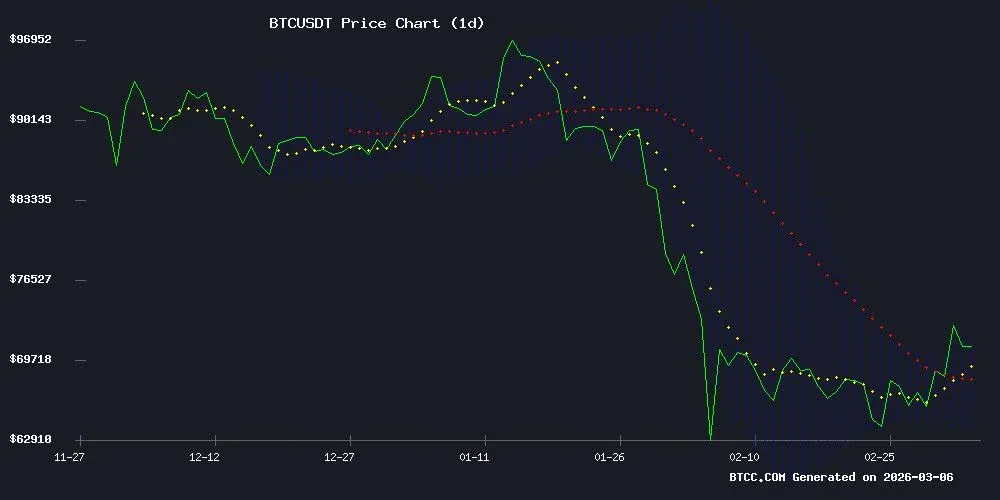
BTCC analyst John reports that Bitcoin is presently trading at 70,761.40 USDT, slightly below the upper Bollinger Band at 71,849.71. The MACD remains in negative territory (‑1,481.79), suggesting that after a recent rally the price is entering a consolidation phase. Nevertheless, the price stays above the 20‑day moving average of 67,831.44, indicating a still‑bullish medium‑term bias. Approaching the upper‑band resistance could cause a pause or a modest pull‑back, but the moving average and the lower band (63,813.17) provide solid support that may prevent a sharp decline. Overall, the price is likely to undergo a healthy consolidation before any renewed upward move.
Market sentiment: Energy and AI driving Bitcoin’s development
BTCC analyst John describes the current market mood as cautiously optimistic, noting that recent news reinforces this view. Bitcoin miners are being treated as energy‑infrastructure assets, and multi‑billion‑dollar bets on the convergence of AI and Bitcoin energy supply are providing a solid foundation for long‑term value. The rebound Bitcoin has shown after periods of global turbulence highlights its growing recognition as a digital safe‑haven asset. The present news environment supports a technical‑level consolidation outlook, meaning that any downside could be limited by institutional interest and emerging investment theses. The fusion of technology, energy, and finance is laying a robust groundwork for Bitcoin.
Factors influencing Bitcoin’s price
AI‑era mining equipment: Viewed as energy infrastructure
- Mining costs have surpassed $70,000, prompting the industry to undergo strategic transformation.
- Wall Street is pouring tens of billions of dollars into publicly listed mining firms, aiming to treat them as critical energy facilities for the AI revolution rather than pure crypto speculation.
- In electricity‑constrained markets, financial institutions regard the network interconnections, land holdings and operational expertise of mining farms as scarce assets, planning to repurpose them for high‑performance computing and replace volatile crypto yields with stable cash flow.
- Morgan Stanley’s $500 million loan to Core Scientific (potentially expandable to $1 billion) exemplifies this shift and reflects a broader trend of traditional digital‑infrastructure financing.
Bitcoin’s rebound after geopolitical shocks
- Military tensions among the United States, Israel and Iran have caused global financial market turbulence, with Bitcoin reacting with sharp price swings.
- After an initial correction, Bitcoin has shown resilience, delivering a technical bounce.
- Although commodity price volatility pressures risk assets, inflows into Bitcoin‑linked financial products have sustained demand.
- Compared with the 2022 market pattern, today’s macro‑economic backdrop and market structure have evolved significantly, yet geopolitical uncertainty remains a key driver.
Former OpenAI researcher betting on AI‑energy convergence
- Leopold Aschenbrenner, a 24‑year‑old ex‑OpenAI researcher, now manages $5.5 billion for the hedge fund “Context‑Aware”.
- His core thesis: the limitless energy demand of AI will intersect with Bitcoin mining infrastructure, creating a financial super‑cycle.
- The fund posted a 47 % return in the first half of 2025, validating investments in companies such as Bloom Energy and Core Scientific.
- Critics argue the view oversimplifies reality, but Aschenbrenner’s logic is that AI data centers need massive power, miners already own network‑connected farms, and Bitcoin’s fixed supply makes it the ultimate energy derivative.
Bitcoin price forecast: 2026, 2030, 2035, 2040
| Year | Expected price range (USDT) | Key drivers |
|---|---|---|
| **2026** | 85,000 – 120,000 | Consolidation of the 2024 halving cycle; ETF momentum spurring institutional adoption; deepening energy‑AI synergy |
| **2030** | 180,000 – 350,000 | Full‑cycle effects of the 2028 halving; more jurisdictions treating Bitcoin as a store of value; maturity of Lightning Network and other layer‑2 solutions |
| **2035** | 400,000 – 800,000+ | Bitcoin positioned as a global asset class and inflation hedge; liquidity constraints become apparent |
| **2040** | 1,000,000 + (optimistic) | Fully mature asset status, comparable to digital gold; widespread use and deep integration into the global financial system, with price shaped by worldwide adoption and macro‑economic conditions |
Note: The forecasts above are based on current technical analysis and market sentiment. Cryptocurrency markets are highly volatile; these projections are for reference only and should not be taken as guarantees.
As John from BTCC points out, the technical picture shows a solid growth foundation, yet the path ahead remains subject to significant fluctuations. The deep integration of AI with sustainable energy could become a pivotal catalyst for Bitcoin’s next appreciation phase.
---
This concludes the overview of “Bitcoin price forecast: technical analysis and long‑term outlook 2026‑2040”. For additional Bitcoin price predictions, search for historical articles from Bitaigen or continue browsing the related links below. We appreciate your continued interest and support for Bitaigen!
*Disclaimer*: Crypto gains may be taxable in your local jurisdiction; please consult a tax professional. U.S. users should access trading services via Binance.US (or other U.S.-compliant platforms), while international users may use standard Binance, SEPA, or SWIFT channels for fiat transactions.
Related Reading
- Silver Price Surge: Supply-Demand, Speculation & Technical Analysis
- Ethereum $2,000 Resistance Holds: March Outlook & Pull‑Back Scenarios
- Bitcoin Price Forecast: $68K Consolidation Sets Up Next Move
💡 Register on Binance with referral code B2345 for the maximum trading fee discount. See Binance complete guide.



