
 Bitaigen Research
Approaching the analysis from a macro‑liquidity perspective, we dissect the potential impact of the upcoming peak in U.S. Treasury maturities on Bitcoin’s price, revealing how Treasury bill issuance can become a key signal for BTC volatility. To understand the underlying logic and future outlook, keep reading and get our unique take on market sentiment.
A Peak in U.S. Debt Maturities Is Near, More Liquidity Set to Flow In
Keyrock notes in its report that global liquidity is approaching a turning point. Over the next four years, roughly $38 trillion of U.S. Treasury debt will mature, forcing the U.S. Treasury to refinance at higher yields—most of this debt was originally issued at near‑zero cost.
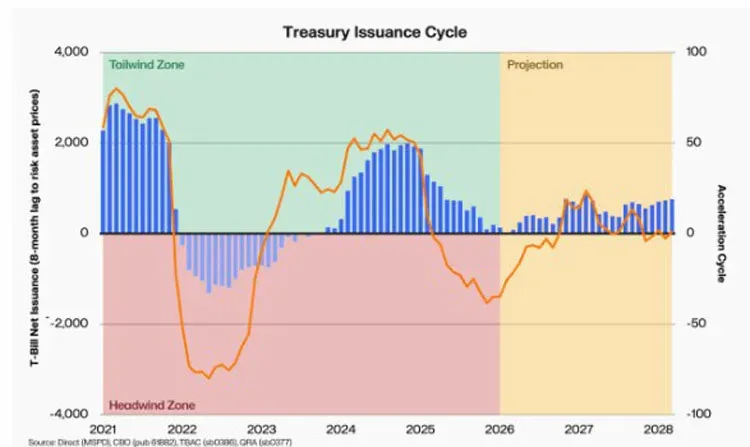
Analysts further forecast that the United States may extend its debt profile by increasing Treasury bill issuance. The report projects that, by 2028, annual U.S. Treasury issuance will stay within a range of $600 billion to $800 billion.
Treasury Bill Issuance as a Core Liquidity Indicator for Bitcoin Prices
Keyrock’s latest research shows that the primary driver of Bitcoin (BTC) price movements is the volume of Treasury bill issuance, rather than the balance sheets of the Federal Reserve or other central banks. Researcher Amir Hajian points out that a 1 % change in global liquidity translates into roughly a 7.6 % impact on Bitcoin price in the subsequent operating quarter. However, not every liquidity shift exerts the same effect on risk assets.
Correlation Between Treasury Bills and Bitcoin Prices
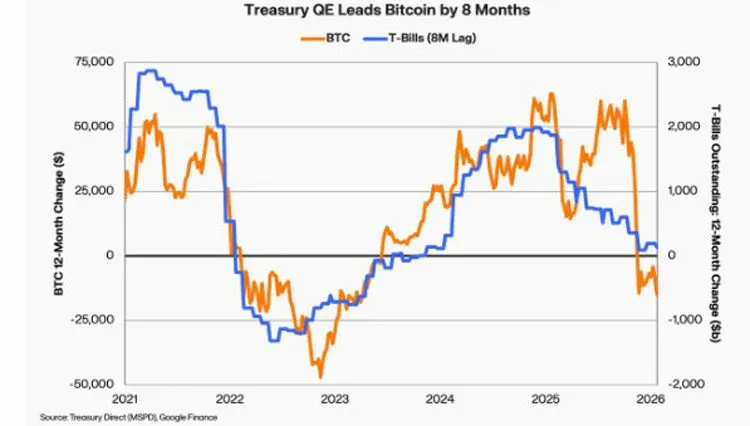
Since 2021, the correlation between Treasury bill issuance and Bitcoin price has hovered around 80 %, with the metric leading Bitcoin’s trajectory by about eight months. Hajian writes in the report:
“When the Treasury ramps up bill issuance, it effectively finances spending that flows into the real economy; that spending eventually finds its way into risk assets such as Bitcoin. A decline—or a negative net issuance—dampens this fiscal‑boost effect.”
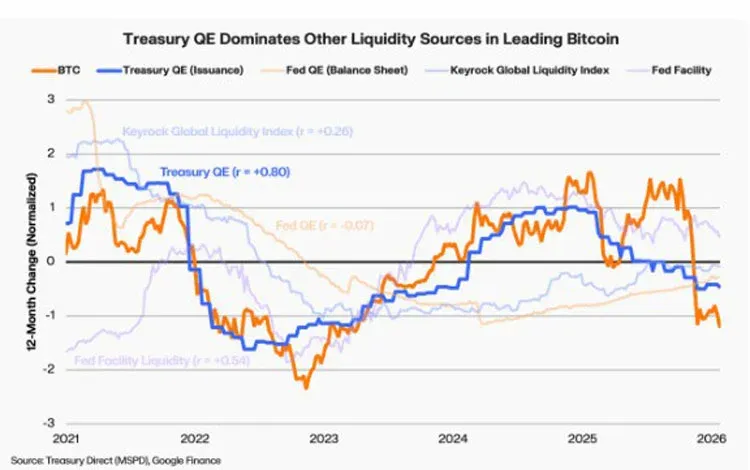
The report further notes that historical data reveal a significant leading statistical relationship between the net issuance of Treasury securities and Bitcoin’s yield. Nevertheless, institutional players and exchange‑traded funds (ETFs) have reduced Bitcoin’s sensitivity to liquidity conditions by about 23 %.
How This Differs From Conventional Wisdom
This finding runs counter to the prevailing view that Federal Reserve rate policy is the main driver of risk‑asset prices. Keyrock predicts that global liquidity will exert a pronounced influence on BTC price from late 2026 into early 2027.
Outlook for the Treasury Bill Issuance Cycle
Looking at the issuance cycle from 2021 through 2028, Keyrock expects this year’s issuance to gradually rise, ushering in a new growth phase.
“By 2028, U.S. Treasury issuance is projected to reach—and stay at—$600 billion to $800 billion per year,” the report predicts.
That concludes the full text of “Treasury Bonds: An In‑Depth Look at the Main Drivers Behind Bitcoin (BTC) Price Volatility.” For more information on how Treasury activity may affect Bitcoin, follow Bitaigen and its related research articles.
*Note:* Crypto gains may be subject to tax in your jurisdiction; consult a local tax professional.
*For U.S. residents, trading on the global Binance platform is not permitted—use Binance.US instead. All fiat transactions should be conducted via USD, SEPA, or SWIFT where applicable.
Related Reading
- Bitcoin Price Forecast 2026: Market Trends, Technical Patterns & Key Influences
- Buy Bitcoin with PayPal FAQ: Purchase, Transfer & Wallet Limits
- Bitcoin Faces $600M Liquidation Risk, Could Surge to $70,000
💡 Register on Binance with referral code B2345 for the maximum trading fee discount. See Binance complete guide.



