
 Bitaigen Research
 When performing any operation on a blockchain, a certain amount of fee must be set aside in advance; this fee is known as the Gas Fee. It functions similarly to a traditional financial service charge, but it compensates the network’s validator nodes (or miners) for the computational resources they expend to process transactions and execute smart contracts. The native token used to pay for gas varies across chains—for example, Ethereum uses ETH, while Solana uses SOL.
---
In this article we systematically outline the concept of Gas Fees, their pricing mechanics, and typical fee structures. We also provide practical cost‑saving tips and calculation methods to help users manage transaction costs more efficiently across different blockchains. Subsequent sections will delve into the details, so a careful read is recommended.
When Do You Need to Pay a Gas Fee?
Almost any action that changes the on‑chain state requires a fee, including but not limited to:
- Buying or selling crypto assets
- Transferring funds between wallets
- Trading NFTs
- Interacting with decentralized finance (DeFi) protocols
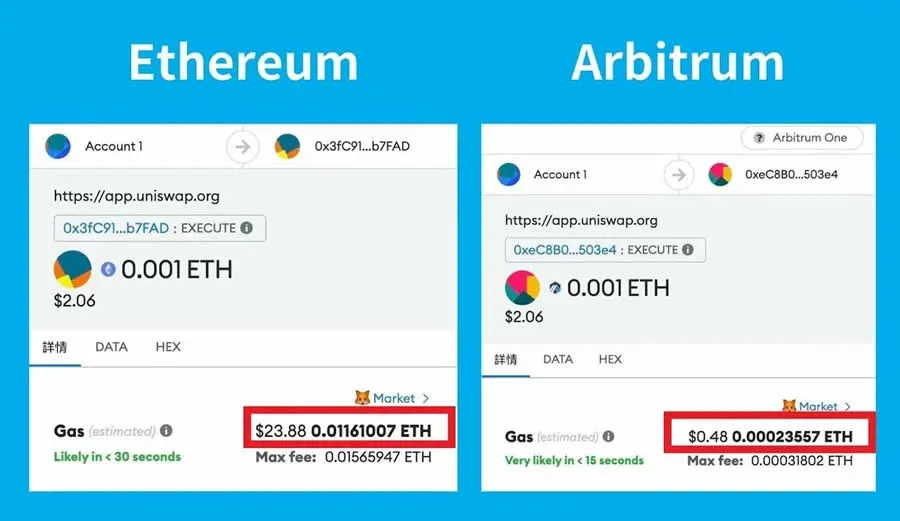
Because Ethereum’s fees can be relatively high, many Layer‑1 and Layer‑2 solutions have emerged in recent years to improve user experience with lower gas costs. The example below shows the same trade on Uniswap: roughly $24 in gas on the Ethereum mainnet versus about $0.50 on Arbitrum.
---
How Gas Fees Are Calculated
Gas Fees are not a fixed number; they fluctuate with network congestion. The basic calculation is:
Gas Fee = Gas Limit × Gas Price
Two key parameters are involved:
Gas Limit (Fuel Upper Limit)
Think of this as the amount of fuel you fill into a car before departure—it caps the maximum amount of gas your transaction is willing to consume. If you set the limit too low, the transaction may run out of “fuel” mid‑execution and be aborted, and any gas already spent is not refunded. A standard token transfer typically has a default limit of 21,000; if the actual consumption is lower, the unused portion is automatically returned.
Gas Price (Fuel Unit Price)
This is the price you are willing to pay per unit of gas, usually expressed in Gwei (1 Gwei = 0.000000001 ETH). When the network is busy, offering a higher Gas Price increases the likelihood that miners will prioritize your transaction, much like paying a higher per‑liter price at a gas station to get service faster. Most wallets automatically estimate a suitable Gas Price and Gas Limit; manual adjustments are only needed for special cases.
Example: If the Gas Limit is set to 21,000 and the Gas Price is 80 Gwei, the maximum fee would be
21,000 × 80 × 0.00000008 ETH = 0.00168 ETH
After Ethereum’s EIP‑1559 upgrade, the Gas Price is split into a Base Fee (burned) and a Priority Fee (paid to the validator). The Base Fee typically constitutes the larger share, which reduces validator revenue relative to the pre‑EIP‑1559 model.
Real‑Time Queries and Fee Tiers
To obtain the latest ETH gas prices, you can visit the Etherscan Gas Tracker. Fees are categorized into low, medium, and high tiers, each corresponding to different confirmation speeds. For instance, at the low tier a single Gwei is worth roughly $1.26, with an estimated confirmation time of 1 minute 23 seconds; at the high tier a Gwei is about $1.38, and the transaction may be finalized within 30 seconds.
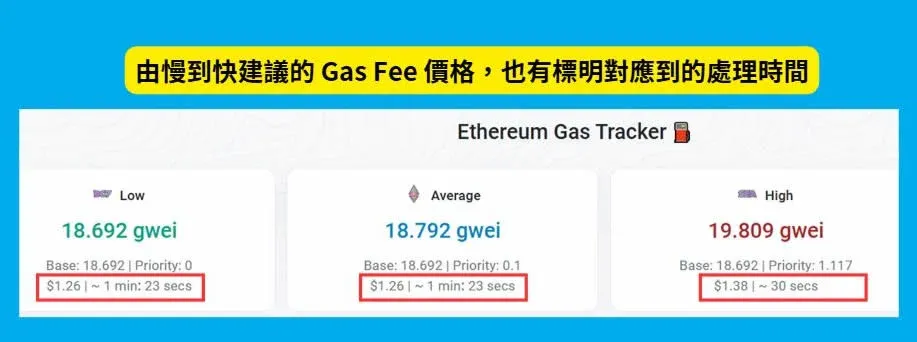
Different operations exhibit markedly different gas consumption—NFT trades often consume the most gas. By performing on‑chain activities during quieter periods or opting for a less aggressive confirmation target, you can significantly reduce expenses.
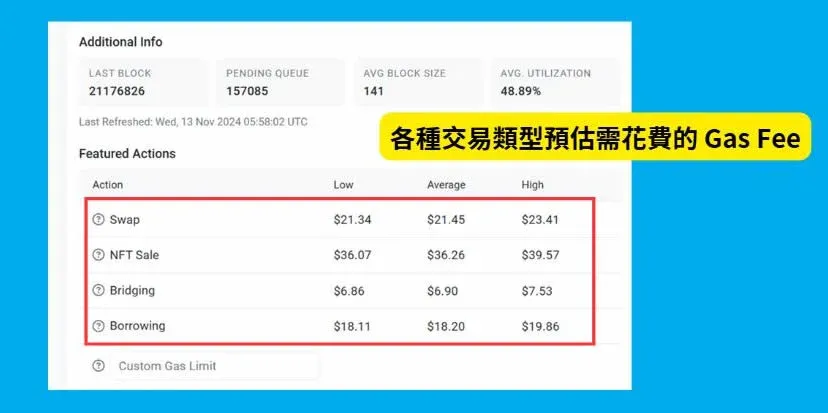
Gas‑fee prediction tools allow users to select the optimal transaction window or adjust strategies, balancing speed against cost.
Practical Tips for Reducing Gas Fees
Choose Low‑Fee Time Windows
In Asian regions—particularly during daytime to early afternoon in Taiwan—the Gas Price tends to stay relatively low. Conversely, during European and North American nighttime (which corresponds to late night in Asia) transaction activity spikes and fees rise sharply. The heatmap below displays a seven‑day weekly view; darker shades indicate cheaper periods, while brighter colors mark expensive periods.
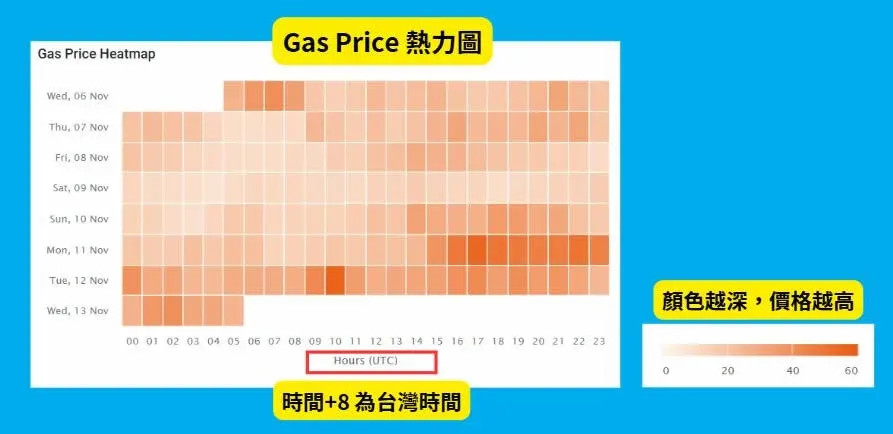
Keep in mind that these are average levels. During hot project launches or token sales, fees can surge dramatically in a short window, similar to needing to tip extra to move ahead in a crowded checkout line.
Adjust Gas Price in Your Wallet
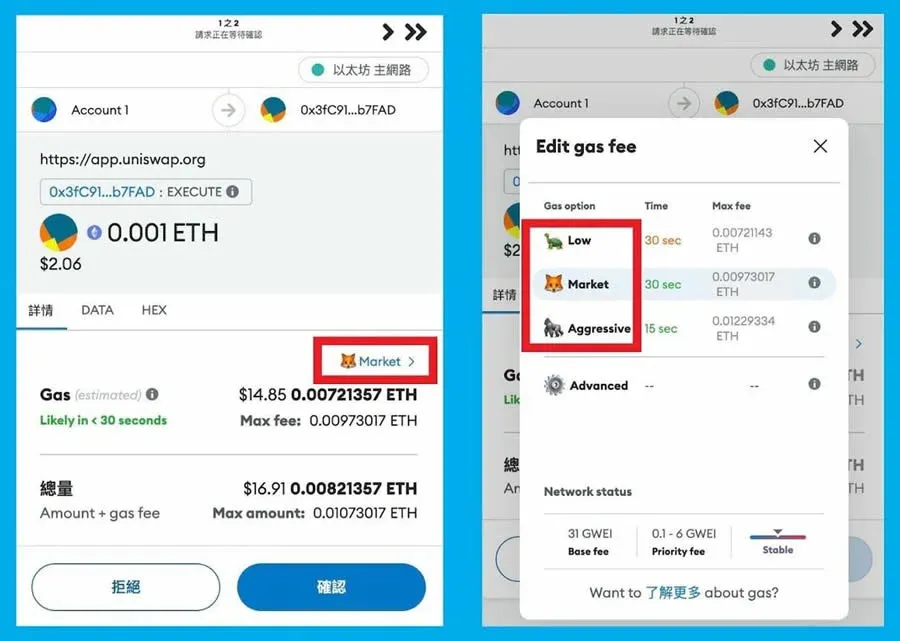
Take MetaMask as an example: its default “Market” mode suggests a balanced Gas Price based on current network conditions. Users seeking faster confirmation can switch to the “Aggressive” setting, while those aiming to save can select “Low”, accepting a slower confirmation time in exchange for reduced overall cost.
Summary
This article has systematically explained what Gas Fees are, when they arise, the underlying calculation formula, and how to retrieve up‑to‑date pricing information. It also presented several hands‑on methods for lowering those fees. In general, avoiding the peak activity windows of Europe and North America and setting a sensible Gas Price can make most on‑chain operations more economical. Only when participating in limited‑supply NFT drops or token sales might you deliberately raise the Gas Price to improve the chances of successful execution.
Please note: Crypto gains may be subject to taxation in your local jurisdiction; consult a tax professional to understand your obligations.
For more in‑depth analysis of Gas Fees, follow Bitaigen’s other topic‑specific articles.
Related Reading
- LetsBONK.fun: Solana Memecoin Launchpad, Zero‑Code Tokens
- Smart Contracts: Core Principles & Use Cases in DeFi & NFTs
- Understanding Ethereum Gas Fees: Costs, Validators, and Network Security
💡 Register on Binance with referral code B2345 for the maximum trading fee discount. See Binance complete guide.



