
 Bitaigen Research
 We analyze the design philosophy of ERC‑8004 from both technical and ecosystem perspectives, explaining how it can provide identity and credit frameworks for AI agents without requiring trust, and how it solves the security and settlement challenges of high‑frequency micro‑payments. The following sections will walk you through the core mechanisms of the standard and its potential impact on Ethereum’s future ecosystem.
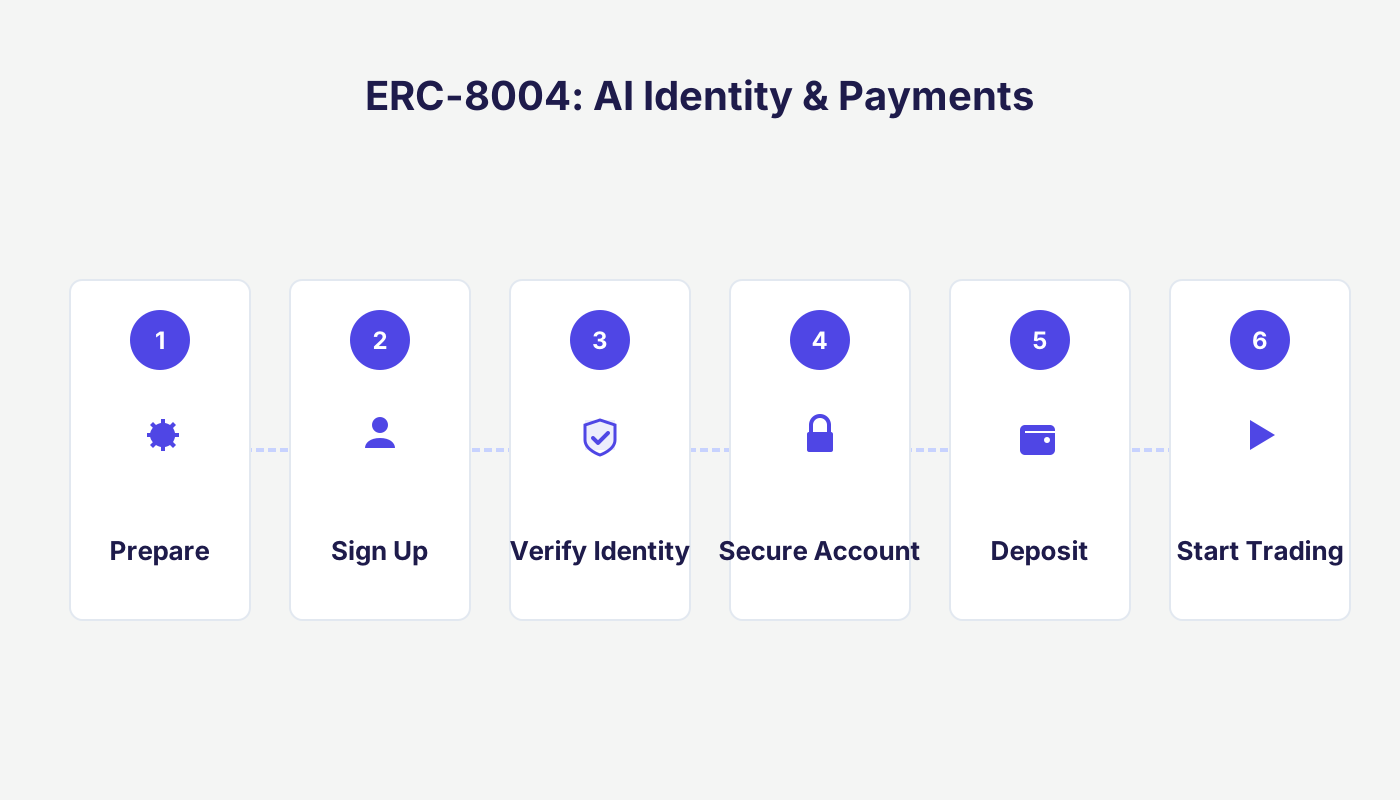
ERC‑8004: A Key Standard for Ethereum in the AI Era
ERC‑8004: Trustless Agents
- Proposed: August 2025; currently still in draft form.
- Strategic positioning: The Ethereum Foundation’s dAI team has earmarked it as a priority project and is running experiments on multiple L2 solutions and allied chains.
- Core objective: Enable AI agents built by different developers or organizations to discover each other, perform trust‑based assessments grounded in transferable reputation, and safely collaborate both on‑chain and off‑chain—*without any prior trust*.
The standard essentially gives each agent “a passport + a public credit record,” establishing the foundational layer for an open‑ended autonomous‑agent economy.
---
Why ERC‑8004 Is Seen as the “iPhone Moment” for Ethereum AI Applications
In the deep convergence of AI and blockchain, the most urgent need is to solve trust and settlement between agents. ERC‑8004 is built around two pillars: Secures (security guarantees) and Settles (value settlement):
- Security guarantees: An on‑chain registry records identity, reputation, and verification data, making every interaction traceable and immutable.
- Value settlement: The standard supplies high‑frequency micro‑payment channels (e.g., inference fees, task rewards) and enforces economic incentives through a stake‑and‑penalty mechanism.
In the forthcoming machine‑to‑machine (M2M) economy, transactions will be extremely frequent, individually tiny, and often span organizational boundaries—scenarios where centralized platforms struggle to provide both security and decentralization. Ethereum’s L1 + L2 stack offers a neutral, verifiable, globally reachable substrate for these interactions.
---
The Deep Symbiosis Between Ethereum and AI
AI requires a trustworthy, immutable settlement and collaboration layer, and Ethereum already possesses these properties. The relationship is not a simple overlay; the two technologies amplify each other:
- Ethereum supplies AI with: decentralized identity, reputation, and behavioral audit capabilities.
- AI injects into Ethereum: more intelligent, higher‑efficiency autonomous application patterns.
This reciprocal dynamic lets AI agents execute complex tasks on‑chain—such as trading, risk management, and market forecasting—thereby increasing both the frequency and sophistication of on‑chain interactions.
---
Core Advantages Brought by This Integration
Higher Trust and Decentralized Foundations for AI
Current mainstream centralized AI providers (OpenAI, Google, Meta, etc.) commonly face issues like model opacity and censorship risk. By anchoring an agent’s identity, reputation, and behavior on Ethereum via ERC‑8004, we achieve a verifiable, composable, portable trust layer that eliminates reliance on intermediaries.
Boost to Ethereum’s Utility and Productivity
- Dynamic smart contracts: Contracts can adjust in real time based on timestamps or external conditions (e.g., floating‑rate lending, automated insurance).
- Robot economy: AI agents can generate revenue and pay gas autonomously, forming a closed‑loop on‑chain economic system—widely regarded as the next major narrative after DeFi and NFTs.
New Economic Models
When agents earn independently (inference fees, gaming, social services) and settle on‑chain, overall Gas fees + Blob fees are expected to rise, adding further deflationary pressure on ETH.
---
Direct Contribution to ETH Revenue
Ethereum’s primary income streams remain Gas fees and Blob fees, followed by the partial burn mechanism introduced by EIP‑1559 that creates a net‑deflationary effect. The influx of AI agents is projected to trigger the following shifts:
- Transaction volume surge: Minute‑level micro‑transactions will markedly lift overall throughput.
- Increased transaction complexity: Cross‑agent identity verification and collaborative calls will make contract executions more intricate.
Analysts forecast that by the end of 2025, AI agents could account for 15‑20 % of DeFi transaction volume; by 2026, Gas consumption may grow 30‑40 % month‑over‑month, thereby boosting fee revenue and burn volume.
*Note for U.S. participants:* When purchasing ETH or related tokens, U.S. users should use Binance.US or other regulated platforms rather than the global Binance site. For fiat on‑ramps, the most common methods involve USD transfers via SEPA (for EUR) or SWIFT networks.
---
Driving On‑Chain Real‑World Asset (RWA) Adoption and Overall Activity
AI can autonomously perform asset valuation, compliance checks, risk monitoring, and dynamic pricing, dramatically improving the operational efficiency of RWA projects. Institutional‑grade RWAs (e.g., BlackRock‑linked funds) have a strong demand for reliable, auditable automation—precisely what AI agents deliver.
- 24/7 autonomous trading: Increases trade count and liquidity, potentially pushing total value locked (TVL) to new highs.
- Diversified fee sources: AI‑driven on‑chain activity is expected to become the second‑largest source of fees after stablecoins.
---
Why Traditional Software Companies Face Disruption While ETH Stands to Benefit
Most legacy software firms can only “layer” AI on top of existing products, yet they cannot escape the commoditization of the intelligence itself (the classic 1 + 1 < 1 effect). In contrast, Ethereum offers trustworthy settlement, the scarcest and non‑replicable asset for AI agents. The more agents that use the network, the stronger the network effect (1 + 1 > 2), creating a positive feedback loop.
---
Comparison With Other Blockchains: Ethereum’s Unique Position
Limitations of Solana
- Strengths: Extremely high throughput and ultra‑low fees, making it a suitable “highway” for AI inference workloads.
- Weaknesses: Lacks a trust framework comparable to ERC‑8004; its historical stability and degree of decentralization remain concerns for institutions, and its settlement layer prioritizes speed over maximal security.
Consequently, Solana resembles a high‑speed conduit for AI agents, whereas Ethereum functions more like a bank + SWIFT, providing final trust anchoring and value settlement.
From a 2026 perspective, if AI agents need to manage real economic value, collaborate across companies, and guarantee irreversible economic commitments, they will ultimately gravitate toward a secure, decentralized, and highly integrated chain—namely Ethereum.
---
Closing Thoughts
The imminent launch of ERC‑8004 marks a pivotal “iPhone moment” for Ethereum. It is not only a technical milestone but also a signal that ETH will occupy a central, beneficiary role in the coming AI wave. By furnishing AI agents with trustworthy identity, reputation, and settlement mechanisms, Ethereum is poised to unlock fresh growth dynamics across robot economies, DeFi, RWA, and many other scenarios.

For a deeper dive into ERC‑8004’s impact on Ethereum, we recommend reading previous articles from Bitaigen (Bit-Root) or continuing with the subsequent sections below. Thank you for your attention and support!
Related Reading
💡 Register on Binance with referral code B2345 for the maximum trading fee discount. See Binance complete guide.



