
 Bitaigen Research
 Long‑Term Trends of Ethereum and the Rollup Ecosystem
*All fiat references are expressed in USD; cross‑border transfers typically use SEPA or SWIFT. Users in the United States should access Binance US rather than the global Binance platform.*
---
In the past year, Rollup technology has made remarkable progress, especially the breakthroughs of ZK‑Rollup in privacy and performance, as well as the next‑generation virtual machines (SVM, MoveVM, FuelVM, etc.) that boost throughput. In 2024, customized L2 solutions and application‑specific chains have proliferated, driving innovation in decentralized finance. Looking ahead to 2025, the flow of on‑chain value is expected to gravitate toward concrete applications; thousands of application‑specific chains or dedicated L2s may re‑allocate revenue through governance or protocol mechanisms. At the same time, a unifying user‑experience trend will weaken the tribalism that currently separates different Rollups, shifting market focus toward a “one‑stop” crypto experience rather than constant multi‑chain hopping.
Key Forecasts
- Revenue structures will overall decline as the number of Rollups explodes, sequencer‑revenue‑sharing demands rise, and applications launch their own chains.
- Ethereum‑based Rollups will attract more capital and technical attention because they can mitigate the “parasitic” debate surrounding L2 reliance on L1.
- Next‑generation virtual‑machine Rollups are poised to out‑perform the classic EVM in TPS and gas costs by enabling parallel processing.
These trends set the stage for the discussion of Based Rollup that follows.
---
In this article we review the key developments of Rollups over the past year and, together with the projected 2025 on‑chain value flow, analyze the concept of a Based Rollup that lets Ethereum itself assume the ordering role. By comparing technical pathways and economic models, readers can grasp the likely trajectory of the ecosystem—material worth a careful read.
Review and Outlook
The Ethereum‑centric Based Rollup puts forward a core idea: why not let Ethereum itself handle transaction ordering? If successful, this design would allow an L2 to keep running as long as Ethereum remains active, and it would enable an atomic combination of L1 and L2 states—e.g., a swap executed on L2 could directly tap into L1 liquidity.
However, this tight coupling also means the Based team would have to relinquish a portion of the priority‑fee revenue and confront Ethereum’s own constraints (such as roughly a 12‑second block time). Techniques like pre‑confirmation can alleviate these issues to a degree, but careful evaluation remains necessary.
At present, @gwyneth_taiko and @Spire_Labs are collaborating on a “next‑generation Based Rollup.” Their goal is to let L1 applications run on a dedicated Based chain that retains priority fees while preserving composability with L1 contracts. This direction merits ongoing attention.
---
Coordination Between Based Rollup and Ethereum Blocks
Based on the schematic from @taikoxyz (
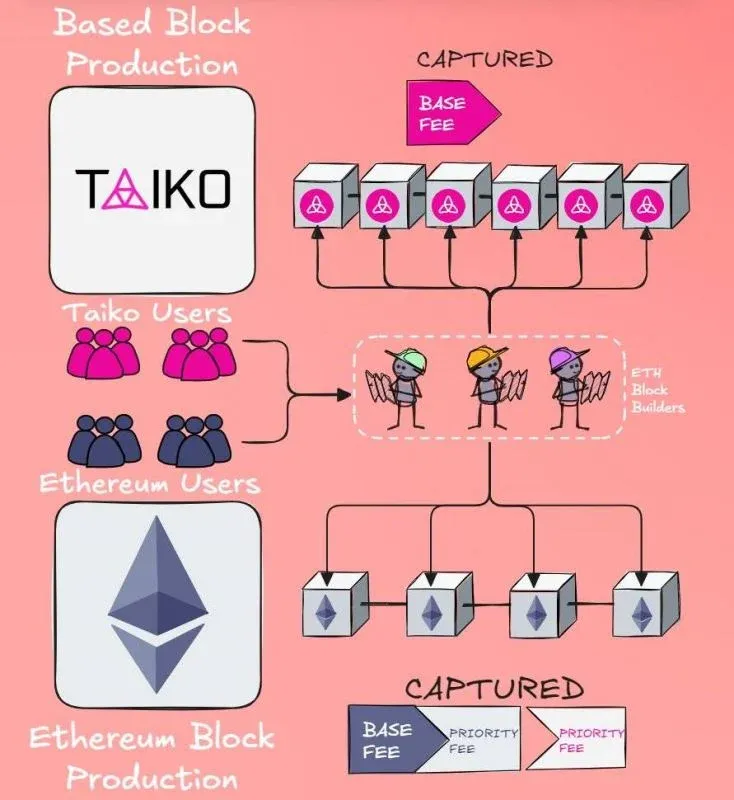
), the operational flow of a Based Rollup is fundamentally the same as a traditional Rollup, except that the sequencer role is handed over to Ethereum’s block builder. The steps are as follows:
- Users submit transactions to a builder that is responsible for constructing both L1 and the Based L2 blocks.
- The transaction specifies the maximum fee the user is willing to pay.
- The L2 charges a Base fee according to its own congestion level, while the remaining priority fee / tip is passed to the L1 builder for ordering.
Under this model, Ethereum captures all fees generated within its own ecosystem, plus a share of L2 tips and the cost of publishing data to the mainnet. Because of this design, a Based L2 enjoys several advantages:
- Reliability: As long as Ethereum continues to produce blocks, the Based L2 remains operational; this is more resilient than relying on a single‑point sequencer that could become a bottleneck.
- Atomic Composability: L2 transactions can interact directly with L1 state, enabling immediate cross‑layer liquidity usage.
The downsides are the concession of part of the revenue and the need to adapt to Ethereum’s block‑production cadence.
---
How Traditional Rollups Connect to Ethereum Blocks
Traditional Rollups (e.g., Optimism) employ a sequencer that substitutes for Ethereum’s block builder. Their workflow can be summarized as:
- Users submit transactions to the OP sequencer, indicating the highest fee they are prepared to pay.
- The fee consists of a Base fee (burned on the OP Stack chain; on chains like Arbitrum it may be handled differently) and a priority fee, which goes to the team operating the sequencer.
- After ordering the transactions, the sequencer posts a new block to the rollup’s canonical chain and updates the state root on Ethereum’s mainnet.
Different Rollup projects allocate fees in various ways: some burn only the Base fee and keep the tip; Arbitrum distributes both components to token holders; Blast returns a portion of revenue to on‑chain developers.
Because the L2 fully controls when to publish data to Ethereum, it enjoys the freedom to capture all internal fees and decide its own posting frequency.
---
Traditional Rollup Block Structure
Taking Optimism as an example, the block structure of a conventional Rollup essentially mirrors Ethereum’s model, with the builder swapped out for a single sequencer (see image
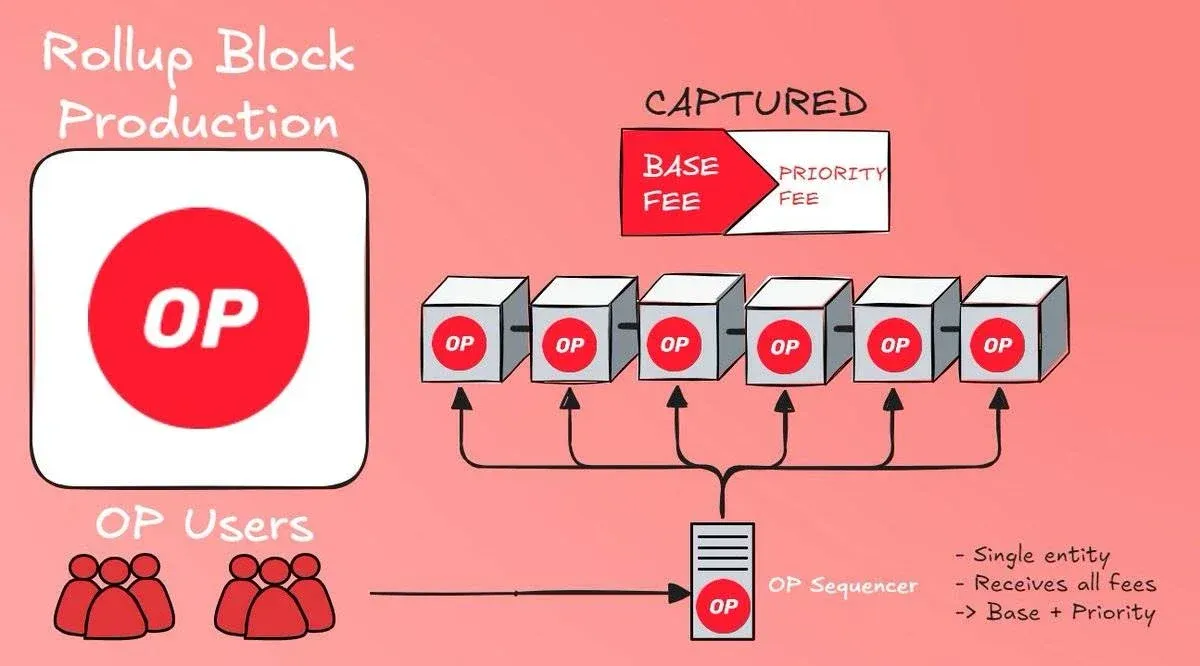
). Users’ transactions still declare a maximum fee, which is split into a burned Base fee and a priority fee retained by the sequencer. The sequencer then submits the ordered block to the L2’s canonical chain and synchronizes the state root to Ethereum.
---
Ethereum Block Production Mechanism
Ethereum’s block‑creation process involves two distinct roles: block builders and validators (illustrated in
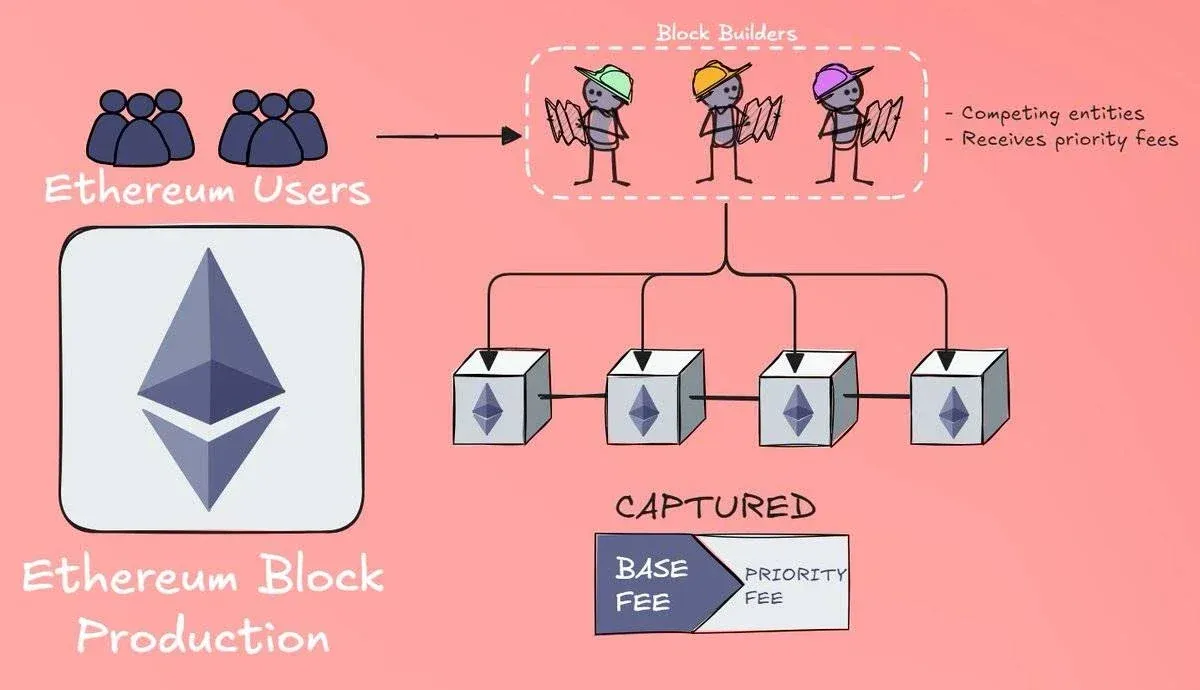
). The core steps are:
- Users send transactions to a block builder, stating the highest fee they are willing to pay.
- The fee first covers the Base fee (which fluctuates with network congestion and is burned on‑chain); any remainder becomes the priority fee / tip that belongs to the builder.
- The builder packages the transactions into a block and hands it to a validator, which finalizes the block by writing it onto Ethereum’s main chain.
User‑paid fees are either burned as ETH (serving as a neutral financing mechanism for the public good) or captured by participants in the building pipeline (e.g., the builder). Both mechanisms are regarded as positive contributions to network value.
---
Glossary
Before diving deeper, let’s clarify several key concepts and roles:
- Sequencer: A machine maintained by the L2 team that gathers user transactions, determines their order within an L2 block, and ultimately submits the batch to L1.
- Block Builder: An entity on Ethereum’s mainnet that receives transactions, orders them to maximize profit, and then forwards the assembled block to validators for final inclusion.
- Base Fee: The minimum fee required for a transaction to be included in a block; it varies with network congestion (e.g., if the gas usage of block 10 exceeds 50 %, the Base fee for block 11 will increase). This fee is burned on Ethereum and on many L2s.
- Priority Fee: An optional “tip” that users add on top of the Base fee to gain preferential placement in the block.
Understanding these terms will make the distinctions between Based Rollup and traditional Rollup fee structures and role allocations clearer.
---
Mid‑Session Recap: Key Points
Before moving forward, let’s summarize the core ideas discussed so far:
- Ethereum blocks are constructed by multiple competing, independent builders.
- Traditional Rollup blocks are generated by a single sequencer operated by each project’s team.
- Both construction processes capture the full fee revenue of their respective ecosystems, while the link between L2 and L1 is governed by the L2’s autonomous publishing schedule.
These fundamentals provide a reference frame for evaluating the unique design of Based Rollup in the sections that follow.
---
Closing Thoughts
Based on the analysis above, whether a Based Rollup can secure a lasting role in the economic relationship between L1 and L2 remains an open question. Its revenue model directly impacts the profitability of the teams involved, which may limit adoption for some projects. Nevertheless, its advantage in L1 atomic composability has already attracted a cohort of developers experimenting with the concept. As the collaboration between @gwyneth_taiko and @Spire_Labs deepens, a dedicated Based chain anchored to L1 could become the seed of the next wave of innovation.
If the Rollup ecosystem had centered on Based Rollup from the outset, today’s narrative landscape might look completely different. The future evolution is still highly uncertain, and it is a development worth watching continuously.
Related Reading
- Based Money DeFi Game: Ethereum, Ampleforth Elastic Supply
- ETF vs Ethereum: Key Differences Between Investment Funds and Crypto
- Ethereum ETF 2026: Regulatory Timeline & Top Tokens
💡 Register on Binance with referral code B2345 for the maximum trading fee discount. See Binance complete guide.



