
 Bitaigen Research
 In this article we systematically outline the concept and measurement methods of mining‑rig hash rate, helping readers quickly grasp the conversion logic from basic to advanced units and explaining the practical significance of hash rate in mining competition. Understanding these fundamentals allows you to assess device performance more accurately; the following sections present a complete conversion table and practical examples, which are worth a careful read.
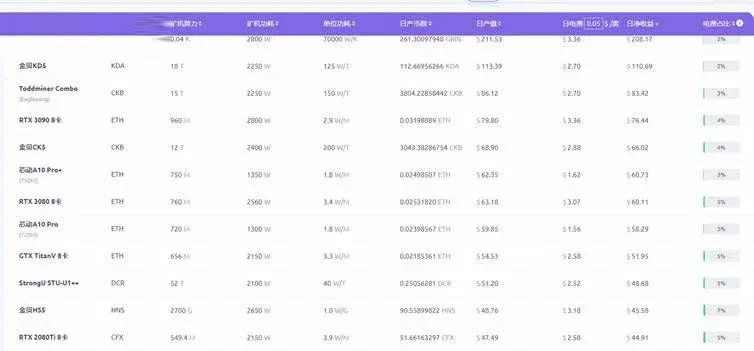
How High Can a Mining Rig’s Hash Rate Go? How Are the Hash‑Rate Units Converted?
A mining rig’s hash rate can range from a few hundred MH/s to several hundred TH/s or even PH/s. The unit conversion follows the decimal “thousand” progression: 1 K = 1,000 H, 1 M = 1,000 K, 1 G = 1,000 M, 1 T = 1,000 G, 1 P = 1,000 T, 1 E = 1,000 P.
The security of a blockchain relies on cryptographic principles and consensus mechanisms, and the key participants that achieve consensus are the miners. Miners operate specialized hardware—mining rigs—to solve mathematical puzzles and earn cryptocurrencies such as Bitcoin.
Definition of Mining‑Rig Hash Rate
- Hash rate: The number of hash‑collision attempts a mining rig can perform each second, denoted as hash/s.
- The higher the hash rate, the more hash calculations are completed per unit time, which theoretically translates into faster mining.
Mining‑Rig Hash‑Rate Unit Conversion
Hash‑rate units use a decimal “thousand” scaling:
| Unit | Conversion |
|---|---|
| 1 H | 1 hash |
| 1 K | 1,000 H |
| 1 M | 1,000 K = 1,000,000 H |
| 1 G | 1,000 M = 1,000,000,000 H |
| 1 T | 1,000 G = 1,000,000,000,000 H |
| 1 P | 1,000 T = 1,000,000,000,000,000 H |
| 1 E | 1,000 P = 1,000,000,000,000,000,000 H |
Example: The Antminer S9 is rated at 13.5 T. Converting yields 13.5 T = 13,500 G = 0.0135 P.
On mining‑pool dashboards you will often see labels such as MH/s, TH/s, etc., which stand for mega‑hashes per second (one million hashes) and tera‑hashes per second (one trillion hashes), respectively, matching the unit system above.
Memory Units That Look Similar to Hash‑Rate Units
Many miners confuse hash‑rate units with memory‑capacity units. Memory capacity follows a binary (base‑2) system (1 024):
- 1 Byte = 8 bit
- 1 KB = 1,024 Byte
- 1 MB = 1,024 KB
- 1 GB = 1,024 MB
Because people often shorten GB to G in conversation, it can be mistakenly associated with the G in Giga‑hash. The two systems use different bases, so it is important to keep them distinct when discussing performance or hardware specifications.
How Mining Rigs Generate Revenue
Using the Bitcoin network as an example, a mining rig’s primary earnings stem from the Proof‑of‑Work (PoW) consensus mechanism:
- Transaction broadcast: Users’ transactions are propagated throughout the network.
- Transaction packaging: Miners gather unconfirmed transactions into a candidate block.
- Nonce search: Miners append a random number (nonce) to the block header and compute its SHA‑256 hash.
- Target threshold: If the resulting hash is lower than the network‑defined target value, the block is considered valid.
- Block propagation: The valid block is broadcast to the entire network; other nodes verify it and attach it to the blockchain.
- Reward collection: The miner who successfully mined the block receives the block reward (newly minted bitcoins) plus any transaction fees.
This process demands substantial hash power and electricity. A higher hash rate raises the probability of finding a nonce that satisfies the target, thereby increasing the chance of earning block rewards.
Hash‑Rate Considerations When Purchasing a Mining Rig
- Higher hash rate → faster mining: For the same electricity cost, a rig with a greater hash rate can attempt more hashes in a shorter period.
- Chip performance is critical: Increases in hash rate depend on advancements in ASIC chip technology. Development and production cycles are long, so the performance gap between mainstream rigs released in the same period tends to be modest.
- Holistic evaluation: When buying a rig, consider not only hash rate but also power consumption, equipment price, and operational factors such as cooling and noise levels. Payments for equipment are typically made in USD via SEPA or SWIFT transfers, depending on the buyer’s location.
Summary
Mining‑rig hash rates span from the MH/s tier up to the PH/s tier, with unit conversions following a decimal thousand‑step pattern. Understanding the relationship between hash rate and power consumption, and correctly distinguishing hash‑rate units from memory‑capacity units, helps you make more rational decisions when investing in or operating mining hardware.
The content above addresses the core question “How high can a mining rig’s hash rate go? How are the hash‑rate units converted?” For further information on mining‑rig performance, please follow additional articles on Bitaigen (比特根).
*Note for U.S. readers: When acquiring or trading cryptocurrencies, platforms such as Binance.US (rather than the global Binance) must be used to comply with regional regulations.*
Related Reading
- Mine BSV on Poolin with Antminer S9 – Full Setup Guide
- Best Ethereum Mining Pools 2024: BTC.com Tops Returns
- Top 10 Cryptocurrency Mining Platforms of 2021 – Technical Strength & Security
💡 Register on Binance with referral code B2345 for the maximum trading fee discount. See Binance complete guide.



