
 Bitaigen Research
 As demand for block‑space continues to rise, the scarcity of that space has become a prominent issue. Web 3 application layers now have to be deployed across hundreds of different blockchains, Layer 2 networks, and application‑specific chains in order to satisfy the ever‑growing capacity requirements. This phenomenon gave birth to two newer terms—cross‑chain and multi‑chain—that virtually every industry professional has now heard.
Multi‑chain refers to deploying separate, independent versions of a dApp on multiple chains; cross‑chain, on the other hand, enables inter‑chain messaging through a unified smart contract, allowing a single application to operate collaboratively on several chains at once.
Our editorial team at Bitaigen has carefully distilled the core concepts of multi‑chain and cross‑chain, explaining how they address block‑space scarcity and improve Web 3 interoperability. By reviewing ecosystem evolution and unpacking the underlying technology, we help readers quickly build a systematic understanding. Subsequent sections will explore implementation pathways and real‑world industry adoption.
A Brief History of the Multi‑Chain Ecosystem
Ethereum was the first smart‑contract blockchain that supported fully programmable decentralized applications, and its rapid network‑effect accumulation drove broad industry adoption. Early dApps such as Compound, MakerDAO, Uniswap, and EtherDelta were born on Ethereum, inaugurating a new model for on‑chain financial services.
Soon after, transaction fees on the Ethereum network kept climbing. Although the Ethereum mainnet remains one of the safest smart‑contract platforms, a large number of users began seeking lower‑cost alternatives. Developers therefore launched a series of competing chains, capturing portions of the market share and sparking the rise of a multi‑chain ecosystem.
What Is Multi‑Chain?
In a multi‑chain ecosystem, each dApp consists of its own set of independent smart contracts, with no direct connection to the processes of applications on other blockchains.
- Parallel scaling: Different chains offer their own scalability, decentralisation level, consensus mechanisms, data‑availability solutions, and privacy schemes, collectively raising the aggregate throughput of the smart‑contract economy.
- Capital‑efficiency challenge: Independent deployments dilute capital efficiency; liquidity becomes fragmented across chains, preventing the synergistic effects that cross‑chain solutions could provide.
- Rising development costs: If a project needs to follow its users onto multiple chains, it must develop, deploy, and maintain a separate version for each, consuming substantial human resources.
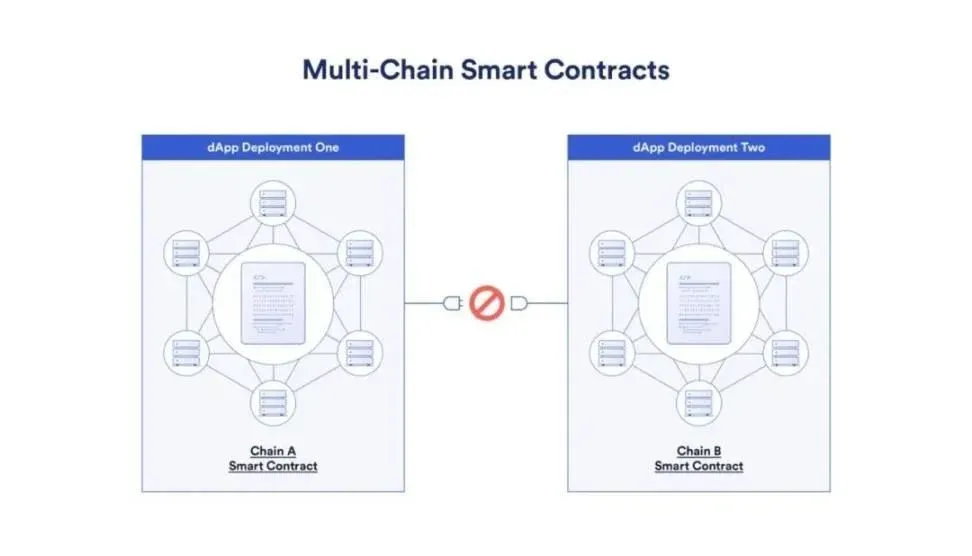
In a multi‑chain setting, any application that relies on a trusted single data source (for example, an on‑chain domain name system) struggles to achieve network‑wide consistency because registries on different chains may conflict. Consequently, such services often deploy on a single chain only.
Nevertheless, multi‑chain deployment still carries advantages. If a cross‑chain token bridge lacks sufficient security, assets can be at risk even when the underlying blockchains themselves are secure. By using a multi‑chain approach, each chain’s smart contracts operate independently, limiting the impact of a single‑point vulnerability.
Note for U.S. users: When converting fiat to crypto or vice‑versa, use Binance.US rather than the global Binance platform. Transactions involving USD typically flow through SEPA or SWIFT corridors, and crypto gains may be taxable under local jurisdictional rules; consult a tax professional for guidance.
What Is Cross‑Chain?
Cross‑chain functionality enables developers to build native cross‑chain applications—single, unified dApps that run across multiple chains through one set of smart contracts, without having to write a full version for each chain.
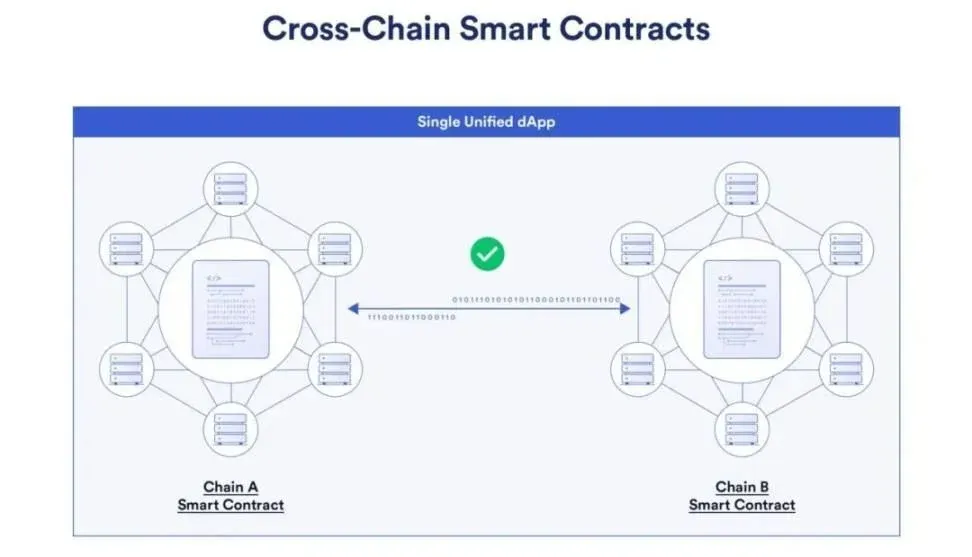
Within a cross‑chain ecosystem, smart contracts on each chain perform their respective tasks but stay synchronized via secure cross‑chain message passing, allowing the whole application to leverage the unique strengths of every chain. For instance, developers can combine the following functionalities:
- Censorship‑resistant chain – records asset ownership.
- High‑throughput chain – enables low‑latency token swaps.
- Privacy‑focused chain – provides an identity‑layer shield.
- Decentralised storage network – stores metadata.
Cross‑chain interoperability is the key to constructing a more integrated Web 3 ecosystem and bridging Web 3 with existing Web 2 infrastructure. By reducing fragmentation, it boosts capital efficiency and liquidity.
Real‑World Cross‑Chain Use Cases
- Cross‑chain Decentralised Exchange (DEX)
- Users can bridge assets between liquidity pools on different chains, achieving the best execution price and lower slippage.
- Native tokens can be traded directly across chains, e.g., swapping ETH on Ethereum for BTC on the Bitcoin chain without the need for wrapped token intermediaries.
- Cross‑chain Yield Aggregator
- Automatically allocates funds to DeFi protocols on multiple chains, expanding yield sources and removing the need for users to move assets manually.
- By increasing the total value locked (TVL) on emerging chains, overall liquidity in the ecosystem is further enhanced.
- Cross‑chain Lending
- Users can deposit collateral (e.g., ETH) on a highly secure chain while borrowing a token (e.g., USDC) on a high‑throughput chain, striking an optimal balance between cost and security.
- Lending rates can be compared across chains, reducing the aggregate borrowing cost.
- Cross‑chain DAO
- Governance voting occurs on a low‑cost chain; the result is then relayed back to a high‑security chain’s governance contract, delivering a win‑win for cost and safety.
- Cross‑chain parameter updates broaden token‑holder voting power across multiple chains.
- Cross‑chain NFT
- Enables users to trade NFTs on any chain; once a trade finalises, the asset is automatically bridged, delivering cross‑chain liquidity.
- Game assets can be tracked across chains, allowing players to store NFTs on their preferred chain while the game logic runs on another.
Multi‑Chain vs. Cross‑Chain
Although multi‑chain and cross‑chain sound similar, their implementation differs markedly:
| Aspect | Multi‑Chain | Cross‑Chain |
|---|---|---|
| Contract deployment | Separate, isolated contracts on each chain | A single set of contracts synchronized via a cross‑chain protocol |
| Development cost | Requires repeated development per chain | Only one cross‑chain contract suite to maintain |
| Capital efficiency | Capital and liquidity are fragmented | Capital and liquidity are aggregated |
| Technical dependency | Chains operate independently | Relies on a secure cross‑chain messaging protocol |
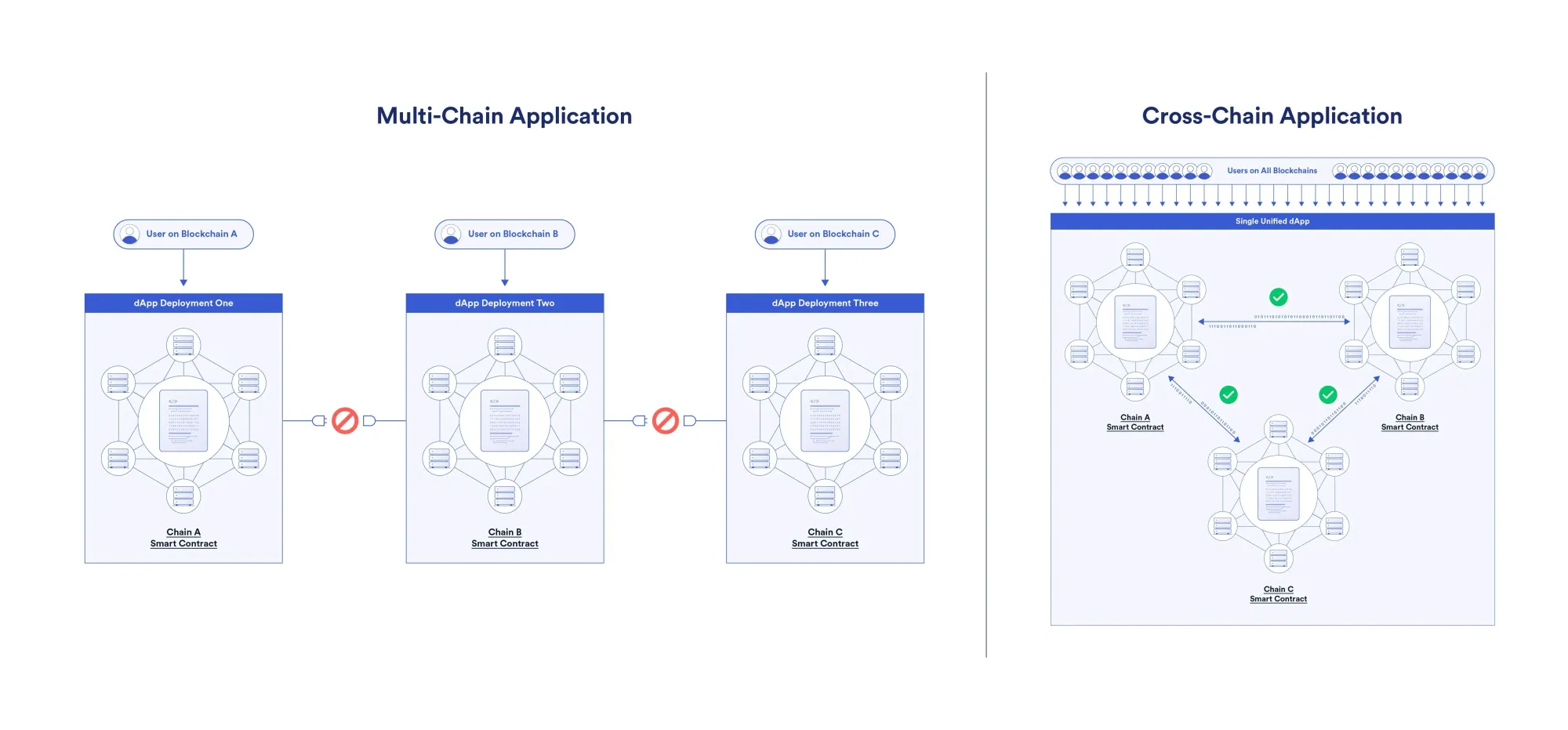
Cross‑chain applications abstract away the technical complexity of underlying blockchains, allowing developers to run different modules on the most suitable chain. For example, a Web 3 game might handle in‑game transactions on a high‑throughput, low‑cost chain while minting NFTs on a highly secure chain; a DeFi protocol could achieve full‑chain liquidity aggregation through cross‑chain bridges.
Why Do We Need Multi‑Chain?
The rapid expansion of the multi‑chain ecosystem signals a healthy evolution for Web 3. Each blockchain possesses its own competitive advantages, fitting particular use‑cases and spurring technological innovation. For users, multi‑chain means access to a broader set of applications on familiar chains; for developers, it offers the freedom to implement functionality on the optimal chain without sacrificing user experience.
Building a More Connected Web 3 Ecosystem Through Cross‑Chain Messaging
Cross‑chain smart contracts represent a paradigm shift for decentralized applications, yet most mainstream chains still operate in isolation. The Cross‑Chain Interoperability Protocol (CCIP) is an open‑source standard that supports the transfer of arbitrary messages and tokens across chains, breaking the single‑chain barrier and giving developers higher scalability and flexibility, improving user experience, and promoting widespread blockchain adoption.
In short, CCIP takes a crucial step toward constructing an interconnected, interoperable ecosystem. As a leading project in the cross‑chain space, Chainlink has already integrated a large number of blockchains and Layer 2 networks, equipping it to support the migration from multi‑chain to cross‑chain smart contracts.
A complete cross‑chain ecosystem can unlock highly scalable application potential, moving the familiar user experience of Web 2 into Web 3 while laying the foundation for a new internet paradigm built on immutability and minimal trust.
That concludes the article “What Are Multi‑Chain and Cross‑Chain in Blockchain? Understanding the Foundations of Web 3 Interoperability.” For deeper explorations of multi‑chain and cross‑chain topics, search for previous Bitaigen articles or continue reading the related posts below. We look forward to your continued interest in Bitaigen!
Related Reading
- Aster DeFi: Multi‑Chain Perpetual Contracts & Binance Labs
- Hyperliquid vs Aster: Decentralized Perpetual Trading Review
- PROVE Token: Zero‑Knowledge Cross‑Chain & 2025 Outlook
💡 Register on Binance with referral code B2345 for the maximum trading fee discount. See Binance complete guide.



