
 Bitaigen Research
 In the crypto community, you’ll often hear people mention PoS, especially since ETH transitioned to ETH 2.0 in June 2022, moving from the original PoW to PoS.
In this article we will explain what PoS is, how it works, its advantages, disadvantages, risks, and any other information you should know.
In this paper we systematically outline the core concepts of the PoS mechanism, its operating principles, and its advantages over PoW. We also dive deep into its potential risks and limitations. Through easy‑to‑understand examples, readers can quickly assess whether PoS fits their investment or technical strategy. The following sections provide a more complete perspective and are worth a careful read.
What Is PoS?
Proof‑of‑Stake (PoS) is a consensus mechanism that grants the right to record transactions in exchange for staking tokens. Validators are selected based on the amount of tokens they lock, the duration of the lock, and the “coin age,” and they receive interest as a reward. However, staking also introduces asset‑locking and price‑volatility risks.
PoS was first proposed in 2011 during the early days of blockchain, aiming to eliminate the high energy consumption associated with Proof‑of‑Work (PoW). Unlike traditional mining rigs, electricity bills, and other costly hardware, PoS only requires users to lock tokens on‑chain to participate in block validation. This lowers the entry barrier, simplifies operations, and aligns better with environmental sustainability goals.
The basic principle is: multiple nodes in a blockchain network compete for the right to write blocks by staking tokens. The larger the staked amount and the longer the staking period, the higher the probability of being chosen as a validator. When a validator successfully creates a block, they receive a reward similar to a dividend on equity, although the source of the reward differs from traditional stock dividends.
Compared with PoW, which consumes computational power and electricity, PoS can dramatically cut energy use, improve security, and, to some extent, reduce centralization risk, thereby increasing validation efficiency.
How Does PoS Operate?
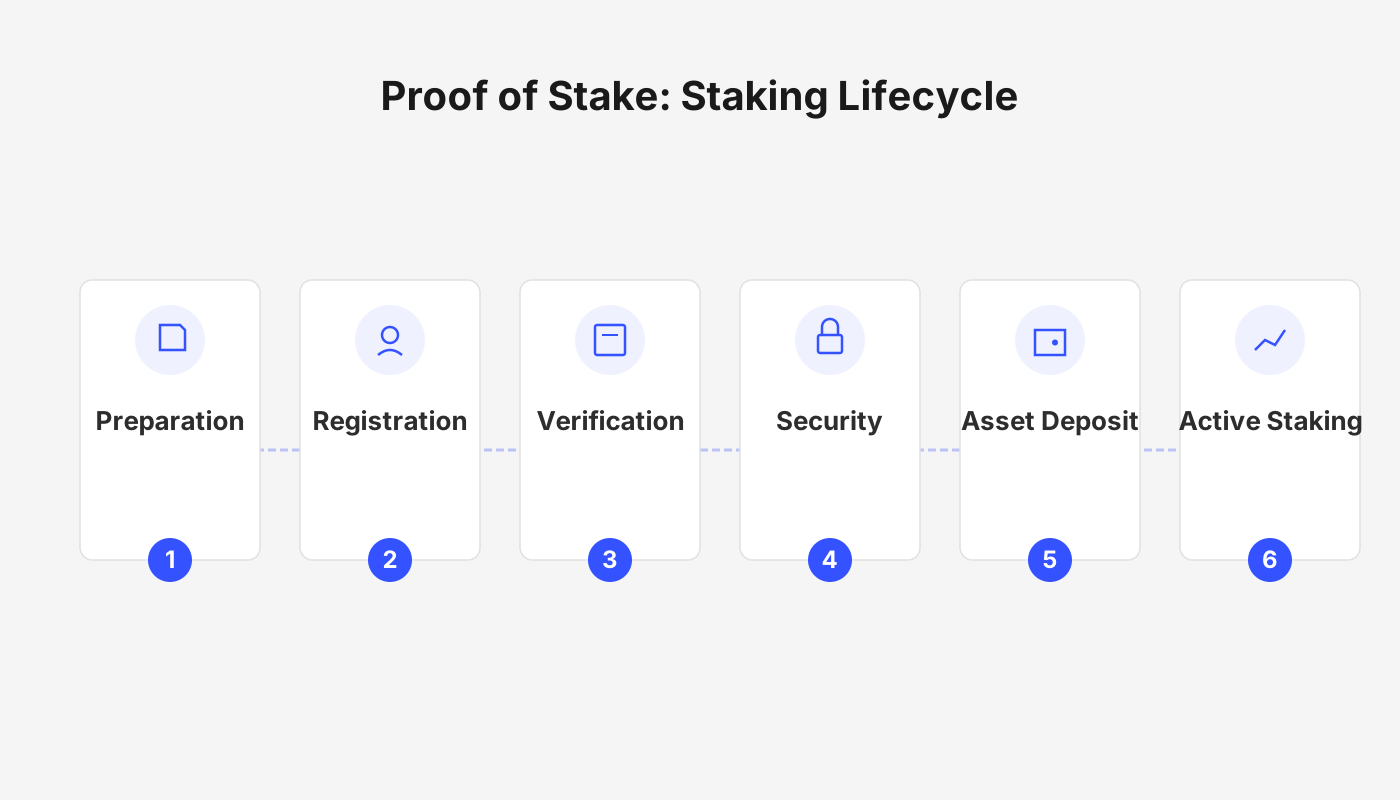
The PoS workflow can be summarized in the following steps:
- Stake Tokens
An investor locks a certain number of tokens in a smart contract on the blockchain.
- Select Validators
The system performs a probabilistic draw based on each node’s staked token amount, staking duration, and coin age (CoinAge) to pick the validator for the next block.
- Package the Block
The selected validator bundles transactions into a block and broadcasts it to the entire network.
- Consensus Confirmation
Other nodes verify the block’s legality using the same staking information. Once consensus is reached, the block is permanently written to the chain.
- Reward Distribution
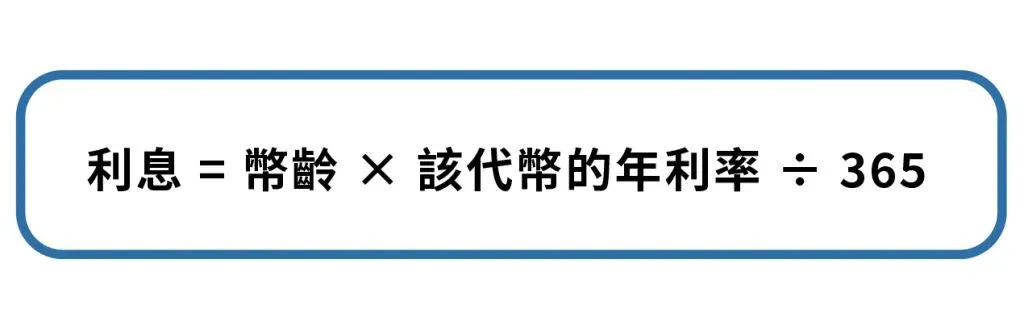
Validators receive token rewards according to their coin age and the annualized yield set by the protocol. The reward formula is:
\[
\text{Interest}= \frac{\text{CoinAge} \times \text{Annual Rate}}{365}
\]
Coin Age and Interest Calculation
- Coin Age = amount of staked tokens × number of staking days
Example: Staking 100 tokens for 10 days yields a coin age of 1,000.
- Interest = Coin Age × Annual Rate ÷ 365
If the annual rate is 12 %, the interest equals 1,000 × 12 % ÷ 365 ≈ 0.328 tokens.
After a reward is paid, the coin age resets to zero and starts counting again, preventing a single node from monopolizing validation rights simply by staking forever.

The three main factors that boost the chance of obtaining validation rights:
- Larger amount of staked tokens
- Longer staking duration
- Longer interval since the last validation reward
Consequently, PoS is well‑suited for investors who intend to hold tokens for the long term and do not need immediate access to their capital. It is important to note that assets are locked during the staking period; if the token price experiences a sharp decline, the investor may be unable to withdraw quickly, potentially facing a situation where the earned interest does not compensate for the loss in principal. *(Note: Crypto gains may be taxable in your jurisdiction; consult a tax professional.)*
Advantages and Disadvantages of PoS
PoS addresses many of PoW’s shortcomings by reducing hardware costs and cutting energy consumption, yet it introduces new challenges related to decentralization, inflation, and token economics. Below is a bullet‑point comparison of its pros and cons:
Advantages
- No mining hardware required, eliminating shortages caused by supply‑demand imbalances.
- Reduced 51 % attack risk, because an attacker would need to control a large share of tokens rather than computational power.
- Environmentally friendly: energy savings align with sustainable development goals.
- Higher validation efficiency, resulting in faster transaction confirmations than PoW.
Disadvantages
- Both chains in a fork can earn interest, potentially exacerbating inflation.
- Token concentration can lead to a capitalist tilt, weakening decentralization.
- Lack of external scarcity: low staking costs may provide insufficient price support.
- Asset locking: during a price crash, users cannot exit quickly, creating a “earning interest while losing principal” scenario. *(Tax reminder: capital gains from staking rewards may be subject to local tax regulations.)*
Differences Between PoS, PoW, and DPoS
The table below highlights the key distinctions among three mainstream consensus mechanisms, helping readers quickly compare them:
| Mechanism | Alias | Validator / Miner | Mining / Validation Method | Main Cost | Delegates | Energy Consumption | Security | Decentralization | Scalability |
|---|---|---|---|---|---|---|---|---|---|
| **PoS** | Proof‑of‑Stake | Validator | Staked tokens | Token lock‑up | None | None | Medium | Medium | Low |
| **PoW** | Proof‑of‑Work | Miner | Computational power | Mining rigs + electricity | None | High | High | Low | Low |
| **DPoS** | Delegated Proof‑of‑Stake | Witnesses | Staked tokens + voting | Token lock‑up | Present | Low | Medium | Low | High |
- PoS: Gains validation rights through token staking, solving the energy problem but still leaving room for performance and scalability improvements.
- PoW: Relies on raw computing power to compete for validation, leading to high energy use and limited scalability.
- DPoS: Adds a voting layer on top of PoS to elect witnesses, dramatically boosting performance and scalability, but at the cost of greater centralization.
Evolution of Consensus Mechanisms
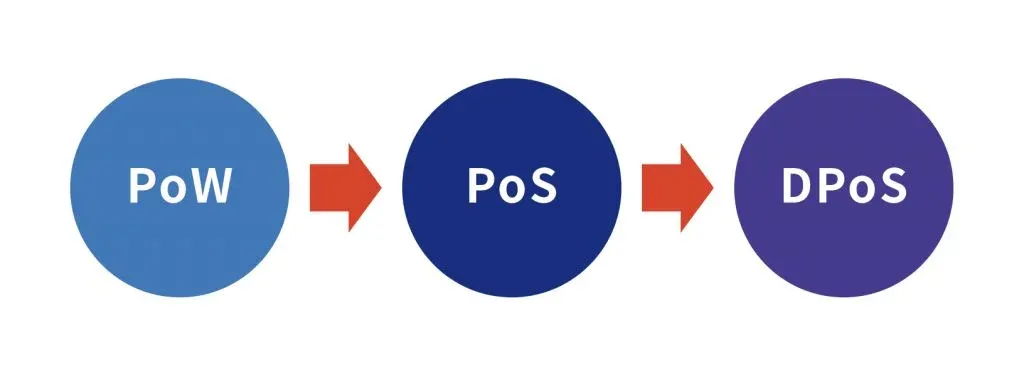
- PoW: The earliest consensus model, relying on computational competition for block rights; it is expensive and hard to scale.
- PoS: Replaces computational work with low‑energy staking, lowering entry barriers and improving security.
- DPoS: Builds on PoS by introducing delegated voting, further increasing transaction throughput and scalability.
Conclusion
The PoS mechanism was created as an alternative to address PoW’s deficiencies in energy consumption, transaction speed, and scalability, aligning with today’s emphasis on environmental responsibility and efficiency. While PoS shines in security and scalability, a heavy concentration of tokens in a few nodes can erode decentralization, and the price risk associated with locked assets cannot be ignored.
The blockchain impossible triangle—decentralization, scalability, and security—still lacks a perfect solution that satisfies all three dimensions simultaneously. Project teams continue to explore more balanced consensus models.
This article ends here. For deeper analyses of the PoS mechanism, please search for previous articles by Bitaigen (比特根) or continue browsing the related links below. Thank you for your continued interest and support!
*For fiat transactions, most platforms accept USD and support SEPA or SWIFT transfers for international users. U.S. residents should use Binance.US rather than the global Binance platform.*
Related Reading
- Proof of Stake vs Proof of Work: Energy, Decentralization & Security Comparison
- TVL vs PoS Staking: Differences & Misconceptions
- What Is xBTC? How It Solves Bitcoin’s Biggest Pain Points
💡 Register on Binance with referral code B2345 for the maximum trading fee discount. See Binance complete guide.



