
 Bitaigen Research
 We systematically review the core principles, historical development, and the unique role of Proof‑of‑Work (PoW) in decentralized security, and we deeply examine real‑world challenges such as energy consumption and scalability bottlenecks while looking ahead to possible technological iteration paths. If you want to understand why PoW remains a cornerstone of blockchain technology and where it might head in the future, keep reading.
What Is Proof‑of‑Work (PoW)?
Proof‑of‑Work (PoW) is a consensus mechanism that generates blocks through competition for hashpower. Its decentralized security properties make it irreplaceable in the blockchain ecosystem, although it faces energy‑intensity and scalability challenges.

Origins and Development
The concept of Proof‑of‑Work was first proposed by Cynthia Dwork and Moni Naor in 1993 as a tool to combat spam and denial‑of‑service attacks. In 1999, Markus Jakobsson and Ari Juels formally coined the term *Proof‑of‑Work*. In 2008, Satoshi Nakamoto applied PoW to a digital currency system for the first time in the Bitcoin whitepaper, establishing it as the foundation of decentralized finance and providing a reference model for subsequent blockchain projects.
How Does Proof‑of‑Work (PoW) Operate?
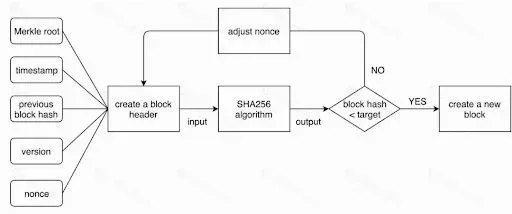
PoW achieves consensus by having network nodes compete for the right to write the next block, with the competition centered on computational power. The process can be summarized in the following key steps:
- Collect Transactions – Miners retrieve pending transactions from the network.
- Construct a Block – They package the transactions into a new block and attach metadata such as a timestamp.
- Compute a Hash – A cryptographic hash function generates a unique hash value for the block.
- Search for a Nonce – Miners repeatedly try different random numbers (nonces) until the block’s hash satisfies the current difficulty target.
- Broadcast and Verify – The first miner to find a qualifying nonce broadcasts the block; other nodes verify it and, if valid, accept it.
The successful miner receives the block reward, and the network moves on to the next round of competition. Because each round is independent, the outcome ultimately depends on the amount of hashpower a node controls—the more hashpower, the higher the probability of winning. The system’s energy consumption and hardware investment constitute the “security deposit” that safeguards the network: the more participants and the greater the energy use, the higher the blockchain’s overall security.
Why Is Proof‑of‑Work Important?
PoW delivers three core values to a blockchain:
- Decentralization – Hashpower is spread across miners worldwide, preventing any single entity from taking control of the network.
- Security – Altering a confirmed block requires recomputing the work for all subsequent blocks, a cost that is prohibitively high.
- Trustlessness – The system relies on verifiable mathematical proof rather than on centralized institutions.
Advantages of Proof‑of‑Work
Security
High‑difficulty computational tasks ensure that only participants who invest substantial hashpower can create new blocks. An attacker wishing to rewrite history would have to redo all the work, incurring an economic cost that is practically infeasible.
Decentralization
Anyone with sufficient computational resources can join mining, reducing centralization risk and enhancing resistance to censorship.
Proven Track Record
Since Bitcoin’s adoption of PoW, the mechanism has demonstrated decades of security and stability across the globe, becoming the benchmark for consensus algorithms.
Disadvantages of Proof‑of‑Work
- Massive Energy Consumption – Continuous hashing leads to high electricity usage, raising environmental concerns.
- Limited Scalability – The computational intensity caps the number of transactions processed per second, making it difficult to meet large‑scale application demands.
- Mining Centralization Trend – Hashpower tends to concentrate in a few large mining pools equipped with specialized hardware, potentially undermining the original decentralization intent.
Proof‑of-Work vs. Proof‑of-Stake (PoS)
Proof‑of-Stake (PoS) selects validators based on the amount of cryptocurrency they hold and the length of time they have staked it, dramatically reducing energy consumption. Compared with PoW, PoS is more environmentally friendly, but debates persist around its security model, degree of decentralization, and incentive structures.
Typical Use Cases of Proof‑of-Work
- Bitcoin – The first cryptocurrency to use PoW, setting the industry standard for the mechanism.
- Ethereum – Initially launched with PoW, then transitioned to PoS during the Ethereum 2.0 upgrade to address energy efficiency and scalability bottlenecks.
Challenges and Industry Trends
- Energy Sustainability – Some projects are experimenting with renewable‑energy‑powered mining to lower carbon footprints.
- Hardware and Algorithm Innovation – New ASIC designs and more efficient hash algorithms aim to improve hashpower utilization and reduce environmental pressure.
- Consensus Diversity – Beyond PoS, hybrid consensus models, validator rotation schemes, and other approaches are being explored to balance security with efficiency.
Despite ongoing debate, PoW retains a core position in mainstream networks such as Bitcoin because of its mature security model.
Why Is PoW Still Irreplaceable Today?
For ordinary users, PoW provides a way to conduct secure transactions without trusting a third party. For developers, it serves as a fundamental benchmark for understanding the trade‑off between blockchain security, energy consumption, and decentralization. Even as new consensus mechanisms emerge, PoW remains an indispensable reference point when evaluating alternatives.
How to Protect Your Crypto Assets on PoW Networks?
Within PoW‑dominated blockchain ecosystems, using a hardware wallet is an effective way to enhance asset security. Take OneKey as an example: this open‑source hardware wallet stores private keys offline, shielding them from most online attacks and embodying a “open‑source + secure + user‑friendly” design philosophy that offers users a reliable asset‑management solution.
The Future of Proof‑of-Work
As the industry places greater emphasis on sustainability, PoW may evolve along several paths:
- Green Mining – More mining operations are expected to shift toward wind, solar, and other renewable energy sources.
- Hardware Upgrades – More efficient ASICs and low‑power chips could reduce the energy cost per unit of hashpower.
- Algorithm Optimization – Research into new hash functions that balance security with energy efficiency is ongoing.
Conclusion
Proof‑of‑Work is one of the foundational technologies of cryptocurrency, enabling secure transaction verification and blockchain integrity in a decentralized environment. While energy consumption and scalability concerns drive the exploration of alternatives such as PoS, PoW continues to occupy a central role in most major networks thanks to its proven security.
This article is derived from earlier series posts by Bitaigen. To learn more, search for the relevant keywords or follow the links below. Stay safe as you navigate the decentralized world.
Related Reading
- Proof-of-Stake Staking: Earn Crypto Rewards Securely
- AI Crypto Tokens: Mid-Term Growth Picks & Insights
- LayerZero: From Ultra-Light Bridge to Decentralized Platform
💡 Register on Binance with referral code B2345 for the maximum trading fee discount. See Binance complete guide.



