
 Bitaigen Research
 Gas fees in cryptocurrency refer to the cost of computational resources paid on a blockchain network to execute a transaction or a smart contract. They are usually denominated in Gwei on Ethereum and serve to incentivize validators to keep the network secure.
Cryptocurrency gas fees are the charges required to process transactions or execute smart contracts on blockchain networks such as Ethereum, Polygon, and Binance Smart Chain (BSC). Gas fees are designed to reward validators for providing the computing power needed to verify transactions and maintain network security.
Key Points
- Gas fees are the cost users must pay to successfully complete a transaction on a blockchain, especially for transactions that involve smart contracts and decentralized applications (dApps).
- Blockchain networks charge gas fees to incentivize validators who confirm transactions and maintain network security.
- Gas is the unit that measures the amount of computational work required to execute a transaction on a blockchain.
- Gas fees are expressed in Gwei, where Gwei stands for “giga‑wei” and equals 10⁻⁹ ETH.
The Bitaigen editorial team has compiled the core cost behind blockchain transactions—gas fees. This article walks through the concept, function, and pricing unit, gradually dissecting its role on Ethereum and cross‑chain networks, helping readers understand why each operation must incur this fee and offering a practical mental framework so you can interact with dApps more intelligently. For details, keep reading.
Understanding Cryptocurrency Gas Fees
*Source: Chainmyne*
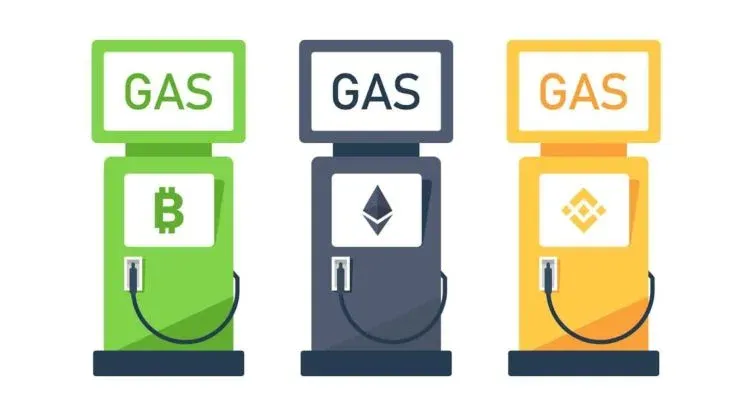
Blockchain transactions are often marketed as a free or cheaper alternative to traditional banking services, but in reality each transaction carries a fee. Whether on Bitcoin, Ethereum, Solana, or Cardano, the network charges for the operations performed on it.
- Simple transaction example: Paying for goods or services, sending funds to a friend.
- Complex transaction example: Running a smart contract, interacting with a dApp, minting a token.
Gas Fees vs. Transaction Fees
Ethereum was the first network to use the term Gas fee to describe transaction costs. Chains such as Ethereum, Polygon, Arbitrum, and BSC usually refer to their costs as Gas fees; Bitcoin uses “mining fee,” while Solana, Cardano and others often call it “network fee” or “transaction fee.” In essence:
- On Ethereum and compatible networks, the cost of a transaction is called a Gas fee.
- On other blockchains, the cost is referred to as a mining cost or transaction fee.
Speed and fee differences between chains are stark. For instance, Solana can process roughly 65,000 transactions per second (TPS), whereas Ethereum’s average block time is about 12 seconds, and its fees fluctuate with network load.
Why Crypto Networks Charge Gas Fees
Transaction validation consumes computing resources and electricity, costs that are borne by validators. Networks that use Proof‑of‑Stake (PoS)—such as Ethereum—require validators to stake at least 32 ETH to obtain the right to validate transactions. Validators are rewarded with gas fees, which can:
- Compensate for resource consumption.
- Raise the cost of attacks, deterring “Sybil” attacks.
- Incentivize continuous maintenance of network security.
Thus, charging gas fees is a core mechanism that keeps the blockchain ecosystem healthy.
How Gas Fees Operate on a Blockchain Network
Gas is the unit that measures the computational power needed to execute a transaction on a blockchain. Every on‑chain action—including dApp interactions, smart‑contract executions, and NFT deployments—requires paying gas. It also serves as the incentive for validators and, by assigning a cost to each transaction, effectively prevents spam attacks.
Who Pays the Gas Fee?
When a user submits a transaction for validation, they must pay the gas fee. This functions like a bid for block space; a higher fee generally yields higher priority for inclusion in the next block. Simple transactions (e.g., an online purchase) consume little gas and therefore cost little, whereas complex DeFi calls or NFT minting consume much more gas and are relatively more expensive.
Who Receives the Gas Fee?
In a decentralized compute network, validator nodes receive a portion of the gas fee as a reward. Proof‑of‑Work (PoW) chains (e.g., Bitcoin, Ethereum Classic) pay the fee to miners; Proof‑of‑Stake (PoS) chains (e.g., Ethereum) award the fee to validators who have staked ETH.
Ethereum Gas Fee Explained
Gas is a foundational concept on the Ethereum blockchain, representing the cost of executing a transaction. Fees are priced in ETH’s sub‑unit Gwei (1 Gwei = 10⁻⁹ ETH) and a portion is allocated to validators as staking rewards.
Ethereum is the leading platform for deploying smart contracts, NFTs, and dApps, which often leads to network congestion and higher compute demand. Even after the transition from PoW to PoS, gas fees remain relatively high.
How Gas Works in the Ethereum Virtual Machine (EVM)
The Ethereum ecosystem provides the Ethereum Virtual Machine (EVM), a decentralized runtime that allows smart‑contract code to be safely executed on every Ethereum node. Any token, NFT, or dApp deployed on an EVM‑compatible network must pay gas. For example, the PEPE token, CryptoPunks NFTs, and the AAVE token from the Aave protocol are all Ethereum‑based and require gas when transferred or interacted with.
Gas Pricing Units: Wei, Gwei, and Ether
| Unit | Description | Conversion |
|---|---|---|
| **Wei** | Smallest unit, named after cryptographer **Wei Dai** | 1 Wei = 10⁻¹⁸ ETH |
| **Gwei** | “giga‑wei”, commonly used to quote gas fees | 1 Gwei = 10⁹ Wei = 10⁻⁹ ETH |
| **Ether (ETH)** | Native token of Ethereum | 1 ETH = 10⁹ Gwei = 10¹⁸ Wei |
When Is ETH Gas Cheapest?
Gas fees typically drop when network traffic is low—e.g., during midnight, early morning, weekends, or public holidays. However, even during off‑peak periods, a constrained network capacity can still cause delays.
Why Do Ethereum Gas Fees Remain High?
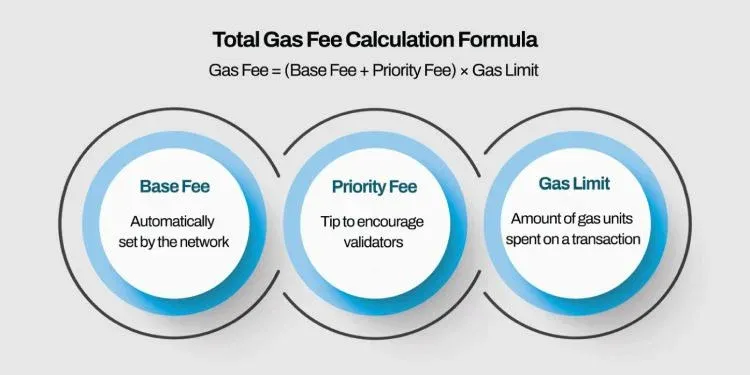
Before 2020, gas fees were relatively stable. The surge of DeFi, NFTs, and GameFi caused congestion and fee spikes. The 2021 London hard fork introduced EIP‑1559, splitting the fee structure into:
- Base fee: Dynamically adjusted according to network load and burned after the transaction.
- Priority fee (tip): An optional extra paid by the user to speed up confirmation.
The 2022 “Merge” switched the consensus mechanism to PoS, cutting energy consumption by over 99 %, yet peak‑period fees remain demand‑driven.
Key events that drove fee spikes:
- ICO boom (2017‑2018): Massive influx of users congested the network.
- DeFi summer (2020‑2022): Complex lending and liquidity operations increased gas consumption.
- NFT craze (2021): Platforms like OpenSea saw transaction volumes soar, with single‑transaction fees sometimes exceeding USD 100.
Future sharding and Layer‑2 solutions are expected to dramatically lower gas costs.
How Is a Gas Fee Calculated?
*Source: Obiex*
Before EIP‑1559, the formula was:
Gas fee = Gas units × Gas price
Since August 2021, the calculation became:
\[
\text{Gas fee} = \text{Gas units} \times (\text{Base fee} + \text{Priority fee})
\]
Example: Sending 5 ETH to a friend, estimated at 3 gas units, with a base fee of 15 Gwei and a self‑added tip of 5 Gwei results in a fee of 3 × (15 + 5) = 60 Gwei, i.e., 0.00000006 ETH. The total amount transferred would be 5.00000006 ETH.
What Is a Gas Limit?
Gas Limit denotes the maximum amount of computation a user is willing to allocate to a single transaction, expressed in gas units. If the actual consumption is lower than the limit, only the used amount is deducted; if the limit is insufficient, the transaction fails with an “out‑of‑gas” error. The gas limit also protects users from runaway contracts that could otherwise incur exorbitant costs.
Total transaction cost = Gas Limit × (Base fee + Priority fee)
Example: Base fee = 50 Gwei, priority fee = 10 Gwei, Gas Limit = 20,000 → fee = 20,000 × (50 + 10) = 1,200,000 Gwei.
How to Use Gas in an Ethereum Transaction
On Ethereum, every operation consumes gas, and users must pay with ETH. The transaction flow includes:
- Set Gas Limit: Define the maximum computation based on transaction complexity.
- Choose Gas Price: Select a low or high price depending on network congestion to balance cost versus speed.
- Confirm & Send: After validators process the transaction, the actual fee is deducted from the wallet.
Mainstream wallets such as MetaMask and Trust Wallet provide real‑time gas estimations and one‑click adjustment tools. The introduction of EIP‑1559 enables the base fee to auto‑adjust with network congestion.
How to Set Your Gas Fee
Users can manually decide the priority fee (tip), while the base fee is automatically calculated by the network. Most wallets offer three preset modes:
- Low: Pay the minimum fee; expect longer confirmation times.
- Market: Use the network‑recommended fee at the moment.
- Aggressive: Pay a higher fee for the fastest possible confirmation.
A custom mode allows manual entry of both Gas Limit and a maximum fee ceiling. Setting the fee too low may cause the transaction to be ignored or to fail with “out‑of‑gas,” and any fee already paid is not refundable.
Ethereum vs. Bitcoin Gas Fee Comparison
| Item | Ethereum (ETH) | Bitcoin (BTC) |
|---|---|---|
| Fee name | **Gas fee** (Gwei) | **Mining fee** (sat/byte) |
| Consensus | PoS (since the 2022 “Merge”) | PoW |
| Fee structure | Base fee + priority fee | Miner fee (based on transaction size) |
| Energy impact | Fee does not directly reflect energy; PoS consumption is low | High energy consumption leads to larger fee volatility |
| Fee drivers | Network congestion, contract complexity | Block capacity, miner competition |
Even after Ethereum’s shift to PoS, gas fees remain driven by network usage and contract intricacy.
Ways to Reduce Gas Fees
- Choose a low‑fee chain: Networks such as Solana, Avalanche, and others offer higher TPS and lower fees.
- Transact during off‑peak periods: Midnight, weekends, or public holidays usually see cheaper gas.
- Use Layer‑2 solutions: Arbitrum, Polygon, StarkNet, Base, etc., handle computation off‑chain and charge minimal gas.
- Monitor gas prices: Tools like Etherscan, Blocknative, and others provide real‑time fee data.
- Optimize contract interactions: Batch multiple actions together and avoid unnecessary calls.
Best Tools for Tracking and Estimating Gas Fees
- Blocknative Gas Estimator: Shows real‑time multi‑chain gas composition, offers a Chrome extension and dashboard.
- Built‑in wallet calculators: MetaMask, Trust Wallet, and similar wallets automatically predict fees.
- Etherscan: Ethereum block explorer that displays live gas prices, historical trends, and transaction analytics.
Conclusion
Gas fees provide essential incentives for validators; without them, validators would lack motivation, jeopardizing network security, transparency, and sustainability. For users, selecting appropriate chains, transacting during low‑traffic windows, and leveraging Layer‑2 solutions can substantially cut transaction costs.
Frequently Asked Questions
How can I minimize gas fees as much as possible?
By executing transactions when network load is low (e.g., late night or weekends), using L2 networks or switching to a cheaper blockchain, and consulting real‑time price feeds such as Etherscan, you can reduce out‑of‑pocket expenses.
What is the gas limit on Ethereum?
The gas limit refers to the maximum amount of computation a user is willing to pay for when submitting a transaction. Since 2021, Ethereum’s block gas cap has been raised to roughly 32 million units per block.
Are gas fees refunded if a transaction fails?
Because the fee is paid to validators, any portion that has already been transferred to them is not refundable, even if the transaction fails due to an “out‑of‑gas” error or a contract bug.
---
*Note:* Crypto gains may be taxable in your jurisdiction. Always consult a tax professional regarding the tax treatment of cryptocurrency transactions. For fiat on‑ramps/off‑ramps, USD transactions typically use SEPA or SWIFT channels, and U.S. users should use Binance.US rather than the global Binance platform.
Related Reading
- Ethereum Chinese Explorer: On‑Chain & Smart Contract Tool
- 2025 XRP ETF: Futures & Spot Launches Boost Liquidity
- Ethereum Launches ERC‑8004: AI Agent Identity Standard
💡 Register on Binance with referral code B2345 for the maximum trading fee discount. See Binance complete guide.



