
 Bitaigen Research
 Ethereum Network Gas Fee
In the Ethereum network, the Gas Fee is fundamentally the cost that users must pay to validators (formerly miners) for providing the computational resources needed to execute a transaction or call a smart contract on the blockchain. This expense serves both as compensation for the compute service and as an incentive that helps keep the blockchain secure and operating smoothly.
Because the fee goes directly to validators, the industry often refers to it as a miner fee. In virtually every blockchain activity today—including token transfers, NFT trades, and more—Gas Fees are indispensable, making it crucial to know how to query and calculate them accurately.
In this article we systematically outline the concept of Ethereum Gas Fee, its underlying causes, and practical methods for querying and calculating it. By mastering these tools, users can better estimate costs in transaction, NFT, DeFi, and other scenarios, and avoid peak‑time surcharges. After reading on, you’ll have a complete guide at your fingertips.
Why Is the Ethereum Gas Fee So Expensive?
Ethereum’s fees are primarily driven by network demand. When the number of users interacting with Ethereum‑based applications (DeFi, NFTs, games, etc.) spikes, validators must allocate additional compute power to process those contracts, pushing Gas prices upward. Historically, popular NFT projects such as CryptoKitties, Stoner Cats, and Yuga Labs’ Otherdeed have driven the cost of a single transaction into the thousands of USD, far exceeding the intrinsic value of the NFT itself.
Moreover, during traffic‑heavy periods ordinary users may see their transaction fees surge dramatically, sometimes resulting in delayed or queued transactions. For this reason, understanding when and how to reduce Gas expenditure has become a focal point for many participants.
What Exactly Is a Gas Fee?
Within a blockchain ecosystem, a Gas Fee is the payment a user makes to validators in order to obtain execution rights on the network. The concept originated on Ethereum (ETH) and has since been adopted by many other chains, albeit with different native payment tokens—e.g., Binance Smart Chain uses BNB.
Collecting fees incentivizes validators to record transactions honestly, maintain ledger integrity, and, to a certain extent, prevents the network from being abused.
Why Do Gas Fees Exist?
Any on‑chain action—whether executing a smart contract or purchasing an NFT—requires computational resources. Validators (formerly miners) run specialized software to verify and bundle transactions, incurring hardware, electricity, and maintenance costs that must be reimbursed.
The Gas Fee transfers value from the demand side (the user) to the supply side (the validator), allowing validators to be compensated while continuously safeguarding the network’s security and reliability.
Understanding the Role of Gas Fees in Ethereum
On Ethereum, each transaction carries a certain amount of data, yet block space is limited. Validators prioritize transactions that offer higher Gas fees to maximize their own earnings. The more data a transaction contains, the more compute it consumes, and consequently the higher its Gas cost.
Lower fees are user‑friendly, but they also reduce the likelihood that a transaction will be selected early, potentially affecting confirmation speed and, indirectly, security. Thus, Gas serves both as remuneration for validators and as a mechanism that promotes transaction safety. Notably, after Ethereum’s transition from Proof‑of‑Work (PoW) to Proof‑of‑Stake (PoS) in September 2022, a portion of the Gas fee is burned (permanently removed from circulation), while validators earn rewards through staked ETH.
Gas Fee Calculation: Key Factors That Influence the Price
Gas fees essentially follow supply‑and‑demand dynamics. The network’s total computational capacity represents supply, while the compute needed for users’ pending transactions represents demand. When demand outpaces supply, fees rise; when supply exceeds demand, fees fall. Users can voluntarily increase or decrease the fee they are willing to pay to achieve faster or slower confirmation times.
Before the London upgrade in August 2021, the fee was determined by two components:
- Gas Price – the amount a user was willing to pay per unit of Gas.
- Gas Limit – the maximum amount of Gas the user allowed the transaction to consume.
Multiplying the two gave the highest possible fee a user might pay.
After the introduction of EIP‑1559, the formula changed to:
```
Gas Limit × (Base Fee + Priority Fee)
```
- Base Fee – automatically adjusted by the protocol each block according to network demand; it is the minimum fee all users must pay.
- Priority Fee (often called a “tip”) – set by the user to incentivize validators to prioritize their transaction.
The Base Fee is burned after the transaction is finalized, while the Priority Fee goes to the validator who included the transaction in a block.
Ethereum’s pricing unit is GWEI, where 1 GWEI = 10⁻⁹ ETH. A standard ETH transfer has a minimum Gas Limit of 21,000 GWEI; any transaction below this threshold is considered invalid and will be rejected, though validators would still retain the associated fee.
How Does an ETH Gas Fee Work in Practice?
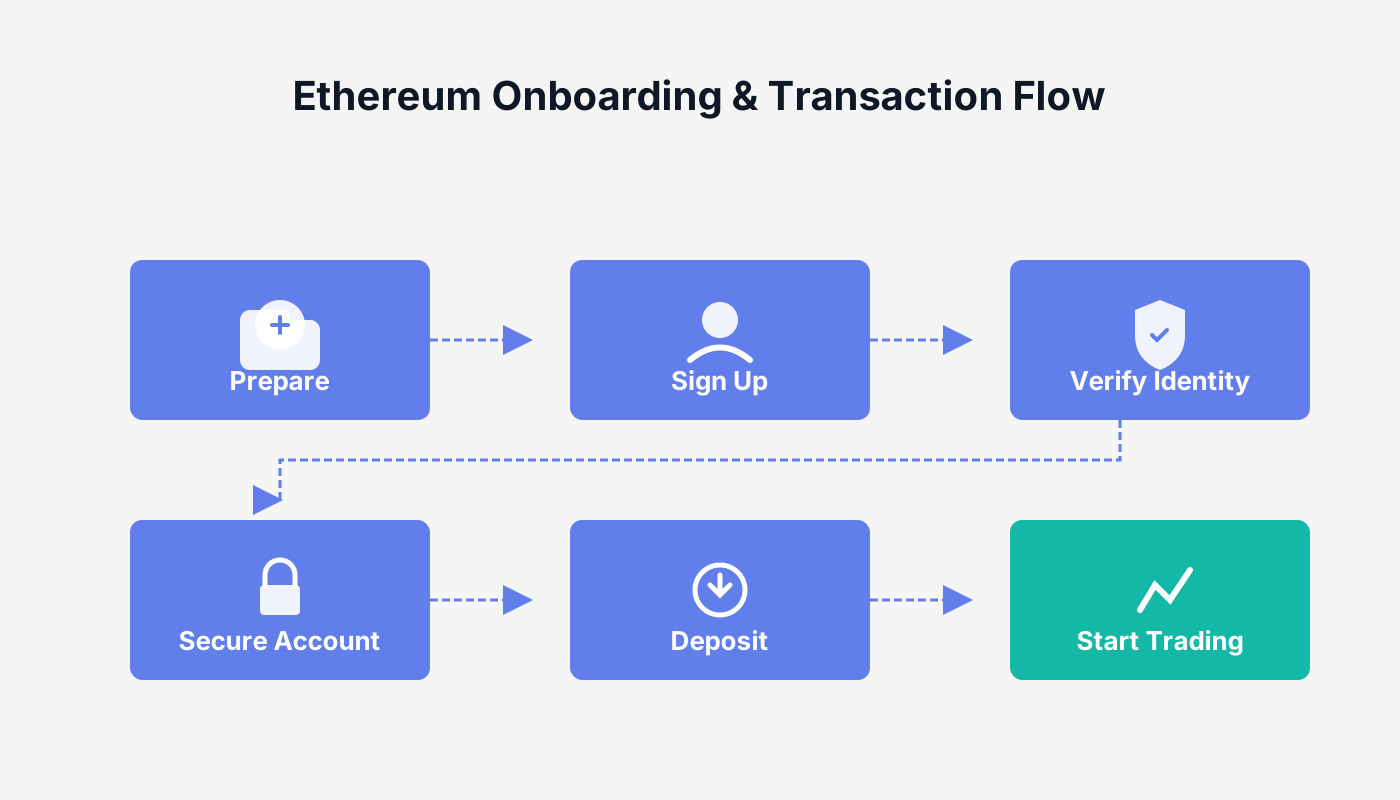
Below is a step‑by‑step illustration using a typical ETH purchase:
- Initiate the transaction – Enter the purchase amount and other details in an exchange or wallet, generating a pending order.
- Confirm fee estimate – The platform provides an estimated Gas fee based on current network conditions; the user accepts it to proceed.
- Broadcast to the Ethereum network – The order, together with the maximum Gas limit, is submitted to the blockchain.
- Validator packing – Validators select the highest‑paying transactions to form a new block; if yours is chosen, it becomes confirmed.
- Wallet balance update – After confirmation, your ETH balance increases, and the corresponding Gas fee is deducted from your account.
- Fee distribution – The Base Fee is burned, while the validator receives the tip (Priority Fee) plus any Base Fees from other transactions in the same block.
Note: Crypto gains, including those realized from ETH or NFT sales, may be taxable in your local jurisdiction. Consult a tax professional for guidance.
How to Query Current Gas Fee Prices?
Keeping an eye on real‑time Ethereum fees helps you time transactions more efficiently. Several dedicated monitoring tools are available, such as Etherscan, ETH Gas Station, and GasNow. These platforms display the current Gas price for three speed tiers—slow, standard, and fast—and provide historical trends, moving averages, and fee leaderboards. Many centralized exchanges and wallet providers also embed fee‑monitoring widgets for user convenience.
When using fiat on‑ramps, the platforms typically accept USD via SEPA, SWIFT, or credit‑card routes. U.S. users must use Binance.US (instead of the global Binance platform) to stay compliant with local regulations.
How to Minimize Gas Fees and Save Money
1. Choose the Right Time Window
Fees spike during periods of network congestion. If your transaction is not time‑critical, avoid peak hours. Data shows that, in the UTC+8 (Beijing) zone, fees are usually highest between 21:00 – 02:00 and tend to dip during weekends—especially Saturday and Sunday. Initiating transactions outside of major North American and European business hours often yields cheaper fees.
2. Consider Layer‑2 or Side‑Chain Solutions
Ethereum scaling solutions such as Polygon (MATIC), Arbitrum, and Optimism offer significantly lower transaction costs and faster confirmations, making them ideal for frequent or high‑value transfers. Using these networks can dramatically reduce expenses while still benefiting from Ethereum’s security guarantees through roll‑up mechanisms.
Why Doesn’t Bitcoin Have a Gas Fee?
Bitcoin also runs on a blockchain, but its fee structure differs from Ethereum’s. Bitcoin primarily relies on the Lightning Network (a second‑layer protocol) to increase transaction throughput and lower costs. The Lightning Network moves many small payments off‑chain, avoiding main‑chain congestion and high fees. In contrast, Ethereum’s diverse use cases—DeFi, NFTs, gaming, etc.—generate a larger on‑chain data volume, naturally leading to higher fees. Ethereum plans to alleviate this pressure through the full rollout of Ethereum 2.0 and continued Layer‑2 adoption.
Latest News and Updates on Ethereum Gas Fees
According to data released by Etherscan on April 28, the average Ethereum Gas fee has fallen to ≈ $1.12 USD per transaction, with the lowest observed price at 5 Gwei, marking the lowest level in nearly six months.
Summary
A Gas Fee is the payment users make to validators for executing operations on a blockchain. It simultaneously incentivizes validators (or miners) and helps secure the network, which is why it is also commonly called a miner fee. Ethereum’s rich functionality often results in relatively high fees, but the transition to PoS, the EIP‑1559 fee‑burning mechanism, and the emergence of Layer‑2 solutions are gradually bringing costs down to more reasonable levels. Regardless of which chain you use, monitoring and strategically scheduling Gas fees remain essential for minimizing transaction expenses.
For more practical tips on querying and calculating Gas fees, stay tuned to Bitaigen’s upcoming series of articles.
Related Reading
- Ethereum Gas Fees Explained: Base & Priority Fees
- Understanding Ethereum Smart Contracts: History & Core Concepts
- Ethereum 2029 Upgrade Roadmap: Forks, Throughput & Security
💡 Register on Binance with referral code B2345 for the maximum trading fee discount. See Binance complete guide.



