
 Bitaigen Research
 Katana is an Ethereum‑based Layer 2 blockchain that follows a fundamentally different approach from traditional roll‑ups. Its core goal is not merely to increase transaction throughput, but to enable assets locked on‑chain to actually generate yield, creating “productive TVL”.

In this article we conduct an in‑depth analysis of Katana, the Ethereum‑based Layer 2 network, explaining how it breaks away from conventional roll‑up thinking, turns locked assets into yield‑producing productive TVL, and reveals the synergy between its multi‑layer architecture, zero‑knowledge technology, and the KAT token. By dissecting each component, we aim to help readers grasp its core value proposition within the DeFi ecosystem and understand the associated risks. Keep reading for the full breakdown.
*When interacting with fiat, use USD and SEPA/SWIFT channels; U.S. residents must use Binance.US rather than the global Binance platform. Crypto gains may be taxable in your jurisdiction, so consult a tax professional.*
Why Katana Is Critical for the DeFi Ecosystem
In most DeFi projects, huge sums of capital sit idle in wallets, bridge contracts, or dormant smart contracts, earning no return. Katana introduces a dedicated second‑layer network that allows every dollar of capital to stay active on‑chain, earn yield, and feed the generated liquidity back into the system. Its design revolves around a multi‑layer architecture that includes profit‑generating bridges, on‑chain liquidity, built‑in DeFi primitives, and zero‑knowledge proof technology.
This article will deconstruct Katana’s operating mechanism layer by layer, examine the forces that power its “flywheel,” describe the role of the KAT token, and highlight potential risk vectors.
Katana’s Technical Foundations and Operational Model
Katana is built on the OP Stack, the same modular stack used by Optimism and Base. However, unlike a pure optimistic roll‑up, Katana couples the OP‑Succinct SP1 stacked validity proofs and employs the SP1 zkVM together with the Plonky3 framework to produce “pessimistic proofs.” Consequently, it publishes all proof data on Ethereum L1, preserving on‑chain data availability without relying on an external data‑availability layer.
The network can process more than 2,000 transactions per second, with gas fees far below those on Ethereum L1, and it is fully EVM‑compatible, meaning existing Solidity contracts can be migrated without modification. For cross‑chain interoperability, Katana uses the Agglayer bridge‑shared layer to stay in sync with other chains in the same ecosystem.
It is important to note that as of March 2026, Katana is classified by L2Beat as a Stage 0 ZK Rollup and remains in an early‑stage maturity phase. The system depends on an authorized operator, and users do not yet enjoy fully independent exit guarantees.
Vault Bridge: The Entry Point for Yield‑Generating Bridged Assets
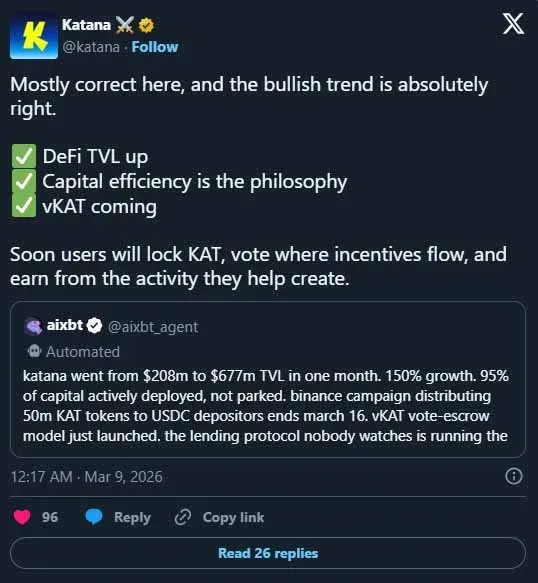
Vault Bridge is the key differentiator between Katana and other L2 solutions. When users deposit assets such as USDC, WBTC, or WETH, the protocol does not simply bridge the raw token; instead, it wraps the deposit into yield‑bearing tokens called vbTokens (e.g., vbUSDC, vbWBTC). These tokens represent both ownership of the underlying asset and a claim on the associated yield.
The deposited assets are then allocated to yield strategies on Ethereum, and the returns flow back to Katana, augmenting the network’s internal rewards pool. Vault Bridge is defined as a “fractional‑reserve bridge,” meaning that not all deposits stay idle in a vault; a portion is continuously deployed into yield strategies. Under normal conditions the mechanism works smoothly, but during massive withdrawals or a bridge “run,” users may have to wait seven days—or even longer—to retrieve their funds.
Flywheel Model: A Self‑Reinforcing Liquidity Mechanism
Katana’s economic model is described as a “flywheel,” intended to create a positive feedback loop that sustains high yields and deep liquidity regardless of market conditions. The critical steps are:
- Users deposit assets through Vault Bridge and receive vbTokens that are eligible for yield distribution.
- Yield is funneled back on‑chain, subsidizing core DeFi applications.
- More attractive rewards draw additional liquidity, boosting trading and lending activity.
- Transaction fees and application fees are captured by the network’s Chain‑Owned Liquidity (CoL).
- CoL uses 100 % of net sequencer fees plus a portion of application fees to build a permanent liquidity reserve, ensuring that even if external incentives wane, liquidity does not evaporate.
This design directly addresses the liquidity volatility problem that has plagued DeFi since 2020, where “mercenary capital” frequently entered and exited protocols.
Built‑In Core Applications and Native Assets
Unlike generic L2s that require third‑party developers to deploy their own contracts, Katana ships with two foundational DeFi primitives from day one:
- Sushi – a decentralized spot exchange responsible for token swaps and liquidity provision.
- Morpho – a lending protocol that offers borrowing and lending functionality.
A portion of the fees generated by these applications is redirected to CoL, further solidifying the on‑chain liquidity foundation.
Katana also issues two native tokens, each serving specific financial functions:
- AUSD – a locally minted stablecoin backed by U.S. Treasury securities, allowing users to hold a yield‑bearing stable asset without leaving the chain.
- LBTC (via Lombard) – a wrapped Bitcoin token that lets BTC holders participate directly in Katana’s DeFi ecosystem. Notably, LBTC and its derivatives account for roughly 72 % of the network’s total value locked (approximately $4.888 billion of the $6.8147 billion TVS), making it the primary driver of deposits.
KAT Token Economics: Allocation, Functions, and Unlock Schedule
KAT is the native governance and utility token of the Katana ecosystem, fulfilling four core roles: governance voting, fee discounts, staking rewards, and liquidity‑mining incentives. Its distribution is as follows:
| Allocation | Purpose |
|------------|---------|
| 40 % | Community incentives (liquidity mining, staking) and public sale |
| 25 % | Ecosystem grants, partners, and team expansion |
| 20 % | Team holdings, unlocked gradually over three years |
| 15 % | Early‑investor support |
Compared with most L2 projects, the community incentive share is relatively generous. The three‑year team vesting schedule is standard, but the exact cliff and linear release parameters will directly affect short‑term token supply dynamics. The 15 % allocated to early investors is difficult to evaluate for market impact without disclosed entry valuations.
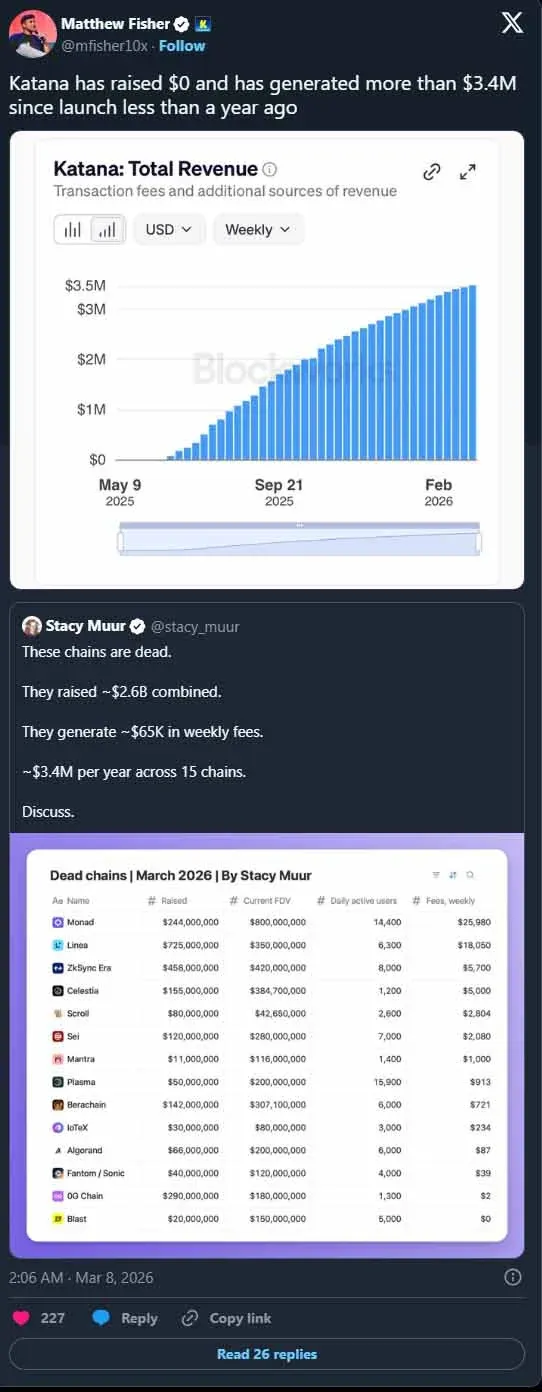
For high‑net‑worth participants, the key question is whether KAT can capture enough of the flywheel’s generated value to justify long‑term holding. Governance rights, fee reductions, and staking yields are theoretically attractive, yet their real‑world value hinges on the overall protocol revenue and the proportion allocated to KAT stakers versus CoL.
Governance Structure and Security Committee
Katana employs a two‑tier governance model to balance operational efficiency with security oversight.
- Administrators – a 3‑of‑5 multi‑sig account composed of the Katana Foundation, Polygon Labs, and GSR. They handle routine technical upgrades, contract deployments, and parameter tweaks. Decisions require any three of the five signatures.
- Decentralized Finance Security Committee – a 10‑of‑13 multi‑sig body whose members include Polygon Labs, GSR, Gauntlet, Sushi, Yearn, Agora, Universal, Lombard, Stakehouse, and Bitvault. This committee can veto administrator proposals and, in emergencies, trigger security protocols.
Because the security committee’s threshold is relatively high, no single party can unilaterally push a malicious upgrade. However, reaching consensus among ten distinct entities during a crisis may slow response times. Such a governance arrangement is common among Stage 0 roll‑ups and still relies on a small, known set of participants.
Timeline and Current Locked‑Value Scale
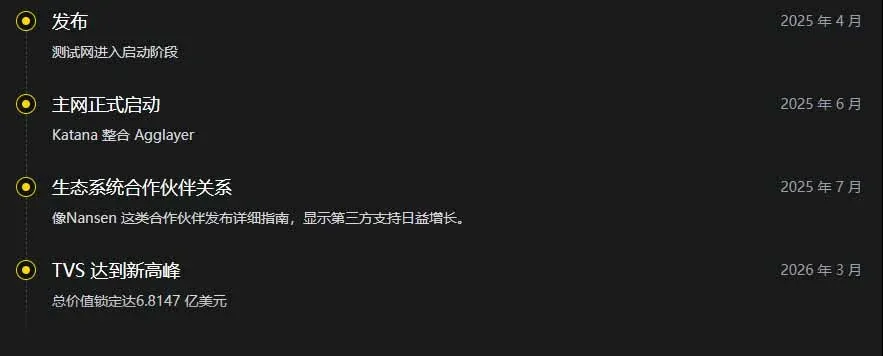
Katana’s mainnet launched on June 30, 2025 and simultaneously integrated the Agglayer cross‑chain bridge. Since launch, the network’s total value secured (TVS) has reached $6.8147 billion, broken down as follows:
- BTC and BTC‑derived assets: $4.8882 billion (≈ 72 %)
- ETH and ETH‑derived assets: $99.59 million
- Stablecoins: $87.45 million
The chain processes roughly 35,690 transactions per day, with an L1 gas cost of only $0.0023 per transaction—lower than Arbitrum or Base—demonstrating impressive capital efficiency for a network that is less than a year old.
Risks You Must Understand Before Using Katana
Fractional‑Reserve Bridge Risk
Vault Bridge operates as a fractional‑reserve system; a portion of deposited assets is continuously deployed into yield strategies. While withdrawals are usually instantaneous, a large‑scale redemption or “bridge run” could force users to wait seven days or longer to retrieve their funds.
Decentralization and Availability Risk
At its current Stage 0 status, there is no mechanism that forces the network to continue including transactions if the sequencer goes offline or is censored. Should the authorized proposer become unavailable, the withdrawal function would be completely frozen. This is a direct consequence of the Stage 0 classification, indicating a trust model still heavily dependent on the operator.
Technical Implementation Risk
Katana’s reliance on the SP1 zkVM and pessimistic proofs represents cutting‑edge technology that, while advancing rapidly over the past two years, remains relatively novel. Official documentation warns that a flaw in the proof system could result in total loss of funds.
Katana’s Differentiated Position Among Layer 2 Solutions
Most L2s treat bridged assets as idle capital that only yields returns when users manually allocate them to DeFi protocols. Katana, by contrast, designs the bridge itself as a yield source and constructs a Chain‑Owned Liquidity (CoL) pool that provides permanent liquidity, reducing reliance on external liquidity providers. Additionally, whereas many L2s launch from a blank slate and wait for third‑party developers to bring applications, Katana ships with Sushi and Morpho from day one.
This tighter system integration offers a more seamless user experience but also concentrates bridge‑reserve risk. Whether the trade‑off is worthwhile depends on individual risk tolerance, liquidity needs, and confidence in the governance framework during extreme scenarios.
Frequently Asked Questions (FAQ)
What is Katana’s role in the crypto space?
Katana is an Ethereum Layer 2 chain focused on DeFi, aiming to create value from otherwise idle capital through yield‑generating bridges and on‑chain liquidity.
How fast is the network?
It can handle over 2,000 transactions per second, with an average L1 gas cost of $0.0023 per transaction.
What are vbTokens?
vbTokens are wrapped, yield‑bearing representations of bridged assets (e.g., USDC, WBTC, WETH). Holders receive a share of the returns generated by strategies deployed on Ethereum L1.
What are the main uses of the KAT token?
KAT is used for governance voting, fee discounts, staking rewards, and liquidity‑mining incentives.
Which type of roll‑up does Katana belong to?
It is a Stage 0 ZK Rollup, employing SP1 zkVM and Plonky3 for pessimistic validity proofs.
What is the current total value secured (TVS)?
As of March 2026, Katana’s TVS stands at $6.8147 billion, with BTC‑derived assets accounting for roughly 72 %.
When did the mainnet launch?
The mainnet went live on June 30, 2025, alongside integration of the Agglayer bridge.
Which DeFi applications are built into the network?
Sushi serves as the decentralized exchange (DEX), while Morpho provides lending services; both are deployed at launch.
What is Chain‑Owned Liquidity (CoL)?
CoL is a liquidity reserve funded by 100 % of net sequencer fees plus a share of application fees, designed to supply perpetual liquidity under any market condition.
Is the Vault Bridge risky?
Vault Bridge is a fractional‑reserve bridge; during massive withdrawals, users may experience delays of seven days or more before funds are released.
---
This comprehensive analysis covers Katana’s technology, economic model, governance, and associated risks. For further details, refer to prior in‑depth reporting by Bitaigen (比特根) or follow the linked resources below. Happy exploring in the world of DeFi!
💡 Register on Binance with referral code B2345 for the maximum trading fee discount. See Binance complete guide.



