
 Bitaigen Research
 The Concept and Overall Framework Behind the USOR Plan
In the wave of tokenizing real‑world assets (RWAs), an increasing number of projects are attempting to blend traditional resources with blockchain technology. USOR (U.S. Reserve Oil Tokenization) is one such example; it wraps the image of the United States’ strategic oil reserves into a crypto token. Although the project itself has not received endorsement from any official or regulatory body, its narrative has sparked widespread attention and controversy within the crypto community.

From the perspective of the Bitaigen editorial team, we outline the concept and framework of the USOR plan, dissect how it packages the United States’ strategic oil reserves as a digital token, and assess the significance and disputes surrounding the project within the broader trend of real‑world asset tokenization—especially in an environment lacking regulatory endorsement. Reading on will give you a comprehensive understanding of its technical implementation, market narrative, and potential risks.
Core Narrative of the U.S. Reserve Oil Token
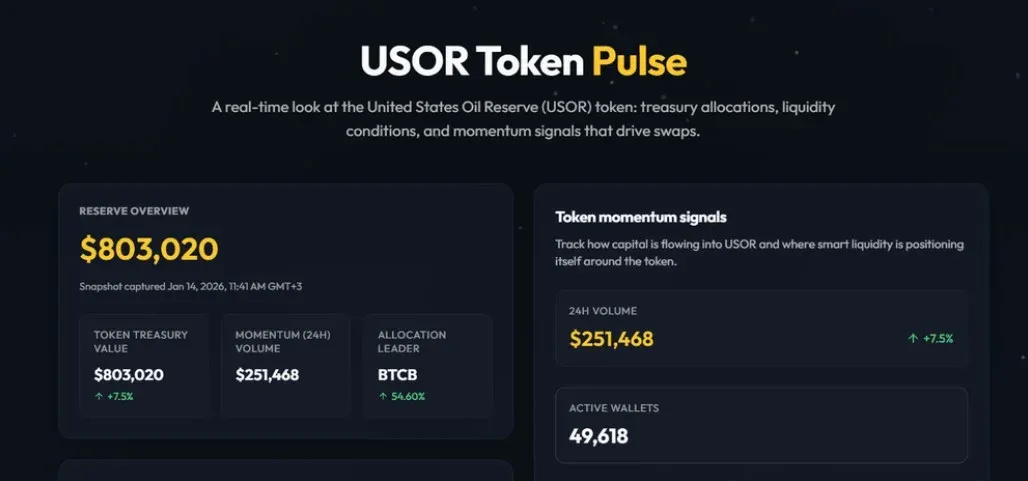
USOR’s promotion revolves around three major themes:
- Perceived Energy Value – Oil remains one of the world’s most important strategic resources; linking it to a digital asset can create an “intrinsic value” narrative.
- Political and Macro Symbolism – The United States’ energy independence and strategic reserves are frequently used to bolster the project’s brand image.
- RWA Alignment Without Formal Custody Proof – Unlike many real‑world asset tokens that provide audited reports and custodial certificates, USOR relies primarily on storytelling rather than verifiable reserve documentation.
It is this story‑centric marketing approach that has granted USOR a large amount of exposure in a short period.
Key Points
- The project focuses on narrative rather than substantive asset backing. USOR frames itself around “U.S. reserve oil” but does not supply third‑party‑verified proof of reserves or any enforceable redemption rights.
- Price is driven by sentiment. The token’s market cap and trading activity are mainly influenced by speculative mood, macro‑economic news, and community buzz; fundamental factors play a minimal role.
- It belongs to the high‑risk RWA tokenization category. Because of the absence of regulatory oversight and institutional custodianship, USOR resembles a speculative digital asset more than a structured commodity‑backed investment tool.
What Is the USOR Plan?
USOR positions itself as a “tokenized oil reserve,” claiming that each token represents exposure on the blockchain to the value of U.S. oil reserves. Unlike traditional commodity futures or regulated energy securities, it operates entirely within a decentralized ecosystem, relying on on‑chain issuance, decentralized exchanges, and community narrative to determine price.
It is important to stress that USOR is not a government‑issued asset and does not enjoy formal support from the United States’ Strategic Petroleum Reserve. Therefore, when someone asks, “What is a U.S. reserve oil token?” the most accurate answer is: it is a private‑sector crypto initiative that uses oil reserves as a conceptual backdrop, rather than providing a legally enforceable commodity guarantee.
How the U.S. OR Crypto Project Operates
From a technical standpoint, USOR employs a fairly common crypto deployment model:
- Token issuance on a public blockchain, enabling open transfers and wallet compatibility.
- Decentralized liquidity pools instead of centralized physical custody.
- Market‑driven pricing mechanism, where price is set by demand, speculative sentiment, and community hype.
The project does not establish a direct redemption channel, meaning token holders cannot exchange USOR for actual crude oil or barrels. The token’s value is entirely derived from the market’s acceptance of its concept.
Market Positioning and Investor Interest
USOR’s buzz is tightly linked to its timing. In recent years, narratives around tokenizing commodity assets and U.S.‑centric themes have been gaining traction, and USOR rode that wave:
- Investor interest in RWA‑themed crypto assets has risen.
- Retail users are increasingly drawn to energy‑related stories.
- Geopolitical discussions about oil provide external momentum for speculation.
Nevertheless, most industry analysts still classify USOR as a “high‑risk, narrative‑driven” token rather than a financial instrument with yield or asset backing.
Transparency and Risk Considerations
When evaluating USOR, focus on the following risk points:
- Lack of audited reserve verification – No independent entity currently proves that USOR holds or controls any U.S. oil reserves.
- Regulatory vacuum – The project is not subject to commodity, securities, or energy‑regulation frameworks.
- Narrative volatility – Token valuation is highly sensitive to news cycles, social‑media buzz, and shifts in sentiment.
These factors do not automatically label USOR as a fraud, but they are sufficient to categorize it as a speculative crypto asset.
Note for global users: Transactions involving fiat should be conducted in USD where applicable, using SEPA or SWIFT channels for cross‑border transfers. U.S. residents must use Binance.US rather than the global Binance platform. Crypto gains may be taxable in your jurisdiction; consult a tax professional for guidance.
USOR Within the Wider RWA Crypto Ecosystem
Compared with institution‑led, audited RWA projects, USOR resembles a “narrative‑type” token aimed at retail participants. The distinction can be summarized as:
- Institutional RWA tokens → Regulated, audited, slower liquidity.
- Narrative RWA tokens (like USOR) → Rapid issuance, sentiment‑driven, high volatility.
Understanding this tiered landscape helps investors avoid being misled by superficial marketing hype when assessing USOR.
Summary
USOR is best viewed as a conceptual experiment rather than a formal digital commodity certificate. Its strengths lie in storytelling, macro‑symbolism, and appeal to speculators, not in legally enforceable oil guarantees.
- For short‑term traders, USOR may present some volatility‑based opportunities.
- For long‑term holders, thorough due diligence is essential, as holding the token does not equate to owning oil.
As the RWA discussion continues to evolve, USOR serves as a typical case study illustrating how strong narratives can influence the crypto market—sometimes outweighing fundamentals. Maintaining transparent information and clear structure remains far more important than flashy hype when making investment decisions.
Frequently Asked Questions
What is the USOR crypto project?
USOR is a privately‑developed initiative on a public blockchain that claims to tokenize the concept of U.S. reserve oil. It does not provide legally enforceable ownership or redemption rights to physical oil; its value is primarily derived from market sentiment and community narrative.
Do U.S. oil reserves officially support USOR?
No. USOR has not received official endorsement from the U.S. government or the Strategic Petroleum Reserve, nor does it have publicly available regulatory filings or audit reports proving any claim to actual reserves.
How does USOR operate?
The project runs through standard token issuance, decentralized exchanges, and liquidity pools. Holders cannot convert the token into physical oil; the token is traded solely as a digital asset within the crypto ecosystem.
Can USOR be considered a real‑world asset (RWA)?
USOR leans toward a narrative‑driven RWA project, lacking audited and custodial proof from a regulatory authority. Compared with traditional RWA tokens, its asset backing exists mainly at the conceptual level.
What are the main risks of investing in USOR?
Key risks include the absence of reserve verification, regulatory gaps, and high sensitivity to market sentiment. Without audited physical asset backing, the token’s price may experience sharp swings driven largely by speculation.
---
This article systematically outlines the concept, operating mechanism, and risk considerations of the USOR plan, helping readers approach the project with a prudent investment mindset. For further information on USOR, you may search Bitaigen’s past reports or continue reading related articles below. Thank you for your continued support of Bitaigen!
Related Reading
- SatLayer (SLAY) Review: Bitcoin‑Based DeFi, RWA & Insurance
- Mantra (OM) Token: RWA Tokenization, Staking & Governance
- Decred (DCR) 2026-2030 Price Forecast: Breaking $50?
💡 Register on Binance with referral code B2345 for the maximum trading fee discount. See Binance complete guide.



