
 Bitaigen Research
 As the crypto ecosystem evolves, the competition between centralized exchanges (CEX) and decentralized exchanges (DEX) has shifted from pure rivalry to deep integration. This article delves into the latest developments in liquidity, security, and compliance for both types of platforms, offering insight into the future layout of financial infrastructure. In an increasingly complex market environment, we aim to help investors clarify the optimal trading routes for different scenarios and reveal how emerging universal exchange (UEX) models will reshape industry dynamics.
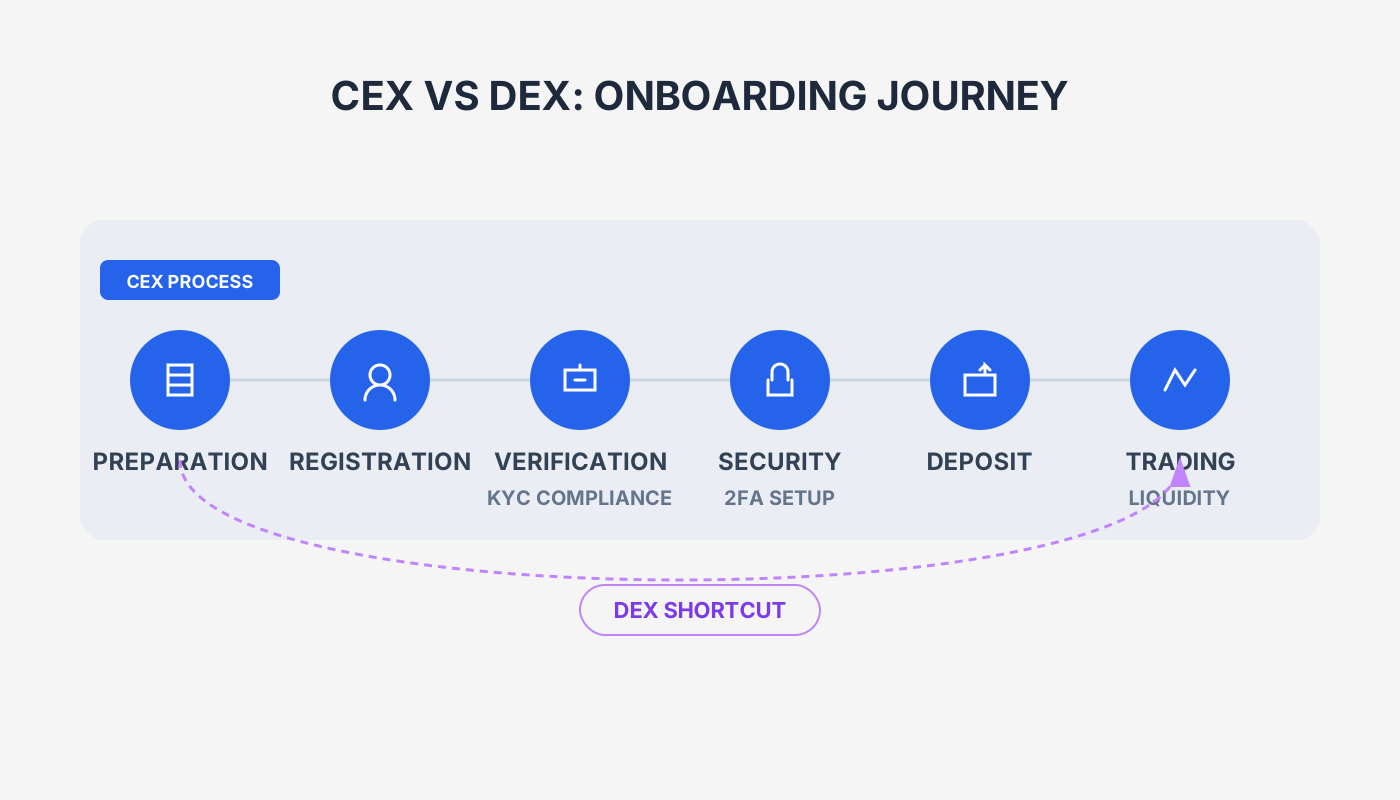
Centralized Exchange (CEX) vs. Decentralized Exchange (DEX): Which Is Better in 2026?
In 2026, centralized exchanges (CEX) and decentralized exchanges (DEX) are no longer strictly substitutable; they coexist complementarily according to trading needs. CEX still commands the majority of mainstream users and fiat on‑ramps thanks to its massive liquidity and ultra‑fast execution, while DEX satisfies the demand for self‑custody and permissionless innovation on‑chain.
Key Takeaways
- Centralized exchanges (CEX) continue to dominate the market in 2026 with strong liquidity, high trading speed, and convenient fiat channels (USD deposits via SEPA/SWIFT, etc.), but their core pain points remain custodial risk and regulatory compliance.
- Decentralized exchanges (DEX) keep growing as users become more aware of self‑custody, although liquidity fragmentation and gas fees still pose technical challenges.
- Investors no longer face a “either‑or” choice; most crypto participants allocate both CEX and DEX resources depending on the trading scenario.
- The Universal Exchange (UEX) concept is gaining traction; Bitget’s UEX model merges centralized efficiency with decentralized freedom, illustrating the next development trend for trading platforms.
What Is a Centralized Exchange (CEX)?
Centralized exchanges (CEX) are digital‑asset trading platforms operated by a specific company or institution that act as intermediaries between buyers and sellers. In this model, users must create an account and deposit funds, while the platform manages the trading infrastructure, order matching, and asset custody. Its operational logic resembles a traditional stock exchange, but it is optimized for crypto assets.
From a technical perspective, CEX relies on a centralized order book and proprietary matching engine. Trades are typically executed off‑chain within the exchange’s internal system, ensuring very high throughput and instant settlement. Real blockchain interactions occur only when users deposit or withdraw funds.
Core Features of CEX
- Centralized entity operation: A single institution controls platform rules, asset listings, and underlying infrastructure.
- Custodial model: The exchange holds and manages users’ private keys and assets on their behalf.
- Off‑chain matching: A centralized order book enables high‑performance trading.
- Account‑based access: Users log in via authentication credentials and security controls.
Advantages of Centralized Exchanges
- Extremely high liquidity: A large user base and professional market makers guarantee tight spreads and minimal slippage.
- Outstanding execution speed: Millisecond‑level response times perfectly support high‑frequency trading, derivatives, and leveraged strategies.
- Convenient fiat on‑ramps: Support for bank cards, credit cards, and various local payment methods (e.g., USD deposits via SEPA/SWIFT) makes it the preferred entry point for newcomers.
- Rich product matrix: Offers futures, options, staking, lending, and copy trading among other diversified financial tools.
Limitations That Still Exist in 2026
- Custodial risk: Users must trust the platform to safeguard funds; a hack or mismanagement could jeopardize asset security.
- Regulatory constraints: Strict KYC (Know‑Your‑Customer) requirements and geographic access restrictions may affect certain users’ experience.
- Single point of failure: Centralized systems can experience downtime due to maintenance, technical glitches, or regulatory pressure.
What Is a Decentralized Exchange (DEX)?
Decentralized exchanges (DEX) are blockchain‑based trading protocols that allow users to trade peer‑to‑peer directly from their own wallets. In a DEX, there is no central intermediary; users do not deposit funds into an exchange account but instead execute asset swaps through smart contracts on‑chain, achieving true “self‑custody.”
DEXs operate on blockchains such as Ethereum, Solana, BNB Chain, or Layer‑2 networks. Most modern DEXs adopt an automated market maker (AMM) model, where liquidity pools are supplied by users, while some explore on‑chain order‑book technologies. Regardless of the underlying tech, users retain control of their private keys throughout the process.
Core Features of DEX
- Non‑custodial mode: Users retain 100 % control over their assets at all times.
- On‑chain execution: All settlements occur via smart contracts on the blockchain, providing transparency.
- Permissionless: No account registration or KYC is required; connecting a wallet is sufficient for global trading.
- Data transparency: Every transaction and fund flow can be publicly verified on a block explorer.
Advantages of Decentralized Exchanges
- Financial sovereignty: Eliminates third‑party risk; users no longer worry about withdrawal bans or frozen funds.
- Open access: Geographic and identity barriers are removed; anyone with a crypto wallet can trade freely.
- Early access to new assets: New tokens can be listed on DEXs without central approval, giving investors the chance to participate at the earliest stage.
- High composability: DEXs integrate seamlessly with the DeFi (decentralized finance) ecosystem, enabling liquidity mining, yield farming, and more.
Ongoing Challenges in 2026
- User‑experience barrier: Wallet setup, private‑key management, and gas‑fee estimation constitute a steep learning curve for beginners.
- Liquidity fragmentation: Assets are spread across multiple chains and protocols, potentially causing high slippage on large orders.
- Network cost volatility: During periods of congestion, transaction fees (gas) can surge dramatically.
CEX vs. DEX: Core Differences Every 2026 Trader Should Know
Although centralized and decentralized exchanges share the same ultimate goal—facilitating asset exchange—their underlying architectures differ fundamentally. By 2026, seasoned traders will switch platforms fluidly based on asset type and market conditions.
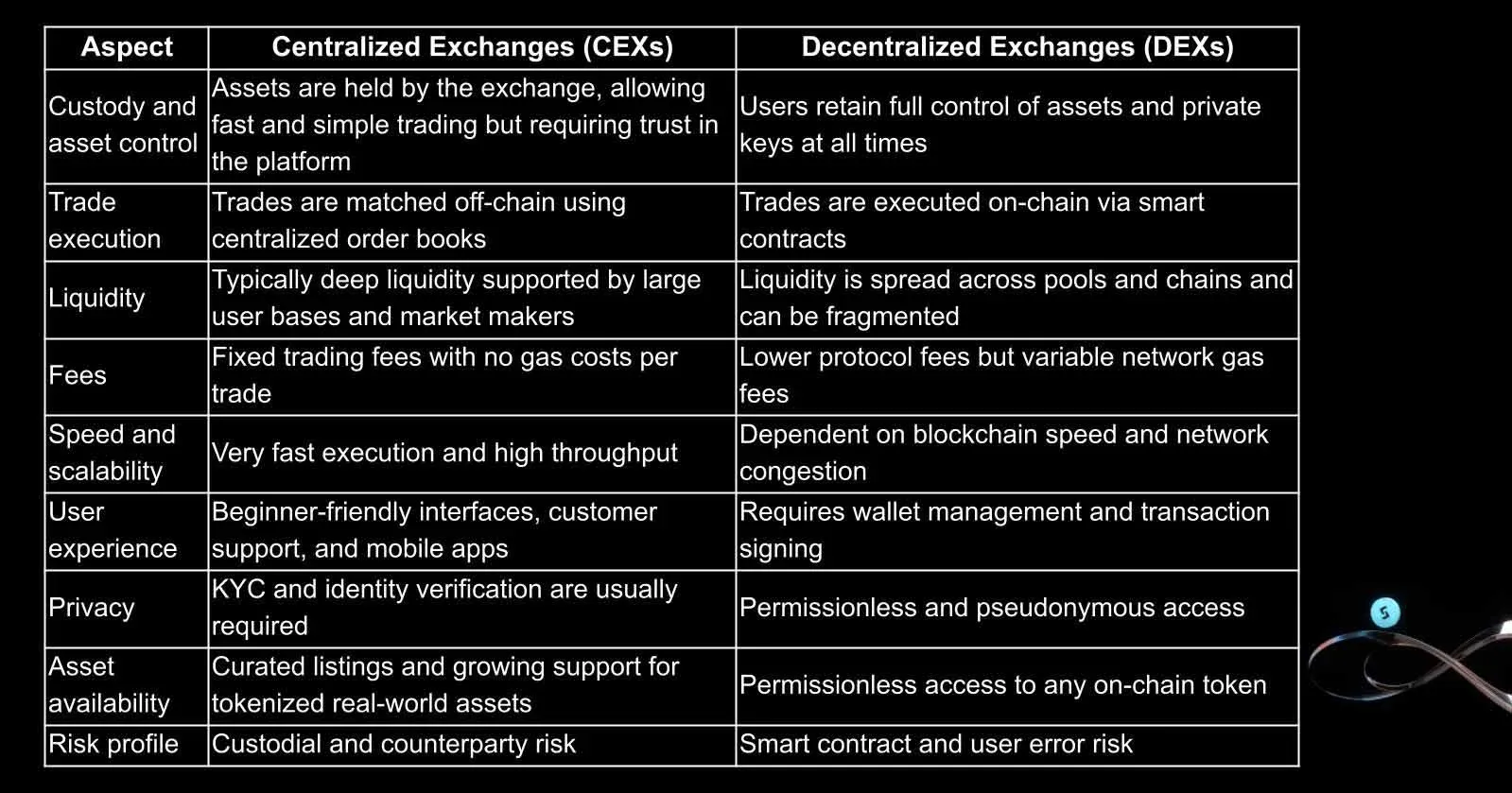
| Dimension | Centralized Exchange (CEX) | Decentralized Exchange (DEX) |
|---|---|---|
| **Asset control** | Platform‑custodied | User‑self‑custodied |
| **Trading speed** | Ultra‑fast (millisecond) | Dependent on blockchain performance |
| **Entry barrier** | Registration & KYC required | Only wallet connection needed |
| **Liquidity** | Consolidated and deep | Relatively dispersed, tied to liquidity pools |
| **Compliance** | Strong regulation, legal obligations | More permissive, regulatory enforcement is harder |
Universal Exchange (UEX): The Next Evolutionary Stage of Crypto Trading
By 2026, the industry increasingly recognizes that neither a pure CEX nor a pure DEX can satisfy all user demands. CEX excels in speed and liquidity but restricts control; DEX offers autonomy but still struggles with performance and usability. The Universal Exchange (UEX) concept emerged to bridge this divide.
UEX aims to blend the efficiency of centralized systems with the freedom of decentralized ones within a single ecosystem. It lets users switch seamlessly between an off‑chain order book and on‑chain liquidity pools from the same interface. This model eliminates the forced choice between “custody” and “control,” delivering flexibility: use CEX‑style execution when efficiency matters, and tap DEX‑style pools when exploring new assets or seeking self‑custody.
Bitget: A Multi‑Chain Universal Exchange Paradigm

Founded in 2018, Bitget has evolved from a derivatives‑only platform into a leading global, integrated trading ecosystem. Confronted with the fragmentation between centralized and decentralized markets, Bitget actively embraces the UEX model, striving to connect the two parallel financial worlds.
By combining deep CEX liquidity with the on‑chain capabilities of Bitget Wallet (formerly BitKeep), Bitget enables users to enjoy high‑speed matching while accessing tens of thousands of on‑chain assets. This strategy mirrors the reality of the 2026 crypto market: assets and liquidity no longer reside on a single platform but are distributed across multiple public chains. Bitget’s unified experience reduces friction across chains and platforms, offering a practical solution for navigating a complex multi‑chain environment.
Final Comparison in 2026: Which Is Right for You?
In 2026, evaluating CEX, DEX, or UEX hinges on the specific use case. The crypto market has entered a tiered stage, and users no longer chase a one‑size‑fits‑all solution.
- Centralized Exchange (CEX): Remains the core hub for high‑frequency traders, institutional investors, and anyone needing fiat on‑ramps (USD via SEPA/SWIFT, etc.).
- Decentralized Exchange (DEX): Ideal for deep DeFi participants, early‑stage token hunters, and users who prioritize privacy and sovereignty.
- Universal Exchange (UEX): For modern investors who want to manage the full spectrum of assets on a single platform while balancing risk and efficiency, UEXs such as Bitget represent a forward‑looking choice.
Conclusion
The evolution of crypto exchanges mirrors the market’s march toward maturity. From the scale‑driven model of CEX, through the decentralization revolution of DEX, to the integrated interoperability achieved by UEX in 2026, technological progress has consistently served “user choice.”
The UEX model championed by Bitget points to the industry’s future direction: abandoning ideological binaries and, through technical integration, allowing users to reap the convenience of centralized services while retaining the freedom of decentralized finance.
Note: Crypto trading may generate taxable events in many jurisdictions. Participants should consult local tax regulations and consider professional advice to ensure compliance.
Related Reading
- DEX vs. CEX: A Beginner's Guide to Crypto Exchanges
- What is a DEX? Best Decentralized Exchanges Guide 2026
- Centralized vs Decentralized Exchanges (CEX vs DEX) Explained
💡 Register on Binance with referral code B2345 for the maximum trading fee discount. See Binance complete guide.



