
 Bitaigen Research
 Bitcoin’s Recent Break of Key Support Triggers a Re‑Examination of Its “Digital Gold” Status
The recent dip of Bitcoin below a crucial support level has sparked a fresh debate about its claim to being “digital gold.” Since the SEC approved a spot Bitcoin ETF at the end of 2024, institutional capital initially pushed the market higher, only for the price to tumble back to the $67,000‑range after a leveraged long‑position collapse in October 2025 caused by a pricing bug in USDe. Faced with such volatility, investors are asking: can Bitcoin still function as a store of value, or has it become merely a high‑beta speculative instrument?
Before asking whether Bitcoin could replace gold, let’s first recall why gold has long been regarded as the “ultimate store of value.” From the ancient Lydian coins to today’s central‑bank reserves, gold’s unique physical properties and scarcity have made it a cornerstone of the financial system. As former Federal Reserve Chairman Alan Greenspan testified in 1999:
“In extreme situations, no one will accept fiat money, but gold will always be accepted.”
This notion of a “sound money” can be distilled into five fundamental characteristics:
- Durability – Gold is virtually immune to chemical corrosion, retaining its luster and shape; it also endures in high‑tech applications such as electric‑vehicle batteries and spacecraft.
- Divisibility – The metal is soft and malleable, making it easy to cast and cut. Standardized bars or coins are interchangeable by weight (ounces/grams) and purity (24 K, 18 K, etc.).
- Stability – Its scarcity and independence from any debtor mean gold naturally resists inflation and carries no counter‑party risk.
- Portability – High density allows a small amount of gold to hold enormous value, facilitating cross‑border transport far more efficiently than silver, artworks, or other bulk commodities.
- Recognizability – Unique physical traits enable professional instruments (e.g., Sigma) to quickly verify authenticity.
While gold’s store‑of‑value attributes are near‑perfect, its tangible nature also brings logistical, custodial, and security challenges – customs seizures, theft, loss, and the like. These frictions have spurred the demand for a “digital equivalent,” of which Bitcoin is the most prominent example.
In this article we outline the background of Bitcoin’s recent breach of key support, compare it with gold’s value properties, and deeply examine whether Bitcoin can still serve as a reserve asset. By analysing institutional cash flows, regulatory developments, and market sentiment from multiple angles, readers can form a reasoned view of Bitcoin’s future role.
---
The Rise of Cryptocurrencies
In the shadow of the 2008 financial crisis, Satoshi Nakamoto published the white paper *Bitcoin: A Peer‑to‑Peer Electronic Cash System*, proposing a technical solution that prevents “double‑spending” without a central authority. Bitcoin’s core traits – a fixed supply cap of 21 million coins and an immutable blockchain ledger – quickly earned it the nickname “digital gold.” The broader blockchain ecosystem then entered a Cambrian‑explosion phase:
- 2011 – Litecoin positioned itself as “the silver to Bitcoin’s gold,” emphasizing faster, cheaper transactions.
- 2015 – Ethereum introduced programmable smart contracts, attempting to replace gold’s passive store‑of‑value function with code. Although it never broke price records, it secured the second‑largest market cap.
- Privacy‑focused coins such as Monero (XMR) and Zcash (ZEC) aim to restore the anonymity of cash. Their brief surges, driven by “privacy” narratives, have not translated into market‑cap scales that can challenge Bitcoin.
- High‑throughput chains Solana and MegaETH sacrificed decentralisation for transaction speed, attracting some institutions and start‑ups, but their long‑term competitive outlook remains unclear.
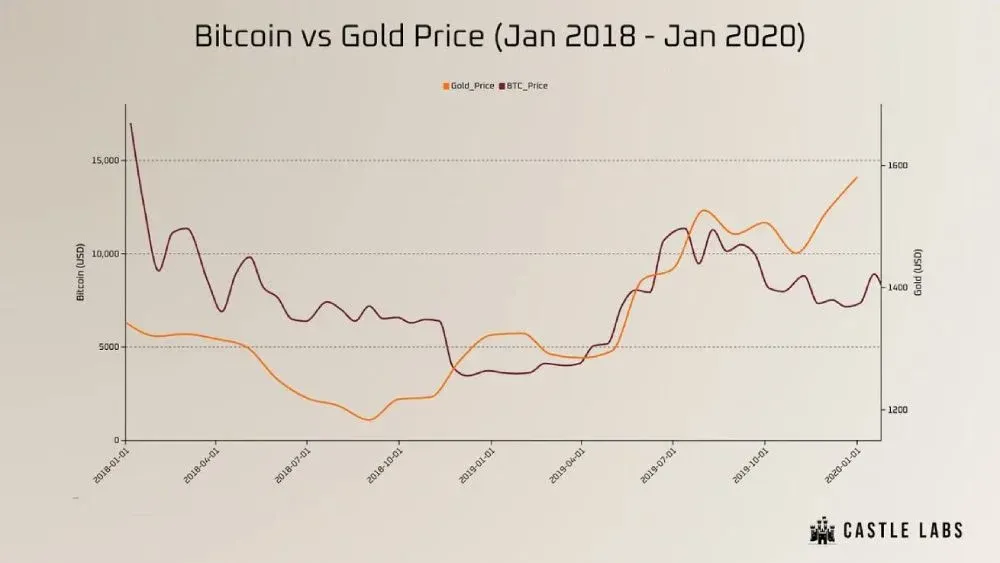
In 2019, Grayscale’s “Abandon Gold” ad campaign portrayed gold investors as lugging around heavy “shiny stones,” while younger people traveled light with digital assets. The hyperbole reflected the ambition of crypto assets to supplant precious metals.
---
Bitcoin’s Historical Trajectory
From its first recorded transaction in 2010 to 2025, Bitcoin has endured multiple dramatic price swings yet consistently rebounded to new highs after each dip. The media has proclaimed Bitcoin “dead” roughly 450 times, but every “death” was disproved by market resilience.
- 2017 – A retail‑driven frenzy pushed Bitcoin past $20,000 before a rapid crash back below $10,000, triggering a broader crypto market collapse.
- 2020 – Macro‑hedging demand rose; institutional investors such as Paul Tudor Jones and Michael Saylor entered the space, bolstering Bitcoin’s reputation as a “gold challenger.”
- January 2024 – The SEC approved a spot Bitcoin ETF, officially integrating Bitcoin into a regulated financial‑product framework. Asset managers like BlackRock and Fidelity soon followed suit.
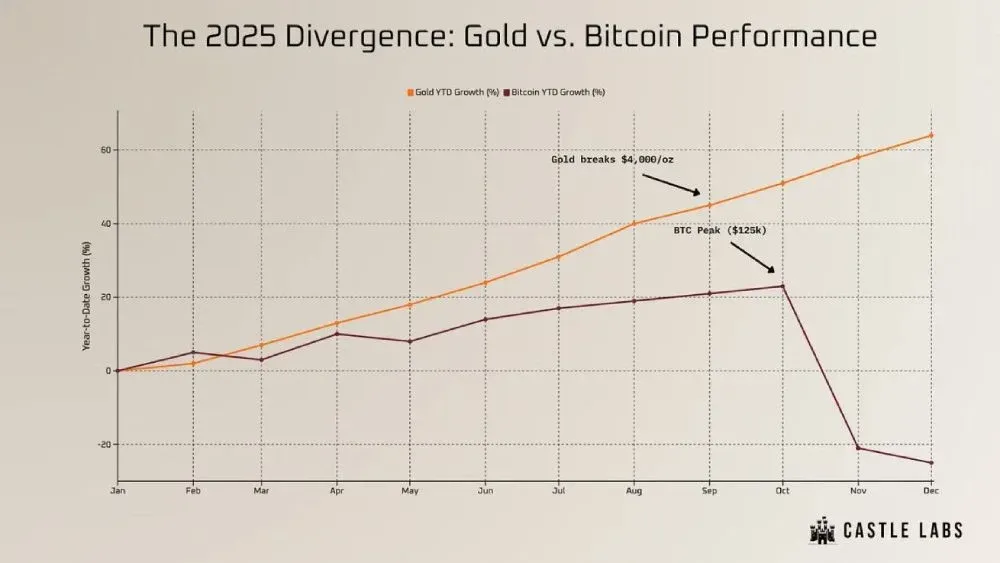
- December 2024 – Bitcoin breached the $100,000 mark, and by October 2025 peaked at $125,000, fueling optimism about a “super‑cycle.”
- October 2025 – A pricing flaw in USDe triggered massive leveraged‑long liquidations; Bitcoin fell to $80,000 and then slid toward the critical $67,000 support zone.
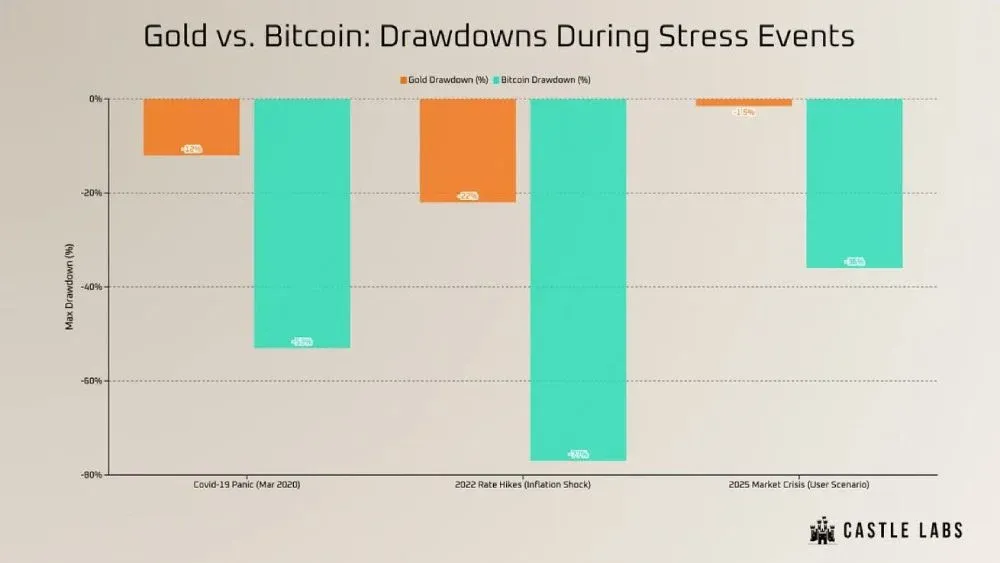
Bitcoin’s scarcity (first‑mover advantage) grants it a premium akin to a precious metal, yet its volatility remains several times higher than gold’s (annualised volatility ≈ 45 % in 2025 versus ≈ 15 % for gold), posing significant risk for those viewing it as a “reserve asset.”
---
2025: Gold’s Victory
In 2025, gold outperformed digital assets across the board. Central banks in multiple jurisdictions accelerated physical‑gold accumulation; Poland, India, Turkey and China expanded their gold allocations to diversify foreign‑exchange reserves. Meanwhile, global jewelry demand remained dominated by China and India, while currencies in Turkey, Argentina and Iran depreciated, further boosting gold consumption.
Institutional outlooks shifted from “gold is dead” to forecasts of gold approaching $5,000 per ounce. VanEck and JPMorgan each predict that, driven by geopolitical tension, fiscal instability and potential Federal Reserve rate cuts, gold could breach the $5,000/oz threshold before 2030.
Conversely, regulatory pressure on the crypto sector intensified: the EU’s MiCA framework became fully enforceable, and the U.S. Treasury cracked down on privacy coins and non‑compliant stablecoins, compressing the growth horizon for digital assets.
---
Shaking Bitcoin: A Daunting Task
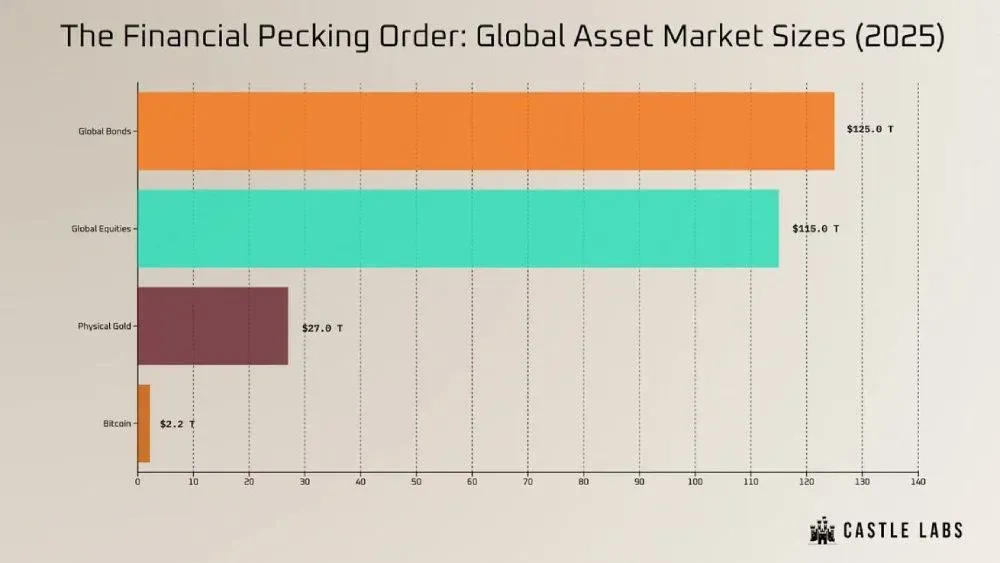
Even though some pundits suggested at the end of 2025 that “privacy coins or a Bitcoin fork could replace gold,” data shows a stark disparity: gold’s market cap sits around $32 trillion, while Monero and Zcash together total roughly $20 billion.
- Zcash (ZEC) gained brief attention under the EU MiCA regime and the U.S. *GENIUS* Act due to compliance‑driven exchange clean‑ups, yet its core value proposition—confidentiality—lacks the transparency and liquidity required of sovereign‑reserve assets.
- Monero (XMR) mirrors gold’s near‑zero inflation design, but its fully un‑auditable ledger fails to meet central‑bank demands for “verifiable reserves.”
- Bitcoin Cash has largely abandoned the store‑of‑value narrative, remaining a payment‑focused token that became even more peripheral after stablecoins rose to prominence.
Structurally, Bitcoin remains the only cryptocurrency that can, in theory, pass the “sound‑money” test. In March 2025, a U.S. executive order classified more than 200,000 seized bitcoins as “national assets” and launched a Strategic Bitcoin Reserve (SBR), providing unprecedented governmental endorsement. Countries such as El Salvador and Bhutan have also disclosed official Bitcoin holdings.
Nonetheless, two major hurdles prevent Bitcoin from truly supplanting gold: its volatility is roughly three times higher, and its market‑cap is far below that of gold and silver. Unless Bitcoin’s price sustainably climbs above $1 million per coin, it cannot supply sovereign nations with sufficient liquidity and shock‑absorption capacity.
---
A Win‑Win Approach
For the past fifteen years, the “precious metals vs. digital assets” debate has never ceased. The 2025 market dynamics have temporarily settled the argument: gold continues to cement its status as “real money,” while Bitcoin is increasingly viewed as a “high‑risk, high‑reward” trading tool. Gold’s price remains relatively stable, with most holdings dormant in central‑bank vaults or private hoards, making it difficult for any single actor to disrupt. Bitcoin’s price, by contrast, is heavily influenced by leveraged trading and short‑term institutional sentiment.
Although Bitcoin has spawned a trillion‑dollar‑scale industry chain and secured a legitimate status within regulatory frameworks, it still struggles to fulfil the responsibilities of a “reserve asset.” Gold, requiring no electricity, internet connection or licensing, remains the preferred sanctuary for nations during periods of turmoil.
Consequently, a rational investor need not force a binary choice between gold and Bitcoin. Each serves distinct functions: gold is the “millennial‑emperor’s coin,” offering long‑term value preservation; Bitcoin is the “frontier asset,” providing liquidity and cross‑border transferability amid high volatility. Only by fully understanding their respective attributes and allocating appropriately can investors maintain resilience amid potential future financial disruptions.
---
*For deeper Bitcoin analysis, feel free to search for past articles by Bitaigen (比特根) or continue reading the related links below. Thank you for your attention and support!*
Note for U.S. readers: When accessing cryptocurrency exchanges, use Binance.US rather than the global Binance platform to comply with U.S. regulations.
Tax reminder: Cryptocurrency gains may be taxable in your local jurisdiction; consult a tax professional for guidance.
Related Reading
- Gold, US Stocks & Bitcoin Slip as Liquidity Tightens
- Gold & Silver Hit All‑Time Highs as Bitcoin Stalls Near $90K – Jan 23 Market Upd
- Gold Prices Surge as Bitcoin Weakens: Safe‑Haven Shift Explained
💡 Register on Binance with referral code B2345 for the maximum trading fee discount. See Binance complete guide.



