
 Bitaigen Research
 January 28 , 2021 marks a landmark technical upgrade for the Ethereum mainnet – the ERC‑8004 standard is officially deployed on‑chain. The launch of this protocol is not merely the release of a new specification; it signals Ethereum’s shift from a pure asset‑settlement layer toward a global AI Agent marketplace and a trust‑co‑ordination layer.

In this article we outline the core concepts and technical highlights of ERC‑8004, and select a handful of already‑deployed AI Agent projects to help readers quickly grasp the key pathway and potential opportunities as Ethereum transforms into a decentralized intelligent‑agent platform.
Why ERC‑8004 Is Being Introduced
ERC‑8004 gives developers a mint‑like mechanism for creating AI Agents, leveraging the ERC‑721 token model for authorization and transfer. By recording reputation scores on‑chain, an Agent can be rapidly discovered and receive trustworthy evaluations.
In traditional web environments, AI Agents are usually confined to the APIs of centralized platforms, lacking any distinct identity and having no independent financial account. ERC‑8004 attempts to solve three major pain points:
- Breaking platform silos – Most existing AI plug‑ins run only inside private ecosystems such as OpenAI, Google, etc. This standard offers a permission‑less public layer, allowing Agents to move freely across different platforms.
- Building a machine‑credit system – Agent behavior is often a black box, making reliability hard to assess. On‑chain reputation records are immutable; negative feedback cannot be erased by a vendor, while positive feedback gains network‑wide recognition.
- Enabling AI remuneration – Although an AI itself cannot open a bank account, it can own an Ethereum address. Coupled with the x402 protocol, an Agent can make micro‑payments to purchase compute, data, or even hire other Agents, effectively becoming an economically autonomous entity.
Marco De Rossi, head of MetaMask AI, said in an interview: “It is still early to discuss a complete business model. Even though x402 is the most direct monetisation route for AI Agents, we should focus on concrete use‑cases rather than on the infrastructure alone.”
It is important to clarify that the core model of an AI Agent is not stored directly on Ethereum. Running a full‑featured Agent requires substantial compute resources and additional overhead, making full decentralisation infeasible. ERC‑8004 offers developers a compromise: a middle layer that balances security and flexibility between a fully closed ecosystem and a completely open, decentralized system.
In this envisioned workflow, users or enterprises can host the model on local devices or private servers, then wrap the model into an NFT via ERC‑8004 and publish it on an open “app store”, where it can be shared, rated, and receive feedback.
What Changes Users Can Expect After the Upgrade
When each Agent possesses its own identity and wallet, Ethereum’s role evolves from a simple transaction hub to an active machine‑to‑machine (A2A) marketplace.
- Agent‑to‑Agent cooperation (A2A economy) – Imagine you hire a travel‑planning Agent. While searching for flights, it discovers that low‑price ticket hunting is not its strength, so it automatically selects the highest‑reputation ticket‑hunter Agent on‑chain and pays it in a stablecoin. The entire workflow is fully automated.
- Fully automated asset management – You can grant a risk‑mitigation Agent permission to monitor your wallet. If the market experiences sharp volatility or a security threat, the Agent will, according to on‑chain verification rules, rebalance funds across protocols without any human intervention.
- Decentralised AI store – Within a specialised Agent browser, you can browse Agents much like an App Store, choosing from a variety of functionalities. Because they exist as ERC‑721 tokens, you can even buy, sell, lease, or stake high‑reputation, high‑yield Agents.
For ordinary users, the most tangible benefit is the disappearance of interaction friction and the reduction of trust costs. Previously, using multiple AI services required separate account registrations, credit‑card bindings, and API‑key management; now a wallet serves as the universal pass, Agents settle via x402, and a modest amount of stablecoin pre‑funded in the wallet suffices—no cumbersome subscription management.
Moreover, the publicly visible “scorecard” on‑chain lets users inspect an Agent’s historical order count, success rate, and user ratings before engaging. This algorithmic trust model replaces traditional vendor endorsements. The pivotal shift is from “tool interaction” to “intent interaction”: you no longer need to first swap tokens on Uniswap, then deposit on Aave; you simply tell an Agent, “Deposit $1,000 in the highest‑yielding, lowest‑risk venue,” and it will automatically execute the complete set of on‑chain actions according to ERC‑8004’s verification logic.
Realising this vision requires a user‑friendly AI Agent browser that offers a smooth front‑end experience and integrates payment settlement. Roughly six teams are already developing such products. However, preserving openness while preventing a platform from arbitrarily limiting the visibility of specific Agents remains a significant challenge.
Davide Crapis, head of AI at the Ethereum Foundation, notes that Ethereum holds a unique advantage in providing security guarantees and settlement for AI‑to‑AI interactions. He adds: “The ERC‑8004 standard will go live in February; this is only the first step, and the ‘genesis month’ will be crucial.”
Projects Likely to Benefit from ERC‑8004
Ethereum Foundation engineer Binji explains from a macro perspective that this upgrade supplies a unified, trustworthy ledger for a large‑scale AI society. He says: “Civilisation scales because humans possess implicit trust; AI Agents still lack such a mechanism, and blockchain is the only viable underlying substrate.” ERC‑8004 cements Ethereum and its Layer‑2 networks as that public ledger.
The industry broadly expects the standard’s deployment to favour a cohort of projects focused on Agent infrastructure, orchestration layers, and on‑chain marketplaces. Analysts and developers typically split potential beneficiaries into two categories:
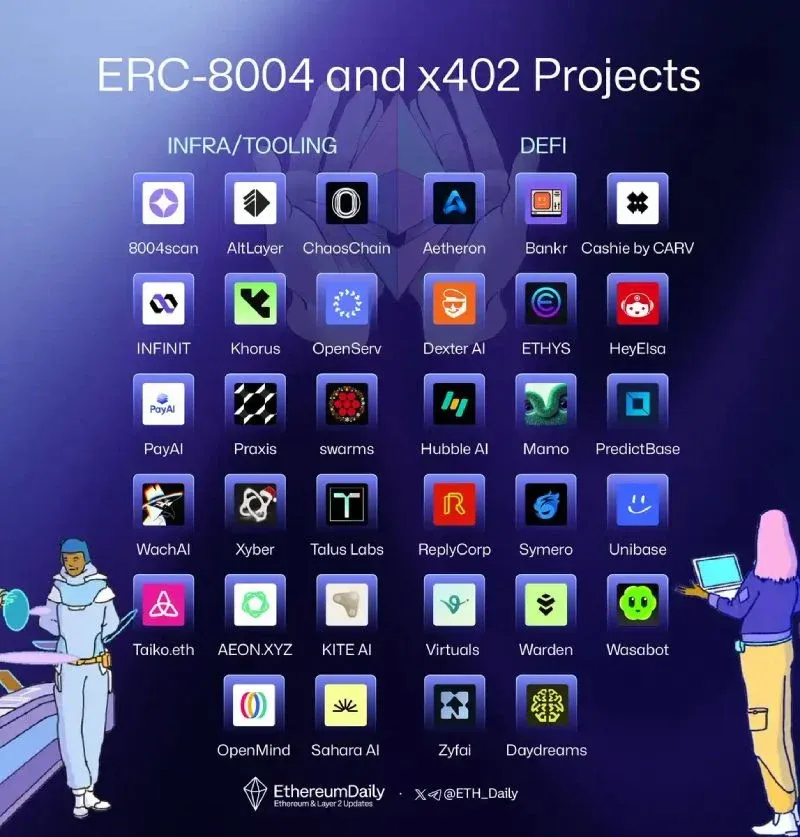
Infrastructure & Tooling Layer
These projects concentrate on discovery, orchestration, reputation tracking, and settlement for Agents, covering registries, interoperability, scalability solutions, and related domains.
- AltLayer
- ChaosChain
- Tascha
- Khorus
- OpenServ
- PayAI Network | x402 Facilitator
- Praxis
- swarms
- WachAI
- Xyber
- Talus Labs
- Taiko.eth
- AEON.XYZ
- KITE AI
- OpenMind
- Sahara AI
AI Agent Application Layer
These initiatives apply Agents to DeFi, prediction markets, automated trading, autonomous service robots, and other scenarios, relying on cross‑Agent authentication, value exchange, and network co‑ordination—the very problems ERC‑8004 aims to solve.
The ecosystem map shows dozens of teams aligning their products with the standard, indicating that a preliminary momentum has already formed before main‑net activation.
- Aetheron
- Bankr
- Cashie by CARV
- Dexter AI
- ETHYS
- HeyElsa
- Hubble AI
- Mamo
- PredictBase
- ReplyCorp
- Symero
- Unibase
- Virtuals Protocol
- Warden
- Wasabot
- Zyfai
- Daydreams.Systems
The Synergistic Effect of x402
The impact of ERC‑8004 is expected to amplify when tightly coupled with the x402 protocol. x402 is designed for “native internet micro‑payments” between Agents, built around the HTTP 402 response and stablecoin settlement, enabling Agents to pay for APIs, data, or compute resources without needing accounts, API keys, or intermediaries.
Industry insiders believe that the reputation layer supplied by ERC‑8004 combined with x402’s low‑friction payment mechanism essentially constitutes a complete “decentralised AI commerce” stack. As adoption rises, token demand for projects that provide Agent infrastructure and payment channels may increase accordingly.
The global AI market is projected to exceed $1 trillion by 2031. Ethereum’s bet is on delivering an open, neutral infrastructure that is more competitive than closed‑enterprise ecosystems. By anchoring identity, reputation, and settlement on‑chain, ERC‑8004 aims to position Ethereum as the “coordination layer” for autonomous Agents rather than merely an application platform.
Whether this vision translates into sustained network activity and value capture will become clearer in the months following main‑net launch. What is certain is that ERC‑8004 represents Ethereum’s most explicit foray to date at the intersection of blockchain and AI.
---
*This concludes the article. For more information on ERC‑8004 and its potential projects, you may search for previous Bitaigen (比特根) reports or continue reading the related articles below. Thank you for following and supporting Bitaigen (比特根)!*
Note: Crypto gains may be taxable in your jurisdiction; please consult local tax regulations. Users in the United States should access Binance.US for fiat‑on‑ramp services, while international users can use SEPA, SWIFT, or other global fiat gateways.
Related Reading
- Ethereum Launches ERC‑8004: AI Agent Identity Standard
- ERC‑8004: Identity & Micro‑Payments for AI on Ethereum
- ERC-8004: Trustless Agent Collaboration on Ethereum
💡 Register on Binance with referral code B2345 for the maximum trading fee discount. See Binance complete guide.



