
 Bitaigen Research
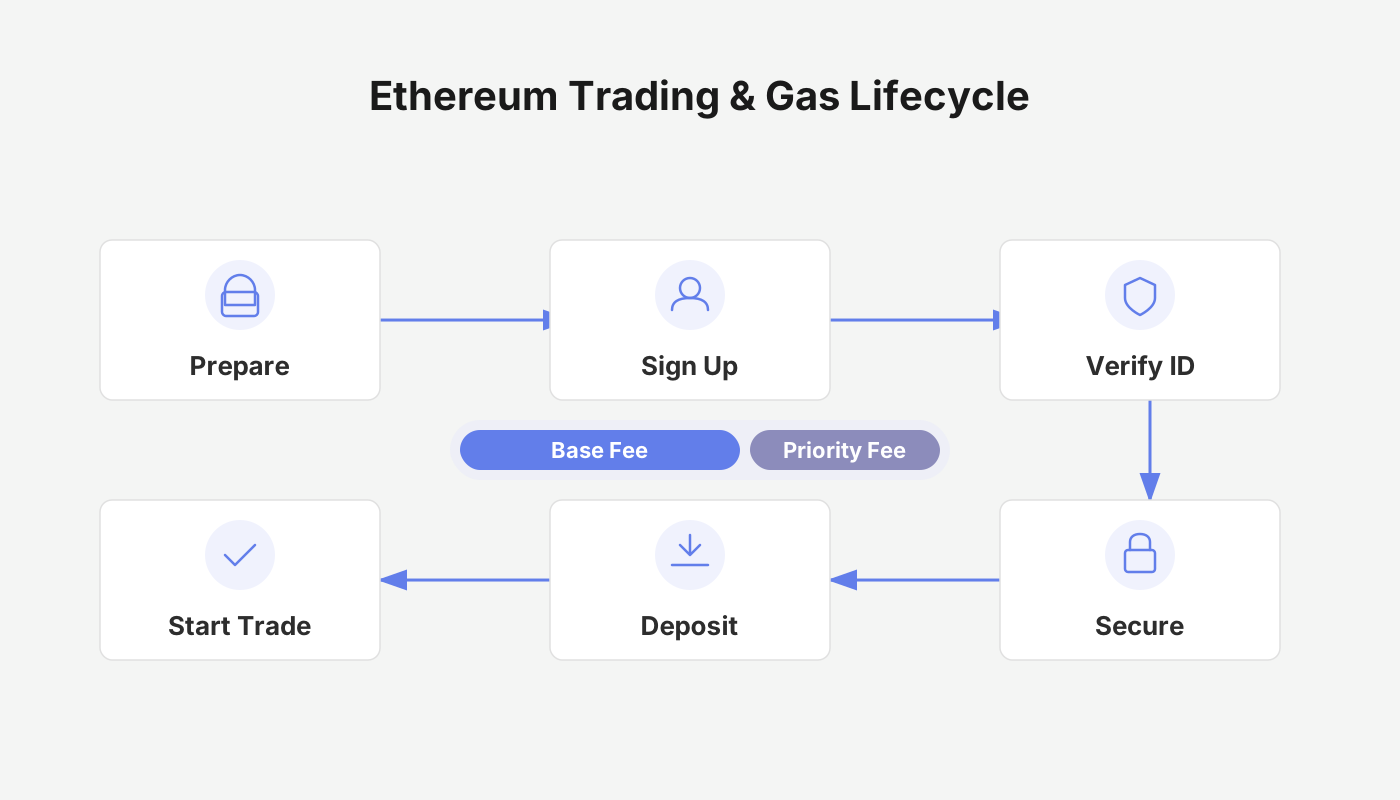
 Ethereum Gas Fees are the computational and storage costs that must be paid when executing a transfer, calling a contract, or writing data on‑chain. They reflect the consumption of network resources and directly determine whether a transaction will be successfully included in a block. Gas fees consist of two parts: a base fee (automatically adjusted according to network congestion and burned after payment) and a priority fee (a tip that incentivizes the block proposer). All fees are quoted in Gwei and ultimately settled in ETH. Understanding the pricing mechanism in depth is the prerequisite for reducing expenses.

In this article we systematically break down the Ethereum gas‑fee pricing model, the factors that influence it, and practical cost‑saving techniques, helping you budget more precisely and cut unnecessary spending when transacting. Read on to gain a full‑stack insight from the base fee to the tip mechanism.
Key Factors That Determine Gas Fees
Gas cost volatility is driven primarily by two major factors:
- Network supply‑and‑demand dynamics – When on‑chain transaction volume spikes, the base fee rises; when activity eases, the fee falls.
- Complexity of the transaction itself – The more intricate the contract logic and the more frequent the storage writes, the more gas is consumed. For example, writing large chunks of data repeatedly or invoking deeply nested contracts will increase the fee.
In addition, directly storing large amounts of raw data on‑chain also incurs high costs because each byte is charged according to a fixed rule. Therefore, improving scalability, optimizing computation, and reducing storage usage remain core objectives of Ethereum’s ongoing evolution.
The Nature of Gas: Measurement and Constraint Combined
In the Ethereum network, every operation must consume gas, which serves as compensation for the compute and storage resources provided by nodes. The gas design prevents users from submitting transactions that require unlimited computation, thereby preserving network stability. Since the London upgrade introduced EIP‑1559, the fee structure has been refined: the base fee automatically adjusts up or down based on block utilization and is burned after payment; users may add an optional priority fee to improve the likelihood of inclusion.
When executing a transaction, users must specify a gas limit and a maximum total payment. If the actual consumption is lower than the limit, the unused gas is refunded (the burned base fee, however, is not returned). If the transaction runs out of gas during execution, it reverts and the paid fees are not refunded. This mechanism provides predictability for transaction execution while urging users to set parameters carefully.
How Ethereum Gas Fees Are Calculated
Since the 2021 London upgrade (EIP‑1559), the gas price is composed of two elements:
- Base fee: The minimum fee per gas unit, determined autonomously by the network and dynamically adjusted according to block congestion. It rises when demand is high and falls when demand wanes. This fee is permanently burned after payment and does not go to validators.
- Priority fee (tip): An optional extra amount that the user can set, paid directly to the block proposer to accelerate confirmation. If fast confirmation is not essential, a lower tip can be chosen.
In practice, the user simply pays the current base fee plus the self‑determined tip. For example, a token swap that requires 100,000 gas with a base fee of 5 Gwei and a tip of 2 Gwei results in a total gas price of 7 Gwei, leading to a total fee of 700,000 Gwei, i.e., 0.0007 ETH.
Optimizations at the Contract and Transaction Levels
Reducing gas expenditure depends not only on network conditions but also on the behavior of developers and users. Developers can lower the cost of a single interaction by:
- Minimizing the number of storage writes;
- Using more efficient data structures;
- Merging multiple steps into a single contract call.
From the user’s side, the following practices help:
- Submit transactions during off‑peak network periods;
- Bundle several small operations into one larger transaction;
- Leverage wallet or third‑party tools that provide fee‑estimation features to set an appropriate tip and avoid overpaying.
For applications with frequent usage, developers may also introduce batch processing or off‑chain computation, moving heavy logic off‑chain and only committing the final result on‑chain, thereby further compressing gas consumption.
Layer‑2: A Real‑World Path to Lower Costs
Migrating workloads to Layer‑2 networks is currently the most straightforward way to cut fees. Rollup solutions execute the majority of transactions off‑chain and submit only aggregated data or validity proofs to the main chain, achieving substantial cost reductions. The main types include:
- zk‑Rollup – Utilizes zero‑knowledge proofs to verify transaction validity quickly, offering high security and short finality times.
- Optimistic Rollup – Assumes transactions are valid by default and resolves disputes during a challenge period; it is relatively easy to deploy.
Users who transact frequently can enjoy low fees on these Layer‑2 solutions while still inheriting the security guarantees of the Ethereum mainnet. However, when selecting a solution, it is important to assess the availability and audit status of cross‑chain bridges to avoid introducing new risks while chasing lower costs.
Fee Management and Future Trends
In everyday use, combining fee‑prediction tools with Layer‑2 services can effectively control spending—for instance, initiating transactions during on‑chain fee valleys or using multi‑chain wallets that integrate various Rollup networks. For developers, continuous gas‑benchmarking and iterative contract optimization are essential to lessen the long‑term financial burden on end‑users.
Looking ahead, Ethereum’s upgrade roadmap focuses on further scaling improvements, fee‑model refinements, and broader adoption of Layer‑2 ecosystems, all aimed at making transactions more affordable for a global audience.
Related Reading
- RWA 2026 Guide: Mechanisms, Top Projects & Risk Analysis
- Understanding Ethereum Smart Contracts: History & Core Concepts
- Ethereum 2029 Upgrade Roadmap: Forks, Throughput & Security
💡 Register on Binance with referral code B2345 for the maximum trading fee discount. See Binance complete guide.



