
 Bitaigen Research
In this article we systematically outline Gensyn’s core concepts, technical architecture, and incentive model, explaining how a decentralized GPU compute network can help machine‑learning practitioners reduce costs and gain flexibility in accessing compute power. Subsequent sections will further dissect real‑world use cases, so please continue reading.
Introduction
Gensyn is a decentralized GPU compute network designed to provide low‑cost, high‑efficiency computing resources for machine‑learning workloads, with token‑based incentives that enable shared compute capacity.
In traditional cloud‑computing solutions, compute power mainly comes from large data centers such as AWS or Alibaba Cloud. While they can deliver high‑quality services, they also charge steep fees. Decentralized cloud compute leverages blockchain technology to bring idle computing resources from around the world onto a shared network. Nodes that contribute GPU cycles receive token rewards, and the platform can be used for graphics rendering, video transcoding, artificial‑intelligence tasks, and more.
The recent surge in AI hype has driven computational complexity to potentially double every three months, creating a sharp rise in demand for compute. For machine‑learning engineers, independent developers, and small‑to‑medium enterprises, the high cost of centralized cloud services has become a bottleneck. Gensyn aims to democratize AI training costs by lowering them through a decentralized approach.
---
Gensyn Overview
- Positioning: A GPU compute network focused on machine‑learning, aggregating the long‑tail of global compute devices (small data centers, personal gaming PCs, Macs, etc.) to provide compute power.
- Tech Stack: Built on the Substrate framework, using smart contracts to schedule tasks and allocate rewards.
- Development Status: The protocol is still under active development; the core product is largely complete, while the economic model has not yet been launched. Deployment is planned within the Polkadot ecosystem.
- Team: Headquartered in London, UK. Co‑founders hold PhDs in computer science, and the team brings experience from both AI and blockchain sectors. Funding rounds include a $1.1 million seed in July 2021, a $6.5 million round led by Eden Block in March 2022, and a $43 million Series A led by a16z in June 2023. Capital has been allocated mainly to team expansion and accelerating protocol rollout.
---
Ecosystem Participants
| Role | Function |
|---|---|
| **Submitter** | Uploads tasks, models, hyper‑parameters, and pre‑processed data, and pays the associated fees. |
| **Solver** | Executes model training and generates a verifiable **learning proof**. |
| **Validator** | Checks the training process against the mathematical proof to ensure the model output meets expectations. |
| **Challenger** | Reviews validators’ work; if an error is found, they can initiate a dispute and earn a reward. |
---
Operational Workflow
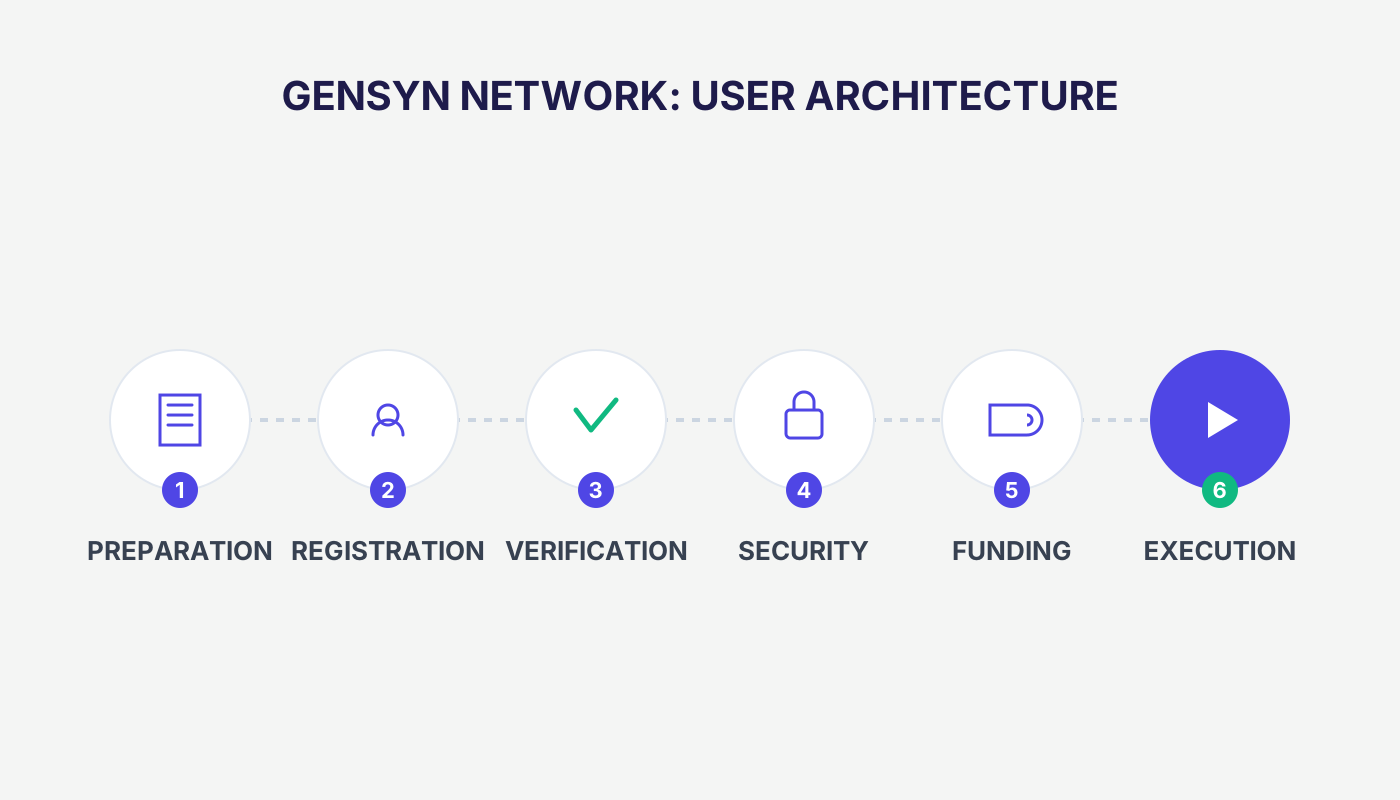
Gensyn’s process consists of six key stages:
- Task Submission
- The submitter uploads task metadata, the model binary, and publicly available pre‑processed training data.
- Task Allocation
- The system places the task into a public pool, from which a single solver is selected to execute it.
- Model Training & Proof Generation
- The solver performs the training off‑chain, periodically saving checkpoints and generating a learning proof for later verification.
- On‑Chain Claim & Validation
- Upon completion, the solver posts a status update on‑chain and publishes the learning proof.
- Validators pick verification jobs from the task pool, reproduce part of the training process, compare results against the proof, and decide whether to accept it.
- Challenge & Dispute
- Challengers may replicate the validator’s work; if they detect a validation mistake, they can trigger an arbitration challenge. Rewards for successful challenges come from the validator’s bond or a dedicated reward pool.
- Settlement
- Based on probabilistic sampling checks and deterministic validation outcomes, the system distributes appropriate compensation to each participant.
---
Cost Efficiency
Compared with centralized cloud services, Gensyn charges roughly $0.40 USD per hour of GPU time, whereas equivalent compute on AWS costs about $2.00 USD per hour, representing an approximate 80 % reduction in expense. This pricing model is especially attractive to individual developers, research groups, and small businesses with limited budgets.
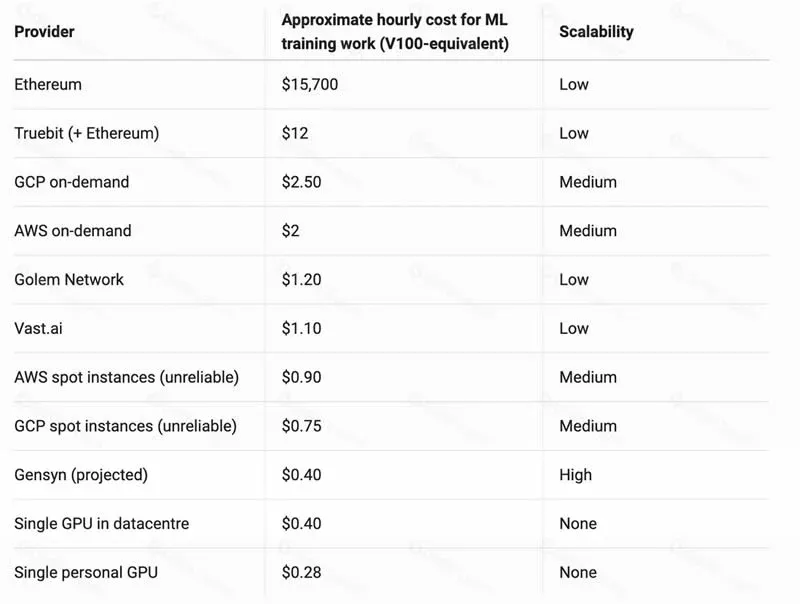
*Image source: https://docs.gensyn.ai/litepaper#scale-and-cost-efficiency*
Payments for token purchases can be made in USD via SEPA or SWIFT transfers. Users located in the United States should use Binance.US rather than the global Binance platform to comply with local regulations. Please be aware that any gains realized from cryptocurrency transactions may be subject to taxation in your jurisdiction; consult a tax professional for guidance.
---
Opportunities and Risks
Opportunities
- Strong demand from user groups that are highly sensitive to compute costs.
- The decentralized model can tap into idle GPU capacity worldwide, enabling scalable expansion.
Risks
- Privacy exposure: Submitters must upload model architectures, training data, and hyper‑parameters. Using proprietary or sensitive data could lead to information leakage.
- Device heterogeneity: Nodes differ in compute power, storage, and network bandwidth; low‑bandwidth devices may cause transmission delays, affecting task allocation and verification efficiency.
- Protocol maturity: The project is still under development; the economic model and incentive mechanisms have not been fully realized, and real‑world usage scenarios remain to be proven.
---
Conclusion
Gensyn connects idle GPU compute from around the globe into a decentralized network, delivering low‑cost, high‑efficiency resources for machine‑learning workloads. Its vision aligns with the current AI boom and is well‑suited for budget‑constrained developers, research teams, and small enterprises. Nevertheless, the project is still in the development phase and faces challenges related to privacy, security, and hardware heterogeneity. Market adoption and deployment speed will need to be observed over time.
This concludes the comprehensive analysis of Gensyn. For further updates, stay tuned to Bitaigen’s (比特根) future reports.
💡 Register on Binance with referral code B2345 for the maximum trading fee discount. See Binance complete guide.



