
 Bitaigen Research
 As the crypto industry continues to evolve, decentralized perpetual contract exchanges (Perps DEXes) are moving from the fringe into the mainstream spotlight. They enable users to trade leveraged derivatives directly on‑chain without relying on a centralized intermediary, striking a new balance between efficiency and security. Below we break down the concept, characteristics, and real‑world use cases of Perps DEXes in a systematic way.
From both technical and regulatory perspectives, we outline the core mechanisms, advantages, and practical deployment scenarios of Perps DEXes, helping readers quickly grasp how decentralized perpetual contracts operate. The rest of the article dissects the concept and its applications layer by layer, and is worth a careful read.
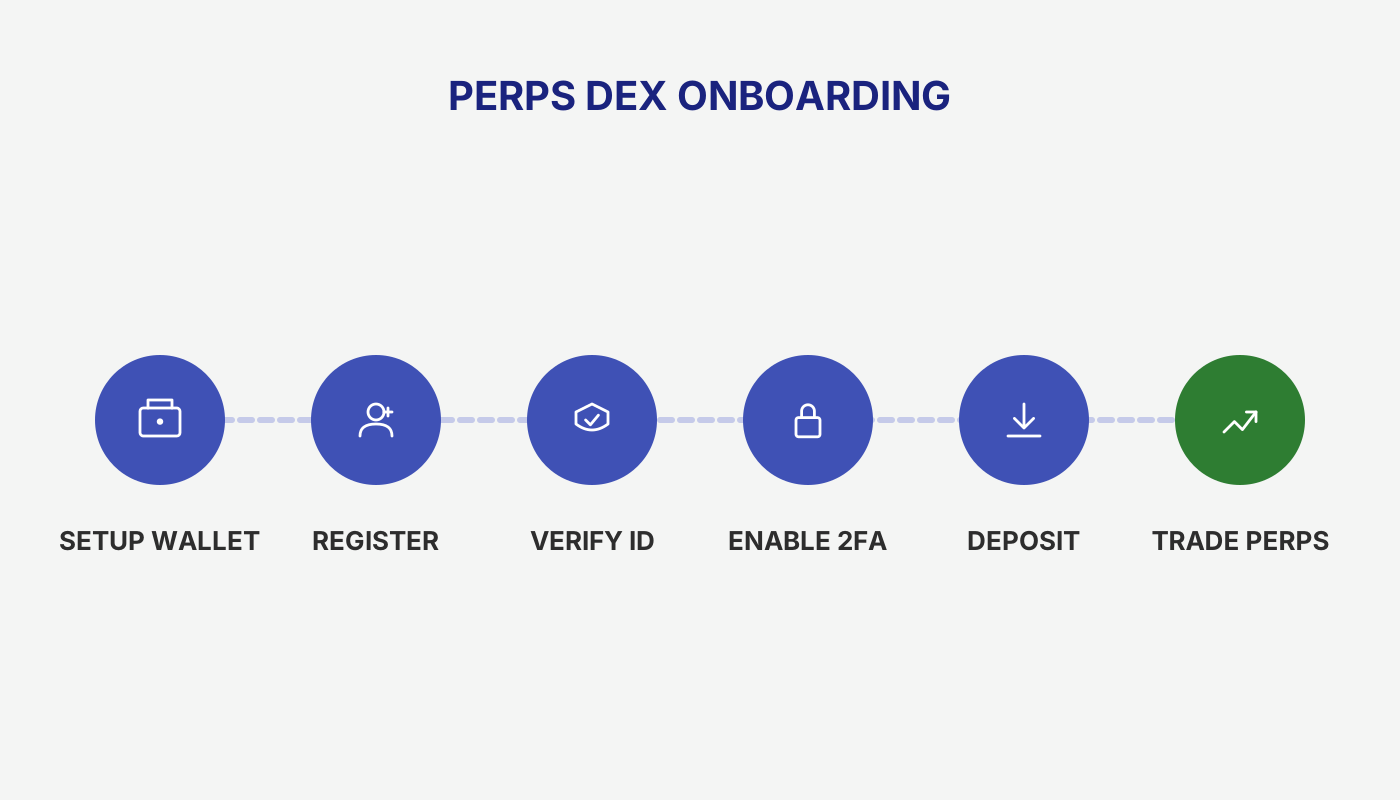
What Is a Perps DEX?
A Perps DEX is a perpetual‑contract trading platform that runs on a blockchain. Unlike traditional centralized exchanges (CEXes), these platforms do not custody users’ assets; every contract is executed by smart contracts directly on‑chain. A perpetual contract has no expiration date, allowing traders to hold positions indefinitely. All trading rules and liquidation logic are hard‑coded, providing a high degree of automation and removing the possibility of manual intervention.
To keep on‑chain contract prices tightly aligned with real‑world markets, Perps DEXes typically call upon oracle services that pull real‑time quotes from multiple centralized exchanges or other on‑chain price feeds. At the same time, the platform charges a periodic funding rate—when long‑side sentiment is overheated, longs pay shorts; when shorts dominate, the reverse occurs. This mechanism helps prevent the perpetual price from drifting too far from the underlying spot price.
How Do They Differ From Centralized Exchanges?
| Dimension | Perps DEX | Centralized Exchange |
|---|---|---|
| **Asset Control** | Assets remain in the user’s own wallet at all times, eliminating the risk of platform‑level misappropriation or withdrawal limits. | Funds must be deposited into the exchange, where they are custodial and therefore exposed to hacking or internal misuse. |
| **Transparency** | All orders, liquidations, and fund flows are recorded on‑chain and can be publicly inspected, preventing data manipulation. | Trading data is generally confined to internal systems and is hard for outsiders to verify. |
| **Entry Barriers & Composability** | No registration or KYC required; simply connect a wallet to start trading. The platform can be freely composed with other DeFi protocols (lending, yield farms, etc.). | Account creation and identity verification are mandatory, and interactions with other protocols are limited by the exchange’s own rules. |
| **User Experience** | Historically constrained by slow on‑chain transaction times and high fees; however, the maturation of Layer‑2 solutions such as Arbitrum, Optimism, Gate Layer, as well as high‑throughput chains like Solana and Hyperliquid, has dramatically improved speed and reduced costs. | Trades are instantaneous with relatively low fees, but users must trust the exchange’s operational security and governance. |
Core Technical Components
- vAMM & Liquidity Pools: Most Perps DEXes use a virtual Automated Market Maker (vAMM) model or liquidity‑provider (LP) pools to generate quotes and supply liquidity, rather than a traditional order book.
- Oracle: Aggregates price information from multiple sources to ensure that contract pricing stays in sync with spot markets.
- Funding Rate: Periodically settles between long and short sides to curb long‑term divergence of the perpetual price from the underlying asset.
Common Perps DEXes on the Market
- dYdX
dYdX is a non‑custodial perpetual‑contract platform supporting more than 35 assets with leverage up to 20×. The team includes alumni from Coinbase and other well‑known institutions. The platform employs a hybrid on‑chain/off‑chain order book: orders are cached off‑chain and maintained by validators, while critical data (price, size, side, etc.) is written on‑chain at execution, achieving both low latency and low cost.
- GMX
GMX supplies the counter‑party for perpetual contracts through its GLP liquidity pool. Users deposit collateral and then hold long or short positions; short‑side earnings are paid in USDC, while long‑side earnings are settled in the other token of the trading pair. Liquidity providers lock any indexed asset into the GLP pool and receive GLP tokens that represent their share; the system automatically stakes those tokens for borrowers and traders to use.
*(Note: The article lists only these two representative platforms; other projects such as Perpetual Protocol, Kwenta, and several more also operate in this space.)*
Risks and Selection Guidance
Although Perps DEXes offer clear advantages in asset sovereignty, transparency, and composability, users should remain vigilant about several risk factors:
- Smart‑Contract Vulnerabilities: Bugs in the code can lead to loss of funds or contract failure.
- Insufficient Liquidity: During extreme market conditions, a thin liquidity pool can cause high slippage or make it impossible to close a position.
- Leverage Amplification: While leverage can boost gains, it also magnifies losses.
- Operational Complexity: Concepts such as oracles and funding rates introduce a learning curve for newcomers.
When choosing a suitable Perps DEX, consider evaluating the following dimensions:
- Total Value Locked (TVL) and Daily Trading Volume
- Number of Supported Trading Pairs and Maximum Leverage
- Fee Structure (trading fees, funding rates, etc.)
- Security Audits and History of Security Incidents
- Community Activity and Frequency of Development Updates
A vibrant community and a continuously iterating development team are often strong indicators of long‑term project health.
Conclusion
This article has explored “What is a Perps DEX,” outlining its operational mechanics, highlighting differences from centralized exchanges, surveying leading platforms, and flagging potential risks. For deeper analysis of Perps DEXes, feel free to search for previous Bitaigen (比特根) articles or follow the related links below. Thank you for following Bitaigen (比特根); we appreciate your support!
*Note: Depending on your jurisdiction, profits from cryptocurrency trading may be subject to taxes. Users should consult local tax regulations or a qualified professional.*
Related Reading
- Bitget 2024: Top Crypto Derivatives Platform $10B Volume
- Hyperliquid: Decentralized Exchange with On‑Chain Order Book & Perps
- Bitget Review 2024: Crypto Derivatives, Copy‑Trading, Low Fees
💡 Register on Binance with referral code B2345 for the maximum trading fee discount. See Binance complete guide.



