
 Bitaigen Research
 Hyperliquid is a decentralized derivatives trading platform that has drawn considerable attention in recent years, aiming to provide users with a high‑speed, transparent, and fully non‑custodial trading experience.
Hyperliquid is a decentralized exchange built on a proprietary Layer‑1 blockchain, offering an on‑chain order book, low‑latency perpetual contracts, and spot trading.
Hyperliquid employs an on‑chain order book, allowing traders to place limit orders, market orders, and execute advanced trading strategies. The platform runs on a native blockchain that is specially optimized for ultra‑fast trading, balancing transaction speed with asset security. The native token HYPE is used for governance, staking, and rewards; token holders can participate in decision‑making and receive ecosystem incentives.
In this article we conduct an in‑depth analysis of Hyperliquid, a Layer‑1‑based decentralized derivatives platform. We focus on the practical roles of its on‑chain order book, low‑latency perpetual contracts, and governance token, and compare it with mainstream DEX models to help you fully understand its technical advantages and use cases. Subsequent sections will reveal further details.
What Is Hyperliquid?
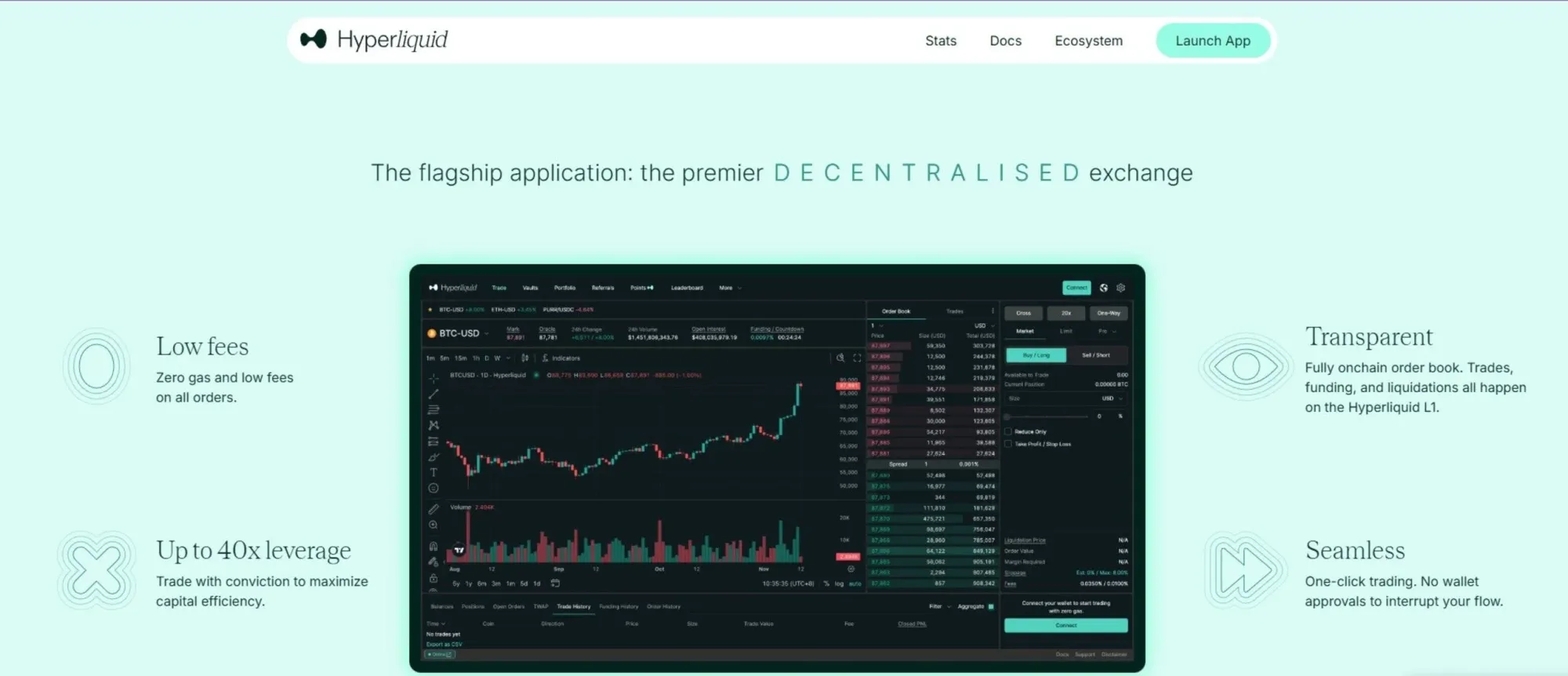
Hyperliquid is a decentralized trading platform focused on fast, efficient, and transparent cryptocurrency trading. Unlike most DEXes that rely on automated market makers (AMMs), it uses an on‑chain order book, allowing users to submit limit and market orders and to execute complex trading strategies.
The platform runs on a purpose‑built Layer‑1 blockchain that is optimized for sub‑millisecond order matching, low latency, and real‑time settlement, while assets remain in the users’ own wallets. Hyperliquid also supports both spot markets and perpetual contracts, giving users a variety of ways to participate in the market.
Who Created Hyperliquid?
Hyperliquid was founded by former Wall Street trader and Chameleon Trading core member Jeff Yan, together with a team of senior derivatives traders from top‑tier financial institutions. Leveraging extensive high‑frequency trading experience, the team identified speed and functionality gaps in traditional DEXes and designed a dedicated Layer‑1 blockchain and decentralized exchange that prioritize speed, precision, and efficiency. Platform hallmarks include sub‑millisecond order matching, advanced order types, and a Hyper Liquidity Provider (HLP) treasury.
How Does Hyperliquid Operate?
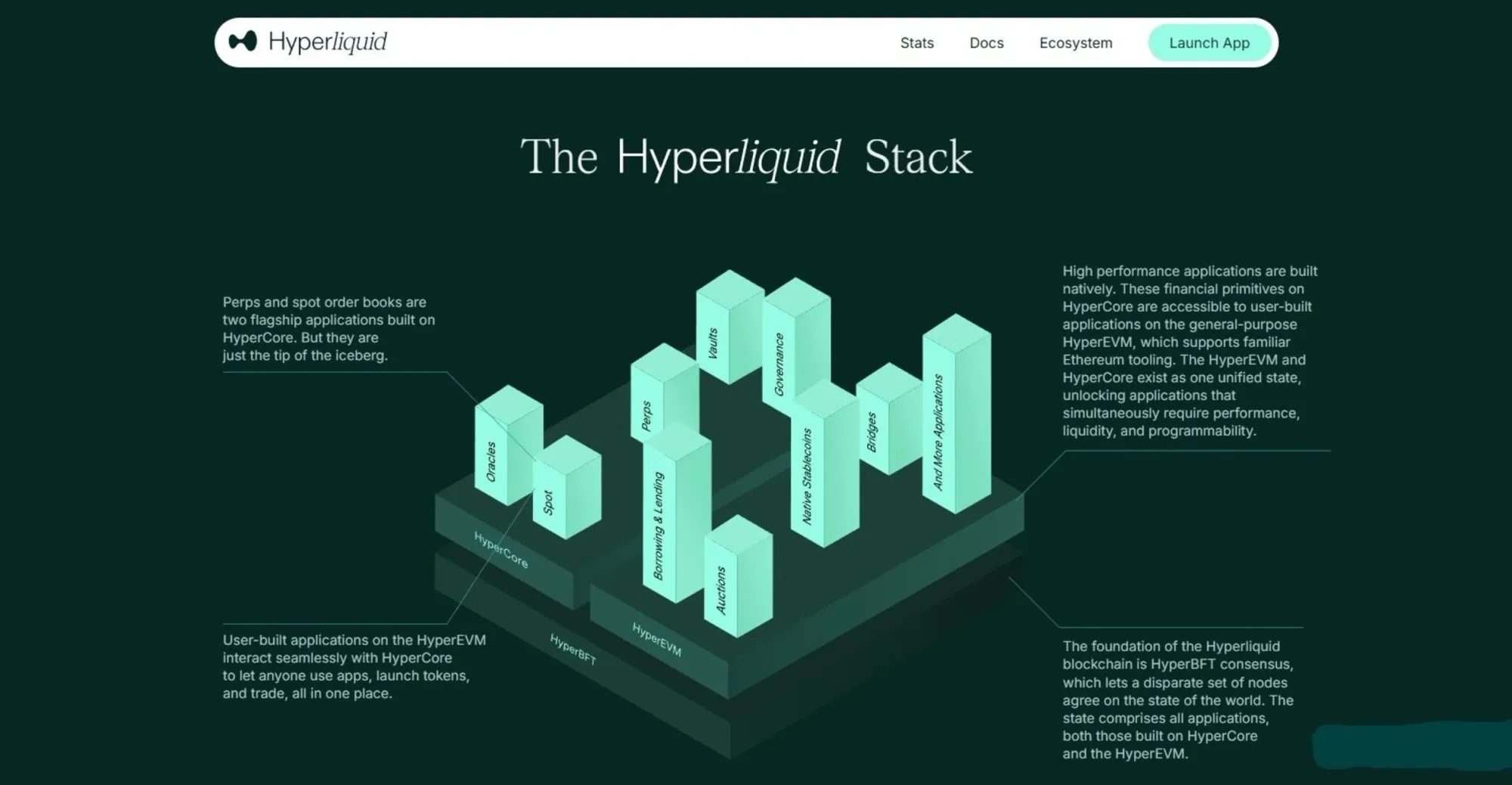
The Hyperliquid ecosystem combines a custom Layer‑1 blockchain called HyperCore with an off‑chain matching engine, delivering centralized‑exchange‑level speed while preserving on‑chain settlement. Orders are sent via HyperBFT to a leader validator, who packages transactions into a block and broadcasts it. After multiple voting rounds, the block reaches consensus from at least ⅔ of the staked validators, completing confirmation.
- Consensus mechanism: Leader‑based design inspired by HotStuff, employing optimistic execution; block generation typically finishes within 0.07 seconds.
- Core functions: HyperCore handles margin, order matching, and liquidation without relying on an external order book; HyperEVM provides EVM compatibility, and all trades are internally optimized within HyperCore to reduce latency.
- Throughput: Peaks of up to 200 k orders per second, suitable for professional and high‑frequency trading strategies.
Hyperliquid Ecosystem and Token
The platform’s native token HYPE sits at the heart of the ecosystem, used for governance, rewards, staking, and transaction‑fee discounts. Holders can vote on platform upgrades, token listings, treasury strategies, and other critical matters.
What Is the HYPE Token?
HYPE is the utility‑and‑governance token of the Hyperliquid Layer‑1 blockchain. It was distributed via a community airdrop at the end of 2024, with a fixed supply of 1 billion tokens. A portion of trading fees is earmarked for HYPE buy‑backs and burns to increase scarcity.
Key functions include:
- Gas fees: Paying for HyperEVM transaction costs; a typical transaction costs less than $0.01 USD.
- Staking: Securing the HyperBFT consensus and earning an annualized return of 20‑50 % (depending on the amount staked).
- Collateral: Used as margin for perpetual contracts and spot trades without the need for cross‑chain bridges.
- Governance: Participating in on‑chain voting on Hyperliquid Improvement Proposals (HIPs) to decide new trading pairs, treasury policies, and more.
Token Utility and Governance
HYPE functions simultaneously as a gas token, collateral, and governance instrument, supporting the platform’s multi‑dimensional operation. Governance is carried out through on‑chain voting; stakers can cast votes on HIPs, upgrades, treasury allocations, etc. A quadratic voting mechanism limits the influence of large holders, and approved changes can be enacted swiftly.
Staking and Rewards
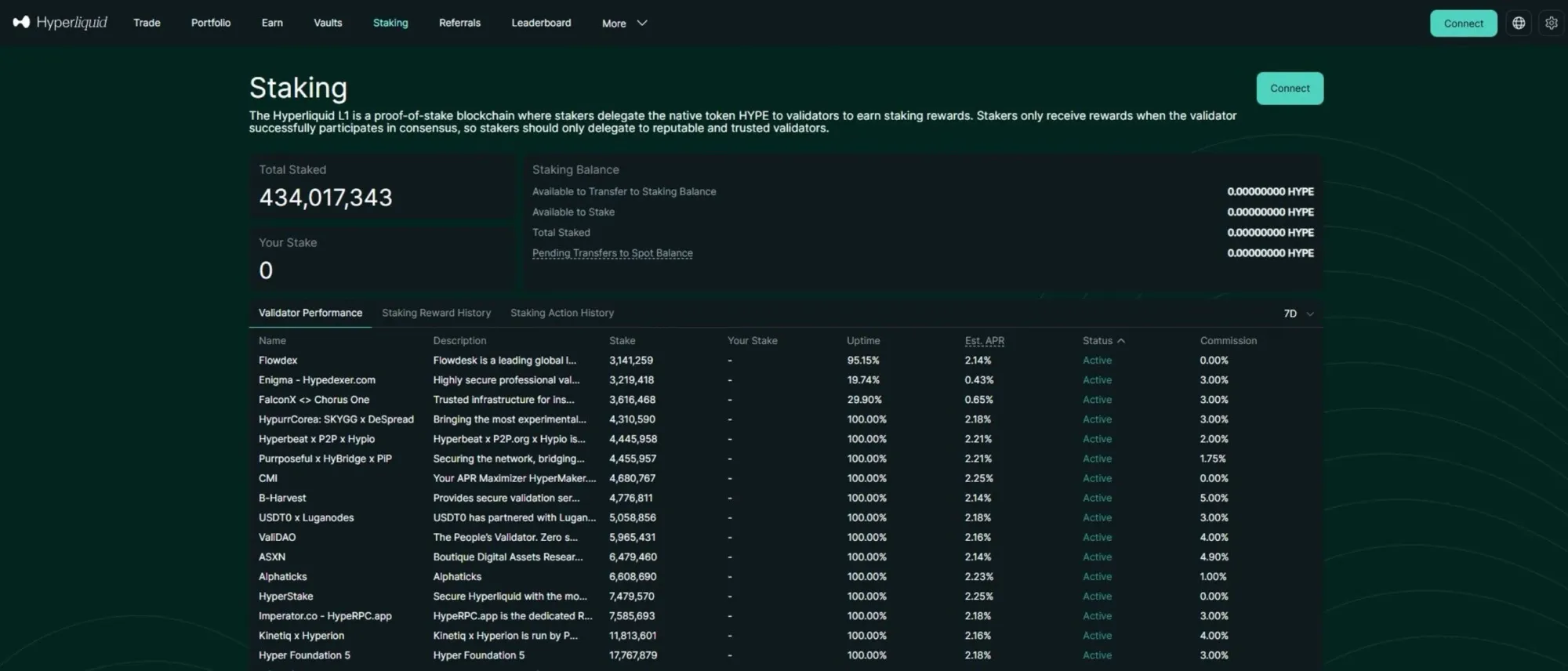
Staking HYPE on Hyperliquid secures the HyperBFT consensus and yields passive income. Users delegate through a dedicated account to active validators, with a minimum delegation of 10 000 HYPE. Rewards are drawn from an emission reserve, accrue per minute, are distributed daily, and automatically compound—no manual claim needed. Reward rates adjust dynamically with total staked amount, for example:
- Staking 400 million HYPE → ~2.37 % APY
- Staking 142‑144 million HYPE → 2.27‑2.29 % APY
Validators retain a 5‑10 % commission and proportionally share block rewards with delegators. Stakers also enjoy 5‑40 % fee discounts, and may qualify for airdrops and treasury incentives.
Core Features of Hyperliquid
1. Hyper‑Liquidity Exchange
Hyperliquid Exchange offers traders a fast, reliable, and flexible environment, engineered for high‑frequency trading to ensure each order is executed precisely and transparently, eliminating latency. The platform caters to both newcomers and professional traders, supporting three core functionalities:
- Perpetual contracts: Leverage, long/short positions, no expiration dates, ideal for volatile markets.
- Spot trading: Immediate buy‑sell, accelerated settlement, reduced slippage.
- Advanced order types: Limit, TWAP, iceberg, etc., helping manage large positions and automate strategies.
Perpetual Contracts
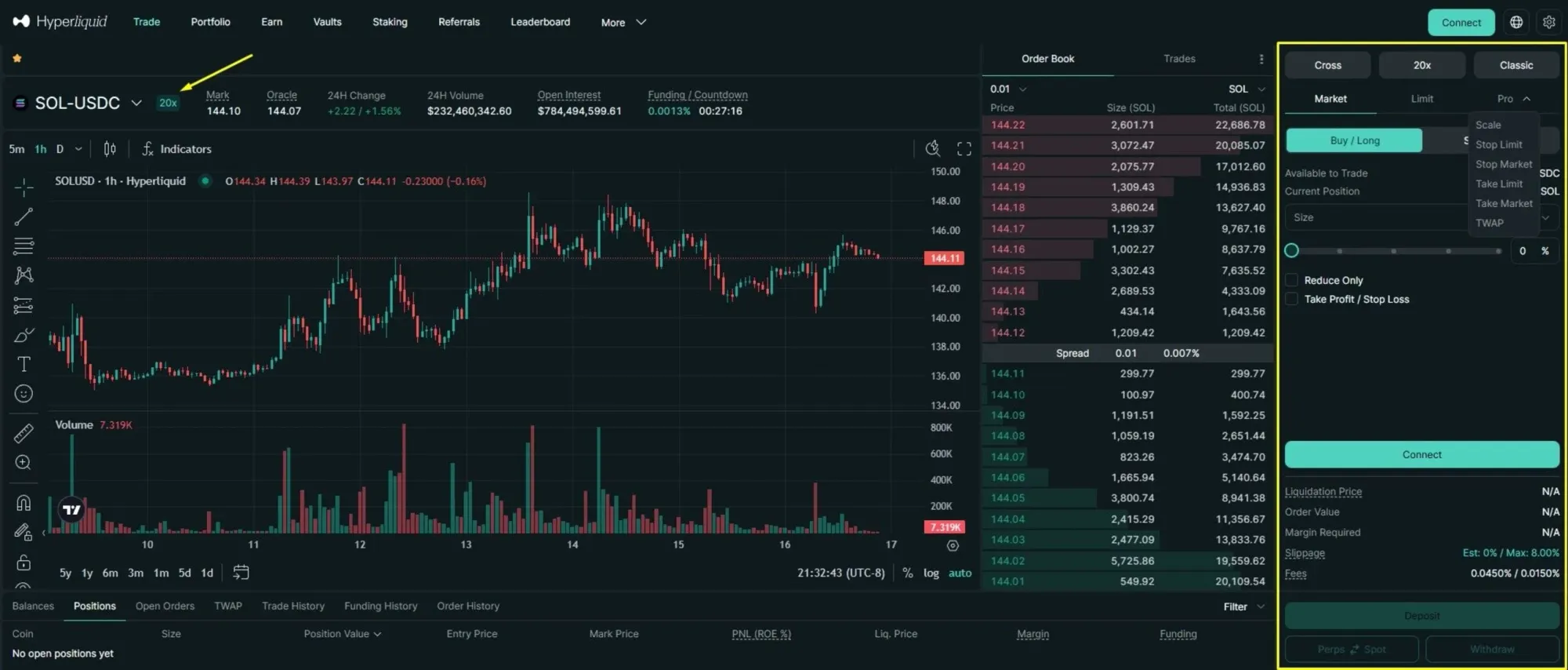
Perpetual contracts let traders take long or short exposure on digital assets, with leverage amplifying potential returns while controlling risk. The system is optimized for speed and accuracy, enabling rapid execution even during extreme volatility.
Spot Trading
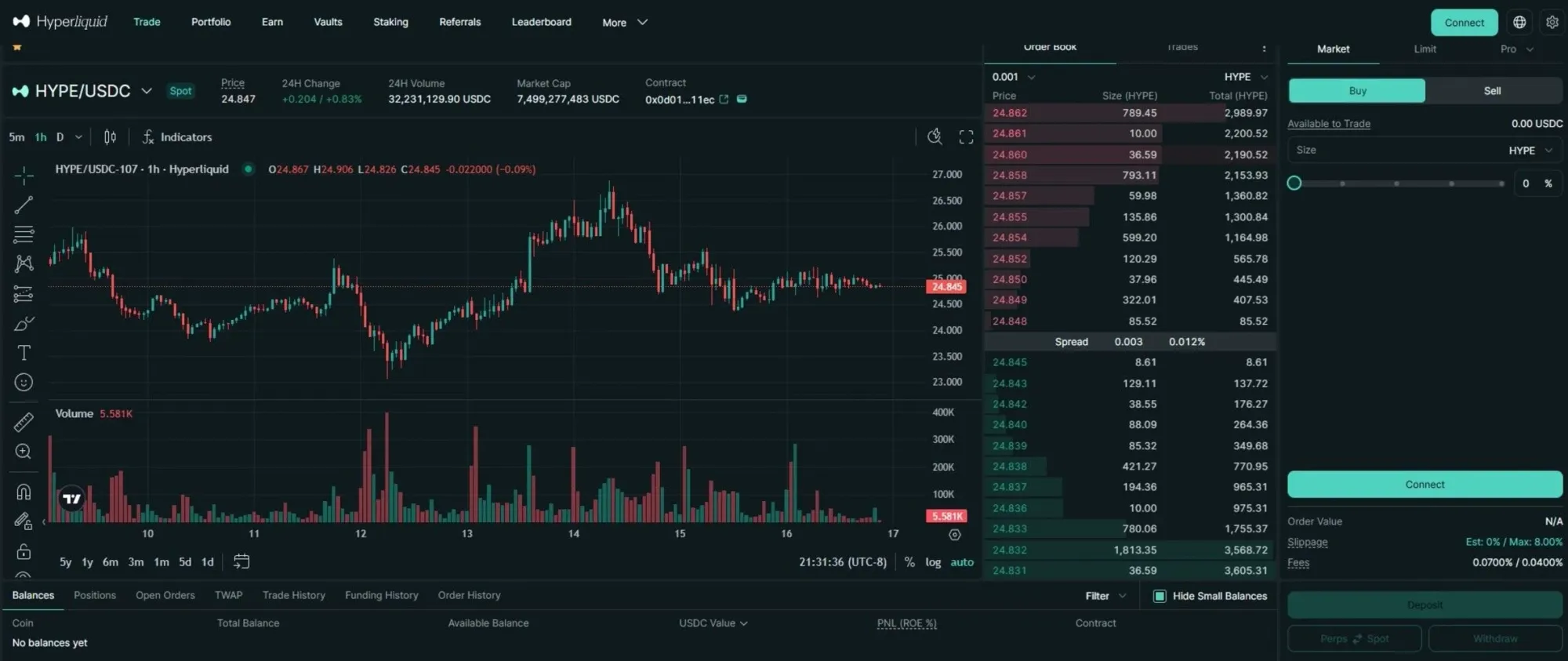
Spot trading supports instant buy‑sell orders, with rapid order processing that ensures reliable execution in active markets and minimizes price slippage.
Advanced Order Types
Advanced orders (limit, TWAP, iceberg) let users control execution timing and price, suitable for splitting large positions and avoiding market impact.
2. Treasury and Hyper Liquidity Providers (HLP)
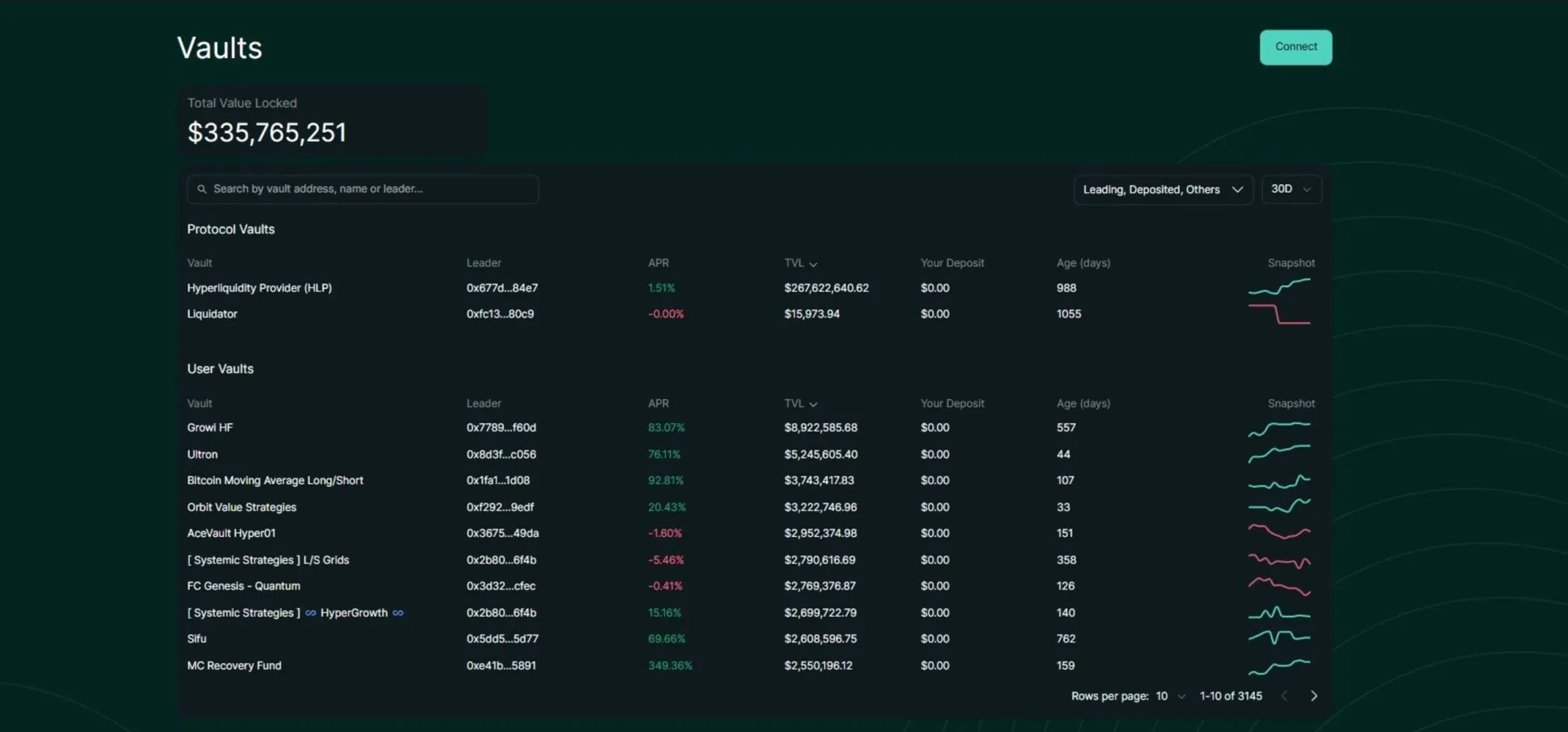
The platform’s treasury aggregates user funds for automated strategies such as copy‑trading and liquidity provision. HLP treasuries act as primary market makers and clearing engines, accepting USDC deposits without charging management fees. Deposited capital is used for buying, selling, and clearing perpetual contracts, and earnings are proportionally distributed to depositors. The treasury lock‑up period is 4 days, with annualized yields typically ranging from 20 % to 60 %.
3. Fee Structure
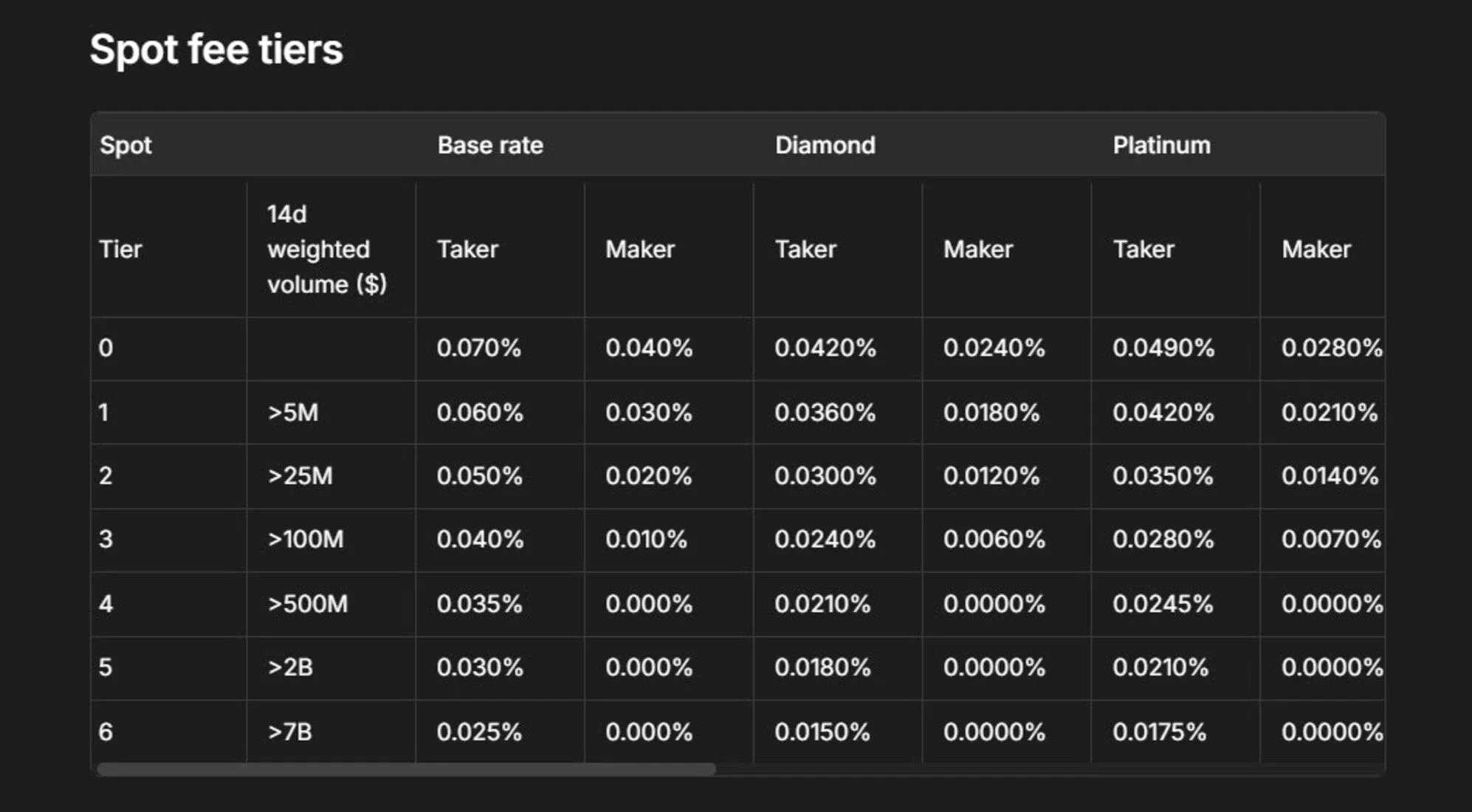
Hyperliquid’s Layer‑1 design eliminates gas fees; it only charges 0.040 % to makers and 0.070 % to takers, which is lower than most DEXes.
- Fee discounts: Staking HYPE can grant up to 40‑50 % fee reductions; HLP depositors receive a share of taker fees.
- Revenue allocation: Part of the fees are used for HYPE buy‑backs and burns, fund protection, and rewarding stakers and liquidity providers, supporting sustainable growth.
4. Hyperliquid Blockchain
Hyperliquid employs a dual‑chain architecture:
- HyperCore: Handles the high‑speed trading core, including margin management, clearing, and order execution.
- HyperEVM: Provides EVM compatibility, supporting decentralized applications and smart contracts.
The network uses HyperBFT consensus, achieving block times as low as 0.07 seconds and processing over 200 k transactions per second. More than 50 validator nodes stake HYPE to secure the network, and the BFT mechanism prevents malicious or offline nodes from disrupting operation.
How Does Hyperliquid Achieve Ultra‑Fast Trading?
The platform couples a purpose‑built Layer‑1 blockchain with an optimized trading engine, leveraging a leader‑based HyperBFT consensus and rapid block finality so that trades settle within seconds. All transactions are processed directly on HyperCore, avoiding external dependencies and reducing network congestion.
Limitations of Hyperliquid
- For beginners, the learning curve for advanced orders and perpetual contracts can be steep.
- Liquidity for niche assets may be thin, leading to wider spreads or higher slippage.
- Validators rely on HYPE staking; any downtime or misbehavior could affect performance.
- Staking and treasury strategies carry impermanent loss risk and reduced flexibility during lock‑up periods; users should fully understand these risks before participating.
Step‑by‑Step Guide to Using Hyperliquid
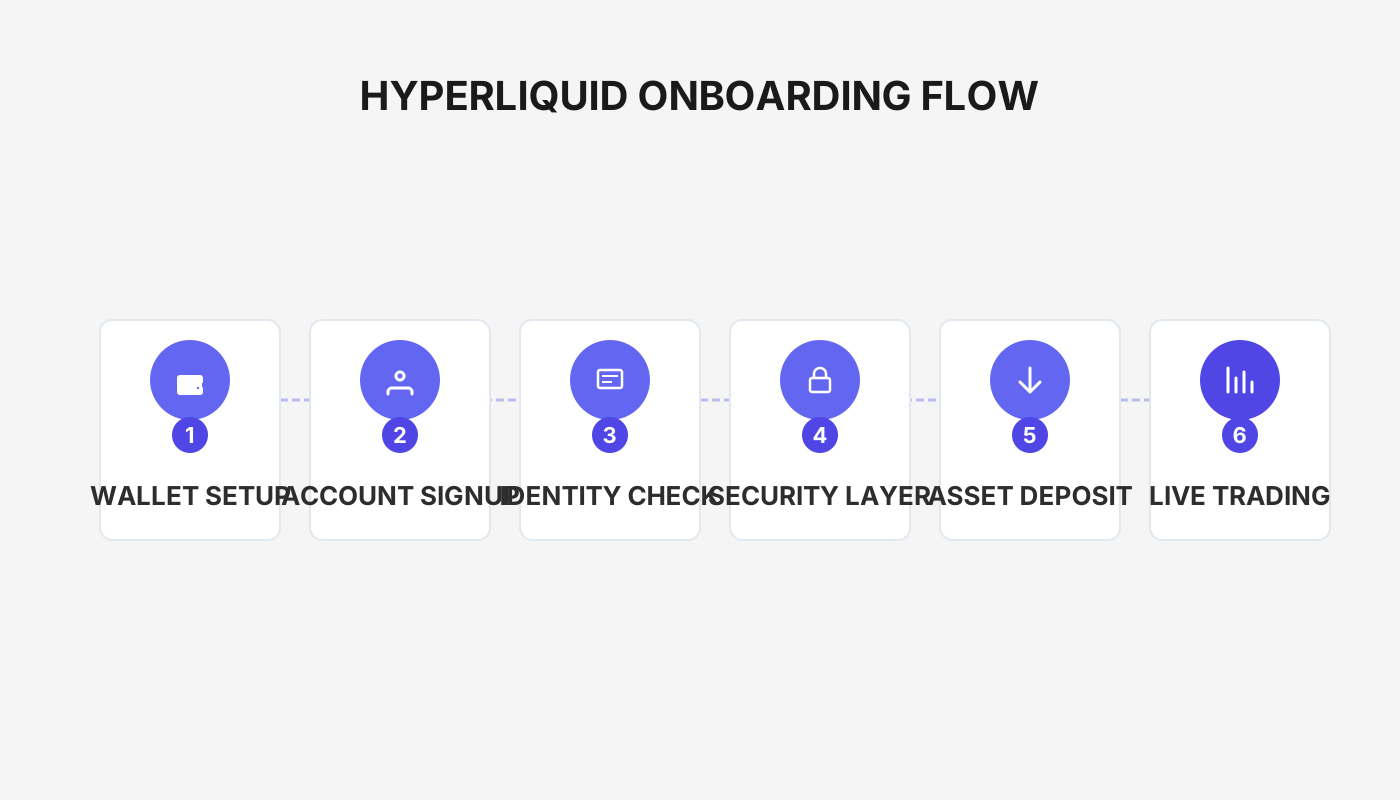
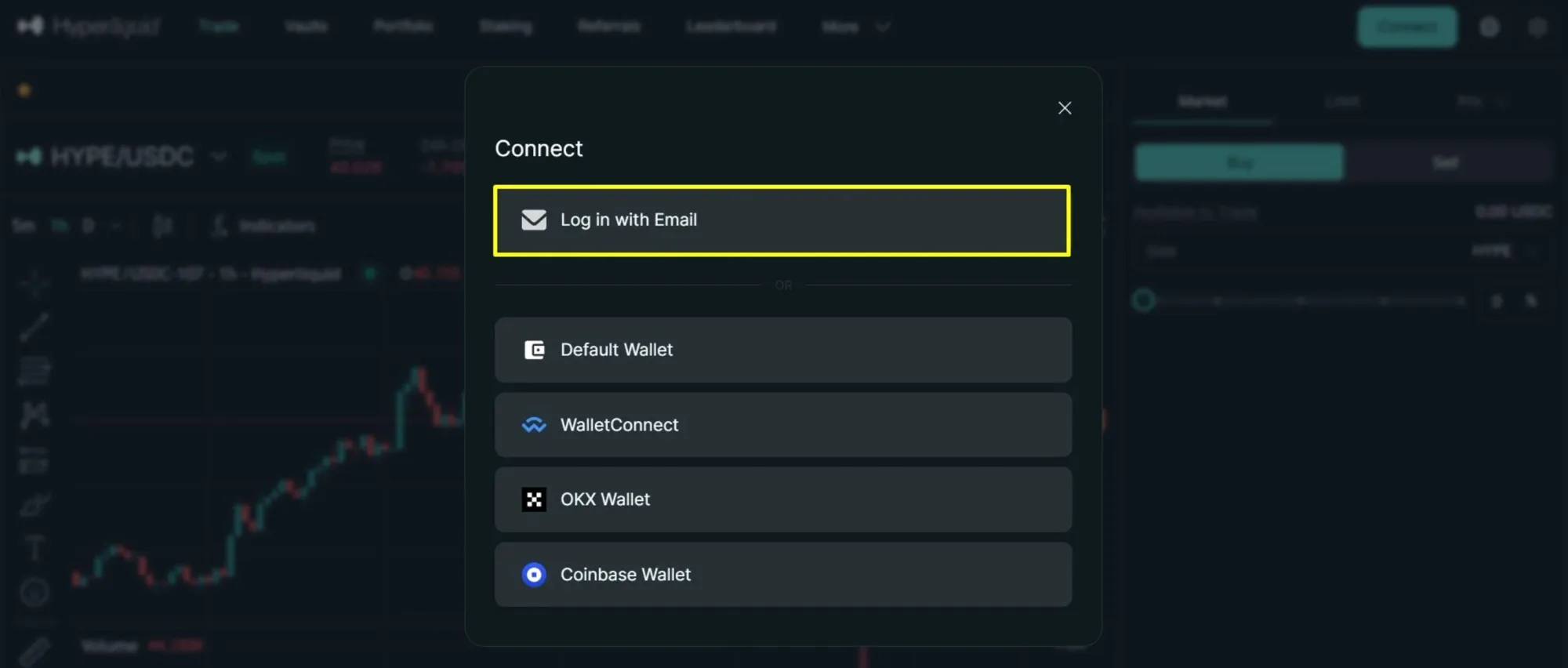
- Connect a wallet: Visit the official Hyperliquid website and connect a supported wallet such as OKX, Coinbase, or use email login. Ensure the wallet holds HYPE or USDC.
- Deposit funds: Transfer HYPE, USDC, or other supported assets into your Hyperliquid account; deposits settle on‑chain instantly.
- Start trading or staking: Choose spot, perpetual contracts, or deposit into the HLP treasury. Each option carries distinct risk‑return profiles.
- Manage positions: Use the control panel to monitor trades, staking rewards, or treasury performance. Withdrawals must comply with platform rules, including the treasury’s 4‑day lock‑up.
Hyperliquid vs. Other Perpetual DEXes
| Feature | Hyperliquid | GMX | dYdX | Other |
|---|---|---|---|---|
| Blockchain layer | L1 (HyperCore order book) | L2 (Arbitrum/Optimism AMM) | L2 (Optimism order book) | Various |
| Order types | Order book + advanced | AMM + basic | Order book + options | Platform‑specific |
| Fees | 0.040 % / 0.070 % (no gas) | 0.05 % / 0.07 % + gas | 0.02 % / 0.05 % + gas | Varies |
| Supported assets | 130+ | 40+ | 200+ | Platform‑specific |
| Liquidity model | On‑chain HLP treasury | GLP pool | Order book / custodial | Diverse |
| TVL (30‑day) | $2.5 B | $150 B+ | $5 B | Varies |
| Staking rewards | 2‑60 % APY (HYPE/HLP) | 10‑30 % (GLP) | ~15 % | Varies |
| Competitive edge | CEX‑level speed, zero MEV, sub‑second execution, deep order book, options integration | Low fees, cross‑chain | High leverage, insurance fund | Each has its focus |
*Note: For users in the United States, trading on Hyperliquid should be conducted via Binance.US or other regulated U.S. platforms, as the global Binance service is not available to U.S. residents.*
The Future of Hyperliquid
Hyperliquid aims to become the leading DeFi derivatives platform by 2026. Key milestones include:
- Full integration of HyperCore and HyperEVM to enable dApps to run at exchange‑grade speed.
- Deployment of a $1 billion treasury fund for HYPE buy‑backs and staking, enhancing token value stability.
- Launch of HIP‑3 (scheduled for October 2025) to deliver permissionless perpetual contracts, further decentralizing the system.
- Expansion into liquidity‑staking projects (kinetiq xyz) and money‑market protocols (hyperlendx) among other innovations.
Conclusion
Hyperliquid combines ultra‑fast trading, sophisticated tools, and a unique token ecosystem to create a professional‑grade decentralized exchange. Its dual‑chain design, HyperBFT consensus, and treasury system provide both retail and institutional participants with a secure and efficient path to earnings. While risks such as validator downtime and lock‑up periods exist, HYPE staking and HLP treasury incentives offer compelling compensation. A full audit report has been published, detailing platform functionality, security, and architecture.
Frequently Asked Questions
Is Hyperliquid safe to use?
Yes. The platform utilizes a validator‑based HyperBFT consensus and backs it with HYPE staking as economic security, which can fend off most malicious activity. Nonetheless, users should remain aware of rare risks such as validator outages or treasury impermanent loss.
Which blockchain does Hyperliquid run on?
It operates on a dual‑chain architecture comprising HyperCore (a trading‑focused Layer‑1) and HyperEVM (an EVM‑compatible Layer‑1), balancing speed with transparency.
Is KYC required?
No. Users can trade on the platform without completing any Know‑Your‑Customer verification.
How fast are trades executed?
Hyperliquid achieves sub‑second execution, with block times as low as 0.07 seconds and throughput exceeding 200 k transactions per second.
What is a perpetual contract?
A perpetual contract is a futures‑style derivative without an expiration date, offering leverage and allowing users to go long or short on an asset without a fixed settlement horizon.
Are crypto gains taxable?
Crypto trading profits may be subject to taxation in your local jurisdiction. Users should consult a qualified tax professional and consider reporting requirements, especially when converting to fiat via SEPA, SWIFT, or other banking channels.
---
Related Reading
- Top 7 Most Liquid Crypto Exchanges by 2026 Trading Volume
- Bitget Review 2024: Crypto Derivatives, Copy‑Trading, Low Fees
- Aster Perpetual DEX: Multi‑Chain Trading with 1001× Leverage
💡 Register on Binance with referral code B2345 for the maximum trading fee discount. See Binance complete guide.



