
 Bitaigen Research
 This article will help you understand smart contracts, providing a comprehensive analysis of their concepts, operation, features, applications, and risks, so you can gain a full picture of this technology within blockchain ecosystems.
A smart contract is a self‑executing, immutable piece of code stored on a blockchain that triggers predefined actions when certain conditions are met, enabling decentralized and trustworthy transactions.
In this article we systematically outline the core principles of smart contracts, their key characteristics, and typical real‑world use cases, while also highlighting potential risks. The goal is to give readers a complete understanding; subsequent sections will dive into implementation details, practical value, and future development trends.
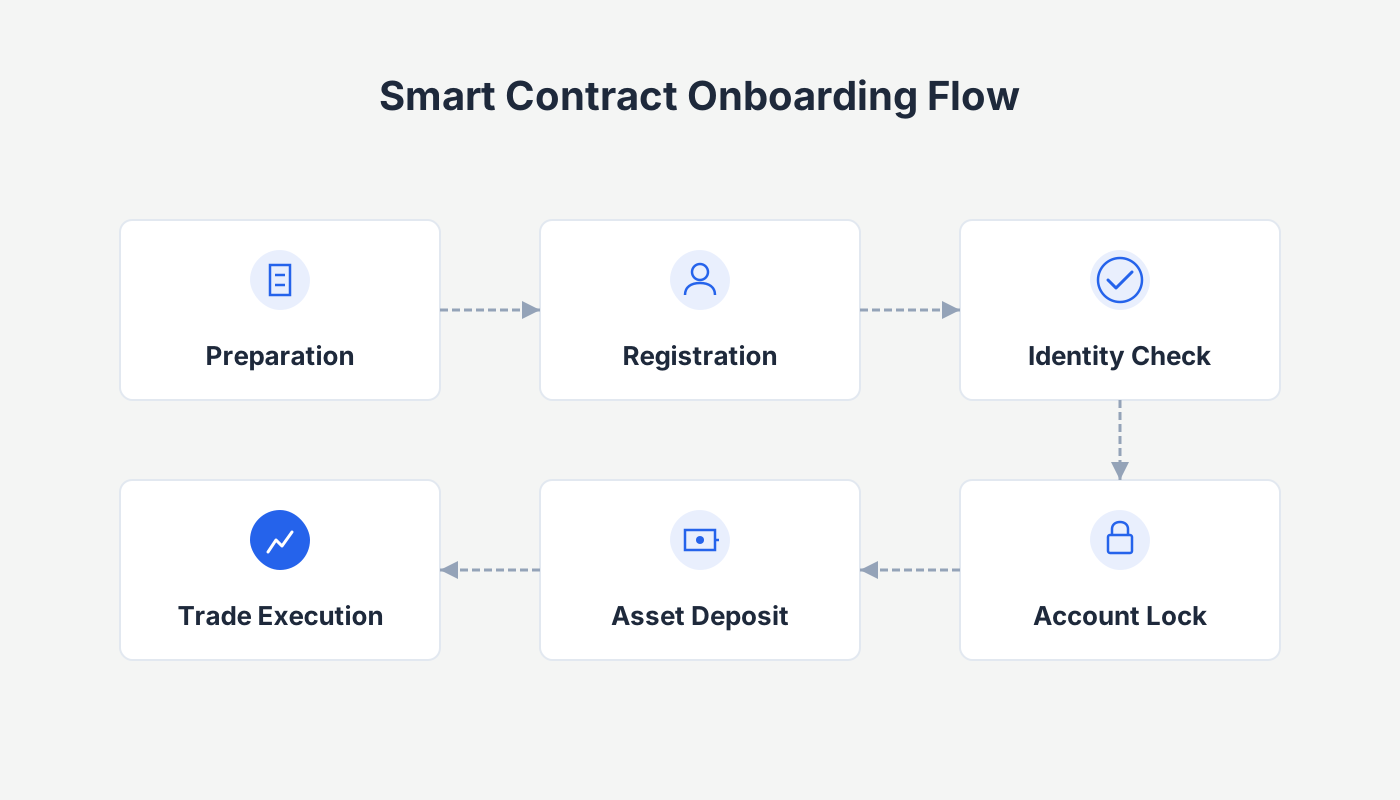
What Is a Smart Contract
Smart contracts (English: Smart Contracts) refer to agreements that automatically execute when preset conditions are satisfied. They can reduce operational time and costs and prevent human tampering, making them an indispensable component of the blockchain ecosystem.
- Analogy: Think of a smart contract as an automatic vending machine—once you insert a coin and meet the listed price, the product is dispensed without any human cashier, and the price cannot be arbitrarily changed.
- Comparison with traditional contracts: Conventional contracts require both parties to sit down, read the terms, and involve a middle‑man to verify asset legality (e.g., in a real‑estate transaction). If a breach occurs, the parties often face lengthy litigation.
- Smart‑contract advantages: After an online signature, the contract’s terms are executed automatically, eliminating intermediaries and removing the risk of breach.
Example: Rich A and Rich B use a smart contract for a loan, collateralizing an NFT as security. If Rich A fails to repay on time, the contract automatically transfers the NFT to Rich B.
Smart Contract ≠ Contract Trading
- Smart contracts are a mode of operation on a blockchain that focuses on code execution.
- Contract trading is a feature of cryptocurrency investing; the two concepts are completely separate.
- Smart‑contract trading refers to the process of interacting with a smart contract, where satisfying certain conditions yields a corresponding result, and it has little to do with traditional contract trading.
If you want to learn about contract trading, you can refer to *2026 Virtual Currency Futures Tutorial: What Is Futures Trading? Binance Perpetual Futures Operation Guide and Pros/Cons Analysis* (for U.S. users, consult Binance.US rather than the global Binance platform).
How Smart Contracts Work
Smart contracts operate on an “If…Then…” logic: once a condition is satisfied, the corresponding result is automatically triggered. Their lifecycle consists of three stages:
- Writing – Developers code the contract in languages such as Solidity, Rust, etc., defining conditions and actions.
- Deployment – The code is uploaded to a blockchain network, generating a unique contract address.
- Automatic execution – Users sign the contract and meet the conditions; the contract then carries out the predefined actions on its own.
Features and Benefits of Smart Contracts
| Feature | Description |
|---|---|
| **Automatic execution** | The contract fulfills its rules without human intervention, reducing error probability. |
| **Public transparency** | Code is published on‑chain, allowing anyone to audit it and preventing hidden manipulation. |
| **High efficiency & low cost** | Eliminates paper workflows and middle‑man fees; execution completes within minutes, requiring only on‑chain transaction fees (payments can be made in USD via SEPA/SWIFT when fiat is involved). |
| **Immutability** | Once deployed, the code cannot be altered, and confirmed transactions cannot be reversed, protecting participants’ rights. |
| **Decentralization** | No central authority is needed for approval; anyone who meets the criteria can take part. |
Primary Use Cases for Blockchain Smart Contracts
Goods Trading and Financial Services
- Lending protocols – Bypass cumbersome bank credit assessments, instantly set interest rates, and disburse loans within minutes.
- Real‑estate transactions – After a one‑time on‑chain verification, buying, selling, or mortgaging can be completed instantly, removing broker fees.
Insurance Claims
- Automated payouts – For example, travel delay insurance can pull real‑time flight data and automatically issue compensation without manual filing.
NFT Marketplaces
- Minting and trading – Contracts define issuance time, eligibility, total supply, and other rules to ensure fairness and transparency.
- Royalty distribution – A preset percentage of each secondary sale is automatically sent to the creator, providing ongoing revenue.
Intellectual‑Property Transactions
- Digital rights licensing – Every time an asset is transferred, the contract automatically deducts the fee and forwards it to the rights holder.
Voting and Governance
- Decentralized voting – Contracts specify voter eligibility, vote weight, and result publication method; outcomes are immutable, enhancing credibility.
Risks Associated with Smart Contracts
Code vulnerabilities
Because a smart contract is essentially program code, bugs are inevitable. Publicly available code can be examined and potentially exploited by attackers, leading to loss of assets.
Irreversible transactions
Once a contract is signed and executed, the transaction cannot be undone, even if the contract was maliciously crafted.
Legal and regulatory uncertainty
Cross‑border participation blurs responsibility and jurisdiction, making it difficult to rely on traditional legal systems for dispute resolution.
Note: Crypto gains may be taxable in your local jurisdiction; consult a tax professional to understand applicable obligations.
Smart‑Contract Scams to Watch Out For
Scams generally fall into two categories:
- Malicious contracts – They lure users with airdrops, rewards, or similar incentives, but actually grant the attacker permission to control the user’s wallet.
- Fake contracts – They advertise high returns without ever deploying a real contract; funds disappear once investors send money.
Prevention tips: Interact only with contracts from reputable sources, carefully review the code before signing, or rely on third‑party audit reports.
Frequently Asked Questions
Which platforms support smart contracts?
Ethereum, Binance Smart Chain, Cardano, Solana, and several others allow smart‑contract deployment.
Are smart contracts absolutely safe?
Not necessarily. While they eliminate manual manipulation, code bugs or malicious use can still cause losses.
Summary
- Definition: Smart contracts are blockchain‑based, self‑executing, immutable code agreements.
- Advantages: Time‑saving, cost‑effective, transparent, decentralized, and highly efficient.
- Applications: Cover lending, real estate, insurance, NFTs, royalty distribution, voting, and many other scenarios.
- Risks: Include code vulnerabilities, irreversible transactions, and unclear legal/regulatory frameworks.
- Scam avoidance: Be wary of malicious or counterfeit contracts; always verify the source and code security.
This concludes the article. For more information on smart contracts, search for Bitaigen (比特根) to find earlier posts or continue browsing the related articles below. Thank you for your support!
Related Reading
- Stock Tokenization on Blockchain: Liquidity & Transparency
- What Is a Blockchain Oracle? Definition, Function & Limits
- What Is ERC‑20? Complete Guide to the Ethereum Token Standard
💡 Register on Binance with referral code B2345 for the maximum trading fee discount. See Binance complete guide.



