
 Bitaigen Research
 In the context of recent heightened U.S.–Iran tensions, Bitcoin has once again experienced sharp volatility: first a short‑term “flash crash” that broke below $63,500, followed by a rapid “V‑shaped” rebound after the market digested the shock, essentially recouping the lost ground. This episode gives us a chance to re‑examine Bitcoin’s role during geopolitical conflicts—it is neither a pure safe‑haven miracle nor merely a highly volatile speculative instrument, but rather an asset that can serve a hedging function under certain circumstances.

Geopolitical turbulence is often regarded as a “litmus test” for Bitcoin’s asset characteristics. Confronted with the recent volatility, Bitcoin again displayed a complex profile that swings from panic‑induced flash crashes to swift recoveries. This article revisits Bitcoin’s historical behavior during major recent conflicts, offering an in‑depth dissection of its true role in extreme environments. Is it digital gold or a high‑volatility token? We invite you to explore the macro logic and market consensus behind it.
1. Review of BTC Performance in Geopolitical Conflicts
Looking back at several major confrontations over the past five years, the price reaction shows a clear “learning effect.” Initial severe swings have gradually been dampened by institutional capital, leading to a decreasing overall volatility trend.
| Date | Conflict | Bitcoin Price Reaction | Key Data / Features |
|---|---|---|---|
| February 2022 | Full‑scale Russia‑Ukraine war (Feb 24) | Plummeted **7.1 %** to **$35,478**, then rebounded over **20 %** within a week to **$44,000** | $150 million liquidated in 24 h, ruble‑denominated trading volume surged **259 %** |
| October 2023 | Israel‑Gaza conflict | Fell from the **$28,300** peak, breaking below **$27,000** and hitting a monthly low | 24‑hour decline ~**2 %**, more than **$100 million** of long positions liquidated, USDT transfers rose **440 %** week‑over‑week |
| April 2024 | Iran‑Israel missile strike | Intraday range limited to **±3 %** | Volatility was less than **1/3** of that seen in the Russia‑Ukraine war; BlackRock spot BTC ETF recorded a net inflow of **$420 million** in a single day |
| June 2025 | Israel “Lion’s Rise” operation | Dropped **4.5 %** to **$104,343** within 24 h | Decline remained modest relative to the event’s severity, showing strong resilience |
| February‑March 2026 | Escalation of U.S.–Iran conflict | On **Feb 28** a flash crash to **$63,030**, a recent trough; on **Mar 2** a strong rebound past **$69,000** | $460 million liquidated in 24 h, nearly **150,000** accounts wiped out; **4.94 %** gain on Mar 2 |
1. Russia‑Ukraine War: The First Test of Bitcoin’s Safe‑Haven Narrative
The outbreak of the Russia‑Ukraine war in 2022 marked the first time Bitcoin was touted as a “lifeline” to escape the fires of war. At the outset, the price climbed roughly 20 % within a short window, and market sentiment turned upbeat. However, the ensuing energy crisis and the Federal Reserve’s aggressive rate hikes drove Bitcoin’s cumulative annual loss to about 65 %, casting the first large‑scale doubt on its alleged “safe‑haven” attribute.
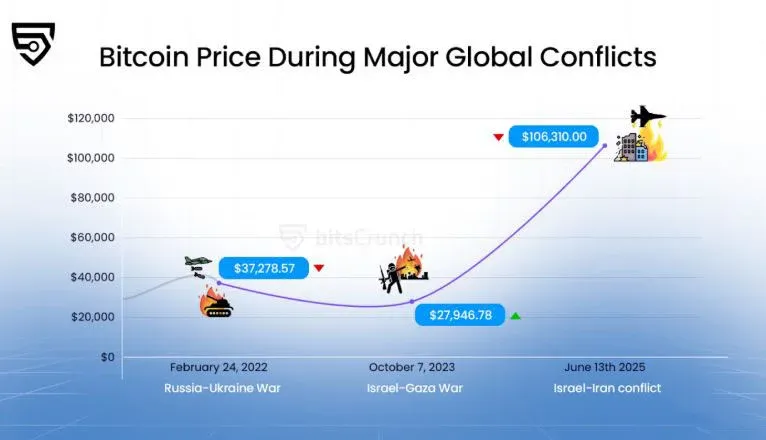
When the VIX fear index spiked, Bitcoin tended to be sold off alongside other high‑risk assets in exchange for safer cash, providing the first lesson for the subsequent review.
2. Institutional Entry Reshapes the Market‑Volatility Buffer
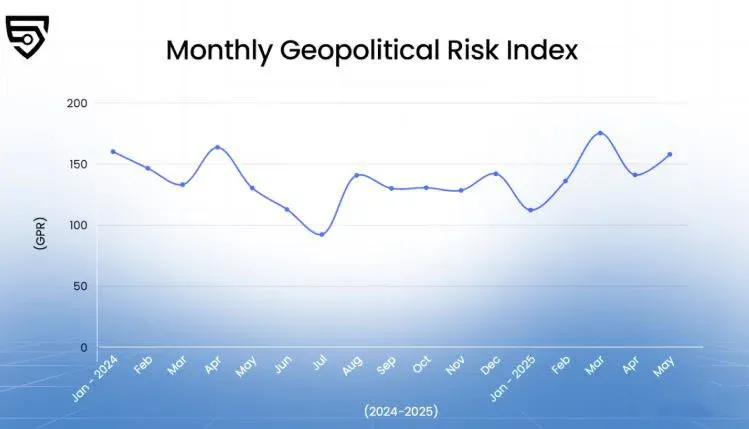
Recent data reveal that the market’s reaction to shocks has quietly shifted. Take the April 2024 Iranian missile strike on Israel as an example: Bitcoin’s intraday swing that day was only ±3 %, roughly a third of the volatility seen at the start of the Russia‑Ukraine conflict in 2022. This moderation is largely attributable to the continued inflow of institutional capital.
Consider BlackRock’s spot Bitcoin ETF: during the conflict period it logged net inflows of several hundred million dollars in a single day, effectively diluting the impact of geopolitical risk on the market. In short, deep participation by institutional investors is re‑crafting Bitcoin’s price elasticity when faced with external shocks.
1. U.S.–Iran Conflict Tests Bitcoin’s Deep‑V Dual Nature
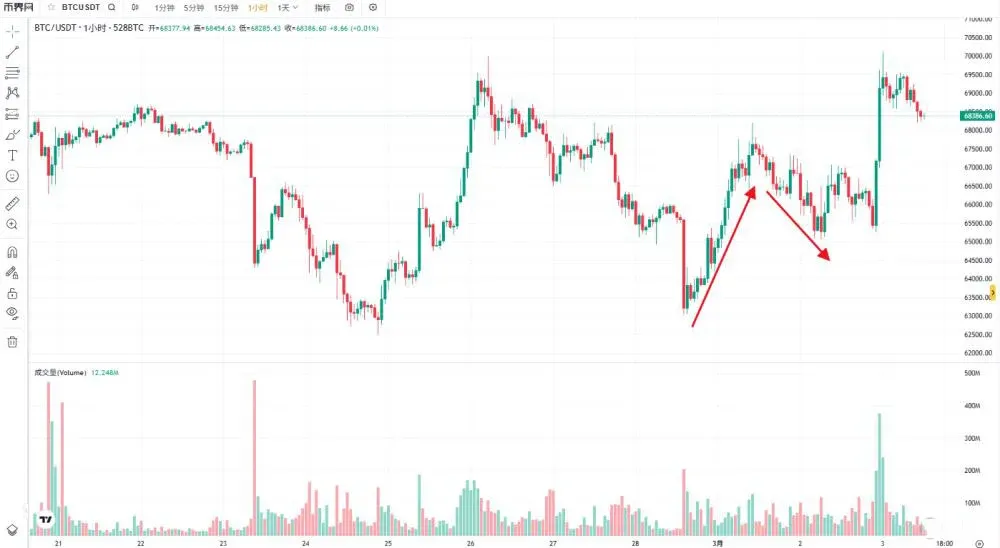
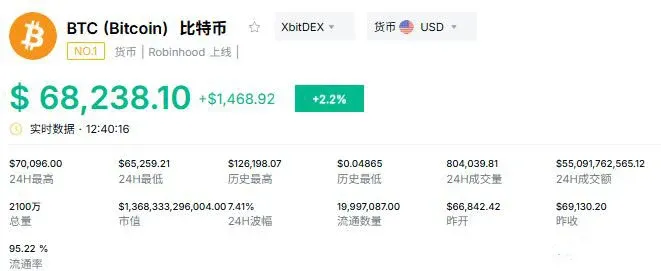
The late‑February 2026 U.S.–Iran flare‑up offered a complete examination of Bitcoin’s “dual‑face” character. On Feb 28, news of a military strike triggered panic; the price slid from $65,000 to $63,000 within 15 minutes, causing more than 150,000 accounts to be liquidated. After a weekend of digestion, the market rebounded strongly on Mar 2, briefly breaching $69,000 and largely recouping the loss. The three‑day pattern demonstrates that Bitcoin can act as a “liquidity ATM” during crises (risk side) while simultaneously serving as a “sentiment barometer” and “escape hatch” when traditional markets are shut (hedge side).
3. In‑Depth Analysis: The Truth Behind the Flash Crash and the Logic of the V‑Rebound
1. Flash Crash Mechanics: Panic Selling and Liquidity Runs
In an extreme panic scenario, a flash crash is essentially a liquidity run. The conflict erupted over a weekend when traditional financial markets were closed, and Bitcoin—being the only asset that trades 24 × 7 with high liquidity—naturally became the outlet for macro‑risk hedging. Institutional investors, needing to meet margin calls, were forced to sell the most liquid asset, generating roughly $1.8 billion of sell pressure in an instant. At that moment Bitcoin behaved more like a high‑beta tech‑stock shadow rather than a traditional store of value such as gold.
2. V‑Rebound Logic: Conflict Re‑Pricing and Long‑Term Capital Inflow
A “V‑shaped” rebound reflects the market’s re‑pricing of the conflict’s nature. Once participants concluded that the strike was a one‑off tactical action rather than a protracted war, panic dissipated quickly. Highly leveraged speculators were cleared out, leaving a cleaner order book that attracted long‑term capital seeking a hedge against fiat depreciation. In particular, regions directly affected by the conflict (e.g., Iran) experienced a crisis of confidence in their national currencies, spurring genuine demand for Bitcoin—mirroring the surge in crypto donations observed during the Ukraine war.
4. Conclusion: A Conditional Hedge Tool, Not a Universal Safe‑Haven Asset
Synthesizing the above review, it becomes clear that labeling Bitcoin solely as “true safe haven” or merely “high volatility” is overly simplistic. Bitcoin lacks the universal value consensus and zero‑production reliance that gold enjoys, yet under specific preconditions it can exhibit hedging properties: (1) the market judges that the conflict will not trigger a systemic liquidity crunch; and (2) Bitcoin’s technical network remains untouched by physical combat. Investors should regard Bitcoin as an alternative macro‑hedge instrument that possesses high volatility but can act as a digital barrier in particular scenarios, rather than mythologizing its safe‑haven capabilities.
The foregoing constitutes a systematic recap of Bitcoin’s behavior in geopolitical conflicts—from flash crash to V‑rebound—probing whether it is a hedge or simply high volatility. For further analysis, follow Bitaigen (比特根) and its forthcoming articles.
Related Reading
- Bitcoin Surges Past $71,000, Nearing $72,000 Monthly High
- Bitcoin Price Forecast: Heading Toward $78,000? Technical & Sentiment Outlook
- Bitcoin’s True Reaction to War: Macro Risk Triggers Short‑Term Corrections
💡 Register on Binance with referral code B2345 for the maximum trading fee discount. See Binance complete guide.



